Tag: Uniswap

  • Aave’s RWA Footprint Expands as Commodity Deposits Reach $133M

    Aave’s RWA Footprint Expands as Commodity Deposits Reach $133M

    Key Highlights

    • Aave founder Stani Kulechov deployed $4.77 million in AAVE liquidity to Uniswap as tokenized commodity deposits across DeFi reached $133.3 million, with Aave commanding $51.3 million across V2, V3, and V4.
    • AAVE exchange reserves surged 7.59% to approximately $415.2 million in 24 hours per CryptoQuant data, creating a supply overhang even as the token broke above $147.64 resistance toward the $160 level.
    • Technical indicators show RSI at 66.61 with room before overbought territory, while Binance liquidation heatmap reveals clusters at $157–$162 that could accelerate upside if buying pressure holds above reclaimed $147.64 support.

    Aave Ecosystem Expansion Bolsters Fundamental Backdrop

    The decentralized finance landscape around Aave showed measurable strengthening this week as founder Stani Kulechov supplied an additional $4.77 million in AAVE liquidity to the Uniswap decentralized exchange. The injection deepened market liquidity at a time when the token continues its recovery from a June local low near the $58 demand zone. Beyond the founder’s direct liquidity deployment, broader ecosystem metrics reinforced the improving outlook. Reported data indicates tokenized commodities deposited across DeFi protocols have reached $133.3 million, with Aave capturing $51.3 million across its V2, V3, and V4 iterations. Combined, Aave and Uniswap now account for approximately 86% of those reported tokenized commodity deposits, underscoring Aave’s expanding role as tokenized real-world assets gain traction across decentralized platforms.

    Rising Exchange Reserves Test Demand Absorption Capacity

    Despite the strengthening fundamental backdrop, supply dynamics present a clear counterweight. According to CryptoQuant, AAVE exchange reserves jumped 7.59% in a single 24-hour period, bringing the total dollar-denominated value held across exchange wallets to approximately $415.2 million. Higher exchange availability typically increases potential selling pressure should holders move to realize gains from the price recovery—a concern amplified after the token climbed approximately 2.7 times from its June local low. However, the reserve increase has not yet reversed the bullish price structure. Buyers have pushed through a key resistance level while the additional exchange-side supply remained available, setting up a critical test: whether demand can absorb the increased availability without surrendering the technical breakout.

    Daily Chart Breakout Targets $160 Resistance

    On the daily timeframe, AAVE broke above the $147.64 resistance level, converting the prior range ceiling into newly established support. The token subsequently extended toward $154.39, leaving only a narrow gap before the next key resistance at $160. Crucially, bulls have defended the reclaimed $147.64 level rather than immediately surrendering it. The Relative Strength Index strengthened to 66.61 while its signal average sits lower at 59.95. Most importantly, the indicator remains below the 70 overbought threshold, preserving room for additional price advance before hitting stretched conditions. A successful break of the $160 resistance could expose the higher $180 zone, while a loss of $147.64 support would weaken the breakout structure back into the previous consolidation range. For now, the combination of rising RSI and higher price structure keeps the $160 resistance as the immediate technical test.

    Liquidation Heatmap Highlights $157–$162 Magnet Zone

    The Binance liquidation heatmap provides an additional dimension to the developing test of the $160 resistance. At reporting time, AAVE traded around the $154 price level while several liquidation clusters remained visible above price in the $157–$162 region. These liquidity concentrations could attract price upward so long as buyers maintain pressure above the newly reclaimed support. A move into these clusters could also trigger short liquidations, potentially accelerating an advance toward the chart’s $160 resistance. The heatmap also reveals meaningful liquidity below price, including concentrations around $151 and $148. Lower liquidity clusters remain positioned around the $151–$148 region, although AAVE has likely already collected much of this liquidity during the recent rally.

    Why This Matters

    The convergence of expanding DeFi fundamentals and technical breakout dynamics places AAVE at a pivotal juncture. Aave’s dominant share of tokenized commodity deposits—alongside Uniswap—signals growing institutional and retail appetite for tokenized real-world assets on decentralized rails, a narrative that could sustain long-term demand for the governance token. However, the sharp rise in exchange reserves introduces near-term selling pressure that must be absorbed for the uptrend to continue. The $160 resistance level represents not only a technical milestone but also a liquidity magnet per the Binance heatmap, meaning a clean break could trigger a cascade of short covering and momentum buying toward $180. Market participants should monitor whether on-chain demand—evidenced by continued liquidity provision and protocol revenue growth—can outpace exchange-side supply in the coming sessions.

    Frequently Asked Questions

    What triggered the recent AAVE price recovery from the June low?
    The recovery has been supported by expanding DeFi fundamentals, including founder Stani Kulechov’s $4.77 million liquidity deployment to Uniswap and Aave’s dominant 86% share (combined with Uniswap) of $133.3 million in tokenized commodity deposits across DeFi.
    Why are rising exchange reserves a concern for AAVE holders?
    CryptoQuant data shows a 7.59% surge in AAVE exchange reserves to ~$415.2 million in 24 hours. Higher exchange balances typically indicate increased selling pressure as holders may move tokens to exchanges to realize gains after the token’s ~2.7x rally from the June low.
    What are the key technical levels to watch for AAVE next?
    Immediate resistance sits at $160, with a potential extension to $180 on a clean break. The newly reclaimed $147.64 level now serves as critical support; a daily close below it would invalidate the breakout structure and risk a return to the prior consolidation range. Liquidation clusters at $157–$162 on Binance may act as a price magnet.

  • New Wallet Withdraws $10 Million in Altcoins from Binance

    New Wallet Withdraws $10 Million in Altcoins from Binance

    Key Highlights

    • A newly created wallet address 0xC374 withdrew approximately $9.93 million in combined assets from Binance in a single transaction batch, per Lookonchain data.
    • Uniswap (UNI) dominated the allocation at 814,020 tokens (~$7.24 million), representing over 70% of the total position.
    • UNI has surged ~20% over the past week but remains 79% below its $44 all-time high; BNB sits 43% below its $1,370 peak.

    Whale Wallet 0xC374 Executes $9.93M Multi-Asset Withdrawal from Binance

    On-chain analytics platform Lookonchain has flagged a significant withdrawal event involving a freshly minted wallet address beginning with 0xC374. The entity behind the address moved three distinct altcoins off the Binance exchange in what appears to be a coordinated accumulation maneuver. The largest leg of the transaction involved 814,020 UNI tokens, valued at roughly $7.24 million at the time of transfer. This single asset accounted for more than 70% of the total capital deployed, signaling a pronounced conviction in the Uniswap governance token despite its distance from historical highs.

    Breakdown of Assets Moved Off-Exchange

    Beyond the UNI position, the whale address also transferred 2,382 BNB worth approximately $1.85 million and 12,397 Litecoin (LTC) valued near $841,000. The aggregate value of the three withdrawals reached $9.93 million, executed in a single transaction batch. Large-scale exchange outflows of this nature are typically interpreted by market observers as a bullish signal, suggesting the holder intends to custody assets long-term rather than trade actively, thereby reducing near-term sell-side pressure on the respective order books.

    Price Context: UNI and BNB Remain Deeply Discounted to All-Time Highs

    Despite the whale’s sizable bet, both primary assets in the portfolio continue to trade well below their respective peaks. UNI has gained roughly 2% in the last 24 hours and an impressive 20% over the trailing seven days, yet it remains 79% below its all-time high of $44 recorded during the 2021 bull cycle. BNB, the native token of the BNB Chain ecosystem, fares comparatively better but still sits 43% beneath its record high of $1,370. The whale’s entry point effectively captures both assets at significant historical discounts, a strategy often associated with long-horizon accumulation rather than short-term speculation.

    Why This Matters

    Large exchange outflows by newly created wallets are closely monitored by on-chain analysts because they frequently precede extended holding periods or strategic positioning ahead of protocol upgrades, governance votes, or macroeconomic catalysts. Uniswap’s upcoming v4 deployment and the anticipated fee switch activation have fueled speculative narratives around UNI’s value accrual mechanics, potentially motivating sophisticated actors to build positions early. Meanwhile, BNB’s correlation with the broader Binance ecosystem health and regulatory clarity in key jurisdictions adds a layer of fundamental scrutiny. The simultaneous accumulation of LTC—a legacy proof-of-work asset often viewed as a macro hedge—further diversifies the thesis. For retail participants, tracking such whale footprints offers a window into institutional-grade conviction, though it carries no guarantee of future performance.

    Frequently Asked Questions

    Who is behind wallet 0xC374?
    The identity of the entity controlling address 0xC374 is unknown. The wallet was newly created at the time of the withdrawals, and on-chain data does not reveal a known exchange, fund, or individual label.
    Why are large exchange withdrawals considered bullish?
    Moving tokens off centralized exchanges into self-custody reduces the available supply for immediate sale, signaling the holder expects higher prices long-term and has no intention to liquidate in the near term.
    What are the key price levels to watch for UNI and BNB?
    UNI’s all-time high stands at $44 (79% above current levels), while BNB’s peak is $1,370 (43% above current levels). Reclaiming psychological round numbers—$10 for UNI and $500 for BNB—would represent initial technical milestones toward those highs.

    Disclaimer: This article is for informational purposes only and does not constitute investment advice.

  • Uniswap Holds Bullish at $9.50 Despite Market’s 4.86% Drop as Momentum Cools

    Uniswap Holds Bullish at $9.50 Despite Market’s 4.86% Drop as Momentum Cools

    Key Highlights

    • Uniswap ($UNI) holds at $9.50 USDT despite a 4.86% decline in total crypto market capitalization over 24 hours, trading well above its EMA20 ($7.55), EMA50 ($6.06), and EMA200 ($4.54) — a clean bullish stack on the daily timeframe.
    • Daily indicators flash overbought warnings: RSI at 71.76 and price pressing against the upper Bollinger Band ($9.95) suggest a pullback is probable, even as MACD remains positive with a 0.24 histogram.
    • Short-term momentum is fading across lower timeframes: 1-hour RSI at 42.36 and 15-minute RSI at 36.69 with negative MACD histograms confirm cooling participation, converging on a critical support cluster at $9.44.

    Market Context: UNI Defies Broad Crypto Sell-Off

    The broader cryptocurrency market contracted sharply on September 23, 2026, shedding 4.86% of its total capitalization in a single day. Against that backdrop, Uniswap’s native token $UNI demonstrated relative resilience, holding at 9.50 USDT. This divergence creates a decisive moment for the asset: the daily trend structure remains firmly bullish, yet shorter timeframes signal that buying pressure is exhausting, leaving traders to weigh whether the token can sustain its premium or must concede to the prevailing market gravity.

    Bitcoin dominance at 58.77% underscores a defensive rotation toward the market’s largest asset, a dynamic that historically pressures altcoins. For Uniswap, the tension is visible in the discrepancy between a daily chart that screams continuation and intraday charts that show sellers testing the floor.

    Daily Chart: Bullish Structure Meets Overbought Conditions

    On the daily timeframe, $UNI trades comfortably above a perfectly stacked moving average hierarchy: the EMA20 at 7.55, EMA50 at 6.06, and EMA200 at 4.54. This alignment typically signals a sustained uptrend rather than a counter-trend bounce. The MACD reinforces the constructive bias, with the line at 1.13 above the signal at 0.88 and a positive histogram of 0.24.

    However, two warning signs temper the optimism. The Relative Strength Index sits at 71.76, deep in overbought territory where continuation becomes statistically less probable. Simultaneously, price is hugging the upper Bollinger Band at 9.95 (mid-band 7.36, lower band 4.77). When an asset rides the upper band this tightly, even a brief pause often triggers a reversion toward the mean. A daily Average True Range of 0.93 confirms that near-dollar swings are normal, making a move toward the daily pivot support at 8.82 structurally insignificant in isolation — but meaningful if it coincides with a breakdown of shorter-term structure.

    Intraday Timeframes Signal Cooling Momentum

    1-Hour Chart: A Textbook Cooling-Off Pattern

    The 1-hour chart reveals a clear loss of upside momentum. Price at 9.50 now sits below the 1H EMA20 at 9.83 but remains above the EMA50 at 9.54 — a classic cooling-off formation after an extended advance. The RSI has retreated to a neutral 42.36, while the MACD histogram has flipped negative to -0.15 (line 0.04, signal 0.19).

    Bollinger Bands on this timeframe (upper 10.96, mid 10.08, lower 9.20) show price drifting toward the lower half of its recent range. A tight pivot cluster — resistance at 9.54 (R1) and support at 9.44 (S1) — creates a narrow battleground for the next directional move.

    15-Minute Chart: Sellers Testing the Floor

    The 15-minute view confirms defensive price action. $UNI trades below both the EMA20 (9.65) and EMA50 (9.87), with RSI at 36.69 and MACD essentially flat and negative at -0.19. This represents intraday chop rather than a decisive breakdown, but it validates that momentum has turned defensive in the very short term.

    Critically, the 15-minute pivot support at 9.44 aligns almost exactly with the 1-hour S1, making this level a confluence zone. A clean break on strong volume would carry outsized significance precisely because multiple timeframes agree on its importance.

    On-Chain Data Confirms Activity Slowdown

    DefiLlama fee data provides fundamental corroboration for the technical cooling. Uniswap V3 fees fell 38.52% in the last 24 hours and are down 8.9% over seven days. Meanwhile, Uniswap V4 fees dropped 10.99% daily but remain up 69.89% over 30 days.

    This divergence suggests a slow migration of activity toward the newer V4 protocol even as overall trading volume has cooled sharply in the near term. The fee slowdown across both versions mirrors the lower-timeframe technicals: less aggressive participation, consistent with a market taking a breath rather than making a decisive directional bet.

    Competing Scenarios: Key Levels to Watch

    Bullish Case Intact Above Structural Supports

    The bullish scenario remains valid as long as the daily uptrend structure holds. Buyers must defend the 1-hour EMA50 near 9.54 and, more critically, prevent a break below the daily pivot support at 8.82. A successful defense could see price target the daily R1 at 10.56, with the upper Bollinger Band at 9.95 as the first real test.

    Given the overbought daily RSI, any fresh leg higher would require genuine volume conviction rather than a thin, low-liquidity push — otherwise it risks simply re-testing the overbought ceiling without follow-through.

    Bearish Case Gains Traction Below $9.44

    The bearish thesis gains credibility if price cleanly loses the 9.44 confluence support. A decisive break would open the path toward the daily EMA20 at 7.55 and the Bollinger mid-band at 7.36 — a far deeper retracement than the current cooling phase suggests. This is well within normal volatility bounds given the daily ATR of 0.93 and ample room for RSI to unwind from 71.76 toward neutral.

    The scenario becomes more probable if broader market weakness persists. With capital rotating defensively (evidenced by BTC dominance at 58.77%), altcoins tend to underperform, and $UNI would not be immune to that dynamic.

    Why This Matters

    Uniswap remains the dominant decentralized exchange protocol by volume and liquidity, making $UNI a bellwether for DeFi sentiment. The current technical tension — a structurally bullish daily trend colliding with exhausted short-term momentum amid broad market risk-off — encapsulates the broader dilemma facing major altcoins in late 2026: whether protocol fundamentals and fee revenue migration (V3 to V4) can sustain valuations when macro liquidity tightens.

    The convergence of the 1-hour and 15-minute pivot supports at 9.44 represents a rare multi-timeframe agreement that lowers noise and raises the signal-to-noise ratio for traders. A hold here with volume renewal could signal that the uptrend has simply digested overbought conditions; a break would suggest the daily structure is vulnerable to a deeper mean reversion toward the EMA20/EMA50 zone. For market participants, the next 24–48 hours of price action at these levels will likely define the token’s trajectory through Q4 2026.

    Frequently Asked Questions

    What does the daily chart show for $UNI right now?

    The daily trend for $UNI remains firmly bullish as of September 23, 2026. Price trades well above the EMA20 at 7.55, EMA50 at 6.06, and EMA200 at 4.54, forming a clean bullish stack. However, RSI at 71.76 signals overbought conditions that increase the likelihood of a short-term pullback, even as the MACD histogram remains positive at 0.24.

    What are the key support levels for $UNI right now?

    The most immediate support sits at 9.44, where both the 1-hour and 15-minute pivot supports converge. Below that, the daily pivot support at 8.82 represents a more significant structural level. A break below 9.44 would open the path toward the daily EMA20 at 7.55 and the Bollinger mid-band at 7.36, representing a deeper retracement.

    Is short-term momentum for Uniswap bullish or bearish?

    Short-term momentum has turned defensive but is not yet bearish. On the 1-hour chart, RSI sits at a neutral 42.36 and the MACD histogram has flipped negative at -0.15. The 15-minute chart shows similar weakness with RSI at 36.69. These readings suggest cooling rather than reversal, with price still holding above the key support cluster at 9.44.

    Disclaimer: This article is for informational purposes only and does not constitute financial advice, an investment recommendation, or a solicitation to buy or sell any financial instrument or cryptocurrency. The analysis provided is not indicative of future results. Investing in crypto assets and financial markets carries a high risk of capital loss. Always do your own research (DYOR) and consult a qualified financial advisor before making any decision.

  • Crypto Rallies on Bullish Bounce After Fed Rate Hike: Weekly Outlook

    Crypto Rallies on Bullish Bounce After Fed Rate Hike: Weekly Outlook

    Key Highlights

    • Bitcoin holds near $84,000, demonstrating resilience despite the Federal Reserve’s benchmark rate holding at 4.00% following last week’s hawkish stance.
    • The SEC’s conditional five-year exemption window for tokenized securities pilot trading opens September 22, allowing select institutional venues to trade tokenized stocks on public blockchains.
    • Major governance votes are underway across Lido DAO, Uniswap, and CoW DAO, addressing liquidity provisions, protocol fee extensions, and solver competition redesigns.

    Bitcoin Resilience Amid Macro Uncertainty

    Cryptocurrency markets opened the week on a firm footing, with bitcoin BTC trading at $83,915.85 and testing the psychologically significant $84,000 threshold. The digital asset’s stability comes as investors digest the Federal Reserve’s latest policy posture, which maintained the benchmark target rate at 4.00% after last week’s hawkish signaling. While traditional risk assets often react negatively to restrictive monetary policy, bitcoin’s current price action suggests a decoupling from immediate rate-sensitive impulses, at least in the near term.

    The macroeconomic calendar this week centers on a cluster of high-impact U.S. data releases that could recalibrate rate-cut expectations. Initial jobless claims for the period ending September 19 are estimated at 201,000, up from the previous 196,000, while new home sales for August are forecast to decline to 700,000 from 739,000. Durable goods orders are expected to contract 0.3% month-over-month in August after a 1.1% gain previously, and the final University of Michigan Consumer Sentiment Index for September is seen at 47.8, down sharply from 51.7. Canadian retail sales for August are also due, estimated at -0.8% versus a prior 0.6% gain. Cross-asset markets continue to process the divergent policy paths emerging from the Bank of Japan and the Bank of England, adding another layer of complexity to the global liquidity backdrop.

    SEC Tokenized Securities Pilot Framework Goes Live

    A pivotal regulatory milestone arrives on September 22, when the U.S. Securities and Exchange Commission’s conditional five-year exemption window officially opens. This framework permits select institutional venues to commence pilot trading of tokenized stocks directly on public blockchains. The initiative represents the most concrete step yet by U.S. regulators to bridge traditional securities infrastructure with distributed ledger technology, potentially unlocking new paradigms for settlement efficiency, fractional ownership, and market accessibility. Market participants will be closely monitoring which venues receive approval and the volume dynamics during the pilot’s early phase.

    Governance Activity Intensifies Across Major DAOs

    Decentralized autonomous organizations are driving a busy week of on-chain governance. Lido DAO is voting on a proposal to authorize a contingent LDO centralized-exchange liquidity market-making mandate, budgeting up to $1.5 million in recallable LDO and 480,000 USDC to maintain orderbook depth and mitigate potential exchange delisting risks. Voting concludes September 21. Uniswap Governance is conducting a temperature check on extending its protocol fee collection and UNI burn infrastructure to Arc, a Layer 1 network built by Circle, with voting ending September 23. Meanwhile, CoW DAO is voting on a redesign of its solver quote competition, allocating a dedicated quote reward budget equal to 10% of protocol revenue to enhance price routing and order conversion; this vote wraps up September 25.

    Token Unlock Schedule Presents Supply Dynamics

    Several notable token unlocks are scheduled this week, introducing incremental supply into circulating markets. Canton (CC) unlocks 0.38% of its circulating supply, valued at approximately $17.17 million, on September 21. Toncoin (TON) follows on September 22 with a 1.3% unlock worth $51.2 million. Humanity (H) releases 14.7% of its circulating supply, valued at $20.8 million, on September 23. No major token launches are confirmed for the period, and the conference calendar remains clear.

    Why This Matters

    The convergence of bitcoin’s price resilience, the SEC’s tokenized securities pilot launch, and heightened DAO governance activity signals a maturing market structure where regulatory engagement, institutional infrastructure, and decentralized coordination are advancing simultaneously. The SEC pilot, in particular, could establish precedent for how traditional assets are issued, traded, and settled on-chain, potentially attracting broader institutional participation. Meanwhile, the governance votes at Lido, Uniswap, and CoW reflect the growing operational sophistication of major protocols as they address liquidity sustainability, cross-chain fee architectures, and execution quality—issues critical to long-term protocol viability. Traders should monitor this week’s macro data for signals on the Fed’s next move, as any shift in rate expectations could rapidly reassert correlation between digital assets and traditional risk markets.

    Frequently Asked Questions

    What is the SEC’s tokenized securities pilot framework?

    The SEC’s conditional five-year exemption window, opening September 22, allows select institutional venues to conduct pilot trading of tokenized stocks directly on public blockchains. This regulatory sandbox aims to test distributed ledger technology for securities settlement and trading under supervised conditions.

    Why are the Lido, Uniswap, and CoW DAO votes significant?

    These governance proposals address critical operational priorities: Lido seeks to secure exchange liquidity for LDO to prevent delistings; Uniswap explores extending its fee and burn mechanism to Circle’s Arc network; CoW Protocol aims to improve solver competition and order routing through a dedicated reward budget. Outcomes will shape protocol economics and cross-chain strategies.

    Which macroeconomic data points should crypto traders watch this week?

    Key releases include U.S. initial jobless claims (Sept. 24, 8:30 a.m. ET), new home sales (Sept. 24, 10:00 a.m. ET), durable goods orders (Sept. 25, 8:30 a.m. ET), and the final Michigan Consumer Sentiment Index (Sept. 25, 10:00 a.m. ET). These indicators will influence Federal Reserve policy expectations and broader risk sentiment.

  • Uniswap Founder Says Sam Bankman-Fried Paid Seven Figures for Domain

    Uniswap Founder Says Sam Bankman-Fried Paid Seven Figures for Domain

    Key Highlights

    • Uniswap founder Hayden Adams alleges Sam Bankman-Fried paid a seven-figure sum for the Uniswap.com domain and redirected it to the SushiSwap fork in 2021.
    • A World Intellectual Property Organization panel ordered the domain transferred to Uniswap Labs in September 2021 after finding it had been registered and used in bad faith.
    • Uniswap.com now redirects to the official Uniswap application, while Bankman-Fried’s 25-year fraud sentence was affirmed by the U.S. Court of Appeals for the Second Circuit in June 2026.

    Adams Reveals Bankman-Fried’s Alleged Domain Purchase

    Uniswap founder Hayden Adams disclosed on September 21, 2026 that Sam Bankman-Fried purchased the Uniswap.com domain for a seven-figure sum after Uniswap Labs declined to meet the original owners’ asking price. In a post on X (formerly Twitter), Adams wrote: “Fun fact, the og owners of https://t.co/bRvDs5brca wanted 7 figures, but we refused to pay that amount So SBF bought it (for 7 figures) and pointed it to a fork – I guess to flex / mess with usThis malicious use of the domain was enough for our legal team to get it for free https://t.co/ZV0yJhdvZg” Adams characterized Bankman-Fried’s motive as speculative, stating: “I guess to flex / mess with us,” while discussing the possible reasoning behind the redirect.

    WIPO Domain Dispute Proceedings Confirm Bad Faith Use

    The World Intellectual Property Organization (WIPO) case record substantiates key elements of Adams’ account. Uniswap Labs filed a complaint in May 2021 after discovering that Uniswap.com was redirecting visitors to SushiSwap, a decentralized exchange created as a fork of the Uniswap protocol. Contemporary reporting from The Block documented the redirect at the time, while SushiSwap contributor 0xMaki denied the SushiSwap team had purchased the domain.

    A three-member WIPO panel reviewed evidence including a screenshot dated May 18, 2021 and archived Wayback Machine records showing the domain resolving to a SushiSwap webpage. The panel described SushiSwap as operating in the same financial market as Uniswap Labs. The respondent, identified in the proceeding as Registration Private, Domains By Proxy, LLC / Future XXX of Hong Kong, contested parts of the case, arguing that SushiSwap was an open-source derivative and disputing the redirect’s establishment. The panel rejected these arguments after reviewing additional evidence.

    The decision, issued September 3, 2021, found that Uniswap Labs held registered rights to the UNISWAP trademark and that the domain was identical to that mark. The panel determined the SushiSwap redirect did not qualify as bona fide use and created a high risk of implied affiliation. WIPO concluded the domain had been registered and used in bad faith, noting the respondent acquired the domain on April 7, 2021—years after the protocol’s creation—and had knowledge of Uniswap Labs beforehand. The domain was ordered transferred to Universal Navigation Inc., which operates as Uniswap Labs, under the Uniform Domain Name Dispute Resolution Policy without requiring purchase from the respondent.

    Bankman-Fried’s Documented SushiSwap Involvement Provides Context

    Bankman-Fried had a documented role with SushiSwap months before the domain dispute. In September 2020, SushiSwap creator Chef Nomi transferred control of the project to Bankman-Fried during a governance crisis after withdrawing tokens from the developer fund. Bankman-Fried helped oversee SushiSwap’s migration before control moved toward a multisignature structure. This historical relationship contextualizes Adams’ statement, though neither the WIPO record nor contemporary reporting independently establishes Bankman-Fried’s ownership of Uniswap.com. The WIPO respondent was represented by Australian law firm Cornwalls, and the published decision does not name Bankman-Fried as Future XXX or disclose a seven-figure transaction.

    Current Domain Status and Ongoing Trademark Enforcement

    As of September 21, 2026, Uniswap.com redirects directly to the official Uniswap application at app.uniswap.org. Uniswap Labs maintains trademark guidelines stating third parties should not use UNISWAP, $UNI, or UNISWAP LABS trademarks in domain names or create names suggesting false affiliation. The company’s support directory identifies Uniswap.org as the official website and app.uniswap.org as the trading interface, with Uniswap.com functioning as a redirect.

    Why This Matters

    The Uniswap.com dispute illustrates how trademark law and domain dispute resolution mechanisms can protect decentralized protocol brands against malicious redirection, even when the underlying software is open source. The WIPO panel’s ruling established that open-source licensing does not permit unauthorized use of trademarked names in domains to create confusion or imply affiliation. For the broader cryptocurrency ecosystem, the case demonstrates that traditional intellectual property frameworks remain effective tools for protecting users from phishing, impersonation, and brand dilution. The alleged involvement of Bankman-Fried—later convicted of fraud in the FTX collapse—adds a notable layer to the narrative of early DeFi competitive dynamics, though the WIPO decision rested on trademark and bad-faith findings rather than the identity of the domain purchaser.

    Frequently Asked Questions

    Did the WIPO panel name Sam Bankman-Fried as the purchaser of Uniswap.com?

    No. The WIPO decision identified the respondent as Registration Private, Domains By Proxy, LLC / Future XXX of Hong Kong and does not name Bankman-Fried as the domain purchaser or disclose a seven-figure transaction. Adams’ allegation is based on his own knowledge and has not been independently confirmed by the WIPO record.

    What was the basis for WIPO transferring Uniswap.com to Uniswap Labs?

    The panel found that Uniswap Labs held registered trademark rights to UNISWAP, the domain was identical to that mark, and the respondent had registered and used the domain in bad faith by redirecting it to SushiSwap, creating a high risk of implied affiliation. The transfer was ordered under the Uniform Domain Name Dispute Resolution Policy without requiring Uniswap Labs to purchase the domain.

    Where does Uniswap.com redirect today?

    As of September 21, 2026, Uniswap.com redirects directly to the official Uniswap trading interface at app.uniswap.org. Uniswap.org remains the company’s primary official website.

  • Layer-2 and DeFi Tokens Lead Broad Crypto Advance as Post-Fed Hike Nerves Fade

    Layer-2 and DeFi Tokens Lead Broad Crypto Advance as Post-Fed Hike Nerves Fade

    Key Highlights

    • DeFi and Layer-2 tokens led a broad crypto market rally Friday, with the DeFi Select Index surging 16% in 24 hours as risk-on sentiment returned following the Fed rate decision.
    • Bitcoin reclaimed $78,000 while Uniswap (UNI) futures open interest neared a record high, signaling strong institutional conviction in major DeFi protocols.
    • Implied volatility dropped to May lows and options skew turned short-term bullish for BTC and ETH, suggesting traders expect near-term market calm after key macro events cleared.

    DeFi and Layer-2 Tokens Spearhead Post-Fed Risk-On Rotation

    Cryptocurrency markets extended their post-Federal Reserve rally into Friday, with a pronounced sector rotation shifting leadership from privacy and haven assets toward decentralized finance (DeFi) and Layer-2 scaling tokens. The DeFi Select Index (DFX) accelerated fastest among major benchmarks, surging 8.3% since midnight UTC and 16% over the trailing 24-hour period, reflecting a broad-based return to risk-on positioning across digital asset markets.

    Bitcoin $BTC rose above $78,000 during the European morning session, adding 2.1% since midnight UTC and 1.9% over the past 24 hours to trade at $78,192.86. Despite the advance, the largest cryptocurrency remains approximately 5% below its September 4 monthly high of $82,284 after two weeks of range-bound price action. The CoinDesk 100 index showed near-universal gains, with all but two constituents trading higher on the day.

    Macroeconomic Backdrop Fuels Risk Appetite

    The rally unfolded against a more conducive macroeconomic backdrop. The 10-year U.S. Treasury yield slipped back below the psychologically significant 5% threshold, while Brent crude eased under $103 per barrel after touching $109 earlier in the week. This combination relieved some of the inflation pressure that had followed the latest rate increase. Traditional risk assets mirrored the optimism, with S&P 500 and Nasdaq 100 futures rising 0.3% and 0.6% respectively, while gold and silver added 1.1% and 2.8%.

    Derivatives Data Reveals Structural Capital Inflows

    Futures Open Interest Expands as Volume Dips

    The crypto futures market is signaling a revival in positional trading rather than speculative churn. Cumulative open interest (OI) expanded nearly 5% to $141.2 billion, contrasting with a 3% decline in daily trading volume to $95 billion. The taker buy-sell volume remains balanced, suggesting capital is entering the market structurally rather than through aggressive momentum chasing.

    Bitcoin Positioning Builds Gradually

    Bitcoin futures open interest ticked up to 680,000 BTC from 670,000 BTC since midnight UTC, a modest increase accompanying the price advance. This combination typically represents a build-up of long, or bullish, positions. However, the increase remains slight, and the OI tally sits well below the peak of 800,000 BTC recorded early this year, indicating overall positioning remains light by historical standards.

    Binance Trader Ratios Show Institutional Conviction

    Binance’s top trader long-short accounts ratio pulled back to 1.52 from Wednesday’s high near 2.0, while the long-short positions ratio remains elevated at 2.36. This divergence means fewer individual large holders, or “whales,” are leaning long, but those who are have significantly increased their bet sizes, pointing to strong institutional conviction rather than retail-driven speculation.

    Uniswap Futures Open Interest Nears Record

    Among altcoins, open interest in futures tied to Uniswap’s $UNI surged to 86.61 million tokens, flirting with an all-time high and up from 76.89 million tokens yesterday. This expansion highlights substantial capital inflows moving in tandem with a 30% explosion in the token’s spot price. The renewed appetite for major DeFi altcoins stems from mounting market optimism surrounding friendly, coordinated crypto regulations from the SEC and CFTC.

    Volume Delta and Volatility Metrics Confirm Bullish Tilt

    The bullish mood is reflected in the 24-hour OI-adjusted cumulative volume delta, which is positive for most major tokens excluding GRAM, SHIB, HBAR, and BNB. A positive reading indicates bulls are being more aggressive by executing market orders rather than passive limit orders. With major events including the Clarity Act vote and the Federal Reserve and Bank of Japan interest-rate meetings now past, Bitcoin’s annualized 30-day implied volatility index (BVIV) dropped to 36%, a level that has acted as a floor since May, pointing to expectations for near-term market calm.

    Options Skew Turns Short-Term Bullish

    In options listed on Deribit, Bitcoin’s one-week put-call skew has turned positive, indicating relative richness of calls over puts. However, one- and two-month skews still show a slight put bias. Ethereum’s one-week skew also shows bullishness. The 24-hour volume rankings present a mixed picture, with both BTC calls and puts featuring among the most actively traded contracts.

    Token Spotlight: UNI Leads DeFi Surge, Layer-2 Tokens Match Strength

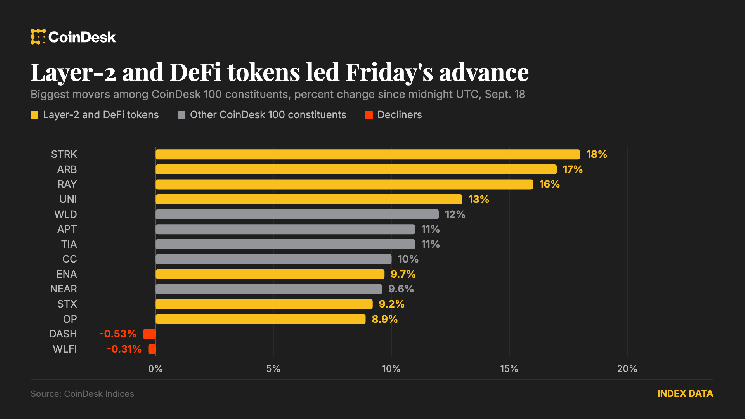
    The DeFi Select Index’s advance rested largely on Uniswap ($UNI), which gained 13% since midnight UTC and 25% over the past 24 hours. Ethena (ENA) added 9.6% and liquid-staking token Lido DAO ($LDO) rose 6.6%. Layer-2 tokens matched DeFi’s strength, led by Starknet ($STRK) at 18% on the day and 21% over 24 hours, with Arbitrum ($ARB) up 17% and 25%, Stacks ($STX) up 9.2%, and Optimism ($OP) up 8.9%. STRK reached its highest level since June 19, while ARB at 20.9 cents hasn’t traded this high since January.

    Solana ($SOL) added 4.5% to $106.14, though the sharper move occurred within its ecosystem where Solana-based DEX token Raydium ($RAY) rose 16% to $1.71 while liquid-staking token Jito ($JTO) lagged at 1.6%. This split points to DEX volume driving the bid rather than a blanket rally for the chain. Thursday’s leader, Zcash ($ZEC), traded at $1,490.10 for a gain of 1.6% on the day against 7.6% over 24 hours, meaning almost all of its advance occurred Thursday. Rival privacy token Dash ($DASH) was one of only two CoinDesk 100 constituents in the red, losing 0.53%, alongside World Liberty Financial ($WLFI), which fell 0.31%. CoinMarketCap’s “Altcoin Season” index rose to 44/100 from Tuesday’s low of 32/100, confirming speculation as the overarching theme Friday.

    Why This Matters

    The sector rotation from privacy coins to DeFi and Layer-2 tokens signals a meaningful shift in market narrative. For months, regulatory uncertainty had pressured DeFi protocols, but the prospect of coordinated SEC and CFTC frameworks has reignited institutional interest in governance tokens like UNI and scaling solutions like ARB, OP, and STRK. The derivatives data reinforces this: rising open interest alongside declining volume suggests conviction-driven positioning rather than speculative flipping. Meanwhile, implied volatility compressing to multi-month lows and short-term options skew turning bullish indicate the options market is pricing in a period of stability after a dense macro calendar. For traders, the Altcoin Season index climbing from 32 to 44 confirms broadening participation beyond Bitcoin, though it remains well below levels seen during full altcoin rotations. The next test will be whether this derivatives-led bid translates into sustained spot accumulation or fades as macro data dependencies return.

    Frequently Asked Questions

    Why are DeFi and Layer-2 tokens outperforming Bitcoin and privacy coins?

    Market optimism around potential coordinated crypto regulations from the SEC and CFTC has renewed institutional appetite for major DeFi protocols like Uniswap and scaling solutions like Arbitrum, Optimism, and Starknet. The DeFi Select Index surged 16% in 24 hours while privacy leaders like Zcash and Dash stalled or declined.

    What does the rise in futures open interest with falling volume indicate?

    The 5% expansion in cumulative open interest to $141.2 billion alongside a 3% drop in daily volume to $95 billion suggests structural capital inflows and positional trading rather than short-term momentum chasing. Balanced taker buy-sell volume further supports this interpretation.

    How should traders interpret the current options skew and volatility readings?

    Bitcoin’s 30-day implied volatility (BVIV) dropping to 36%—a floor since May—signals expectations for near-term calm after key macro events. One-week put-call skew turning positive for both BTC and ETH shows short-term bullish bias, though longer-dated skews retain a slight put bias, indicating hedging for medium-term downside risk remains.

  • Altcoin Whale Offloads Major Holding, On-Chain Data Shows

    Altcoin Whale Offloads Major Holding, On-Chain Data Shows

    Key Highlights

    • A single wallet address sold 600,000 UNI tokens across multiple transactions, netting approximately 5.1 million USDT according to on-chain data tracked by Onchain Lens.
    • The same address transferred an additional 100,000 UNI, valued at roughly $844,000, to the cryptocurrency exchange OKX, signaling potential further liquidation.
    • Market participants are monitoring the activity closely, as large-scale transfers to exchanges by major holders often precede selling pressure on the Uniswap governance token.

    Major UNI Holder Liquidates Position, Moves Additional Tokens to OKX

    On-chain analytics platform Onchain Lens reported on September 18 that a single wallet address executed a significant sell-off of Uniswap (UNI) tokens, offloading 600,000 UNI through a series of transactions. The sales collectively yielded approximately 5.1 million USDT in stablecoin proceeds, according to blockchain data reviewed by the firm.

    The wallet’s activity did not stop at the executed sales. Subsequent on-chain analysis revealed the address transferred an additional 100,000 UNI to the centralized exchange OKX. At the time of the transfer, this batch of tokens carried an estimated value of $844,000. Analysts interpret such deposits to exchange wallets as a standard precursor to further selling, as it moves assets from cold storage or self-custody into a liquid trading environment.

    Market Watches for Supply Overhang Amid Whale Activity

    The sequence of events has redirected market attention toward the concentration of UNI supply among large holders, often referred to as “whales.” While the 600,000 UNI sale represents a realized outflow, the 100,000 UNI deposit to OKX represents a potential future supply overhang. Market structure analysts caution that the transfer alone does not confirm a sale; the tokens could be held on the exchange for market-making, collateral, or other strategies. However, historical precedent suggests exchange inflows from dormant or accumulating wallets frequently correlate with distribution phases.

    Uniswap’s UNI token functions as the primary governance asset for the leading decentralized exchange protocol. As such, its tokenomics are sensitive to large-scale portfolio rebalancing by early investors, team allocations, or treasury managers. The current circulating supply and the identity of the specific address involved have not been disclosed in the Onchain Lens report, leaving the total magnitude of the holder’s remaining position unknown.

    Why This Matters

    Large-token transfers by single entities serve as critical market structure signals for decentralized finance (DeFi) assets. Unlike equities markets where insider filings are mandatory, on-chain transparency is the primary tool for detecting shifts in whale positioning. The combination of realized sales (600k UNI) and exchange staging (100k UNI) suggests a deliberate reduction in exposure. For UNI holders and liquidity providers, tracking whether the OKX deposit translates into active sell orders on the order book will be key to assessing near-term price resilience. The event underscores the ongoing maturation of Uniswap’s token distribution, where early concentrated holdings continue to enter circulating supply years after the initial airdrop and token generation event.

    Frequently Asked Questions

    How much UNI was sold and what was the proceeds?

    The address sold 600,000 UNI tokens across multiple transactions, receiving approximately 5.1 million USDT in return, based on on-chain data reported by Onchain Lens on September 18.

    Why is the transfer of 100,000 UNI to OKX significant?

    Moving tokens from a private wallet to a centralized exchange like OKX typically indicates the holder intends to sell, trade, or use the assets as collateral. While not a guaranteed sale, this $844,000 deposit increases the available supply on the exchange order book, which traders monitor for potential downward price pressure.

    Does this activity represent the entire holdings of the whale address?

    No. The Onchain Lens report explicitly states that available data does not provide definitive information about the address’s total UNI balance or its future transaction plans. The 700,000 UNI moved (600k sold + 100k transferred) may represent only a portion of the wallet’s total position.

  • Altcoin Founder Claims “We’ll Benefit the Most from This SEC Move” as Price Surges

    Altcoin Founder Claims “We’ll Benefit the Most from This SEC Move” as Price Surges

    Key Highlights

    • The SEC granted a temporary, conditional exemption for “Tokenized Securities Platforms” enabling on-chain trading of tokenized U.S. stocks under specific transparency, record-keeping, and security requirements.
    • Uniswap founder Hayden Adams emphasized SEC Commissioner Hester Peirce’s assessment that “truly decentralized systems operated by autonomous software” do not create the intermediary risks that securities regulation targets.
    • Adams stated the exemption creates a regulatory pathway for licensed pools on Uniswap v4 and announced plans to submit a formal comment letter to the SEC with suggestions for regulatory improvements.

    SEC Announces Innovation Exemption for Tokenized Securities Platforms

    On September 17, the U.S. Securities and Exchange Commission unveiled what it termed an “Innovation Exemption” — a temporary and conditional framework allowing platforms designated as “Tokenized Securities Platforms” to facilitate on-chain trading of tokenized U.S. equities. The exemption mandates that participating platforms satisfy specific requirements around transparency, record-keeping, trading volume thresholds, and technological security. SEC Chairman Paul Atkins framed the regulation as enabling tokenized stocks to be traded on-chain within permissioned environments, marking a notable step in the agency’s engagement with blockchain-based financial infrastructure.

    Commissioner Peirce’s Dissent Highlights Decentralized Systems

    While the official exemption drew attention, Uniswap founder Hayden Adams directed focus toward the assessment offered by SEC Commissioner Hester Peirce. Adams characterized Peirce’s view as the most significant development of the day for automated market makers (AMMs). Peirce’s assessment articulated that “truly decentralized systems operated by autonomous software” do not expose the underlying intermediary risks that securities regulation is designed to address. Adams argued this framing could be interpreted to mean that normal, permissionless use of the Uniswap protocol does not require an additional exemption, a distinction with profound implications for decentralized finance protocols operating without centralized intermediaries.

    Implications for Uniswap v4 and Licensed Pools

    Adams specifically highlighted the exemption’s relevance to licensed pools on Uniswap v4, the protocol’s latest iteration featuring a modular “hooks” architecture. He stated that this structure could create a pathway for compliant trading in the United States for assets and users subject to regulatory requirements. By enabling permissioned pools that adhere to the SEC’s newly outlined framework, Uniswap v4 may serve as a bridge between permissionless DeFi infrastructure and regulated traditional finance participants seeking on-chain execution with compliance guarantees.

    Uniswap to Submit Regulatory Recommendations

    Beyond analyzing the immediate ruling, Adams signaled proactive engagement with the regulatory process. He announced that the Uniswap team would submit a formal letter of opinion to the SEC containing suggestions for regulatory improvements. Adams framed the development as creating significant opportunities for the adoption of AMM technologies in traditional financial markets, suggesting that the intersection of decentralized exchange mechanics and regulatory clarity could accelerate institutional on-chain activity.

    Why This Matters

    The SEC’s Innovation Exemption represents one of the clearest regulatory signals to date that tokenized traditional assets have a defined, albeit conditional, path to on-chain trading. Commissioner Peirce’s concurrent articulation of a principle distinguishing “truly decentralized systems operated by autonomous software” from intermediated platforms provides a potential analytical framework for future enforcement and rulemaking. For Uniswap, the convergence of this exemption with the v4 architecture’s licensed pool capability positions the protocol as a potential primary venue where regulated and permissionless liquidity can coexist. Market participants should monitor the SEC’s formal rulemaking docket, Uniswap’s forthcoming comment letter, and the deployment of licensed hooks on v4 as leading indicators of how DeFi infrastructure integrates with U.S. securities law.

    Frequently Asked Questions

    What assets are eligible for trading under the SEC’s Innovation Exemption?
    The exemption applies to tokenized U.S. stocks traded on platforms that qualify as “Tokenized Securities Platforms” and meet the SEC’s specified transparency, record-keeping, volume, and security requirements.
    Does the exemption apply to Uniswap’s permissionless pools?
    According to Hayden Adams, Commissioner Peirce’s assessment suggests that “truly decentralized systems operated by autonomous software” do not create the intermediary risks targeted by securities regulation, which Adams argues could mean normal permissionless Uniswap use does not require this exemption.
    What are licensed pools on Uniswap v4?
    Licensed pools are a feature of Uniswap v4’s hooks architecture that allow pool creators to implement custom logic, including compliance controls such as KYC/AML checks and jurisdictional restrictions, enabling permissioned trading environments atop the permissionless protocol.
  • Uniswap Extends DEX Lead as Volume Tops $70 Billion

    Uniswap Extends DEX Lead as Volume Tops $70 Billion

    Uniswap processed over $70 billion in trading volume during the 30‑day period ending September 13, surpassing the combined volume of the next three largest decentralized exchanges according to DeFiLlama Research data cited by the protocol. The milestone reflects activity across Uniswap v2, v3 and v4 on all supported blockchains and does not represent revenue earned by Uniswap Labs or the market value of the $UNI governance token.

    Uniswap has processed $70B+ in volume over the past monthMore than the next three DEXs combinedThe world’s value moves on 🦄 pic.twitter.com/ak426mmX1x
    — Uniswap (@Uniswap) September 12, 2026

    Uniswap v4 and v3 drive the bulk of volume

    DeFiLlama’s Uniswap v4 page showed nearly $38 billion in trading volume over the preceding 30 days when accessed on September 13, while the analytics platform attributed roughly $32 billion to Uniswap v3 over a similar period. Uniswap v2 contributed more than $1.2 billion, pushing the combined three‑version total above the $70 billion figure cited by the protocol. Minor discrepancies between the version‑level sum and Uniswap’s published number can arise from smaller deployments or differences in data‑update timing.

    Volume measures the dollar value of swaps executed by the protocol; it does not indicate trader profits, liquidity‑provider returns, or revenue flowing to $UNI holders. Each trade generates fees for liquidity providers, and selected pools direct a portion of those fees to the protocol under governance‑approved settings. Uniswap v3 remains active because it allows liquidity providers to concentrate capital within chosen price ranges, while version 4 employs a shared contract architecture with programmable hooks that let developers add customized pool functions. Recent growth has moved v4 ahead of v3 in the current monthly snapshot, though both versions continue to serve different pools, assets and integrations.

    Volume spans dozens of blockchain networks

    Uniswap’s aggregate volume covers deployments on Ethereum and numerous scaling networks. DeFiLlama lists v3 contracts on more than 40 chains, with Ethereum accounting for the largest share of the version’s locked liquidity. Activity from Base, Arbitrum, BNB Chain, Polygon, OP Mainnet and Robinhood Chain all contribute to the combined protocol figures. Each deployment processes swaps through its own pools, while analytics providers group the results under the Uniswap protocol.

    Robinhood Chain emerges as a notable contributor

    Robinhood Chain has recently become a significant source of Uniswap activity. As reported by crypto.news, the network reached approximately $945 million in daily DEX volume on August 25, with Uniswap serving as its primary public automated market maker. DeFiLlama’s September 13 snapshot showed Robinhood Chain processing roughly $1.35 billion in total DEX volume over 24 hours and $12.19 billion over seven days. Uniswap accounted for about $262 million of the chain’s daily volume and close to $4 billion of its seven‑day total at the time of measurement. Uniswap Labs launched v2, v3, v4 and UniswapX on Robinhood Chain in July, integrating the protocol into the Uniswap web app, wallet and API from the network’s first day of public operation.

    On Ethereum, DeFiLlama recorded approximately $681 million in total DEX trading over the latest 24‑hour period and $8.5 billion over seven days. Uniswap competes there with Curve, PancakeSwap, SushiSwap and other automated exchanges.

    Competitor comparison is a moving snapshot

    Uniswap stated that its monthly volume exceeded the next three DEXs combined but did not name the three competitors in its announcement. Rankings can vary depending on whether an analytics provider groups protocol versions, counts only spot swaps, or combines activity across supported chains. DeFiLlama defines DEX volume as the value of spot token swaps processed by a protocol; perpetual futures trading is presented separately, preventing derivatives‑focused venues from being mixed with spot exchanges in the same metric.

    Competition within the DEX sector has shifted over time. Raydium surpassed Uniswap in one monthly comparison during January 2025, while PancakeSwap held a higher 30‑day total during parts of that year. The latest data cited by Uniswap places the protocol back at the top of the selected spot‑DEX ranking. An earlier monthly record offers additional context: crypto.news reported in November 2024 that Uniswap reached $38 billion across Ethereum scaling networks. The current figure is more than 80 % above that total, though the two measurements cover different dates and may not include an identical set of chains and protocol versions. Uniswap’s competitor comparison should therefore be read as a trailing‑period snapshot verifiable only against the methodology, protocol groupings and timestamp used for the underlying ranking.

    Protocol fees link volume to $UNI supply

    Uniswap governance approved a fee mechanism that directs a portion of trading charges from selected pools to the protocol. The settings do not cover every pool or every dollar of reported volume, so monthly trading volume cannot be multiplied by a single fee rate to calculate protocol revenue. In July, Governance Proposal 100 expanded the mechanism to v4 pools across seven networks. Crypto.news reported that the change raised Uniswap’s measured daily protocol revenue from approximately $114,000 to $325,000 at the time.

    Captured fees are routed through TokenJar contracts and can fund $UNI purchases and token burns under the governance system. Liquidity providers continue to receive the portion assigned to them under each pool’s settings. Uniswap Labs has continued expanding products connected to the protocol’s liquidity. A June agreement brought $150 million in Spark stablecoin liquidity to v4, with plans to move the assets into a programmable DualPool hook developed with Uniswap Labs. Spark’s design places idle stablecoins in yield‑bearing vaults between trades and moves the required capital into a v4 pool when a swap occurs. Uniswap said USDS would serve as the first quote asset, with support planned for USDT and PYUSD liquidity.

    $UNI price action

    $UNI traded near $6.21 during the latest market session, down roughly 2 % from the previous close. The token moved between approximately $6.17 and $6.55 during the day, with no verified evidence connecting the price decline to Uniswap’s monthly volume announcement.

  • Uniswap Saw Over $500M in Token While Wall Street Closed

    Uniswap Saw Over $500M in Token While Wall Street Closed

    Uniswap Processes $500M in Stock Token Volume During Wall Street Holiday

    Uniswap facilitated over $500 million in stock token trading volume while traditional U.S. markets remained closed for a three-day weekend, according to data highlighted by the decentralized exchange platform. The activity underscores Uniswap’s growing role as a continuously operational venue in the decentralized finance (DeFi) ecosystem.

    Continuous Operations Amid Traditional Market Closures

    While Wall Street observed a holiday shutdown, Uniswap maintained uninterrupted trading, processing significant volume in tokenized equity products. This capability highlights a structural advantage of decentralized exchanges: 24/7/365 market access without reliance on centralized clearing hours. The volume surge during the closure suggests traders—both retail and institutional—are actively utilizing DeFi infrastructure for equity exposure when conventional venues are offline.

    Indicator of Institutional Engagement

    The $500 million figure reinforces Uniswap’s position as a primary gateway for on-chain stock token trading. Sustained high-volume periods during traditional market holidays may signal deepening institutional comfort with decentralized execution layers. As crypto markets navigate mixed macroeconomic signals, Uniswap’s ability to absorb and execute large-scale tokenized asset flows without interruption strengthens its credibility as core DeFi infrastructure.

    Market Context and Structure

    Uniswap operates as an automated market maker (AMM), enabling peer-to-contract token swaps through liquidity pools rather than order books. This model eliminates intermediaries and supports permissionless access to tokenized assets, including synthetic equities that track traditional stocks. The platform’s resilience during the holiday period demonstrates the operational maturity of AMM-based venues for non-crypto asset classes.

    Key Trends to Monitor

    • Volume correlation: Whether holiday-driven DeFi volume normalizes during regular trading weeks or remains elevated.
    • Regulatory trajectory: How evolving frameworks for tokenized securities impact on-chain equity trading.
    • Institutional adoption: Growth in whitelisted pools, KYC-enabled front ends, and compliance tooling on Uniswap v4 and associated hooks.

    As market structure evolves, Uniswap’s always-on architecture positions it as a critical venue for traders seeking continuous access to tokenized traditional assets. The platform’s performance during the latest Wall Street closure offers a real-time case study in DeFi’s expanding role in global capital markets.

    This article is for informational purposes only and does not constitute financial advice.