Tag: U.S. Treasury yields

  • Coinbase and Wintermute Release Key Analyses: “The Balance is Shifting in the Bitcoin-Gold Equation! This Week’s Focus Will Be This Level!”

    Coinbase and Wintermute Release Key Analyses: “The Balance is Shifting in the Bitcoin-Gold Equation! This Week’s Focus Will Be This Level!”

    Key Highlights:

    • Bitcoin has risen over the past month while gold has declined, despite their 90-day correlation approaching a record high.
    • Coinbase Institutional said marginal investment demand is favoring Bitcoin even as interest rates remain elevated.
    • Wintermute identified $82,500 as Bitcoin’s critical level this week after the cryptocurrency closed above its 50-week moving average for the first time since November 2025.

    Bitcoin Outperforms Gold Despite Near-Record Correlation

    Bitcoin is diverging from gold in recent performance, according to an analysis by Coinbase Institutional. The 90-day correlation between Bitcoin ($BTC) and gold is nearing a record high, indicating that the two assets have recently tended to move in similar directions. However, the analysis emphasized that a stronger correlation does not necessarily produce similar returns.

    Bitcoin rose over the past month, while gold declined during the same period. The divergence highlights how closely correlated assets can still deliver significantly different price movements over shorter time frames.

    Coinbase Institutional also pointed to the effect of higher interest rates on investment demand. According to the firm, new marginal demand has shifted toward Bitcoin in an environment of rising rates, with Bitcoin favored despite the higher cost of capital.

    “Bitcoin > altın. $BTC’nin altınla korelasyonu rekor düzeye yakın. Ama benzer korelasyonlar benzer getiriler anlamına gelmez. Son bir ayda $BTC yükseldi, altın ise düştü.
    The lesson we learned: Marginal demand favors bitcoin despite higher interest rates.

    Wintermute Identifies $82,500 as Bitcoin’s First Major Test

    Wintermute, a cryptocurrency market maker, has also assessed Bitcoin’s latest move. In its most recent market analysis, the company said Bitcoin closed above its 50-week moving average last week for the first time since November 2025.

    Following that advance, market attention has shifted to the $82,500 level. Wintermute described the level as critical for Bitcoin this week because it marks the upper boundary of the cryptocurrency’s previous consolidation range.

    Wintermute said that holding above $82,500 would be important for sustaining Bitcoin’s recent rally. The price has struggled to break through this area for weeks, and sustained trading above it could suggest that the first weekly close above the 50-week moving average represents a more lasting price formation rather than a temporary move.

    However, Wintermute expects Bitcoin to test $82,500 several times in the short term. A weekly close below the level could raise questions about the validity of the upward breakout, according to the market maker.

    Risk Assets Stay Strong Despite Higher Treasury Yields

    Wintermute also noted that risk assets remained strong last week even as the U.S. 10-year Treasury yield climbed above 5%, reaching its highest level since 2007. The observation places Bitcoin’s latest technical test against a backdrop of elevated bond yields and continued strength across risk-oriented markets.

    Why This Matters

    The developments show that Bitcoin and gold can maintain a high correlation while producing sharply different short-term returns. For Bitcoin, the $82,500 level now represents an important technical marker: holding above it would support the sustainability of the recent rally, while a close below it could weaken confidence in the breakout.

    Bitcoin’s position above its 50-week moving average and the continued strength of risk assets are central to Wintermute’s assessment. At the same time, Coinbase Institutional’s analysis indicates that marginal demand is currently favoring Bitcoin despite higher interest rates.

    Frequently Asked Questions

    Did Bitcoin outperform gold over the past month?

    Yes. Bitcoin rose during the last month, while gold declined, even though their 90-day correlation is nearing a record high.

    Why is $82,500 important for Bitcoin?

    Wintermute identified $82,500 as the upper limit of Bitcoin’s previous consolidation range and said that holding above it is important for sustaining the recent rally.

    What could happen if Bitcoin closes below $82,500?

    According to Wintermute, a close below $82,500 could raise questions about whether Bitcoin’s upward breakout is valid.

    This is not investment advice.
  • Bitcoin Enters ‘Rektember’ as Rate-Hike Risk and Seasonal Trends Threaten Rally

    Bitcoin Enters ‘Rektember’ as Rate-Hike Risk and Seasonal Trends Threaten Rally

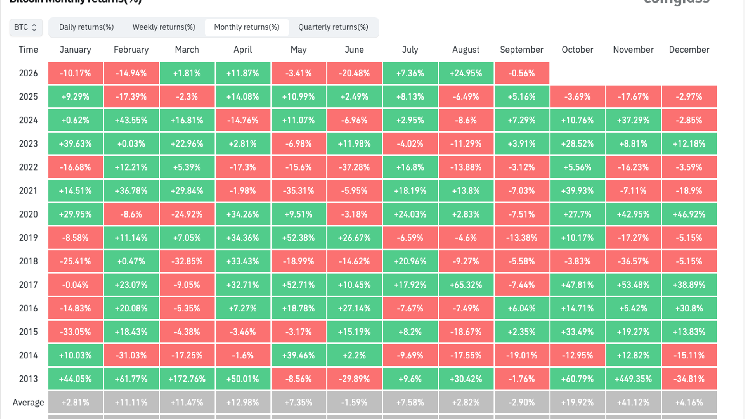
    Bitcoin started September on a weaker note, falling 1% to below $78,000 as the cryptocurrency entered what is commonly called “Rektember.” Since 2013, September has been Bitcoin’s worst-performing month on average, with an average decline of about 3% and only five positive monthly returns.

    Recent performance offers some encouragement for Bitcoin bulls. The cryptocurrency has gained in each of the past three Septembers, while BTC surged 25% in August—its strongest monthly performance since November 2024. After that rally, the market may be due for a period of consolidation or a potential correction.

    Macro headwinds weigh on Bitcoin

    The broader macroeconomic environment is also creating pressure for risk assets. Fed Chair Kevin Warsh’s hawkish speech at Jackson Hole last Friday, which emphasized elevated inflation, helped trigger a global bond sell-off. Several sovereign bond yields have reached new cycle highs, while the U.S. 10-year Treasury yield climbed to 4.784%.

    Markets are now pricing in a 66% probability of a 25-basis-point rate hike at the Federal Reserve’s Sept. 16 meeting, followed by the possibility of another increase before the end of the year. Such moves would bring the federal funds target range to 4.00-4.25% by the close of 2026.

    Source: cryptonews.net

  • Will the Fed Raise Interest Rates in September? Latest Probability Figures Revealed

    Will the Fed Raise Interest Rates in September? Latest Probability Figures Revealed

    Expectations that the Federal Reserve could raise interest rates at its September meeting have increased sharply after cautious comments on inflation from Fed Chairman Kevin Warsh. The probability of a rate hike in forecasting markets has reached one of its highest levels in recent months, while U.S. Treasury yields have also risen significantly.

    Rate hike expectations shift ahead of September Fed meeting

    Market expectations are changing rapidly ahead of the Federal Reserve’s monetary policy meeting on September 16. Data from forecasting markets indicate that the probability of the Fed keeping interest rates unchanged is about 55%, while a 25-basis-point rate hike is priced at approximately 46%. The probability of a larger increase is estimated at only about 1%.

    CME Group’s FedWatch tool shows that investors have raised the probability of a rate hike at the September meeting to 55.7%, an increase of approximately 20 basis points in a single day.

    Warsh says inflation trend has not improved significantly

    Speaking at the Jackson Hole symposium in Wyoming, Federal Reserve Chairman Kevin Warsh said inflation remains elevated.

    Warsh acknowledged that inflation data released during the summer was more positive than expected but said it did not demonstrate a lasting improvement in underlying inflation trends.

    Warsh stated, “While inflation data released this summer was better than expected, it doesn’t indicate a significant improvement in underlying trends.”

    The Fed chairman added that policymakers must ensure inflation is moving clearly and quickly enough toward the level targeted by the central bank.

    Warsh indicated that the Fed could otherwise need to tighten monetary policy further, saying, “Otherwise, we have more work to do. This is our duty, our authority, and our responsibility.”

    However, Warsh did not provide direct guidance on how the Fed will act at upcoming meetings or offer a definitive framework for the economic data that will determine future interest rate decisions.

    U.S. Treasury yields rise after Warsh’s remarks

    Following Warsh’s speech, U.S. stock indexes rose, while selling pressure emerged in the bond market.

    The yield on the 2-year U.S. Treasury note, which is highly sensitive to expectations for Federal Reserve interest rate policy, climbed approximately 8 basis points to 4.31%. That was the highest level for the 2-year yield since the end of July.

    The increase in short-term Treasury yields suggests that investors increasingly expect the Fed to pursue tighter monetary policy in the coming period.

    With approximately two and a half weeks remaining before the September meeting, upcoming inflation and employment data are expected to be critical in determining the direction of interest rate expectations. If inflation remains stronger than expected, the likelihood of a rate hike will increase. A significant slowdown in price pressures, however, could reinforce expectations that the Fed will leave interest rates unchanged.

    This is not investment advice.

  • Why Bitcoin Crashed After Warsh’s Jackson Hole Speech—and What Happens Next

    Why Bitcoin Crashed After Warsh’s Jackson Hole Speech—and What Happens Next

    Bitcoin’s recovery from below $65,000 to above $81,000 has encountered its first major macroeconomic setback after Federal Reserve Chair Kevin Warsh delivered a hawkish message at Jackson Hole on Friday. The key question now is whether the prospect of higher interest rates and rising U.S. Treasury yields could undermine the cryptocurrency market’s sharp rebound.

    Bitcoin ($BTC) held relatively steady during Warsh’s speech, but fell by $3,000 within hours of its conclusion, dropping below $77,000 for the first time in nearly a week. The sell-off spread across financial markets, weighing on stocks, precious metals and other risk-sensitive assets.

    Why Warsh’s Jackson Hole Speech Hurt Bitcoin

    Warsh did not explicitly say that the Federal Reserve is seriously considering raising interest rates, but his message was clear. Inflation remains elevated, the U.S. economy remains strong, and the central bank cannot simply declare victory. The Fed’s preferred personal consumption expenditures (PCE) inflation gauge is currently at 3.7% year over year, while its six-month annualized rate is even higher at 4.1%. Both measures remain well above the Fed’s target.

    Warsh emphasized that the Fed’s 2% inflation objective is “firm and fixed” and argued that price stability will not restore itself without further action from the central bank.

    He also played down some of the summer’s more encouraging inflation data, including the June figures, saying they had not convinced him or his colleagues that the underlying trend had improved substantially. Until the Fed can reassure markets that inflation is moving toward 2% “clearly and at sufficient speed,” policymakers will continue to “have work to do,” he added.

    Rate-Hike Expectations Rise as Bitcoin Falls

    Before Warsh’s speech, traders had assigned a one-third chance to an interest-rate increase in September. Those odds moved toward 60% after the speech, based on market pricing cited by Reuters. U.S. Treasury yields climbed again, while the dollar strengthened sharply after weakening the previous week.

    That is almost the opposite of the macroeconomic backdrop that helped Bitcoin surge 10 days earlier. The shift may explain why BTC fell from a recent peak above $80,000 to below $77,000 within hours, pulling most altcoins lower as well.

    Warsh also highlighted business investment growth of roughly 9% annually and a 20% rise in the S&P 500. Unemployment remained around 4%, while credit conditions were relatively easy. In practical terms, the economy is not currently giving the central bank an obvious reason to accept inflation above its target.

    Higher expected policy rates generally push Treasury yields higher, increasing the returns investors can earn from assets viewed as considerably safer. A more hawkish Federal Reserve also tends to support the U.S. dollar and tighten broader financial conditions. Historically, that combination has been unfavorable for Bitcoin and more speculative altcoins.

    Treasury Support Conflicts With the Fed’s Inflation Fight

    Treasury Secretary Scott Bessent’s recent intervention in the bond market helped drive long-term yields lower, at least temporarily, and contributed to Bitcoin’s major rally. However, Warsh reminded investors that the Federal Reserve has a different mandate.

    The Treasury may want to reduce borrowing costs and improve market liquidity, but the central bank must continue addressing inflation that remains above its target.

    As a result, markets remain caught between two powerful forces: Treasury efforts to support financial conditions and a Federal Reserve that may need to keep monetary policy tighter for longer than investors had expected.

    Source: cryptonews.net