Tag: U.S. Senate

  • Crypto Traders Braced for Total Wipeout, But Bitcoin Defied Expectations

    Crypto Traders Braced for Total Wipeout, But Bitcoin Defied Expectations

    Key Highlights

    • Bitcoin demonstrated unexpected resilience, holding near $75,000 despite a Federal Reserve rate hike and the failure of the Clarity Act in the U.S. Senate.
    • Market analysts indicate Bitcoin remains insulated from legislative setbacks, with derivatives traders having largely priced in the Senate’s rejection of the crypto bill.
    • Bitfinex’s Jag Kooner notes the modest spot market reaction reflects a market that was not positioned for a legislative breakthrough.

    Market Defies Bearish Expectations Amid Macro and Legislative Headwinds

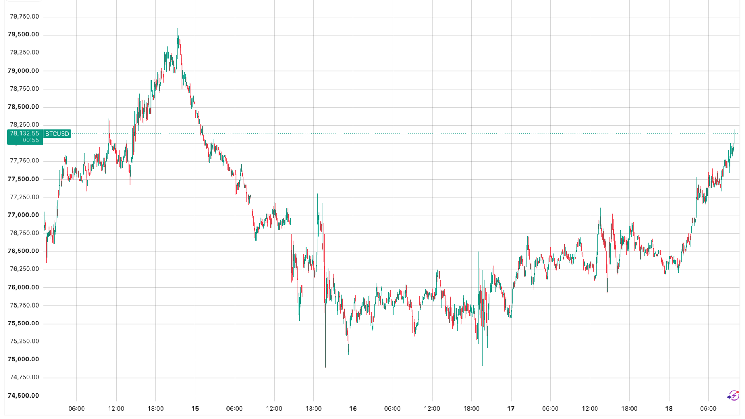
    Just one week ago, sentiment across the cryptocurrency sector bordered on panic. The prevailing consensus among market participants was that a dual catalyst—a Federal Reserve interest rate hike combined with the anticipated failure of the Clarity Act in the Senate—would trigger a sharp correction for Bitcoin and the broader digital asset complex. However, that predicted sell-off failed to materialize. Even as the Fed tightened monetary policy and the landmark crypto legislation stalled on Capitol Hill, Bitcoin not only stabilized but continued its ascent, brushing against the psychologically significant $75,000 level.

    Senate Vote Dynamics and Price Action

    The tension peaked on the night of September 14, as senators prepared to cast their ballots on the Clarity Act. In the hours leading up to the vote, Bitcoin experienced a dip driven by pre-vote jitters. Rumors of partisan gridlock—specifically concerning stablecoin yield provisions and ethics amendments attached to the bill—circulated rapidly through trading desks and social media, amplifying uncertainty. Despite this noise, the selling pressure proved shallow. By the time the Senate session commenced, Bitcoin had already recovered its footing, marching toward $75,000 and effectively shrugging off the legislative defeat once the final tally confirmed the bill’s failure.

    Derivatives Market Signals Resilience and Priced-In Outcomes

    The disconnect between the legislative outcome and the market’s muted reaction finds its clearest explanation in the derivatives arena. According to Jag Kooner, head of derivatives at Bitfinex, derivatives traders largely anticipated the Senate’s failure to approve the law. The modest spot reaction reflects a market that was already not positioned for a legislative breakthrough, he said. This insight suggests that sophisticated market participants had hedged or reduced exposure well in advance, neutralizing the potential for a cascading liquidation event. The data implies that the Clarity Act’s passage was viewed as a potential upside catalyst rather than a baseline expectation, meaning its failure represented a maintenance of the status quo rather than a negative surprise.

    Why This Matters

    The market’s ability to absorb simultaneous hawkish monetary policy and legislative disappointment signals a maturation of the Bitcoin market structure. It suggests that institutional participation and derivatives sophistication have created a buffer against binary political events that historically caused violent volatility. For investors, the key takeaway is that Bitcoin’s price discovery is increasingly decoupling from U.S. regulatory timelines, relying instead on global liquidity conditions and adoption metrics. The next critical inflection points will likely come from Federal Reserve policy signals regarding the terminal rate and incoming inflation data, rather than Congressional action on market structure bills.

    Frequently Asked Questions

    Why did Bitcoin not crash after the Clarity Act failed in the Senate?

    Derivatives traders had largely anticipated the bill’s failure and adjusted positioning accordingly. The market was not priced for a legislative breakthrough, so the negative outcome was already reflected in prices, resulting in only a modest spot market reaction.

    What role did the Federal Reserve rate hike play in Bitcoin’s price action?

    Despite the Fed hiking rates—a traditionally bearish signal for risk assets—Bitcoin continued its upward trajectory toward $75,000. This suggests that current market dynamics, including derivatives positioning and supply constraints, are overriding traditional macro correlations in the near term.

    What is the significance of the $75,000 level for Bitcoin?

    The $75,000 level represents a key psychological and technical resistance zone. Bitcoin’s ability to approach and hold near this level amid adverse legislative and macro news is being interpreted by analysts as a sign of underlying structural strength and buying conviction.

  • Bitcoin Endures September Volatility Amid Rate Hikes and Clarity Act Setback Challenging Bulls

    Bitcoin Endures September Volatility Amid Rate Hikes and Clarity Act Setback Challenging Bulls

    Key Highlights

    • The Clarity Act failed to advance in the U.S. Senate on Tuesday, securing only 49 of the 60 votes required for cloture.
    • Bitcoin dipped briefly below $74,887 but stabilized rapidly, signaling traders had largely priced in the legislative risk.
    • Analyst Mitchell Askew of Blockware Intelligence interprets the muted price reaction as evidence of seller exhaustion, a potential indicator of a market bottoming process.

    Senate Rejects Clarity Act as Bitcoin Shrugs Off Legislative Setback

    The Clarity Act, a closely watched piece of digital asset legislation, failed to overcome a procedural hurdle in the U.S. Senate on Tuesday. The measure attracted just 49 supporters, falling 11 votes short of the 60-vote supermajority needed to advance. Despite the legislative defeat, the cryptocurrency market’s reaction was notably subdued. Bitcoin briefly slipped below the $74,887 level during the session but recovered quickly, stabilizing in a manner that suggested market participants had already discounted the probability of failure.

    Analyst Cites Seller Exhaustion as Bullish Signal

    Mitchell Askew, head of Blockware Intelligence at Blockware, characterized the price action as a significant technical development. In an email commentary, Askew stated: “What stands out to me is that Bitcoin has hardly budged at all in response to two objectively bad pieces of news. A 25-basis-point hike and the CLARITY Act failing to pass are both headlines that, in a different market environment, would have sent price meaningfully lower. Instead, we got basically nothing.”

    Askew explained that the absence of a sustained sell-off on adverse headlines points to a depletion of motivated sellers. “Anybody who was going to sell bitcoin based on events like these has already sold. They no longer have coins to sell. That is an incredibly positive sign for the medium to long term, and it is exactly what you tend to see in the later stages of a bottoming process,” she noted. The analysis frames the legislative loss as a non-event for price discovery, reinforcing a narrative of structural support accumulating at current levels.

    Energy Markets Compound Macro Pressure

    Adding to the complex macroeconomic backdrop, energy markets exerted additional pressure early in the week. West Texas Intermediate (WTI) crude futures climbed above $106 per barrel on Tuesday, marking a five-month high. The surge was driven by persistent geopolitical tensions in the Middle East, which continue to inject volatility into global risk assets. While Bitcoin demonstrated resilience against the specific legislative catalyst, the broader inflationary impulse from rising energy costs remains a variable for monetary policy expectations.

    Why This Matters

    The failure of the Clarity Act represents a continuation of legislative gridlock surrounding digital asset regulation in the United States. However, the market’s indifferent reaction may be more consequential than the vote itself. The concept of “seller fatigue” described by Blockware Intelligence suggests that the marginal supply of Bitcoin available for sale on negative news shocks is diminishing. Historically, such dynamics have preceded periods of price consolidation and eventual upward re-rating. Meanwhile, the simultaneous spike in crude oil prices underscores that crypto assets are not trading in isolation; they remain sensitive to the same liquidity and inflation crosscurrents driving traditional markets. The next focal point for traders will be whether the Federal Reserve’s response to energy-driven inflation reintroduces correlation between risk assets and rate expectations.

    Frequently Asked Questions

    What was the vote count for the Clarity Act in the Senate?

    The Clarity Act received 49 votes in favor, failing to reach the 60-vote threshold required to invoke cloture and advance the legislation.

    Why did Bitcoin’s price not crash after the bill failed?

    According to Blockware Intelligence analyst Mitchell Askew, the muted reaction indicates seller exhaustion. Market participants looking to exit on regulatory or macro headlines have likely already done so, leaving a holder base less reactive to negative catalysts.

    How do rising oil prices affect the cryptocurrency outlook?

    Higher energy costs contribute to inflationary pressures, potentially influencing Federal Reserve policy. While Bitcoin showed resilience to the specific legislative news, sustained oil price strength could tighten financial conditions broadly, creating headwinds for risk assets including crypto.

  • Ripple Legal Chief Offers Bullish XRP Outlook After CLARITY Act Failure

    Ripple Legal Chief Offers Bullish XRP Outlook After CLARITY Act Failure

    The U.S. Senate failed to advance the CLARITY Act on September 15, with a 49–50 procedural vote falling short of the 60-vote threshold required to move the legislation to formal floor debate. The outcome stalls a bill that previously passed the House of Representatives in July 2025 by a 294–134 margin.

    Senate Deadlock Halts Legislative Momentum

    The procedural vote concluded with 49 senators voting in favor and 50 against, preventing the measure from proceeding along its immediate regulatory path. Senate negotiations had stalled over objections surrounding public ethics standards and the regulatory oversight of decentralized protocols, despite the strong bipartisan showing in the lower chamber.

    Ripple Leadership Affirms Legal Standing

    Ripple Chief Legal Officer Stuart Alderoty emphasized that the company and its digital asset operate on established legal ground following the legislative impasse. In a post on his X account, Alderoty stated:

    Don’t forget – Ripple and $XRP stand on settled ground. The 2023 federal Court ruling established $XRP is not a security.
    And in March the SEC and CFTC issued a joint interpretation naming $XRP a digital commodity. SEC Chairman Atkins and a CFTC Chairman Selig understand these… https://t.co/63ML5xmbAP

    Alderoty referenced the 2023 federal court ruling that established programmatic sales of $XRP on exchanges do not constitute securities, effectively decoupling those transactions from classification as investment contracts.

    Market Reaction and Technical Indicators

    Over the past 24 hours, $XRP declined 7.95% to $1.29, according to CoinMarketCap metrics. Technical indicators suggest the breach below the 200-day moving average at $1.355 likely accelerated defensive sell orders following the Senate vote.

    Judicial Precedents and Regulatory Framework

    The company anchors its stance in administrative determinations established prior to the legislative debate. Official March 2026 documentation issued jointly by the Securities and Exchange Commission (SEC) and the Commodity Futures Trading Commission (CFTC) categorized $XRP among sixteen digital assets recognized as digital commodities.

    According to financial sector reports, this interagency interpretation limits the company’s operating exposure to direct disputes regarding the commercial nature of the asset. Industry representatives note that the absence of comprehensive federal legislation shifts the task of defining operating boundaries back to agency-level technical rulemaking.

    Business Operations Continue Uninterrupted

    Corporate leadership maintains that business operations will proceed without adjustments in the wake of the legislative stall. According to remarks by Chief Executive Officer Brad Garlinghouse, commercial activity and cross-border agreements are maintaining their standard operational momentum.

    The Commodity Futures Trading Commission’s formal roadmap outlines the release of updated regulatory guidance for the spot market toward the end of the fourth quarter, which may provide further clarity on the regulatory treatment of digital commodities.

  • Clarity Law Fails, Bitcoin and Altcoins Drop; Analysts Say “Don’t Worry About It,” Outline Recovery Needs

    Clarity Law Fails, Bitcoin and Altcoins Drop; Analysts Say “Don’t Worry About It,” Outline Recovery Needs

    The Digital Asset Market Clarity Act failed to advance in the U.S. Senate on Tuesday, falling short of the 60-vote threshold required to proceed. The procedural vote tally stood at 49 in favor and 50 against, effectively stalling the comprehensive regulatory framework for digital assets.

    The outcome triggered immediate sell-offs across Bitcoin and altcoin markets. However, analysts speaking to The Block characterized the legislative setback as a delay rather than a structural shift for the crypto sector, emphasizing that macroeconomic forces—particularly Federal Reserve monetary policy—remain the primary driver of medium-to-long-term market direction.

    “The Failure of the Law to Pass is Not a Structural Problem”

    Arctic Digital Research President Justin d’Anethan told The Block that while the CLARITY Act’s failure was disappointing, it does not signal a fundamental market problem.

    d’Anethan pointed out that current Bitcoin price levels and previous all-time highs were achieved before the Clarity Act was in effect. He noted that institutional investors view the development not as a complete failure of the regulatory framework, but rather as a delay in the regulatory timeline. According to the analyst, interest rates and the overall monetary policy environment may be more decisive than regulatory clarity in determining the direction of the crypto market.

    Regulation Not a Key Determinant in Current Cycle

    BTC Markets crypto analyst Rachael Lucas offered a parallel assessment, stating that regulatory efforts are not a key determinant in the current crypto market cycle and that the market is more sensitive to interest rates.

    Lucas identified three critical areas for investors to monitor in the coming period:

    “1) Whether the Fed’s expected interest rate hikes will mark the beginning of a longer period of tightening, 2) Whether capital inflows into spot Bitcoin ETFs will accelerate again, 3) Whether an alternative regulatory path will emerge that can proceed without requiring 60 Senate votes.”

    Lucas added that capital is not exiting the market but concentrating in specific assets. While Congress is not strictly necessary for a fourth-quarter recovery, the analyst stressed that a prerequisite for such a rebound is for interest rates not to worsen further.

    “All Eyes Are on the FED Today!”

    Market attention has now pivoted squarely to the Federal Reserve. The U.S. central bank is expected to raise its benchmark interest rate for the first time since 2023 at today’s FOMC meeting, with a 25-basis-point increase widely anticipated. Futures markets are pricing in a higher than 90% probability of a hike at this session, with an additional increase projected before year-end.

    This is not investment advice.

  • XRP Sinks 10% as Clarity Act Fails, Bitcoin Slides Toward $76,000

    XRP Sinks 10% as Clarity Act Fails, Bitcoin Slides Toward $76,000

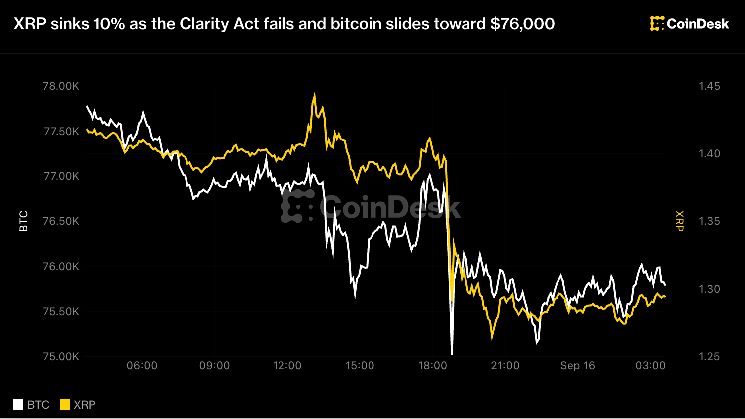
    XRP led a broad cryptocurrency sell-off Wednesday morning, plunging nearly 10% to $1.30 during Asian trading hours after the U.S. Senate failed to advance the Clarity Act, according to CoinDesk data.

    Major Tokens Slide Across the Board

    Ether followed with a decline of nearly 5% to approximately $2,410. Solana dropped 5% to just above $97, while Dogecoin fell nearly 5%. Zcash and Hyperliquid’s HYPE each slipped close to 4%, and Bitcoin retreated nearly 3% to just above $76,000. BNB and Tron proved the most resilient, each down only about 1%.

    Clarity Act Fails on Cloture Vote

    The legislation fell short on a 49-50 cloture vote, the procedural threshold requiring 60 senators to move a bill to debate. Multiple Republicans joined Democrats in voting against the measure. Negotiators had produced more than 600 pages of compromise text, but the provision that ultimately derailed the bill centered on ethics language designed to prevent senior government officials from maintaining crypto business interests.

    Senator Slotkin Cites Ethics Concerns

    Senator Elissa Slotkin, a Michigan Democrat, explained her opposition by stating the “the ethics provisions in this bill are simply too thin,” pointing to President Donald Trump, his children and his Cabinet earning money in crypto.

    She also said the Commodity Futures Trading Commission lacks the staffing to implement the law, and that the bill left gaps on money laundering and terrorist financing.

    Today, I voted no on the Clarity Act, legislation meant to regulate cryptocurrency in America.The ethics provisions in this bill are simply too thin. President Trump, his children, and his Cabinet are making billions of dollars in the crypto space, in part from bilking everyday…

    — Sen. Elissa Slotkin (@SenatorSlotkin) September 15, 2026

    Crypto Equities Hit Harder Than Tokens

    Publicly traded crypto companies suffered steeper losses than the underlying assets. Coinbase shares fell nearly 9% to $174.42, while Circle dropped more than 9% to $88.26. Galaxy Digital declined 8% and Gemini slid 7%. Bullish and Riot Platforms each lost 5%, eToro fell 4%, and Robinhood, MARA Holdings, CleanSpark, IREN and Core Scientific all dropped between 3% and 4%.

    Regulatory Path Forward Shifts to SEC

    Attention now turns to the regulators the bill was intended to constrain. The Securities and Exchange Commission is already advancing its proposed Reg Crypto framework and rules for tokenized securities, which now represents the primary pathway to the regulatory certainty the industry sought from Congress.

    Political and Market Implications

    Industry political action committees, including Fairshake, must now decide how to approach senators who voted against the legislation ahead of the November 3 election. A new Congress will convene in January 2027.

    Meanwhile, the Federal Reserve is scheduled to announce its rate decision later Wednesday, with traders leaning toward a quarter-point hike. The decision lands on a market that has just watched its legislative push collapse and is already selling risk assets.

  • CLARITY Act Vote Stalls in Senate

    CLARITY Act Vote Stalls in Senate

    Senate Stalls CLARITY Act, Amplifying Crypto Regulatory Uncertainty

    The U.S. Senate failed to advance the CLARITY Act today, a development that injects fresh uncertainty into the digital asset regulatory landscape. According to a report from Fireblocks, the legislative stall threatens to disrupt the independent rulemaking timelines of both the Securities and Exchange Commission (SEC) and the Commodity Futures Trading Commission (CFTC), leaving traders and investors navigating a prolonged period of ambiguity.

    Legislative Gridlock Complicates Agency Timelines

    The CLARITY Act was designed to establish clearer jurisdictional boundaries between the SEC and CFTC regarding digital assets, providing a statutory framework many argue is essential for fostering innovation and investor confidence. With the bill stalled, both agencies continue to draft rules through their existing notice-and-comment processes—a timeline that extends roughly two years into the future.

    Fireblocks highlights that this legislative vacuum forces market participants to operate under overlapping and potentially conflicting regulatory regimes for the foreseeable future. The lack of congressional action effectively cedes the pace and shape of crypto regulation to agency-level proceedings, which may not align with industry needs or market realities.

    Mixed Market Signals Reflect Cautious Sentiment

    The broader cryptocurrency market is currently exhibiting mixed momentum across major assets, a pattern consistent with heightened regulatory sensitivity. The absence of decisive price action suggests traders are adopting a wait-and-see posture, recalibrating strategies around the extended horizon for regulatory clarity.

    Key factors influencing near-term sentiment include:

    • Potential revival of CLARITY Act discussions in the Senate
    • Upcoming SEC and CFTC rule proposals and comment deadlines
    • Shifts in trading volumes tied to regulatory news flow

    What Market Participants Should Monitor

    Stakeholders should track any signals of renewed legislative momentum around the CLARITY Act, as well as formal rulemaking publications from the SEC and CFTC. The interplay between congressional action and agency rulemaking will likely dictate market structure, compliance costs, and the competitive landscape for digital asset services in the U.S. over the next two years.

    This article is for informational purposes only and does not constitute financial advice.

  • Bessent Urges Senate to Advance CLARITY Act as Crypto Rules Stall

    Bessent Urges Senate to Advance CLARITY Act as Crypto Rules Stall

    Treasury Secretary Scott Bessent is pressing the Senate to advance the CLARITY Act when lawmakers return from their August recess, renewing pressure on Congress to establish a comprehensive regulatory framework for digital assets. In a post on X, Bessent warned that further delays could weaken U.S. leadership in crypto and limit the government’s ability to prevent digital assets from being misused.

    In July, I called on the Senate to advance the Clarity Act — a bill to establish a comprehensive regulatory framework for digital assets and upgrade our ability to prevent bad actors from exploiting these critical technologies.When the Senate returns from August recess, I…

    — Treasury Secretary Scott Bessent (@SecScottBessent) September 9, 2026

    Senate Faces September Test

    Bessent made the appeal, urging senators to “remain at the negotiating table” and agree to a motion to proceed with the bill. The legislation still faces disagreements over crypto holdings, stablecoin rewards, and measures targeting illicit finance. Senate Majority Leader John Thune filed a cloture motion in August, setting the stage for a possible vote on Sept. 15. The bill needs at least 60 votes to advance, making Democratic support crucial.

    Regulation and National Security

    The CLARITY Act would divide digital-asset oversight between the SEC and CFTC while adding consumer-protection and anti-money-laundering requirements. Bessent has argued that clearer rules could encourage crypto companies and investment to remain in the U.S. Administration officials have also said stronger regulations could support dollar-backed stablecoins and make digital assets harder to use for illicit finance. If lawmakers fail to advance the bill, the U.S. would remain without a broad framework for crypto market oversight.

    Related Coverage