Tag: Tyre strategy

  • Max Verstappen: ‘I was trying everything’ after missing 2026 Azerbaijan Grand Prix victory

    Max Verstappen: ‘I was trying everything’ after missing 2026 Azerbaijan Grand Prix victory

    Key Highlights

    • Max Verstappen finished second at the Azerbaijan Grand Prix, losing to George Russell by just one-tenth of a second after starting eighth on the grid.
    • The Red Bull driver recovered through the field on medium tyres before a safety car allowed a switch to softs, where he matched Russell’s pace but could not complete the overtake.
    • Verstappen remains without a victory in the 2026 season, admitting he “was trying everything” including brushing the wall at Turn 16 on the final laps.

    Verstappen’s Baku Charge Falls Short by a Tenth

    From Eighth on Grid to a Photo-Finish Duel

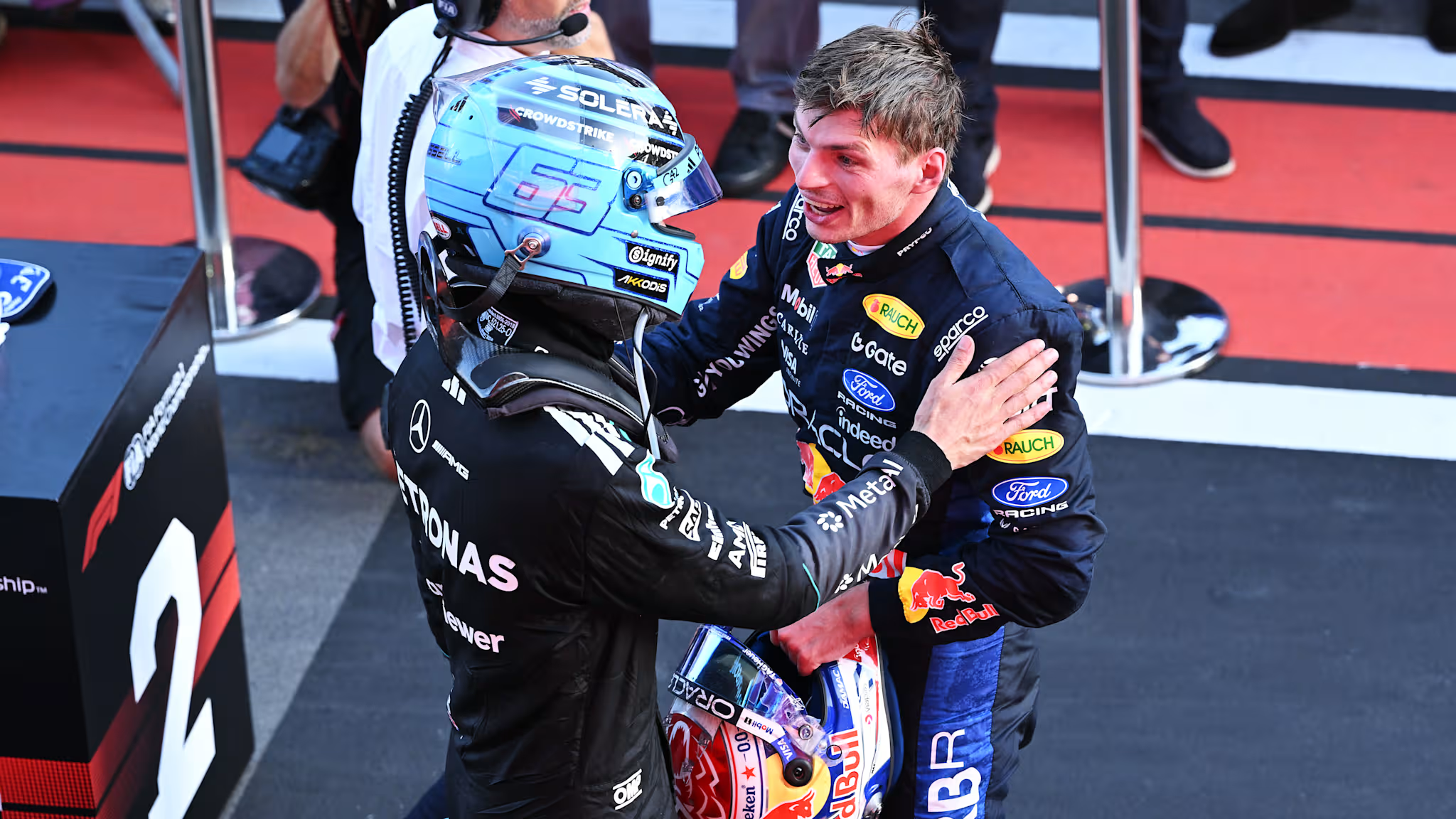
    Max Verstappen conceded he “was trying everything” to claim victory on the streets of Baku, the Red Bull driver eventually falling short by just one tenth against George Russell. The Dutchman was left a frustrated eighth on the grid for Saturday’s 51-lap race after issues in Qualifying, but Verstappen quickly began to make progress with the medium tyre. Moving into third, Verstappen demoted Oscar Piastri’s McLaren for second at the first of two Safety car restarts, allowing him to challenge race leader Russell in the closing stages.

    Tyre Strategy and the Medium-Stint Struggle

    Reflecting on the difficult opening phase, the four-time World Champion explained: “Starting in P8 I knew it wasn’t going to be that straightforward but we worked our way quite nicely up into the top three but that first stint was very tricky.” He added: “That medium tyre was just not very good, not having the grip that I think the soft tyres had so was just trying to survive on that stint to try and stay with the guys on the soft.” The intervention of the Safety Car transformed the race dynamics. “I think that Safety Car came at the right time for everyone to box onto that soft, because once we were on that soft tyre, it felt a lot better, just miles faster.” Verstappen noted the pace advantage was clear: “I think that also showed once George and I were on the soft, we were pulling away quite a lot over everyone else.”

    Final-Lap Drama and a Missed Opportunity

    Verstappen stayed on the cusp of a one-second gap to Russell over the final laps down the main straight, with Red Bull enjoying straight-line speed during the race. A yellow flag at Turn 15 after Valtteri Bottas crashed gifted Verstappen the chance to gain an even stronger slipstream on the run to the line for the final time. But the Dutchman ultimately fell short by just one tenth, meaning he has still yet to record a victory during the 2026 season. “I was trying everything that I have available,” said Verstappen in his quest to pass Russell, which included glancing the wall on the entry to Turn 16 several times. “Of course on the last lap because there was a yellow, I think George picked up a bit of boost lag, so he didn’t pull out of Turn 15 and that gave me a little bit more of an opportunity and that’s why it was so close to the line. We were constantly one second, so we were very close to each other.”

    Why This Matters

    The result extends Verstappen’s winless start to the 2026 campaign, placing added pressure on Red Bull to unlock race-winning performance across varying circuit layouts. While the team demonstrated strong straight-line speed in Baku, the inability to convert a recovery drive from P8 into victory highlights the fine margins separating the leading contenders. Russell’s ability to manage tyre degradation and defend under late-race pressure strengthens Mercedes’ championship credentials, while the safety car timing and yellow-flag dynamics underscore how unpredictable street circuits remain. With the championship still in its early stages, both drivers and teams will analyse the tyre-phase data from Baku to refine strategies for upcoming rounds.

    Frequently Asked Questions

    Why did Verstappen start eighth in Baku?

    Verstappen qualified eighth after encountering issues during the qualifying session, which compromised his grid position for the 51-lap race.

    What role did the safety car play in Verstappen’s charge?

    The safety car allowed Verstappen and the leaders to switch from the struggling medium compound to the soft tyre, which Verstappen described as “miles faster,” enabling him to close the gap to Russell and pull away from the rest of the field.

    How close was the finish between Verstappen and Russell?

    Verstappen finished just one-tenth of a second behind Russell, with a late yellow flag for Valtteri Bottas’ crash giving the Red Bull driver a stronger slipstream on the final run to the line.
  • What We Learned From Formula 1’s First Visit to the Madring

    What We Learned From Formula 1’s First Visit to the Madring

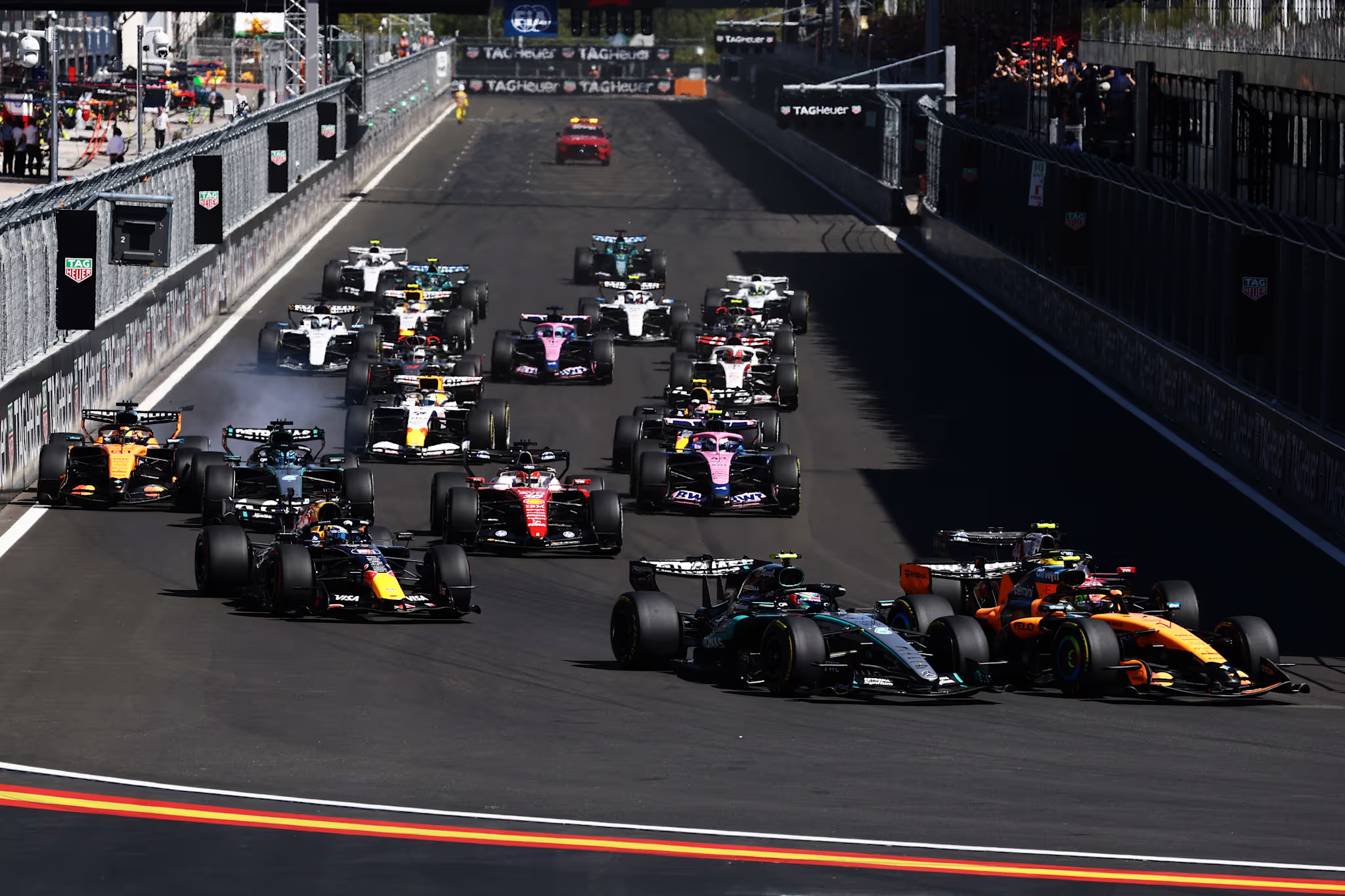
    The debut of a new circuit always injects a mix of adrenaline, curiosity, and trepidation into a Formula 1 weekend, and the Madring in Madrid delivered on every front. The inaugural Spanish Grand Prix at this venue offered immediate lessons on driver adaptation, tyre strategy, and the shifting dynamics of the 2026 title fight.

    How drivers tackled a fresh challenge

    While factors like weather swings and split‑second strategy calls always influence a race result, drivers usually rely on intimate knowledge of track layouts honed over years of simulator work and muscle memory. The Madring reset that familiarity. Despite extensive virtual preparation, the reality of a freshly laid surface, the proximity of the walls, and the electric atmosphere of the Spanish capital could only be absorbed once Free Practice 1 began on Friday afternoon.

    Home favourite Fernando Alonso described the layout as “very technical” and “attractive”, while several drivers drew parallels to Jeddah’s high‑speed, narrow character. Like its Saudi Arabian counterpart, the Madring showed its teeth early: Arvid Lindblad, Lewis Hamilton, and Ollie Bearman all ran into trouble during Free Practice. As the field found the initial limits, lap times tumbled dramatically — plummeting by more than two seconds between FP1 and Lando Norris’s stunning final qualifying effort.

    Tyre management proved decisive

    The ability to nurse tyres remains a cornerstone of race success, extending stint options and preserving grip for stability. At the Madring, that skill was tested severely. George Russell admitted after qualifying, “as the track has got faster, I’ve been struggling to get the most out of the tyres”, a deficit he believed cost him a shot at pole position and left him sixth on the grid.

    In the Grand Prix, Nico Hulkenberg secured just his third points finish of the season as Audi continued to close the gap to midfield rivals Racing Bulls and Alpine. The German highlighted that “managing the tyres and making sure you get to the end” made the difference on a day when the three teams showed “identical pace”. Lando Norris also excelled in tyre preservation — until a poorly timed Virtual Safety Car unravelled his race. He remained proud of his performance, stating: “The way I drive, the way I can look after the tyres and get lap time out of it, it’s giving me a lot of opportunities and I can do a better job than the others.”

    La Monumental lived up to its name

    Few corners punish Pirelli rubber as severely as La Monumental. This 550‑metre arena‑style section, flanked by up to 45,000 passionate fans and featuring a banking gradient of up to 24%, became a defining feature of the circuit. The variety of racing lines through the corner sparked heated moments, especially as it leads into a blind crest that demands immense courage to attack flat‑out.

    Another twist in the title fight

    It is rare to hear an F1 driver — among the most ruthless competitors in sport — concede that a rival deserved victory more than they did, yet that is exactly what unfolded in Madrid. Kimi Antonelli claimed his eighth win of the season, extending his Drivers’ Championship lead to a commanding 81 points. Despite the triumph, he remarked: “It’s good to win, but it doesn’t feel as good because I think Lando today deserved to win. But overall, you know, we’ll take it.”

    Antonelli’s assessment undersold his own drive: starting second, he overtook Norris during the pit stops and inherited the lead from Charles Leclerc after the Ferrari driver’s long opening stint ended with fewer than ten laps remaining. The 20‑year‑old then resisted pressure from both Norris and Max Verstappen to secure the most comfortable championship position of his career so far.

    The weekend also revealed a shift in mindset within the Mercedes camp. Team‑mate George Russell declared he is no longer “in the fight for the drivers’ title” after finishing fifth. Team principal Toto Wolff disagreed, stressing that anything can happen over the remaining rounds and that a “nice buffer” can evaporate quickly after a couple of crashes or retirements. With Norris on a scintillating run of form, Ferrari consistently close, and Russell operating with reduced pressure, the battle for the 2026 crown remains wide open.