Tag: Tokenized securities

  • NYSE Parent ICE Names Avalanche for 24/7 On-Chain Trading Platform

    NYSE Parent ICE Names Avalanche for 24/7 On-Chain Trading Platform

    Key Highlights

    • Intercontinental Exchange (ICE), parent of the New York Stock Exchange, is developing an alternative trading system (ATS) for 24/7 on-chain trading and has publicly identified Avalanche as a leading blockchain candidate.
    • ICE executive Michael Blaugrund stated Avalanche “checks a lot of those boxes” and the firm is “very engaged with the team,” marking the clearest public signal yet of the exchange group’s on-chain ambitions.
    • The initiative builds on ICE’s recent partnership with tZERO for tokenized securities settlement and its investment in crypto exchange OKX, though no launch date is set and regulatory approval remains pending.

    ICE Signals Strategic Shift Toward 24/7 On-Chain Trading

    Intercontinental Exchange (ICE), the operator of the New York Stock Exchange, is advancing plans to launch an alternative trading system (ATS) that would enable round-the-clock trading of tokenized securities on a public blockchain. In a statement reposted by Avalanche on September 17, ICE’s Head of Market Structure and Technology, Michael Blaugrund, offered the strongest public indication to date that the exchange group is seriously evaluating blockchain infrastructure for this purpose. “As we’ve evaluated different platforms, Avalanche checks a lot of those boxes for us, so we’re very engaged with the team,” Blaugrund said in the statement reposted by Avalanche.

    Regulatory Pathway Through an Alternative Trading System

    The proposed venue would operate as an ATS—a regulated platform that matches buyers and sellers without functioning as a full national securities exchange. This structure provides ICE with a distinct regulatory pathway compared to a traditional listing venue, potentially accelerating the approval process for on-chain settlement. The move represents a significant evolution in how traditional market infrastructure providers are approaching digital-asset integration, opting to leverage existing blockchain networks rather than building proprietary solutions entirely in-house.

    Building on a Year of Digital-Asset Foundations

    The announcement extends a series of strategic steps ICE has taken over the past twelve months. In August, the exchange group agreed to partner with tZERO to develop the settlement infrastructure for a planned NYSE-affiliated tokenized securities platform, a collaboration the companies described as foundational for on-chain settlement. ICE has also taken an equity stake in the global crypto exchange OKX, signaling a broader strategy of combining traditional market architecture with established digital-asset rails. These moves collectively underscore a deliberate effort to bridge conventional finance and blockchain technology through regulated, institutional-grade pathways.

    Avalanche Positions for Institutional Adoption

    Avalanche has actively courted this category of institutional use case, promoting its high-throughput, subnetwork-based architecture as purpose-built for regulated financial systems requiring both speed and control. The network’s institutional momentum received a separate boost when brokerage giant Charles Schwab announced plans to add spot trading for Avalanche’s native token, AVAX, alongside other major crypto assets. However, both parties have been careful to characterize the current engagement as exploratory. No formal agreement has been signed, no launch timeline has been disclosed, and ICE must still secure regulatory clearance before any 24/7 on-chain venue becomes operational.

    Why This Matters

    U.S. equity markets have historically operated on fixed weekday sessions with overnight and weekend closures. A 24/7 ATS built on a public blockchain like Avalanche would bring traditional securities closer to the continuous trading model native to cryptocurrency markets, enabling orders to settle and clear without the pauses that define legacy exchange infrastructure. For ICE, the public naming of Avalanche serves as a directional signal to the market and regulators alike, indicating where the exchange group sees the convergence of traditional finance and decentralized technology heading. Critical questions remain regarding how ICE will structure market oversight, investor protections, and interoperability with existing clearing and settlement systems on a venue that never closes.

    Frequently Asked Questions

    Has ICE formally selected Avalanche for its 24/7 trading platform?

    No. ICE has publicly identified Avalanche as a leading candidate and confirmed active engagement with the Avalanche team, but no binding agreement or final platform selection has been announced.

    What is an alternative trading system (ATS) and how does it differ from a national securities exchange?

    An ATS is a regulated trading venue that matches buy and sell orders but does not operate as a full national securities exchange. This distinction allows it to follow a different regulatory approval path, which can be more flexible for innovative market structures like on-chain trading.

    When might ICE’s 24/7 on-chain trading venue launch?

    ICE has not set a launch date. The ATS remains in development and must navigate regulatory approval processes before any live deployment can occur.

  • SEC’s ‘Innovation Exemption’ Boosts ONDO – Can the Altcoin Escape Its 4-Month Trap?

    SEC’s ‘Innovation Exemption’ Boosts ONDO – Can the Altcoin Escape Its 4-Month Trap?

    Key Highlights

    • Ondo Finance ($ONDO) surged over 12% in 24 hours as trading volume jumped 91% to exceed $267 million, driven by the SEC’s new five-year Innovation Exemption for tokenized securities venues.
    • The regulatory order allows qualified venues to trade tokenized stocks through permissioned liquidity pools without registering as traditional exchanges, potentially expanding the regulated market for Ondo’s tokenized products, which already exceed $3.5 billion in total market cap with over $900 million in tokenized stocks.
    • Technical analysis shows $ONDO testing a four-month descending triangle resistance near $0.38–$0.49, with MACD signaling a bullish crossover but bearish RSI divergence warning of rejection risk toward $0.30–$0.32 support.

    SEC Innovation Exemption Catalyzes Ondo Rally

    Ondo Finance’s native token $ONDO climbed more than 12% over the past 24 hours, outperforming the broader cryptocurrency market rally as daily trading volume surged 91% to surpass $267 million at press time. While the token benefited from general risk-on sentiment, the primary catalyst was a landmark regulatory development from the U.S. Securities and Exchange Commission that directly addresses the tokenized asset ecosystem Ondo operates within.

    Five-Year Regulatory Window for Tokenized Securities Venues

    On September 17, the SEC issued its “Innovation Exemption,” granting conditional relief to qualifying Tokenized Securities Venues for a five-year period. The order permits these venues to trade tokenized stocks through permissioned liquidity pools without requiring registration as traditional national securities exchanges. SEC Chairman Paul Atkins called the decision a significant step toward bringing U.S. capital markets on-chain. For Ondo Finance, which has positioned itself as a leading infrastructure provider for tokenized real-world assets, the exemption could substantially widen the regulated market accessible to its product suite.

    Ondo’s Tokenized Asset Footprint Expands

    According to data from Token Terminal, Ondo Finance’s total tokenized market capitalization has exceeded $3.50 billion. Tokenized stocks represent more than $900 million of that value, accounting for 25.5% of the composition. Funds hold the largest share at 71.2%, while stablecoins and commodities constitute 2.1% and 1.2% respectively. The regulatory clarity provided by the SEC’s temporary relief strengthens Ondo’s business case by reducing compliance uncertainty for institutional participants seeking exposure to on-chain representations of traditional securities.

    Technical Structure Tests Four-Month Triangle Resistance

    Despite the fundamental tailwind, $ONDO’s price action remains at a critical technical juncture. The token has been consolidating within a descending triangle pattern since early May, with resistance declining from $0.49 toward $0.38. Recent sessions saw price test this descending trendline as the MACD histogram turned positive after eight days of seller dominance, accompanied by a bullish signal line crossover. A confirmed breakout could target the pattern’s upper boundary near $0.50. However, bearish RSI divergence persists, indicating selling pressure may not be fully exhausted. Rejection at current levels risks a return to the $0.30–$0.32 support zone, with a break below $0.30 opening the path toward a deeper demand area around $0.26. Profit-taking from positions established near $0.30 could also interrupt the near-term advance.

    Why This Matters

    The SEC’s Innovation Exemption represents the most concrete federal regulatory acknowledgment to date that tokenized securities can operate within a tailored framework distinct from traditional exchange infrastructure. By creating a five-year sandbox for permissioned liquidity pools, the order addresses a core structural barrier that has limited institutional adoption of on-chain assets: the lack of a clear legal pathway for secondary trading. Ondo Finance, alongside peers such as Franklin Templeton and BlackRock in the tokenized fund space, stands to benefit directly as the universe of compliant counterparties and venues expands. The coming months will test whether regulatory relief translates into sustained capital inflows and deeper liquidity for tokenized equities, or whether the market remains constrained by custody, settlement, and interoperability frictions that the exemption does not resolve.

    Frequently Asked Questions

    What does the SEC’s Innovation Exemption allow for tokenized securities venues?
    The exemption grants conditional relief for five years, permitting qualified venues to trade tokenized stocks through permissioned liquidity pools without registering as traditional national securities exchanges.
    How large is Ondo Finance’s tokenized asset market currently?
    Ondo’s total tokenized market capitalization exceeds $3.50 billion, with tokenized stocks accounting for more than $900 million (25.5%) of that total, according to Token Terminal data.
    What are the key technical levels to watch for $ONDO?
    Immediate resistance sits at the descending triangle trendline near $0.38–$0.49, with a breakout target near $0.50. Key support lies at $0.30–$0.32; a break below $0.30 could see price test the $0.26 demand zone.
  • SEC Proposes Broad Update to Decades-Old Transfer Agent Rules With Blockchain Nod

    SEC Proposes Broad Update to Decades-Old Transfer Agent Rules With Blockchain Nod

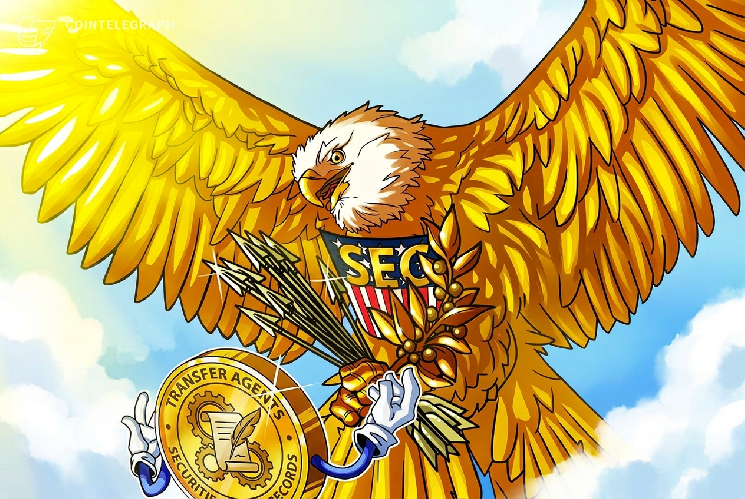
    The US Securities and Exchange Commission (SEC) has proposed the most significant overhaul in decades of the rules governing transfer agents, as blockchain-based recordkeeping and tokenized securities gain traction in US financial markets.

    The proposed SEC transfer agent rules would update requirements for registration, recordkeeping, securities safeguarding and transfers. They would also introduce new compliance measures addressing risks linked to increasingly digital and automated market infrastructure.

    “Market participants are actively seeking to bring blockchain-native, or ‘onchain’ transfer agents into the U.S. market,” the SEC said, citing potential applications including blockchain-based recordkeeping, tokenized fund administration and cross-chain interoperability.

    The agency said its current regulatory framework does not adequately address these developments. In particular, the SEC identified risks involving cybersecurity, operational resilience and the protection of securities and investor records.

    Under the proposal, transfer agents would face expanded reporting obligations and additional compliance standards. The changes would include requirements covering restrictive legends on securities and the use of third-party service providers.

    SEC’s proposed Transfer Agent Rules. Source: SEC

    SEC transfer agent rules date back decades

    The SEC said its transfer agent rules have not undergone substantive updates since the late 1970s and early 1980s, when the industry still depended heavily on paper certificates and manual recordkeeping.

    The regulatory agency is seeking public comment on the proposed changes. Comments will be due 60 days after the proposal is published in the Federal Register.

    Related: CFTC chair says agency will move forward with crypto regulation if CLARITY fails

    SEC advances broader securities rule changes

    The SEC is “on a mission to simplify its rules,” according to an analysis from law firm Cahill Gordon & Reindel that was sent to clients on Tuesday.

    In May, the SEC proposed three major changes to public-company reporting and securities rules. The proposals would allow companies to choose semiannual reporting, simplify the current filer classification system and expand access to streamlined registered securities offerings.

    Last week, the SEC sent a proposed overhaul of custody rules for investment advisers and investment companies to the White House for review. The potential changes include provisions on how firms hold crypto assets for clients.

    The proposed custody changes could establish clearer standards for investment advisers and funds holding digital assets while they comply with federal securities regulations.

    Magazine: Does the Bitcoin rally mean we haven’t wasted our lives in crypto?

  • Cashlink Adds Avalanche Support for Tokenized Securities

    Cashlink Adds Avalanche Support for Tokenized Securities

    Cashlink Technologies has integrated Avalanche into its infrastructure for issuing and managing tokenized securities, giving financial institutions an additional blockchain option while keeping issuance, custody and registrar services within Cashlink’s regulated platform.

    Cashlink expands blockchain infrastructure for tokenized securities

    Cashlink is a German provider of infrastructure for digital securities. The company holds a BaFin license as a crypto securities registrar and custodian, supporting regulated workflows for institutions entering the tokenized assets market.

    Cashlink has processed more than €1 billion in transaction volume across more than 300 live issuances. Its institutional clients include KfW, NRW.BANK, DZ Bank and Helaba.

    The integration gives Avalanche a defined route into institutional tokenization through an established regulated infrastructure provider. Future adoption will depend on whether Cashlink’s institutional clients select the network for new digital securities workflows.

    Image: Magnific

    Source: cryptonews.net

  • Payward and London Stock Exchange Partner to Tokenize Leading UK Stocks

    Payward and London Stock Exchange Partner to Tokenize Leading UK Stocks

    The London Stock Exchange (LSE) and Payward, the parent company of crypto exchange Kraken, are partnering to bring tokenized versions of the UK’s largest listed companies to blockchain-based markets.

    Under the planned initiative, Payward will tokenize the top 100 London-listed stocks as xStocks. The LSE will explore supporting trading in those tokens through LSE 24, its proposed 24-hour trading venue, subject to regulatory approval.

    Top 100 London-listed companies planned for xStocks

    The partnership would expand xStocks into one of the world’s major equity markets. Since launching just over a year ago, the tokenized stock framework has recorded more than $40 billion in total volume, including over $20 billion in onchain settlement volume.

    xStocks now have more than 200,000 holders. Payward said the framework has demonstrated how tokenized assets can give investors access to companies and markets beyond traditional geographic and market-access limitations.

    The planned UK rollout would make the top 100 London-listed companies available as xStocks to investors in more than 110 countries. The tokens would provide continuous, onchain exposure to some of the UK’s largest listed companies, although they are not currently available to UK investors, Payward stated.

    If regulators approve the arrangement, the LSE would list the xStocks and support their trading through LSE 24. The initiative could enable LSE members to trade tokenized securities representing companies from the US, EU, UK and Hong Kong alongside other asset classes, combining continuous blockchain-based trading with established regulated infrastructure.

    Payward and the LSE also plan to examine native, issuer-sponsored equity tokens. These instruments could allow LSE members to issue and service shares directly onchain while preserving the rights and fungibility associated with conventional securities.

    London Stock Exchange plans longer trading hours

    The London Stock Exchange plans to launch an overnight trading venue in the first half of 2027. The move would extend the exchange’s operating hours as it seeks to attract international retail investors and compete with the continuous accessibility of crypto markets.

    The LSE has already expanded its presence in crypto-linked products. In mid-2024, it began listing physically backed Bitcoin and Ethereum ETNs after the debut of US spot Bitcoin ETFs. Although those products initially targeted professional investors, changes by the Financial Conduct Authority have since enabled retail participation.

    The overnight venue will initially focus on exchange-traded products, giving the LSE a targeted entry point into extended-hours trading. Longer trading hours could make London-listed investment products more accessible to investors in Asia, the Middle East, North America and other markets outside the exchange’s traditional trading window.

    The exchange also intends to integrate agentic AI capabilities into the venue. The systems could support portfolio evaluation, market research and trade execution.

  • SEC Presses Investment Firms to Prove They Own the Hot Startup Shares They Sell

    SEC Presses Investment Firms to Prove They Own the Hot Startup Shares They Sell

    According to a Wall Street Journal (WSJ) report published Monday, the U.S. Securities and Exchange Commission (SEC) is asking investment companies to prove that their products actually hold the private-company shares they claim to offer.

    The inquiry comes as investors seek exposure to high-profile artificial intelligence companies such as OpenAI and Anthropic through private-market funds and, increasingly, blockchain-based investment products. It raises a fundamental question: does the promised investment really exist?

    Reuters, citing the WSJ report, said the SEC has asked registered investment advisers to demonstrate that the special purpose vehicles (SPVs) they oversee actually own, or have exposure to, the shares they promote. Reuters said it was unable to independently verify the report. The reported SEC examination does not target any specific firm.

    Why SPV scrutiny matters for AI investments

    SPVs pool money from investors to acquire stakes in private companies, giving outside investors access to businesses whose shares are not publicly traded. In recent years, they have become a popular way to invest in the artificial intelligence boom.

    According to a Cryptopolitan report published August 27 and based on DeFiLlama’s pre-IPO valuations tab, Anthropic and OpenAI ranked first and second among 182 companies, with estimated valuations of $1.38 trillion and $900.29 billion, respectively.

    Source: Cryptopolitan, citing DeFiLlama’s pre-IPO tracker snapshot reported August 27, 2026. These are estimated private-market valuations, not official company funding valuations.

    The sums involved are substantial. Stanford’s AI Index for 2026 reported that global private investment in artificial intelligence increased 127.5% in 2025 to $344.7 billion, including $170.9 billion invested in generative AI. As capital continues to flow into private AI companies, proving exactly what an investment buys is becoming increasingly important.

    OpenAI and Anthropic warn about unauthorized equity exposure

    Companies are already taking steps to police their own equity. OpenAI has warned investors about unauthorized opportunities to gain exposure to its shares. In its equity-transfer notice, the company says it is “aware of firms that market unauthorized opportunities to gain exposure to OpenAI,” including through direct equity sales, SPV interests, tokenized interests and forward contracts.

    OpenAI also warns that unauthorized transactions may leave investors with an interest that:

    “will not be recognized and carry no economic value to you.”— OpenAI, Unauthorized OpenAI Equity Transactions

    Anthropic has issued a similar warning, stating that transfers involving its stock require board approval and that it does not allow SPVs to acquire Anthropic stock. In both cases, an SPV’s claim that it has access to a company’s shares does not necessarily mean that the underlying exposure is valid.

    SEC case highlights risks in pre-IPO investments

    The SEC has already brought a case illustrating how investors can be misled. On August 10, 2026, the agency charged Adit Ventures Management, CEO Eric Munson and three affiliated general partners with allegedly defrauding investors in connection with pre-IPO holdings, including stakes in SpaceX and Klarna.

    The SEC alleged that Munson falsely told an investor that a fund owned shares in a private company when it did not. The complaint also alleges that the defendants resold pre-IPO shares to client funds at inflated prices, misrepresented costs, collected millions of dollars in unauthorized fees and pledged client assets to support a $10 million credit line.

    “That misconduct has no place in investment advisory relationships where clients count on investment advisers being their fiduciaries.” — Corey A. Schuster, Chief of the SEC Enforcement Division’s Asset Management Unit

    Without admitting the allegations, the defendants consented to judgments subject to court approval. The proposed resolutions include disgorgement, civil penalties and, for Munson, an associational bar with the right to seek reentry after three years.

    Tokenized private-company investments add further risk

    The issue also extends to cryptocurrency markets as exposure to private companies increasingly moves onchain. Cryptopolitan reported in April that OpenAI’s implied valuation exceeded $1 trillion through onchain pre-IPO instruments backed 1:1 by SPV exposure on Jupiter.

    Tokenization does not resolve the underlying ownership question. Instead, it can distribute the same claim across a larger number of investors.

    In a January 28, 2026 statement concerning tokenized securities, SEC divisions said that moving a security onchain:

    “does not affect application of the federal securities laws.”— SEC Divisions of Corporation Finance, Investment Management, and Trading and Markets

    The next key questions are whether the reported examinations lead to enforcement actions and whether products linked to major AI companies become specific targets. For investors, the issue is straightforward: can the firm selling the exposure prove that it owns what it claims to own?