Tag: Tokenized real-world assets

  • Cardano Foundation, Fireblocks Open Native Tokens to Institutions

    Cardano Foundation, Fireblocks Open Native Tokens to Institutions

    Key Highlights

    • Cardano Foundation and Fireblocks announced a technical roadmap to bring Cardano Native Tokens (CNTs) onto Fireblocks’ institutional custody platform by March 2027, covering CIP-26 and CIP-68 token standards.
    • The integration will allow thousands of banks, exchanges, payment firms, and fintechs using Fireblocks to custody, send, and receive CNTs with the same security and policy controls applied to other digital assets.
    • Fireblocks, which secures over $16 trillion in digital asset transactions, has supported ADA since 2021; this move eliminates manual steps previously required for CNT custody and positions Cardano-issued assets directly in front of institutional infrastructure users.

    Cardano Foundation and Fireblocks Map Institutional Custody Path for Native Tokens

    The Cardano Foundation, the Swiss nonprofit overseeing the Cardano blockchain ecosystem, announced on September 24 a strategic integration with Fireblocks to bring Cardano Native Tokens (CNTs) onto the institutional custody platform. The move represents a significant infrastructure upgrade: tokens minted directly on the Cardano blockchain—rather than through separate smart contracts—will become standard assets on Fireblocks, accessible to the thousands of banks, exchanges, payment firms, and fintechs that rely on the platform for digital asset operations.

    Native Tokens Receive Standard Asset Treatment

    CNTs are distinguished by their on-chain architecture: they are minted alongside Cardano’s native currency, ADA, without requiring a separate contract deployment. The integration covers two key Cardano Improvement Proposals—CIP-26, the Cardano Token Registry, and CIP-68, the on-chain metadata framework. Once support is live, tokens built to either standard will be treated as standard assets on Fireblocks rather than bespoke additions requiring manual configuration. Cardano Foundation chief executive Frederik Gregaard framed the development as an infrastructure play critical for institutional adoption.

    “Institutions rarely adopt a new asset on its own. Adoption happens through trusted infrastructure,” he said. “Bringing Cardano Native Tokens onto Fireblocks puts the assets issued on Cardano in front of the exchanges, payment firms and fintechs that build on that infrastructure every day.”

    A 2027 Rollout Timeline, Not an Immediate Launch

    The announcement outlines a technical roadmap rather than a finished deployment. The Cardano Foundation stated that support is expected by March 2027, with both organizations planning to scope further DeFi and ecosystem integrations over the same year. The notice does not report new token issuance or institutional purchases of ADA. Stephen Richardson, Fireblocks’ chief strategy officer and head of banking, emphasized the dual criteria institutions evaluate before engaging with new assets.

    “the network the asset lives on and the infrastructure they’ll engage with managing that asset.”

    Richardson noted that Cardano has spent a decade building credibility through peer-reviewed research, formal verification, and a governance model institutions can scrutinize, while Fireblocks supplies the security and policy controls that more than 100 banks rely on.

    Extending Cardano’s Institutional Push

    The Fireblocks integration extends a series of institutional-focused moves by the Cardano Foundation. Earlier this year, the nonprofit opened a blockchain lab at the University of Brasília to expand its Latin American footprint and has backed a capital-markets blockchain risk framework aimed at traditional finance. For issuers of stablecoins and tokenized real-world assets on Cardano, standard Fireblocks support removes a practical barrier: those assets can now reach the same institutional rails as ADA instead of waiting for a custodian to add each token individually by hand.

    Why This Matters

    The integration signals a maturation of Cardano’s infrastructure layer for institutional finance. By embedding CNTs directly into Fireblocks’ policy and security framework—used by over 100 banks and securing more than $16 trillion in transaction volume—Cardano removes a longstanding friction point: the need for custodians to manually whitelist each native token. This standardization is particularly consequential for the emerging tokenized real-world asset (RWA) and stablecoin sectors on Cardano, where institutional custody is a prerequisite for scale. The March 2027 target also aligns with broader industry timelines for regulated digital asset infrastructure, suggesting coordination with evolving regulatory frameworks in major jurisdictions.

    Frequently Asked Questions

    When will Cardano Native Tokens be available on Fireblocks?

    The Cardano Foundation stated that support is expected by March 2027. This is a technical roadmap announcement, not an immediate launch.

    Which token standards are covered by the integration?

    The integration covers CIP-26 (Cardano Token Registry) and CIP-68 (on-chain metadata framework). Tokens built to either standard will become standard assets on Fireblocks.

    Does this mean institutions can immediately custody any CNT?

    No. The integration must be built and deployed first. Once live, Fireblocks’ existing institutional clients—including banks, exchanges, payment firms, and fintechs—will be able to custody, send, and receive supported CNTs using the same security and policy controls applied to other digital assets on the platform.


  • Chainlink Launches Upgrade to Power Onchain Equities

    Chainlink Launches Upgrade to Power Onchain Equities

    Key Highlights

    • Chainlink announced a major infrastructure upgrade via official tweet, integrating with xStocksFi to bring the world’s largest equities onchain and enhance digital finance security and efficiency.
    • The xStocksFi integration aims to reshape onchain equity trading dynamics by improving liquidity, access, and trading functionalities for market participants.
    • Community engagement has surged following the announcement, signaling positive market sentiment as traders monitor developments that could set new standards for blockchain-based equity markets.

    Chainlink Unveils Infrastructure Upgrade With xStocksFi Integration Targeting Onchain Equities

    Chainlink, the decentralized oracle network that provides critical infrastructure for smart contracts across multiple blockchains, has announced a significant upgrade designed to enhance digital financial systems. The revelation came through an official tweet from the Chainlink team, underscoring the protocol’s continued commitment to advancing the technical foundations of decentralized finance (DeFi) and bridging traditional financial markets with blockchain technology.

    xStocksFi Partnership Aims to Bring Global Equities Onchain

    The centerpiece of the announcement is Chainlink’s integration with xStocksFi, a development positioned to facilitate the world’s largest equities trading onchain. This partnership targets a fundamental shift in how equity markets operate by leveraging Chainlink’s oracle technology to bring traditional stock assets onto blockchain networks. The integration is expected to significantly impact trading dynamics by enhancing liquidity, broadening access for global traders, and introducing new functionalities that could redefine onchain equity markets.

    Security and Efficiency Enhancements Drive Upgrade

    According to the announcement, improved security features are central to this upgrade, addressing core requirements for institutional-grade financial infrastructure. As the cryptocurrency landscape matures, such advancements are viewed as crucial for maintaining competitiveness and meeting the stringent demands of traditional finance participants entering the blockchain space. The initiative aligns with broader market trends where distributed ledger technology is increasingly adopted by established financial institutions seeking settlement efficiency, transparency, and programmable asset management.

    Market Response and Community Engagement Surge

    While Chainlink’s current price and trading volume metrics remain unspecified in the announcement, social media activity indicates growing interest in the project. The xStocksFi integration has sparked extensive discussions among traders and developers regarding the potential for enhanced trading functionalities and the broader implications for tokenized real-world assets. Community engagement around the announcement has increased significantly, reflecting positive sentiment and anticipation for the promised capabilities.

    Why This Matters

    The Chainlink and xStocksFi collaboration sits at the intersection of traditional finance and blockchain technology, representing a concrete step toward the tokenization of real-world assets (RWAs)—a narrative gaining substantial traction among institutional players. By targeting the world’s largest equities, the integration addresses a multi-trillion-dollar market that has remained largely inaccessible to onchain participants due to oracle reliability, regulatory, and liquidity challenges. Chainlink’s established position as the dominant oracle provider, securing billions in total value locked across DeFi protocols, lends credibility to the technical feasibility of this ambition. For market participants, the development signals accelerating convergence between TradFi and DeFi infrastructure, with potential implications for settlement times, counterparty risk reduction, and 24/7 market access. The coming months will test whether the promised functionalities materialize at scale and whether regulatory frameworks accommodate onchain equity trading.

    Frequently Asked Questions

    What is the Chainlink and xStocksFi integration designed to achieve?

    The integration aims to bring the world’s largest equities onchain, facilitating trading of traditional stock assets via blockchain infrastructure. It seeks to enhance liquidity, broaden global access, and improve trading functionalities for onchain equity markets.

    How does this upgrade affect Chainlink’s role in decentralized finance?

    The upgrade reinforces Chainlink’s position as essential infrastructure for DeFi by expanding its oracle technology into traditional equity markets. It represents an ongoing effort to lead in digital finance by bridging TradFi assets with blockchain networks.

    What should traders monitor following this announcement?

    Traders should watch for developments regarding the xStocksFi integration rollout, as it could establish new standards for onchain equity trading. Follow-through on promised functionalities may drive further market activity and influence Chainlink’s market position.

  • Ondo Finance Succession Crisis Deepens as Kathleen Allman’s Daughter Alleges ‘dementia’, Alcoholism, Reckless Spending

    Ondo Finance Succession Crisis Deepens as Kathleen Allman’s Daughter Alleges ‘dementia’, Alcoholism, Reckless Spending

    Key Highlights

    • Ondo Finance founder Nathan Allman’s mother, Kathleen Allman, has filed a lawsuit against acting CEO De Bode alleging a “brazen usurpation of corporate control” and a proposed $11 million compensation package drafted days after her son’s death.
    • The disputed package included a $900,000 annual salary, a $1 million signing bonus, 26 million restricted token units valued over $9 million, and equity awards that would have increased De Bode’s stake from 0.33% to roughly 8%.
    • A September 3 court order currently maintains De Bode as acting CEO and board member, despite Kathleen Allman’s attempt to remove him after appointing herself chair and interim CEO alongside daughter Tahnee Towill.

    Leadership Vacuum Triggers Boardroom Battle at Ondo Finance

    The sudden death of Ondo Finance founder Nathan Allman has precipitated a high-stakes corporate governance dispute that now sits before the courts. Following Allman’s passing, De Bode—identified in court filings as the company’s acting chief executive—assumed operational control of the tokenized treasury management firm. The transition, however, was immediately contested by Allman’s mother, Kathleen Allman, who moved swiftly to restructure the board by appointing herself and another of Allman’s children, Tahnee Towill, as directors. Kathleen Allman subsequently named herself board chair and interim chief executive, and moved to strip De Bode of all corporate titles.

    Court Order Preserves Status Quo as Litigation Advances

    Kathleen Allman’s attempt to remove De Bode has been temporarily blocked by a September 3 court order that explicitly preserves his status as acting CEO and board member pending further proceedings. Ondo Finance declined to comment on the matter when contacted, and De Bode did not respond to inquiries. The legal standoff centers on the legitimacy of De Bode’s appointment and the validity of a compensation package that Kathleen Allman’s complaint characterizes as a “brazen usurpation of corporate control.”

    Lawsuit Details Alleged Self-Dealing and Fiduciary Breaches

    The complaint filed by Kathleen Allman paints a picture of rapid self-dealing in the immediate aftermath of her son’s death. According to the filing, De Bode began plotting a new $11 million compensation package within a week of Nathan Allman’s passing. The package, as detailed in the complaint, comprised a $900,000 annual salary and bonus structure, a $1 million signing bonus, and 26 million restricted token units valued at more than $9 million. Additionally, the awards covered 846,000 shares that would have inflated De Bode’s equity stake from a marginal 0.33% to approximately 8%—a roughly 24-fold increase. Vesting for these awards was scheduled to commence on May 25, the day immediately following Allman’s death.

    Chen Appointment and Governance Validity Also Challenged

    The lawsuit extends beyond compensation to challenge the legitimacy of De Bode’s own appointment and his effort to install Chen, described as an early Ondo backer, to the board. Kathleen Allman’s suit seeks a judicial determination that neither De Bode nor Chen were validly appointed to their positions, that the contested compensation awards be declared void, and that damages be awarded for alleged breaches of fiduciary duty. The complaint frames these actions as an exploitation of the governance vacuum created by the founder’s unexpected death.

    Why This Matters

    The dispute at Ondo Finance highlights the acute governance risks facing young, founder-led crypto and tokenization firms where succession planning is often informal or nonexistent. Ondo, a significant player in the tokenized real-world asset (RWA) sector, manages substantial on-chain treasuries for DAOs and institutions. The legal battle introduces uncertainty over who controls the protocol’s strategic direction, treasury management, and tokenomics at a time when the RWA narrative is attracting significant institutional capital. The court’s eventual ruling on the validity of De Bode’s appointment and the disputed equity grants will set a precedent for how Delaware corporate law—under which many crypto entities are incorporated—treats rapid post-founder governance maneuvers and insider compensation in the digital asset space.

    Frequently Asked Questions

    Who currently controls Ondo Finance?

    As of the September 3 court order, De Bode remains the acting CEO and a member of the board. Kathleen Allman’s attempt to remove him and install herself as interim CEO has been temporarily stayed pending litigation.

    What is the total value of the compensation package Kathleen Allman is challenging?

    The complaint alleges an $11 million package consisting of a $900,000 annual salary and bonus, a $1 million signing bonus, 26 million restricted token units valued over $9 million, and equity awards covering 846,000 shares that would increase De Bode’s stake from 0.33% to roughly 8%.

    What legal claims does Kathleen Allman’s lawsuit assert?

    The suit seeks to invalidate De Bode’s and Chen’s board appointments, void the disputed compensation awards, and recover damages for alleged breaches of fiduciary duty, arguing the actions constitute a “brazen usurpation of corporate control” executed within days of the founder’s death.

  • BlackRock’s BUIDL Outpaces Circle’s USYC as Tokenized Treasury Race Heats Up

    BlackRock’s BUIDL Outpaces Circle’s USYC as Tokenized Treasury Race Heats Up

    BlackRock’s USD Institutional Digital Liquidity Fund (BUIDL) has narrowly overtaken Circle’s USYC to become the second-largest tokenized U.S. Treasury fund, highlighting the accelerating competition in the tokenized real-world asset (RWA) market.

    BUIDL and USYC compete for market share

    According to Token Terminal data, the total tokenized U.S. Treasury market is worth approximately $15.1 billion. BUIDL accounts for about $2.8 billion, giving it an estimated 18.5% market share. Nearly one-fifth of all tokenized Treasury assets are therefore held through BlackRock’s fund.

    USYC also recorded rapid growth in 2025, rising from roughly $600 million to nearly $3 billion. By late August 2026, the fund had reached approximately $2.9 billion, slightly above BUIDL’s estimated $2.7 billion at that point.

    In a separate market snapshot, Sky’s uSDS ranked first with a value of $4.4 billion, followed by BUIDL at $2.28 billion. Tether’s XAUT ranked third at $2.8 billion, while Circle’s USYC was listed fourth at $2.28 billion.

    However, XAUT is classified as a tokenized commodity rather than a tokenized fund. Excluding uSDS and XAUT, BUIDL and USYC remain closely matched, meaning new institutional inflows or withdrawals could quickly change their rankings.

    BlackRock’s position may also shift rapidly because the asset manager frequently records significant inflows and outflows across its Bitcoin [BTC] and Ethereum [$ETH] exchange-traded funds (ETFs), affecting their cumulative flow totals.

    BlackRock expands its tokenized fund offering

    The competition comes as BlackRock recently launched BSTBL on Ethereum and BRSRV on Solana [$SOL]. The tokenized money market funds are designed to serve as reserve assets for stablecoins.

    The development is significant because stablecoins now represent approximately $305 billion and have become a major source of on-chain liquidity. By offering similar institutional products on both Ethereum and Solana, BlackRock is providing capital access to both ecosystems while reinforcing the competition between $ETH and $SOL for liquidity.

    By late August, USYC had reached approximately $2.9 billion, slightly above BUIDL’s estimated $2.7 billion. BUIDL has since narrowly overtaken USYC, underscoring the growing competition among tokenized Treasury funds and the broader expansion of institutional RWAs.

  • Bullish Makes $100 Million AI Credit Bet Using GPUs as Collateral

    Bullish Makes $100 Million AI Credit Bet Using GPUs as Collateral

    Two major financial trends are converging in the artificial intelligence sector: private credit for AI infrastructure spending and the tokenization of real-world assets (RWAs).

    Bullish, a New York Stock Exchange-listed institutional crypto platform and the parent company of the news publication Coindesk, announced this week that it is lending $100 million to USD.AI. The financing will support loans to businesses developing AI systems and related infrastructure.

    Under the model, AI companies use valuable graphics processing units (GPUs) as collateral. Bullish says the market for this emerging form of lending is substantial and larger than several established borrowing categories.

    “Bullish is targeting a capital-intensive sector that has rapidly emerged as one of the largest in private credit, with a scale that eclipses legacy debt markets such as auto loans and home equity lines of credit (HELOCs),” the company said.

    Bullish Expands Its Real-World Asset Strategy

    Block.one co-founder and CEO Brendan Blumer established Bullish in Hong Kong in 2020. Following Friday’s announcement, Bullish shares fell 2% on the NYSE. However, the stock was up 10.5% over five days and had gained more than 44% over the previous month.

    Thomas Cowan, Bullish’s head of tokenization, said the company believes physical assets should be connected to digital financial systems. He described the USD.AI transaction as an example of that strategy.

    “Our commitment to USD.AI reflects a conviction we’ve believed since our first investment in the protocol: that credible, well-structured real-world assets belong onchain,” Cowan remarked. “USD.AI’s onchain transparency gave us the visibility to underwrite this facility with the same institutional diligence we apply across our platform, and backing it is a meaningful step toward bringing tokenized assets to institutional scale.”

    GPU-Backed Loans Face a Major Risk Test

    GPU-backed lending also carries significant risks. Hardware prices can fall rapidly, while GPUs may become obsolete soon after more advanced models reach the market.

    As of Saturday, Aug. 29, 2026, GPU prices remained high, particularly for Nvidia consumer graphics cards with larger amounts of video memory. Valuations had also risen again during the summer rather than easing.

    The model’s most important test will come if a borrower is unable to repay its loan. In that scenario, lenders will need to determine how much value the pledged GPUs retain and how quickly they can be sold.

  • Global ETF Demand Could Drive Bitcoin’s Next Bull Cycle Peak

    Global ETF Demand Could Drive Bitcoin’s Next Bull Cycle Peak

    Bitcoin’s current bull-cycle peak could be driven by institutional capital and exchange-traded funds (ETFs) outside the United States, according to Ki Young Ju, founder and CEO of cryptocurrency market analytics platform CryptoQuant.

    Ju outlined the forecast in an Aug. 27 post on X, arguing that international market access could become a significant source of demand after U.S. products expanded regulated exposure to bitcoin.

    Ju stated:

    “The peak of this bull cycle will likely be driven by institutional money and ETFs outside the US.”

    South Korea Highlights Barriers to Bitcoin ETF Access

    Ju cited South Korea as an example of the restrictions that remain in international markets. The country does not have a spot bitcoin ETF, retail investors cannot purchase foreign-listed spot bitcoin ETFs, and most companies are still unable to open exchange accounts to buy $BTC.

    South Korea has begun allowing corporate participation in stages. A Financial Services Commission (FSC) roadmap includes a phase covering about 3,500 listed companies and qualified professional investors, while financial companies and other corporations remain outside the framework.

    Ju described widespread retail access as a possible signal that the market cycle is reaching its peak:

    “This cycle’s top might be when a banker at a regional bank in Korea recommends a spot bitcoin ETF to a granny for her savings.”

    The forecast shifts attention away from U.S. fund flows and toward markets where regulated bitcoin investment products are unavailable or have limited distribution. The U.S. Securities and Exchange Commission (SEC) approved spot bitcoin exchange-traded products in January 2024, enabling investors to gain exposure through conventional brokerage and investment accounts.

    Ju argues that similar access in other countries could broaden participation during the next phase of bitcoin’s cycle.

    Institutions Build Bitcoin and Tokenization Infrastructure

    Institutional adoption extends beyond direct bitcoin purchases and spot ETF holdings, although access and service offerings remain uneven. Strategy’s Bitcoin Banking Adoption Index assessed 25 major institutions across trading, custody, digital asset products, financing, and corporate participation.

    The index placed overall bank adoption at 32%, indicating substantial room for financial institutions to expand their digital asset capabilities.

    Tokenized real-world assets (RWAs) could provide another part of the financial infrastructure that Ju expects to support broader adoption. As of Aug. 29, RWA.xyz’s Global Market Overview reported $38.63 billion in distributed asset value, an increase of 2.65% over the previous 30 days.

    These products are part of the tokenized RWA market, which transfers claims on assets such as government securities and private credit to blockchain-based systems for issuance, settlement, and transfer.

    Stablecoin Liquidity Could Expand Market Access

    Deeper stablecoin markets could provide institutions with greater liquidity for trading, settlement, and cross-border transfers as regulated bitcoin access expands.

    The Bank for International Settlements (BIS) said stablecoins show potential for faster, programmable payments but warned that current designs can create financial integrity, liquidity, and monetary risks. The assessment underscores that expanding on-chain financial infrastructure does not remove regulatory or operational concerns.

    Bitcoin’s fixed supply limit and decentralized settlement remain distinct from the regulated funds and tokenized financial systems that give investors access to the asset. Wider ETF distribution could increase bitcoin access without changing the network’s underlying design.

    Ju expects both investment access and the infrastructure supporting it to expand beyond the U.S. market. His comments follow rapid adoption of U.S. bitcoin ETFs, with spot funds attracting about $57 billion in net inflows during their first two years.

    “So far this has been a US adoption story, but the next phase is global institutionalization with deeper stablecoin liquidity and RWA rails,” Ju noted, adding:

    “More institutions will hold $BTC as a strategic asset, and access will improve in the many countries that still lack ETFs.”

    The outlook centers on wider international ETF availability, increased institutional bitcoin holdings, and blockchain-based financial infrastructure as factors that could shape the cryptocurrency’s next stage of adoption.

  • RWA Market Growth Puts LINK, XLM, and ONDO in Focus

    RWA Market Growth Puts LINK, XLM, and ONDO in Focus

    The real-world asset (RWA) market is becoming increasingly difficult to ignore. Excluding stablecoins, tokenized real-world assets have grown 18.1 times in three years to $44.6 million, with institutional demand for yield-bearing products driving much of that expansion.

    Three tokens closely linked to the RWA infrastructure—$LINK, $XLM and $ONDO—are now approaching technically important price levels that could shape their next major moves.

    RWA Market Growth Is Driving New Demand

    Tokenized U.S. Treasury bills lead the market at $15.1 billion, followed by active yield strategies at $8.9 billion and private credit funds at $6.4 billion. However, the growth of tokenized assets is not simply a competition between blockchains offering the same function.

    Ethereum remains the dominant Layer 1 settlement network, accounting for roughly one-third of the tokenized asset market. Stellar and Avalanche have also become important issuance rails for institutional funds.

    The specialized protocols supporting this market are particularly important. Ondo Finance focuses on issuing and distributing yield-bearing traditional assets, including U.S. Treasuries, on-chain. Chainlink provides middleware through its oracle infrastructure and CCIP, including Proof of Reserves and connections between off-chain financial data and on-chain assets. Stellar offers a fast, cost-effective settlement environment and hosts financial products such as Franklin Templeton’s tokenized money market fund.

    $LINK Price Faces a Major Weekly Test

    $LINK has already bounced from an important demand area during August and is now approaching the 200-day exponential moving average (200-EMA) on the weekly chart near $13.83. This is the key resistance level bulls must overcome.

    A weekly breakout above that resistance could strengthen the case for a longer-term recovery and open the way toward higher price levels. Failure to break through, however, could send $LINK back toward lower support zones. The setup is promising, but the chart still needs confirmation rather than another speculative rally.

    $XLM Holds Support but Shows a Warning Signal

    $XLM is also showing a constructive setup after rising from a major ascending trendline that has previously triggered significant price moves. The token tested the 200-day EMA in August but has so far been rejected.

    If $XLM eventually flips that resistance on the weekly chart, $0.30 and $0.50 will become important levels to monitor. There is also a warning signal: a weekly death cross has formed between the 50-EMA and 200-EMA. If selling returns, a loss of the ascending trendline could expose $XLM to lower support levels.

    $ONDO Needs to Hold Its Long-Term Trend

    $ONDO may have the most fragile technical setup of the three tokens. Since early February, its weekly chart has maintained an ascending trendline following a major H2 2025 crash.

    That trendline is now critical. A breakdown could deepen the correction and potentially create a continuation pattern, with new all-time lows forming ahead. Conversely, $ONDO has not reclaimed its weekly 50-EMA since September 2025. If it finally does, $0.60 and $0.85 could become relevant recovery targets.

    The RWA market is expanding rapidly, but that growth does not automatically guarantee that token prices will follow. $LINK, $XLM and $ONDO are exposed to an expanding tokenization ecosystem; their charts now need to show that institutional growth can translate into sustained demand.

    Source: cryptonews.net

  • Why Is Ripple Hiring a London Metal Exchange Treasury Executive Now?

    Why Is Ripple Hiring a London Metal Exchange Treasury Executive Now?

    Ripple has hired a senior London Metal Exchange (LME) treasury executive as the company expands its focus on institutional trading, tokenization and corporate finance.

    Joseph Thompson, senior vice president and head of treasury at the LME, is leaving the exchange on Aug. 31 to join Ripple’s Trading and Markets team. According to the original hire report, his responsibilities are expected to include work related to tokenized real-world assets.

    The appointment adds experience from one of the world’s largest commodities exchanges to a company increasingly focused on liquidity, collateral and blockchain-based capital markets.

    Ripple Expands Institutional Finance Strategy

    Thompson’s appointment follows Ripple’s broader push into corporate treasury services and institutional financial infrastructure.

    Ripple acquired GTreasury for $1 billion in 2025, adding an established treasury management platform to its business. The platform has since been integrated into Ripple Treasury, which combines traditional cash management with digital-asset capabilities.

    Ripple has also launched native digital-asset functionality across its Treasury platform. Coinpaper’s coverage of Ripple’s SWIFT tools showed how the company is increasingly positioning its products alongside existing financial infrastructure rather than targeting only crypto-native users.

    Tokenization Becomes a Larger Focus

    Ripple has also increased its exposure to tokenized assets. Recent investments in ZILO and Licuido were aimed at strengthening issuance, transfer agency and collateral infrastructure for institutional markets.

    The $XRP Ledger is gaining more tokenized products as well. Aviva Investors recently launched a tokenized liquidity fund on XRPL, expanding the network’s real-world asset footprint.

    Ripple and Boston Consulting Group have estimated that tokenized assets could approach $19 trillion by 2033, although adoption will depend heavily on regulation and institutional demand.

    Thompson’s appointment does not mean that the LME itself is adopting Ripple technology. Instead, it highlights Ripple’s effort to recruit expertise from traditional market infrastructure as the company seeks to expand beyond payments and further into institutional finance.

    For background on the relationship between Ripple, $XRP and the $XRP Ledger, Coinpaper’s evergreen $XRP guide provides a concise overview.

  • Tokenized Assets Are More Active Than the Data Shows

    Tokenized Assets Are More Active Than the Data Shows

    Estimates of how much tokenized real-world assets (RWAs) are actually being used in decentralized finance (DeFi) range from less than 1% to 7%, 11.7% and nearly 20%. All of these figures were published this year, and each can be defended. The problem is that they do not measure the same thing.

    The lowest estimate receives the most attention. Of the roughly $51 billion in tokenized real-world assets on public blockchains, it suggests that only a single-digit percentage is actively used. The figure is often cited as evidence that onchain finance remains a toy: a great deal of tokenized “value,” but very little of it operating in public markets.

    That criticism is not without merit. An asset that moves onchain, incurs transaction fees and gains no additional utility is a worse product than the traditional asset it replicates. However, the statistic used to support that criticism is nearly meaningless—not because the percentage is too low, but because both sides of the calculation are misleading.

    Where tokenized RWA utilization figures come from

    The sub-1% estimate covers only three tokenized money market funds, rather than the broader market. BlackRock’s BUIDL, Circle’s USYC and Franklin Templeton’s iBENJI hold a combined $7.2 billion and have approximately $50 million deployed.

    Expanding the sample produces a utilization rate of 11.7% according to DeFiLlama. Using CoinShares’ $7.4 billion second-quarter estimate against RWA.xyz’s $38 billion total produces a figure of about 19%. The resulting 20-fold gap reflects the lack of agreement over what should be measured, not necessarily a change in the underlying market.

    Why the denominator distorts the calculation

    According to Bernstein research, private credit accounts for approximately 47% of the $51 billion in tokenized real-world assets onchain. Private credit also tends to move infrequently in traditional finance. Tokenization does not change its redemption schedule or its holder base.

    Including private credit in the denominator of a metric intended to measure composability is therefore a category error rather than evidence of disappointing adoption. A meaningful assessment of DeFi usage must distinguish between assets designed for frequent onchain activity and assets whose underlying structure makes limited movement normal.

  • Bullish Provides USD.AI With $100 Million Facility for GPU Loans

    Bullish Provides USD.AI With $100 Million Facility for GPU Loans

    Bullish has provided USD.AI with a $100 million stablecoin debt facility to finance loans secured by graphics processing units (GPUs) used in artificial intelligence infrastructure.

    Announced Friday, the facility gives USD.AI additional capital to finance operators purchasing high-performance computing equipment. The deal expands Bullish’s exposure to tokenized real-world assets and AI infrastructure.

    USD.AI expands GPU-backed lending capacity

    Developed by Permian Labs, USD.AI connects stablecoin liquidity with companies seeking funding to purchase GPUs. Rather than evaluating a borrower’s entire business, the platform issues non-recourse loans secured by the computing hardware bought with the financing.

    Bullish Head of Tokenization Thomas Cowan said the company relied on USD.AI’s onchain records when assessing the facility. Bullish had already invested in the platform before agreeing to provide the debt financing.

    “Our commitment to USD.AI reflects a conviction we’ve believed since our first investment in the protocol: that credible, well-structured real-world assets belong onchain.”

    USD.AI will use the $100 million facility to originate loans for middle-market AI infrastructure operators. The financed hardware serves as collateral, while the loans do not create claims against the operators’ other corporate assets, according to the announcement.

    This structure separates the loans from borrowers’ main balance sheets, although repayment still depends on the income and resale value of the underlying computing equipment. GPUs can lose value as newer models reach the market, making loan terms, collateral checks and repayment schedules important to the financing process.

    USD.AI has already completed major transactions involving Nvidia hardware. In June, the protocol announced a $98.1 million loan backed by 2,304 Nvidia B300 GPUs. Investors separately provided full funding for a $34 million facility secured by 768 Nvidia B200 units.

    Together, the two disclosed loans involved 3,072 GPUs and more than $132 million in financing. The Bullish facility gives USD.AI another source of stablecoin liquidity as it extends lending to operators developing data centers and AI computing clusters.

    Permian Labs CEO David Choi said demand for computing equipment has created a distinct lending category.

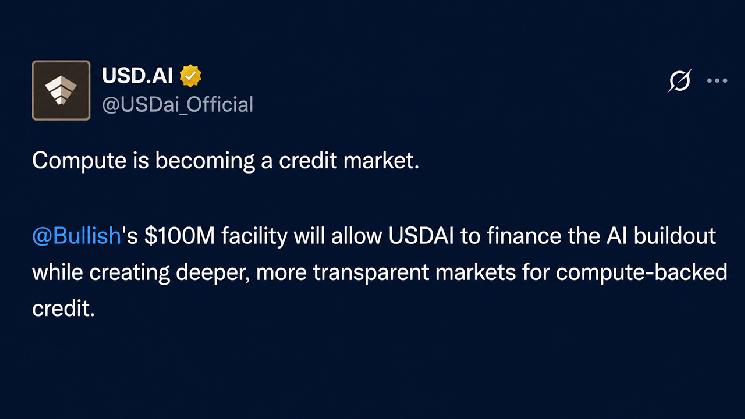
    “Compute is becoming a credit market in its own right,” Choi said, adding that Bullish’s facility would allow USD.AI to finance more infrastructure and develop trading markets for compute-backed debt.

    USD.AI says its financing is settled onchain, giving capital providers exposure to loans backed by income-producing computing equipment. The company describes the funding as non-dilutive because operators do not have to give up an ownership stake when borrowing.

    Bullish plans sUSDai listing and secondary market

    Alongside the lending facility, Bullish plans to list sUSDai across several trading pairs on its institutional exchange. A dedicated market-making program will provide orders for the token once trading begins, according to the companies.

    USD.AI uses sUSDai as its yield-bearing token, giving holders exposure to returns generated by the protocol’s credit operations. A listing would allow holders to trade their positions instead of relying solely on the repayment period of the underlying loans.

    Bullish expects the program to improve secondary liquidity and price discovery for GPU-backed debt. The companies did not disclose the planned trading pairs, launch date or market-making budget in Friday’s announcement.

    Bullish and USD.AI are also expanding a research project focused on financing capital spending in the AI sector. The work will combine Bullish’s experience operating institutional markets with USD.AI’s lending model, according to the announcement.

    Tokenized exposure to computing hardware has emerged elsewhere in the crypto market. In August 2025, Injective introduced an Nvidia GPU derivatives market that gave traders exposure to rental prices for Nvidia H100 processors.

    Aethir and Injective launched a tokenized GPU marketplace in December 2024, using blockchain-based products to provide access to computing capacity. Unlike those trading and rental products, USD.AI’s model centers on secured loans issued to infrastructure operators.

    Bullish deepens existing USD.AI relationship

    The $100 million facility follows Bullish Capital’s $4 million investment in USD.AI in September 2025. Cowan said onchain transparency allowed Bullish to review the protocol using the institutional underwriting standards applied elsewhere across its business.

    Bullish operates spot and derivatives markets for professional investors and supplies the liquidity supporting the new facility.

    In Europe, Bullish operates under the European Union’s Markets in Crypto-Assets framework as an authorized crypto asset service provider offering spot trading and custody. Its U.S. presence expanded after the company obtained a New York BitLicense in September 2025.

    The license allows Bullish to serve eligible customers in New York and came about one month after the company’s public listing. The announcement did not specify whether sUSDai would be offered to U.S. customers or describe any access restrictions.

    Bullish shares recover after post-IPO decline

    For U.S. investors, the transaction adds AI infrastructure lending to the businesses linked to NYSE-listed Bullish shares, which trade under the ticker BLSH. The financial impact will depend on the facility’s terms, loan performance and contribution to Bullish’s results, none of which the companies disclosed.

    Bullish debuted on the New York Stock Exchange in August 2025 after pricing its shares at $37. The offering raised about $1.03 billion, while the stock opened at $90 during its first trading session.

    Earlier coverage of the public offering reported that Bullish entered the market at a valuation of about $5.4 billion after pricing above its original range. BlackRock-managed funds and accounts linked to ARK Investment Management had indicated interest in purchasing up to $200 million of stock.

    Despite its recent recovery, BLSH remains more than 60% below its $90 opening price. The shares traded around $33 on Friday after gaining approximately 45% during the preceding month.

    Other U.S.-traded crypto companies also advanced over the same period. Bitcoin treasury company Strive gained about 88%, Bitcoin miner Canaan rose roughly 55%, and USDC issuer Circle added close to 40%.