Tag: Tipped minimum wage

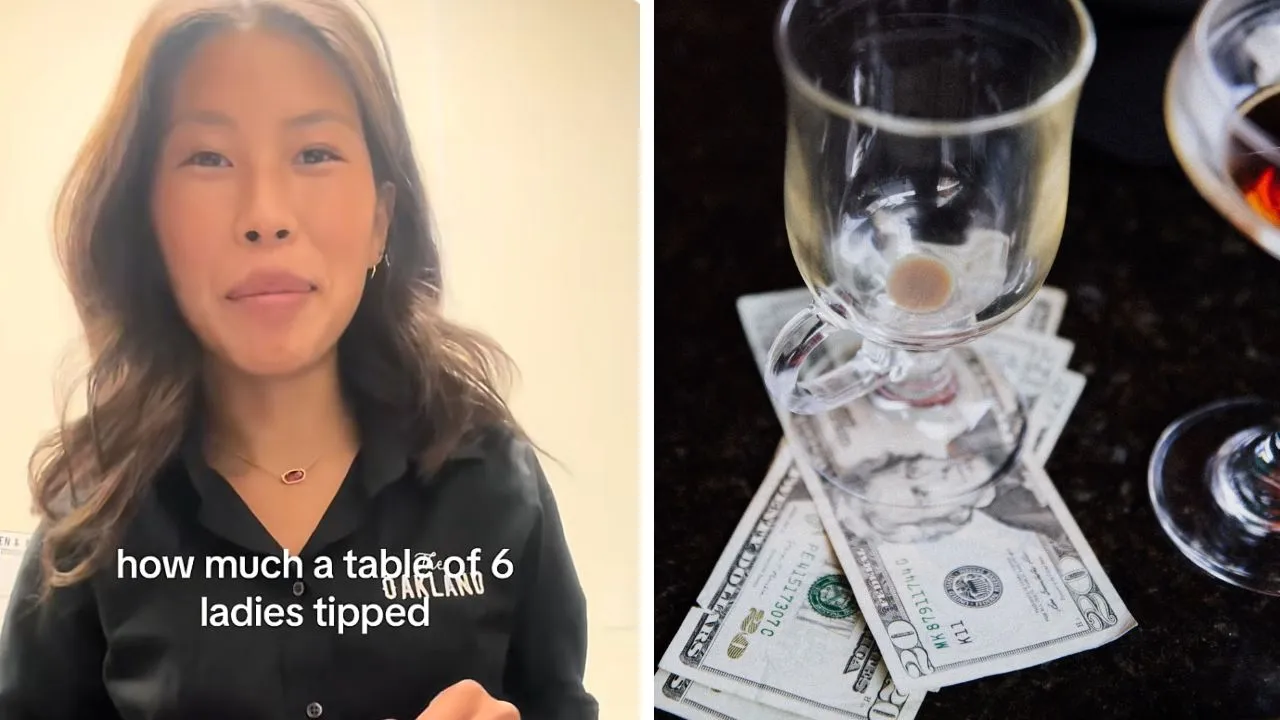
  • ‘Doctors Don’t Get a Tip, Why You Want Tips?’: Server Says She’d Prefer 20% Tip After Table of 6 Women Leaves Little

    ‘Doctors Don’t Get a Tip, Why You Want Tips?’: Server Says She’d Prefer 20% Tip After Table of 6 Women Leaves Little

    Key Highlights

    • TikTok creator @Andjjj.7 posted a video on May 8, 2025, showing itemized tips from a table of six women, revealing multiple $0 tips on bills ranging from $32 to $60.
    • The video amassed 12.7 million views, 802,500 likes, and 21,700 comments, igniting a polarized debate over tipping expectations versus earned gratuity.
    • A separate viral clip from creator @lovee.leahh_ captured a retail customer refusing a tip prompt with “Hell no!” — further fueling the national conversation on tip fatigue.

    Server’s Itemized Receipt Breakdown Sparks Massive Tipping Debate

    TikTok user @Andjjj.7 — identified in the video as a server in restaurant uniform — uploaded a clip on May 8, 2025, that has since garnered 12.7 million views, 802,500 likes, and 21,700 comments. In the video, she flips through six separate checks from a single table of six women, narrating the tip amount left on each. The first bill, $51, carried a $9 tip. The second, $32, received $0. The third, $55, also received $0. The fourth, $60, left a $6 tip. A $21 bill yielded a $7 tip, and a final $23 bill left $4. Summarizing the experience, she stated directly to the camera:

    “I am grateful for any tip but will prefer 20 percent.”

    The on-screen caption accompanying the post read:

    @andjjj.7 their bill was $250. tipping culture may have gotten out of hand but I didn’t know we’re normalizing no tips. ♬ original sound – Andj

    Comment Section Erupts With Divergent Views on Gratuity Norms

    The comment section quickly became a battleground for opposing philosophies on tipping culture. One user challenged the expectation of tips altogether, writing:

    “doctors dont get a tip; why u want tips? Bruh.”

    Another commenter echoed the sentiment that gratuity should reflect service quality, not obligation:

    “You earn tips not expect them.”

    A third contributor offered a detailed personal anecdote illustrating a performance-based approach:

    “There’s only been one time I haven’t tipped a server and it was because he never refilled my drink. there was no one else in the restaurant to serve I gave him the change he brought me back which was like 9cents. I’ll give a $20 tip on a $50 total just because the server was amazing. you leave me to eat without a drink to wash it down your getting Pennies.”

    Yet another voice acknowledged systemic issues while defending the practice of tipping service workers:

    “I get that the tipping culture is getting out of hand but not tipping servers is crazyyyyyy.”

    Parallel Viral Moment: Retail Tip Prompt Rejection Goes Viral

    The discourse gained additional momentum from a separate TikTok posted by creator @lovee.leahh_ (Leah Danzy), which documented a confrontation at a mall retail counter. In the clip, a female customer completes a purchase when the shop employee asks twice, “Do you want to tip?” The customer responds emphatically:

    “Hell no!”

    She continues, “No tip.” After the shopkeeper replies, “Ok! I just asked,” the customer counters, “I know, and I just told you,” and begins walking away. She adds, “Thank you! Have a good day,” then turns toward the camera and appears to address the person filming:

    ‘They are talking about f—- tip,’

    before the video ends. Danzy captioned the post: “I still can’t get over this? Ariel was so embarrassed #fypシ゚viral #fyp #grandmagonewild ♬ original sound – Leah Danzy.”

    Why This Matters

    The dual viral moments underscore a growing cultural flashpoint in the United States: the expansion of tip prompts beyond traditional full-service dining into counter service, retail, and self-checkout environments. While the federal tipped minimum wage remains $2.13 per hour in many states — making tips essential income for servers — consumers increasingly report “tip fatigue” amid inflation and ubiquitous digital prompts. The @Andjjj.7 video highlights the tension between servers who depend on 20% gratuity as a professional standard and diners who view tipping as discretionary or excessive. Meanwhile, the @lovee.leahh_ clip illustrates how tip requests in non-service contexts can provoke hostility. Neither TikTok experience has been independently verified by The Daily Dot, but together they reflect a nationwide debate over who should be tipped, how much, and whether the burden of fair wages should fall on customers or employers.

    Frequently Asked Questions

    What were the exact tip amounts left by the table of six women in the @Andjjj.7 video?

    The server showed six checks: $51 bill with $9 tip; $32 bill with $0 tip; $55 bill with $0 tip; $60 bill with $6 tip; $21 bill with $7 tip; $23 bill with $4 tip. The total bill was approximately $250.

    How did the retail customer in the @lovee.leahh_ video respond when asked to tip?

    The customer said “Hell no!” and “No tip.” After the employee said “Ok! I just asked,” she replied “I know, and I just told you,” wished them a good day, and told the camera, “They are talking about f—- tip.”

    Has The Daily Dot verified the events shown in these TikTok videos?

    No. The Daily Dot explicitly stated it was “unable to independently verify the experiences described by commenters on this video” and noted the details reflect the creators’ stated views and commenters’ individual accounts as shared on TikTok.

  • Man Claims Restaurant Workers Have ‘No Excuse to Be Broke’: ‘Hustle Until You Have $10K in the Bank’

    Man Claims Restaurant Workers Have ‘No Excuse to Be Broke’: ‘Hustle Until You Have $10K in the Bank’

    Key Highlights

    • TikTok creator Ryan Stannard (@ryan_stannard4) argues restaurant workers can achieve financial success through hustle, shift pickup, and saving habits, recommending workers build a $10,000 safety net.
    • The video sparked polarized debate, with commenters citing low base wages, toxic management, slow seasons, and federal minimum wage disparities as structural barriers to Stannard’s advice.
    • The Daily Dot could not independently verify Stannard’s earnings claims; the discourse reflects broader tensions around tipped labor economics and workplace conditions in the U.S. restaurant industry.

    TikTok Creator Sparks Debate With Claim That Restaurant Workers Have ‘No Excuse to Be Broke’

    TikTok content creator Ryan Stannard, who posts under the handle @ryan_stannard4, published a video reflecting on his experience in the restaurant industry and asserting that financial struggle among hospitality workers is largely a matter of personal accountability. The video, which had garnered 12,000 likes and 151 comments at the time of reporting, outlines a series of behavioral changes Stannard believes can transform a restaurant job into a lucrative career.

    Stannard’s Framework: Shift Pickup, Tip Maximization, and a $10,000 Target

    In the video, Stannard lists several strategies he says enabled his own success. He encourages workers to pick up colleagues’ shifts, work harder to increase tip earnings, and adopt a mindset of financial discipline. “Little steps in the right direction are still steps. Set a goal, hit the goal, raise the goal.” he wrote in the video’s caption. Stannard explicitly states he would rather clean restaurant bathrooms than struggle to pay bills, framing undesirable tasks as a necessary trade-off for income stability. He recommends that workers “hustling” until they accumulate $10,000 in their bank accounts, a threshold he says provides a critical financial safety net and peace of mind.

    Commenters Challenge Structural Realities of Tipped Labor

    The response on TikTok was sharply divided. A significant portion of commenters pushed back against Stannard’s characterization, arguing that his experience does not reflect the structural realities faced by many hospitality employees. One commenter wrote, “Except my manager expects me to clean the toilets for my regular wage every shift and will still complain about paying me if it takes time to do,” highlighting unpaid or underpaid side work. Another pointed to geographic and role-based wage disparities: “UNLESS you work at a slow restaurant/its slow season or if you’re a host on federal minimum wage.”

    Others emphasized the difficulty of securing high-volume positions in the current economy. “Most people struggle to even find a position in the industry that ACTUALLY either pay well, or is a spot busy enough to make them money,” one user wrote. The discussion touched on the federal tipped minimum wage of $2.13 per hour, which persists in numerous states, and the volatility of tip income during seasonal downturns or in lower-traffic establishments.

    Support for Savings Discipline Amid Skepticism on Universality

    Not all feedback was critical. Several commenters validated the core savings principle while contesting the universality of Stannard’s operational advice. “Might be the best advice he’s given. Although no ones paying their servers to clean toilets. That’s just wherever he worked. but the saving part is spot on. I saved up 11k in one year and I didn’t have to pick up doubles or give up all my weekends,” one user commented. Another offered a complementary perspective on professional conduct: “It is genuinely so easy to be one of the better servers at any restaurant. Don’t come into work under the influence whatsoever, trade cuts to close, don’t stand around and talk on shift, make your complete focus your tables and the money you make and you will see how easy it is to rise through the ranks.”

    Why This Matters: The Tipped Wage Debate in Context

    The viral exchange encapsulates a long-standing policy and cultural debate in the United States over the subminimum wage for tipped workers. Under the Fair Labor Standards Act, employers may pay tipped employees as little as $2.13 per hour federally, provided tips bring total compensation to the standard minimum wage; if they do not, the employer is legally required to make up the difference. However, enforcement is inconsistent, and wage theft investigations by the Department of Labor frequently cite restaurant violations. The discourse also reflects post-pandemic labor market shifts: while some urban fine-dining servers report record earnings, many casual-dining and rural workers face reduced hours, tip pooling dilution, and rising living costs that outpace gratuity income. Stannard’s $10,000 benchmark aligns with common personal-finance guidance for an emergency fund, yet the feasibility of reaching it varies dramatically by concept, region, and schedule control.

    Frequently Asked Questions

    Who is Ryan Stannard and what platform did he use?
    Ryan Stannard is a TikTok creator who posts under the username @ryan_stannard4. He shared a video discussing his perspective on earning potential and financial habits for restaurant workers.
    What specific financial goal does Stannard recommend for restaurant workers?
    Stannard advises workers to “hustle” until they have $10,000 in their bank accounts, which he says will help them feel more financially secure.
    Why did some TikTok users disagree with Stannard’s advice?
    Commenters cited structural barriers including the federal tipped minimum wage of $2.13 per hour, slow seasons, low-traffic restaurants, unpaid side work such as cleaning bathrooms at base pay, and difficulty securing high-earning positions in the current economy.