Tag: TikTok server

  • Server Reveals Better Way to Greet Tables Than Introducing Yourself: ‘Meet Their Needs First’

    Server Reveals Better Way to Greet Tables Than Introducing Yourself: ‘Meet Their Needs First’

    Key Highlights:

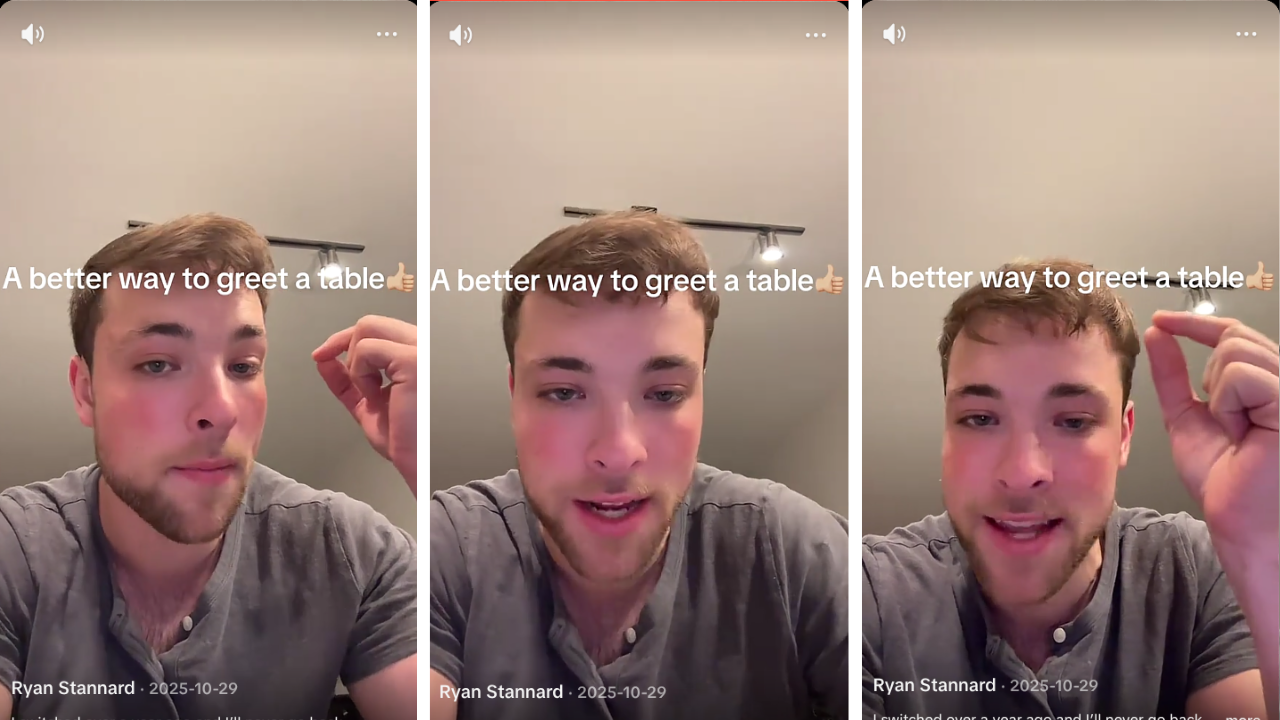
    • TikTok creator Ryan Stannard (@ryan_stannard4) argues servers should greet tables with “Hey guys. How’s our day going?” instead of introducing themselves first, claiming the standard introduction gets servers forgotten.
    • Stannard’s method prioritizes taking food and drink orders before revealing his name, citing a psychological principle that people remember names better after their immediate needs are met.
    • The video sparked debate, with some commenters supporting the approach while others—including self-identified guests—said they prefer efficient service without small talk.

    Server’s Viral TikTok Challenges Standard Restaurant Greeting Script

    TikTok creator Ryan Stannard, known as @ryan_stannard4, has ignited a conversation about restaurant service etiquette with a video that has amassed over 1.6 million views and nearly 1,000 comments. Drawing on his experience as a server, Stannard contends that the industry-standard greeting—introducing oneself by name before taking orders—is a strategic error that causes servers to blend into the background and potentially lose tips.

    The Case Against the Standard Introduction

    Stannard opened his critique by targeting the ubiquitous server script. “Hi, my name is __, I’ll be taking care of you today,” he said, characterizing this approach as a bad start. His reasoning centers on volume and differentiation: with multiple servers working the same floor, all using near-identical language, none of them stand out. He argues that a greeting must sound different from everyone else’s to capture attention and build rapport quickly.

    In place of the scripted introduction, Stannard demonstrated his preferred opener: “Hey guys. How’s our day going?” He explained that opening with a question forces engagement. The table almost invariably responds in kind—“And how’s your day going?”—creating a natural opening for the server to reply with energy. Stannard suggested responses such as “Phenomenal” or “Fantastic” or “Stupendous. Thank you for asking.” At that point, he said, “you now have their attention.”

    Psychological Timing: Orders First, Name Later

    The core of Stannard’s method is a deliberate reordering of the interaction sequence. He does not disclose his name until after taking the guests’ food and drink orders. He frames this as a psychological fact: a person is more likely to remember a server’s name after their immediate needs—deciding what to eat and drink—have been addressed. If the server introduces themselves first, Stannard argues, the guests are mentally preoccupied with the menu and forget the name within minutes.

    He also described his approach as more natural and less “carbon-copied” than the standard introduction. He said it saves time and makes the interaction more efficient while keeping the conversation “short, sweet, and to the point.” Waiting to introduce himself, he believes, makes it more likely that guests will remember his name when it matters—at tip calculation time.

    Why This Matters: Service Psychology Meets Social Media Scrutiny

    The debate Stannard sparked reflects a longstanding tension in hospitality between scripted consistency and authentic connection. Corporate training programs have long mandated the name-first introduction as a brand standard, equating it with professionalism and accountability. Stannard’s challenge, amplified by TikTok’s algorithm, puts that orthodoxy to a public stress test. The reaction split—some servers adopting the tactic, some guests rejecting the forced familiarity—highlights that “good service” is not a monolith. For operators, the takeaway may be less about adopting one viral script and more about empowering staff to read the table and adapt, rather than reciting a line that guests have heard a thousand times. The Daily Dot was unable to independently verify the claims made in the video, which are based solely on @ryan_stannard4’s experience and perspective as a restaurant server, as shared on TikTok.

    Frequently Asked Questions

    What is Ryan Stannard’s suggested alternative to the standard server greeting?
    He recommends opening with “Hey guys. How’s our day going?” and delaying his name introduction until after taking food and drink orders.
    Why does Stannard believe introducing yourself first hurts tips?
    He argues guests are focused on the menu and forget the server’s name within minutes; psychologically, people retain names better after their own needs are met.
    How did commenters react to the video?
    Reactions were mixed. One commenter wrote, “I usually get interrupted with ‘Waters to start please.’” Another guest responded, “Please no! As a guest… I don’t want to answer small talk questions. Just get my order right, bring the sauces I asked for, and refill my drink before it’s completely empty and we’re golden!”
  • Server Calls Out 3 Frustrating Restaurant Habits: ‘That Just Really Gets to Me’

    Server Calls Out 3 Frustrating Restaurant Habits: ‘That Just Really Gets to Me’

    Key Highlights

    • TikTok server @hannah__lynn16 (Hannah) posted a viral video with 156,100 views detailing three workplace pet peeves: late-arriving coworkers refusing to help open, servers ignoring assigned side work, and colleagues leaving dirty tables before shift cuts.
    • Hundreds of fellow servers flooded the comments validating her frustrations, with one 20-year veteran stating, “More times than not, I’m mad at my coworkers and not the customers.”
    • Commenters suggested systemic management failures rather than individual laziness, noting that unclear expectations and poor accountability enable the behavior Hannah described.

    Server’s TikTok Rant Exposes Common Restaurant Workplace Tensions

    TikTok creator @hannah__lynn16, who goes by Hannah, recently struck a nerve across the service industry with a candid video enumerating three specific behaviors that frustrate her as a restaurant server. The clip has amassed 156,100 views and 338 comments, sparking a widespread conversation about team dynamics, accountability, and the often-overlooked friction between front-of-house staff.

    Opening Shift Struggles: The 11 a.m. Server Who Won’t Help

    Hannah’s first grievance centers on the handoff between the sole opener and the midday crew. She arrives at 10:15 a.m. to prepare the restaurant for an 11:00 a.m. opening, but describes a recurring scenario where the scheduled 11:00 a.m. server arrives, watches her scramble to finish opening tasks, and simply waits for their first table without offering assistance. “We have one opener. We come in at 10:15. The restaurant opens at 11. We always have an 11:00am server come in. So when that 11:00am server comes in, and they see me still running around trying to do things to get the restaurant open, and then they just stand there and wait for their first table, and don’t ask me if I need help with anything,” she says in the video. This failure to pitch in during a critical window leaves the opener shouldering the full setup burden alone.

    Side Work Evasion: Assigned Tasks Left Undone

    The second issue involves the restaurant’s running side work chart—a system that assigns specific recurring tasks (like refilling ice bins) to named servers each shift. Hannah describes colleagues who stand idle in the kitchen while their designated duties go neglected, forcing her to intervene. “At my restaurant, we have a lot of servers on at the same time, usually for night shifts. So we have, like, a running side work chart, and it is always filled out with someone’s name next to the running side work that they’re responsible for. So an example being, you know, filling up ice. If I see that person standing there in the kitchen doing nothing, and the ice bin is empty, and I have to ask you to get ice,” she explains. The chart exists precisely to prevent this confusion, yet compliance appears inconsistent.

    Pre-Bussing Neglect: Leaving Plates for the Closing Crew

    Hannah’s third frustration—admittedly one that “doesn’t really affect me personally”—involves servers who deliberately skip pre-bussing tables before being cut (sent home) at night. Because the restaurant trains bussers to clear only glasses and trash, not plates, departing servers leave full dishware behind, creating extra work for those remaining. “This doesn’t really affect me personally, it just really gets on my nerves for some reason. But when my co workers don’t pre-bus their tables, and it happens a lot at night, specifically when they know that they’re about to be cut soon, and then they don’t wanna get sad again, so they’ll just leave their tables filled with dishes. Because our bussers are trained to only grab, like, glasses and trash off of the table and not grab plates. So they’ll do it on purpose, and that just really gets to me for some reason,” she says. The phrase “don’t wanna get sad again” appears to reference the disappointment of being cut early or having sections reduced.

    Industry-Wide Resonance: Commenters Validate the Experience

    The comment section quickly became a forum for shared grievances. A veteran server with over 20 years of experience summed up a sentiment echoed by many: “I’m 37. Been in the restaurant world for over 20 years. More times than not, I’m mad at my coworkers and not the customers.” Another commenter emphasized personal accountability: “I ALWAYS stay on top of my side work, because when its time to go. I’m out of there with all my work is done.” The volume of similar stories suggests Hannah’s experience reflects systemic patterns rather than isolated incidents.

    Management Accountability Questioned

    Several observers redirected the focus toward leadership. One commenter wrote bluntly, “Sounds like you might have a management issue.” This perspective frames the behaviors Hannah describes—ignoring opening duties, skipping assigned side work, abandoning tables—as symptoms of insufficient oversight, unclear consequences, or a culture where teamwork isn’t enforced. When side work charts exist but aren’t upheld, and when bussers’ limited scope creates gaps no one fills, the responsibility arguably extends beyond individual servers to the systems managing them.

    Why This Matters

    The viral response to Hannah’s video underscores a persistent, under-discussed challenge in hospitality: interpersonal friction among staff often outweighs guest-related stress. While customer complaints dominate public narratives about restaurant work, servers consistently report that coworker reliability, fairness in task distribution, and management enforcement of standards dictate daily job satisfaction more than any difficult table. The video also highlights how tipped-wage structures and shift-cut practices can incentivize short-term self-preservation over collective responsibility—when being cut early means lost income, servers may prioritize exiting quickly over leaving their station ready for the next shift. For operators, the takeaway is clear: clear side work protocols, enforced accountability, and busser training that covers full table clearance aren’t just operational details—they’re retention tools.

    Frequently Asked Questions

    What were the three specific pet peeves Hannah described in her TikTok?

    Hannah cited: (1) 11:00 a.m. servers who watch the opener struggle but refuse to help set up; (2) coworkers who ignore their assigned side work tasks (like refilling ice) while standing idle; and (3) servers who deliberately leave dirty plates on tables before being cut, knowing bussers only clear glasses and trash.

    Did other servers agree with Hannah’s complaints?

    Yes. The video garnered 338 comments, many from servers validating her experience. A 20-year veteran stated they’re more often angry at coworkers than customers, and numerous commenters shared similar frustrations with side work neglect and pre-bussing failures.

    Was the restaurant’s management mentioned as a factor?

    Multiple commenters suggested the issues stem from management failures rather than individual laziness, citing lack of accountability, unclear enforcement of side work charts, and busser training gaps that leave plates uncleared.

  • Server Explains Why Sending Food Back Isn’t the Problem—Blaming the Server Is: ‘Don’t Make Me Feel Like It’s My Fault’

    Server Explains Why Sending Food Back Isn’t the Problem—Blaming the Server Is: ‘Don’t Make Me Feel Like It’s My Fault’

    TikTok Server Sparks Debate on Restaurant Etiquette When Sending Food Back

    Hannah, a restaurant server known as @hannah__lynn16 on TikTok, has spent several years navigating the dining room floor. Through that experience, one recurring frustration stands out: how certain customers behave when they want to send a dish back to the kitchen. Unless the server entered the order incorrectly, Hannah emphasizes that the server is rarely at fault when a guest dislikes their meal. In a recent video, she broke down exactly how diners should handle the situation.

    A Real-Life Example of the Right Approach

    Hannah recounted serving a young couple who were regulars at the restaurant. When the man began eating his wings, he immediately noticed something was off. He calmly explained that he had ordered the same wings many times before, but they didn’t taste right that day. He asked to try a different flavor instead. Hannah appreciated his respectful tone and promptly sent the dish back to the kitchen.

    She stressed that a modification doesn’t come out of a server’s paycheck. She is happy to accommodate changes as long as the customer treats her with basic respect. Too often, diners place the blame squarely on the server when numerous factors—kitchen errors, ingredient variations, or simple personal taste—can affect a dish. Servers, she noted, are willing to help guests find something they enjoy.

    Viral Response Highlights Industry-Wide Sentiment

    Hannah’s perspective resonated widely. Her TikTok amassed 24,800 likes and 415 comments, igniting a conversation among fellow service industry professionals. Many agreed that respect is the deciding factor in whether a comp or remake feels like hospitality or a hostile exchange.

    “If customers are kind and respectful, they can have whateverrrrr they want, idc,” one server wrote in the comments.

    “It’s amazing how if you’re cool to your server, how much better your dining experience will be. Don’t be a dick.”

    Other commenters drew a sharp line between legitimate kitchen mistakes and subjective dislike.

    “If something is wrong or messed up = we will absolutely fix it for you. If you just don’t like the dish = that’s on you. Don’t order that again,” one server wrote.

    “I believe every person needs to work in the restaurant industry at least once in their life because those who get it, get it.”

    Servers Share Stories That Tested Their Patience

    The comment section became a repository for similar encounters. One server recalled a confrontation over a steak temperature:

    “I had a lady say, ‘I didn’t say I wanted it medium well I? I said I wanted it well done how stupid are you?’ Come to find out kitchen read the ticket wrong… little kindness and human decency goes a long way,” one server shared.

    Another added a moment of levity amid the frustration:

    “Server/bartender here . Someone asked if I could take the cheese out of the cheese sticks.”

    The Core Issue: Respect, Not the Return

    For Hannah and the hundreds of servers who chimed in, the problem isn’t the act of sending food back—it’s the attitude that accompanies it. Treating the messenger with dignity determines whether the interaction ends with a satisfied guest or a strained shift.

    The Daily Dot was unable to independently verify the events described in @hannah__lynn16’s TikTok video. The details in this article are based on Hannah’s account of her experience as a restaurant server and the reactions shared by viewers in the comments.

  • Diners Ask If Ice Cream Is Vegetarian 20 Minutes Before Closing, Server Says: ‘Did Our Kitchen Closing Sound Like 10 More Minutes?’

    Diners Ask If Ice Cream Is Vegetarian 20 Minutes Before Closing, Server Says: ‘Did Our Kitchen Closing Sound Like 10 More Minutes?’

    TikTok creator @gemma.moro, known as Gemma, has gone viral after sharing a shift story about a challenging table that arrived minutes before closing time. As of publication, the video has amassed 9.9 million views and over 6,150 comments.

    Server Says Group Arrived 20 Minutes Before Close

    Gemma begins the video by explaining she knew the group of women would be “trouble right away.” Two members of the party immediately stated they were vegetarian, which she notes was not an issue. The friction stemmed from their questions and the late arrival — 20 minutes before the restaurant’s closing time.

    “They, in all seriousness, asked me if the spicy chicken ramen was vegetarian,”

    she recounts in the video.

    According to Gemma, the group received their meals and enjoyed them. When she approached to inform them the kitchen was closing and they needed to place any final orders, they requested 10 more minutes because they had not yet looked at the menu.

    “What about our kitchen is closing right now sounds to you like you have 10 more minutes?”

    Gemma asks in the recording.

    Ice Cream Question Leaves Server Stunned

    The table ultimately decided on dessert, but their next inquiry left Gemma “dumbfounded.”

    “They asked me if our ice cream was vegetarian. Not vegan. They asked me if our ice cream had meat in it,”

    she says.

    Gemma adds that the group remained seated for another 30 minutes after the restaurant closed. At the end of the service, she says they left a $5 tip on a $120 bill.

    Commenters React to Viral Server Story

    The video sparked significant discussion in the comments section, with many users focusing on the ice cream inquiry. Several commenters expressed bafflement that the diners were unsure whether ice cream contained meat, while others debated the broader interaction.

    Reactions to Gemma’s delivery were mixed. One user questioned her tone, writing,

    “is the yelling necessary.”

    Another commenter defended Gemma’s right to vent, arguing servers should be allowed to express frustration provided it is not directed at customers.

    “no bcs some of yall acting like it isnt that deep. ITS THAT DEEP. holy hated being a waitress,”

    a separate user added.

    The Daily Dot was unable to independently verify the events described in the video. The details above reflect the account shared on TikTok by @gemma.moro.

    Image Credit: TikTok/@gemma.moro