Tag: Tether

  • Binance Deal Boosts Circle in Stablecoin Race With Tether, Analysts Say

    Binance Deal Boosts Circle in Stablecoin Race With Tether, Analysts Say

    Key Highlights

    • Binance processed $5 million to $10 billion in daily USDC spot trading volume throughout 2026, capturing 10-20 times more activity than most other exchanges which typically stay below $500 million daily.
    • USDC’s market capitalization reaches approximately $74 billion, remaining the second-largest dollar stablecoin behind Tether’s USDT at roughly $140 billion.
    • Circle is expanding beyond issuance with its Circle Payments Network and a $400 million acquisition of Singapore-based Tazapay to build payment infrastructure across emerging markets.

    Binance Drives USDC Trading Dominance in 2026

    Binance has cemented its position as the primary venue for USDC spot trading throughout 2026, consistently capturing the largest share of daily volume according to data from market research firm Kaiko. The exchange processed between $5 million and $10 billion in USDC spot trading activity each day, a figure that dwarfs the competition. Most other trading venues typically remain below $500 million in daily USDC volume, making Binance’s throughput roughly 10 to 20 times greater than its nearest rivals.

    “Throughout 2026, Binance has consistently captured the largest share of $USDC spot trading activity, processing $5 million-$10 billion in daily volume, roughly 10-20 times more than most other trading venues, which typically stay below $0.5 billion,” said Anastasia Melachrinos, head of research at Kaiko.

    Exchange Landscape Remains Static as Binance Expands

    Kaiko’s analysis indicates that other major exchanges have largely maintained their previous USDC trading ranges, suggesting that Binance itself has been the primary driver of the volume increase. The concentration of activity on a single platform underscores the exchange’s outsized influence on stablecoin liquidity and market structure. As Binance continues to push USDC adoption in emerging markets, researchers expect this dominance to intensify further.

    “As Binance accelerates $USDC’s reach in emerging markets, that dominance is likely to grow even further,” Melachrinos said.

    Circle Counters Tether with Infrastructure Play

    The trading dynamics unfold against a backdrop of intensifying competition between the two leading dollar-pegged stablecoins. USDC currently holds a market capitalization of about $74 billion, positioning it as the second-largest U.S. dollar stablecoin behind Tether’s USDT, which commands roughly $140 billion. Industry observers see a clear mutual incentive for both Binance and Circle, USDC’s issuer, to expand the stablecoin’s footprint through the exchange’s global user base and infrastructure.

    “There is a clear incentive on both sides to grow $USDC through Binance’s user base and infrastructure,” said Martins Benkitis, co-founder and CEO of Gravity Team.

    Circle has been actively building beyond its core issuance business. The company’s Circle Payments Network aims to connect financial institutions for stablecoin-based payments, while its recently announced $400 million acquisition of Singapore-based Tazapay would add local banking relationships and payment rails across emerging markets. This strategy arrives as the stablecoin competitive landscape broadens beyond the traditional Circle-Tether duopoly, with major banks and payment companies including Visa, Mastercard, and Stripe pushing further into stablecoin payments and infrastructure.

    Why This Matters

    The concentration of USDC trading volume on Binance highlights the evolving market structure of stablecoin liquidity, where a single centralized exchange acts as the primary price discovery venue for a major digital asset. For Circle, the partnership with Binance and the Tazapay acquisition represent a strategic pivot toward becoming a payments infrastructure company, not just a stablecoin issuer. This shift coincides with increasing regulatory clarity in major jurisdictions and the entry of traditional financial giants like Visa and Stripe, signaling a maturation of the stablecoin sector from speculative trading instruments to settlement layers for global commerce. The coming months will test whether Circle’s infrastructure investments can translate USDC’s trading dominance into broader adoption for cross-border payments and institutional settlement.

    Frequently Asked Questions

    How much USDC trading volume does Binance handle compared to other exchanges?
    Binance processes $5 million to $10 billion in daily USDC spot trading volume, which is roughly 10-20 times more than most other trading venues that typically stay below $500 million daily, according to Kaiko research.
    What is Circle’s strategy beyond stablecoin issuance?
    Circle is building the Circle Payments Network to connect financial institutions for stablecoin payments and has announced a $400 million acquisition of Singapore-based Tazapay to gain local banking relationships and payment rails across emerging markets.
    How does USDC’s market cap compare to USDT?
    USDC has a market capitalization of about $74 billion, making it the second-largest U.S. dollar stablecoin behind Tether’s USDT at roughly $140 billion.
  • Bitget Hacker Moves $83 Million in Stolen XRP That Ripple Cannot Freeze

    Bitget Hacker Moves $83 Million in Stolen XRP That Ripple Cannot Freeze

    Key Highlights

    • Circle and Tether froze approximately $320,000 in USDC and USDT stablecoins linked to the Bitget exchange hack, leveraging built-in blacklist controls.
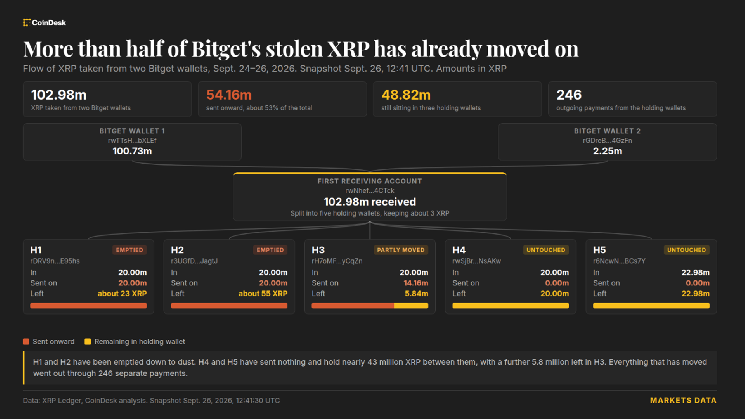
    • The attacker moved roughly 54 million XRP from the original five holding wallets overnight, reducing the balance from 70 million to 49 million tokens in eight hours.
    • XRP traded near $1.54 on Saturday, down 4% in 24 hours but retaining a 9% weekly gain, with the stolen haul valued at approximately $160 million.

    Stablecoin Issuers Intervene to Block Illicit Funds

    Circle and Tether, the operators behind the leading dollar-pegged stablecoins USDC and USDT, have taken swift action to mitigate the fallout from the massive Bitget crypto exchange breach. The companies froze roughly $320,000 worth of stablecoins associated with the hacker’s wallet addresses. Both tokens possess programmable controls that allow the issuers to blacklist specific addresses, effectively preventing the frozen assets from being transferred or redeemed. This intervention highlights the centralized enforcement layer that exists within major fiat-backed stablecoins, a feature often cited by regulators and critics alike.

    Attacker Accelerates XRP Distribution Across Wallets

    On-chain data shows the perpetrator significantly sped up the movement of stolen XRP tokens during the early hours of Saturday. At 04:32 UTC, approximately 70 million XRP remained in the original five accounts identified as the initial holding points for the stolen funds. Roughly eight hours later, that aggregate balance had dropped to 49 million, indicating a rapid dispersal strategy. The transfers reveal the attacker distributing the assets across a growing number of wallets, a common tactic to obfuscate the trail and complicate recovery efforts.

    Transaction Patterns Suggest Automated Scripting

    Analysis of the transfer flows shows certain payments replicating routes previously used by the first wallet. In one notable instance, an attempted transfer of about 521,000 XRP failed because the sending account lacked sufficient funds. Approximately one hour later, a second wallet executed an identical transfer of 521,000 XRP to the same intended recipient. This pattern suggests the use of automated scripts or predetermined routing logic rather than purely manual intervention, with the attacker managing multiple wallets in parallel to drain the holdings.

    Market Absorbs Supply Overhang Amid Price Resilience

    Despite the significant movement of stolen funds, XRP markets displayed relative stability on Saturday. The token traded around $1.54, representing a 4% decline over the preceding 24 hours but maintaining a weekly gain of approximately 9%, according to data from CoinGecko. At the prevailing price, the original XRP haul—estimated at roughly 100 million tokens based on the 54 million moved and 49 million remaining—was worth approximately $160 million. That figure equates to roughly 4% of XRP’s reported $4.4 billion in daily trading volume, suggesting the market possesses sufficient liquidity to absorb potential sell pressure, though actual price impact will depend on the depth of buy orders at the time of execution.

    Why This Matters

    The Bitget hack and subsequent fund movements underscore several critical dynamics in the crypto ecosystem. First, the ability of Circle and Tether to freeze assets demonstrates the “off-switch” capability inherent in centralized stablecoins, providing a rapid response mechanism for illicit flows that does not exist for native blockchain assets like XRP. Second, the speed and sophistication of the XRP laundering—evidenced by automated multi-wallet distribution and retry logic—illustrates the operational maturity of modern cybercriminal groups targeting exchanges. Finally, the market’s muted price reaction reflects XRP’s deep liquidity and the market’s growing desensitization to large-scale exchange breaches, though the ultimate impact hinges on whether the attacker opts for rapid liquidation via decentralized exchanges or slower over-the-counter channels.

    Frequently Asked Questions

    How much XRP was stolen in the Bitget hack?

    Based on on-chain analysis, the original haul held in five primary wallets totaled approximately 119 million XRP (70 million remaining at 04:32 UTC plus 49 million moved subsequently). At Saturday’s price of $1.54, the total value was roughly $160 million.

    Can Circle and Tether freeze XRP tokens?

    No. Circle and Tether can only freeze assets issued on their respective contracts—USDC and USDT. XRP is a native asset on the XRP Ledger and does not have a centralized freeze function. The $320,000 freeze applied only to stablecoin balances held in the hacker’s wallets.

    Will the stolen XRP dump crash the price?

    The stolen amount represents about 4% of XRP’s reported daily trading volume ($4.4 billion). While a sudden market sale could cause short-term slippage, the depth of the order books across major exchanges suggests the market could absorb the supply without a catastrophic price collapse, especially if distributed over time or via OTC desks.

  • Tether Confirms Minimal EQIBank Exposure After $89M US Asset Seizure

    Tether Confirms Minimal EQIBank Exposure After $89M US Asset Seizure

    Key Highlights

    • Tether confirms exposure to EQIBank is less than 0.034% of total group assets, approximately $64 million based on its June 2024 attestation of $187.75 billion.
    • U.S. authorities seized funds from Capstone, a payment processor used by EQIBank to move customer money through Wells Fargo and JPMorgan Chase accounts, alleging misrepresentation of business activities.
    • Tether states it had no knowledge of the alleged conduct by Capstone cited in the Department of Justice civil forfeiture case.

    Tether Limits EQIBank Exposure Amid U.S. Asset Seizure

    Stablecoin issuer Tether has moved to reassure markets regarding its exposure to EQIBank, a Dominica-licensed lender caught in a U.S. law enforcement action. According to a company spokesperson, assets held at EQIBank represent less than 0.034% of Tether’s total group assets. Based on the firm’s June 2024 attestation reporting $187.75 billion in consolidated assets, that percentage translates to roughly $64 million at risk. The disclosure comes after reports by the Financial Times and The Information detailed a U.S. asset seizure that could potentially force EQIBank into liquidation.

    Capstone Payment Processor at Center of Civil Forfeiture Case

    The regulatory action centers on Capstone, a U.S.-based payment processor that EQIBank utilized to hold funds and facilitate customer money movements through correspondent banking accounts at Wells Fargo and JPMorgan Chase. Court filings indicate that U.S. prosecutors seized funds from those Capstone accounts and filed a civil forfeiture complaint. The Department of Justice alleges that Capstone misrepresented the nature of its business to the banking institutions involved, a characterization that triggered the enforcement action and the subsequent freezing of assets flowing through the processor’s channels.

    Tether Denies Prior Knowledge of Alleged Misconduct

    In a statement provided to CoinDesk, a Tether spokesperson explicitly distanced the company from the allegations facing Capstone. “Tether had no knowledge of the conduct by Capstone alleged by the Department of Justice,” the spokesperson said via email. The company further clarified that its assets held at EQIBank were limited to “less than 0.034% of the assets of the group,” though it declined to specify the exact dollar figure. The response underscores Tether’s effort to contain reputational fallout as the stablecoin giant navigates heightened scrutiny over its reserve composition and banking partnerships.

    Why This Matters

    The episode highlights the persistent counterparty and banking-layer risks inherent in the stablecoin ecosystem, even for the largest issuer by market capitalization. Tether’s reserve attestations have historically shown a mix of cash, Treasury bills, and other assets held across a network of global financial institutions. The EQIBank situation illustrates how enforcement actions against second- or third-tier payment processors—entities often invisible to end users—can create sudden liquidity constraints for custodial partners. For the broader digital asset industry, the case reinforces regulatory focus on the “on-ramp/off-ramp” infrastructure connecting crypto markets to the traditional financial system, particularly regarding anti-money laundering compliance and know-your-customer obligations at the payment processor level. Market participants will likely monitor whether other stablecoin issuers disclose similar exposures and how EQIBank’s potential liquidation proceedings unfold in the coming weeks.

    Frequently Asked Questions

    How much money does Tether have at risk in EQIBank?
    Based on Tether’s June 2024 group asset figure of $187.75 billion and the disclosed exposure limit of less than 0.034%, the at-risk amount is approximately $64 million. Tether has not provided an exact dollar amount.
    What triggered the U.S. seizure of funds connected to EQIBank?
    The U.S. Department of Justice seized funds from accounts held by Capstone, a payment processor used by EQIBank, at Wells Fargo and JPMorgan Chase. Prosecutors filed a civil forfeiture case alleging Capstone misrepresented its business activities to those banks.
    Did Tether know about Capstone’s alleged misconduct?
    No. A Tether spokesperson stated explicitly: “Tether had no knowledge of the conduct by Capstone alleged by the Department of Justice.”
  • Paolo Ardoino: 650 Million People Hold Decentralized US Debt, Yet Tether Controls T-Bills

    Paolo Ardoino: 650 Million People Hold Decentralized US Debt, Yet Tether Controls T-Bills

    Tether CEO’s ‘Decentralized Ownership’ Claim Faces Scrutiny Over Legal and Economic Reality

    Paolo Ardoino offered a striking answer to a familiar U.S. debt problem: replace concentrated foreign buyers with hundreds of millions of stablecoin users. In an Aug. 31 episode of The Wolf of All Streets, the Tether CEO said the company had created the decentralized ownership of the US debt through 650 million people who were basically holding some US Treasuries. His point centered on concentration risk: unlike a foreign government, hundreds of millions of users are unlikely to decide together to sell U.S. debt in a single morning.

    The macroeconomic intuition carries weight. Demand for USDT gives Tether funds that it can place in a Treasury-heavy reserve portfolio. However, calling token users owners of government debt collapses several distinct relationships into one. Tether’s own documents state that users own USDT, eligible verified customers have a personal contractual right to redeem, and Tether International owns and manages the reserve assets.

    The 650 Million Figure: Attribution and Methodology

    The 650 million figure is attributable to Tether, not an independently verified count of Treasury investors. In an Aug. 13 audit announcement, the company said more than 650 million users across emerging markets rely on Tether daily, without publishing a methodology for that figure.

    Tether’s earlier work shows why users needs qualification. Its 2024 methodology note treated on-chain addresses or accounts as a proxy and upper-bound estimate, acknowledging that one person can control multiple wallets. It then added estimates for people holding USDT through centralized services. Tether’s fourth-quarter 2025 report used that broad approach to estimate 534.5 million users at year-end.

    Those measures are useful for estimating reach, but they do not establish 650 million unique people, 650 million current holders, or 650 million customers able to redeem directly with Tether. They establish the scale Tether assigns to its network.

    What USDT Holders Actually Own

    Tether’s current terms call the right to purchase or redeem tokens a personal contractual right. They also say issuance and redemption are administered by Tether and require the customer to be verified.

    The company’s Relevant Information Document makes the allocation of control clearer. After a verified customer sends fiat and receives tokens, Tether says it holds or invests the funds in a basket of reserves. The composition of that basket can change at Tether’s sole discretion, and Tether says it primarily holds the assets through banks and licensed financial institutions.

    Its latest Financial Figures and Reserves Report uses similarly direct accounting language. It describes the reserves as assets owned by Tether International and the issued tokens as refund liabilities recorded at their contractual redemption value.

    That arrangement is not the same as owning a Treasury bill through a brokerage account or holding a beneficial interest in a fund that passes through portfolio economics. USDT holders own transferable tokens. The reserve assets sit on the issuer’s side of the structure.

    The documents do not eliminate holder rights; they define them more narrowly. The Relevant Information Document says an eligible redemption is paid at the token’s face value in fiat, less fees. It also says holders are not entitled to increases in reserve value above face value. The income and gains from the portfolio therefore do not flow through to USDT holders merely because Treasuries back the token.

    Redemption Terms and Limitations

    Direct access to that redemption promise is narrower than USDT’s global circulation. Tether’s fee schedule sets a $100,000 minimum for direct acquisition or redemption. A redemption costs the greater of $1,000 or 0.1%. Applicants must complete verification, and Tether retains sole discretion to approve or reject requests to become verified customers.

    The legal terms allow Tether to delay or suspend services, including redemptions, in circumstances involving suspected prohibited use, legal requirements, government directions, investigations, unauthorized access or risks that Tether considers unacceptable. Fees can change.

    Secondary Market vs. Direct Redemption

    Holders can still sell USDT through secondary markets, subject to the rules and liquidity of the exchanges, dealers, or other platforms they use. That is a market exit, however, rather than a direct exercise of the issuer contract. It may transfer the token to another buyer instead of shrinking Tether’s outstanding liabilities.

    The distinction also limits what can safely be said about creditor priority. Tether’s public materials establish an issuer liability and an eligible customer’s redemption right. They do not establish one universal insolvency ranking for every secondary-market holder across every jurisdiction.

    The Treasury Exposure Is Real and Large

    None of this makes the reserve portfolio economically irrelevant to users. USDT’s reliability depends in part on Tether’s ability to meet its obligations, and the composition and liquidity of the reserves are central to that ability.

    As of June 30, Tether International reported $187.751 billion in reserve assets against $183.642 billion in liabilities. The portfolio included $114.961 billion of direct U.S. Treasury bills. It also reported $18.626 billion of overnight reverse-repurchase exposure, collateralized by about $18.596 billion of U.S. Treasuries. Those are distinct positions. Directly owned bills and Treasury collateral supporting a repo should not be combined and described as if they create the same legal relationship.

    Decentralized Distribution, Centralized Control

    The scale helps explain Ardoino’s framing. Broad demand for USDT can create broad economic dependence on a company whose reserve allocation generates substantial demand for short-term government debt. Earlier analysis has examined Tether’s Treasury scale and the risks embedded in U.S. debt markets, and how stablecoin issuers can become marginal buyers as other holders retreat.

    The ownership question is different. Tether can spread dollar access across wallets and platforms, and rising issuance can increase the pool it allocates partly to Treasuries. It does not follow that each user owns a pro rata slice of those bills, can direct their sale, or receives their yield.

    A more precise description is that USDT decentralizes the distribution of an issuer-mediated dollar claim. The associated funding demand is geographically dispersed. Legal title to the reserves, portfolio control, and the economics above token face value remain centralized at Tether. Ardoino’s macro intuition is directionally meaningful, but the legal and economic plumbing remains issuer-mediated.

  • Tether and Fasanara Launch $400 Million Stablecoin Private Credit Fund

    Tether and Fasanara Launch $400 Million Stablecoin Private Credit Fund

    Tether and Fasanara Capital Launch $400M StableFund to Bridge SME Financing Gap With USDT Infrastructure

    Tether and Fasanara Capital announced the launch of StableFund on September 9, unveiling an evergreen private credit vehicle backed by $400 million in co-investment from the two sponsors. The fund combines Tether’s USDT settlement infrastructure with Fasanara’s global fintech lending network to finance short-duration, asset-backed credit strategies targeting small and medium-sized enterprises and consumer lending.

    Fund Structure and Capital Targets

    The joint announcement states that StableFund will target up to $3 billion in third-party institutional capital. The sponsors clarified that this figure represents a fundraising objective rather than committed outside capital, while the $400 million reflects sponsor co-investment disclosed at launch.

    StableFund’s evergreen structure is designed to scale as third-party institutions commit capital. However, the release does not disclose target returns, fee terms, redemption conditions, or a timetable for reaching the outside-capital goal.

    Fasanara Leads Investment Management Across 60+ Countries

    London-based Fasanara Capital will act as investment manager, deploying capital through its fintech lending network. The strategy focuses on originating short-duration, asset-backed instruments via fintech platforms operating in more than 60 countries, targeting SME loans, consumer credit, trade receivables, and supply-chain finance.

    Fasanara describes itself as managing more than $6 billion across those verticals. These are company-provided figures included in the sponsors’ release.

    Tether Embeds USDT Into Lending Flows as Co-Sponsor and Originator

    Tether will serve as co-sponsor, originator, and adviser. Its role includes sourcing USDT-linked financing opportunities and providing stablecoin infrastructure for settlement, on- and off-ramp connectivity, and treasury-rail integration. The structure is intended to embed USDT directly into lending operations rather than limit the token to trading or payments use cases.

    Part of a Broader Shift Toward Tokenized Credit

    The launch aligns with a growing trend of digital assets entering credit products. BlockchainReporter recently reported that Arch Lending began accepting tokenized gold as loan collateral, another example of tokenized assets expanding into lending markets. StableFund distinguishes itself as a sponsored institutional vehicle focused on originating real-economy loans rather than solely facilitating crypto-native borrowing.

    No Borrowers or Deployed Capital Disclosed at Launch

    The sponsors cited demand for alternative financing and a persistent funding gap among smaller businesses as market drivers for the strategy, though those estimates remain projections included in their release.

    Critically, the announcement does not identify initial borrowers, disclose completed loans, or specify which jurisdictions will receive the first capital allocations. As a result, the September 9 development constitutes a fund launch and capital commitment — not evidence that the targeted $3 billion has been raised or that lending outcomes have been realized.

  • Tether Freezes $39M USDT in Tron Wallets Linked to Xinbi, MistTrack Says

    Tether Freezes $39M USDT in Tron Wallets Linked to Xinbi, MistTrack Says

    Tether has frozen approximately $39.27 million in USDT across 10 TRON blockchain addresses linked to Xinbi Guarantee, a Telegram-based escrow platform, according to blockchain analytics firm MistTrack. The freeze, executed on September 8, 2026, involved 39,273,713 USDT and marks the second major action by the stablecoin issuer targeting Telegram-based guarantee services in recent months.

    MistTrack Reports Freeze Details

    MistTrack disclosed the enforcement action in a post on X (formerly Twitter), identifying the affected wallets and connecting them to Xinbi Guarantee, known in Chinese as 新币担保. The firm noted the move follows a previous freeze of funds associated with Huione Guarantee (汇旺担保), another Telegram-based escrow service.

    Hours ago, Tether froze approximately 39,273,713 $USDT across 10 TRON addresses linked to Xinbi Guarantee新币担保.Following its freeze of 汇旺担保Huione-linked funds, this appears to mark another crackdown on illicit Telegram-based escrow platforms. https://t.co/07xAOUaQPm pic.twitter.com/927jgLK4jM
    — MistTrack🕵️ (@MistTrack_io) September 8, 2026

    Xinbi Guarantee Under Regulatory Scrutiny

    Xinbi Guarantee emerged around 2022 as a Telegram-based marketplace reportedly connecting merchants with services linked to scams and money laundering. Blockchain investigators estimate that Xinbi-linked wallets have processed billions of dollars in USDT, with some estimates placing the total volume near $24 billion, the majority occurring on the TRON network.

    In March 2026, the United Kingdom sanctioned Xinbi Guarantee over alleged links to scam compounds and human rights abuses. Despite the sanctions, reports indicate the platform continued operating through alternative channels.

    Tether’s Centralized Control Over USDT

    The freeze underscores Tether’s ability to blacklist specific blockchain addresses through its USDT smart contracts, effectively preventing those wallets from transferring the tokens. This mechanism highlights the centralized control the issuer maintains over the stablecoin’s supply.

    As of publication, Tether had not publicly explained the rationale for the freeze or confirmed whether the action was taken in response to a law-enforcement request. The move may prompt operators to attempt shifting funds to alternative wallets or blockchain networks to circumvent restrictions.

    Broader Crackdown on Illicit Escrow Services

    The action against Xinbi Guarantee follows a pattern of increased scrutiny on Telegram-based escrow platforms accused of facilitating illicit cryptocurrency activity. The earlier freeze targeting Huione Guarantee-linked funds suggests a coordinated effort to disrupt financial infrastructure used by cybercrime networks operating in Southeast Asia and beyond.