
Tag: Tether USDT

  • BoE Official: Stablecoin Growth Could Strengthen Dollar Dominance, Boost US Treasury Demand

    BoE Official: Stablecoin Growth Could Strengthen Dollar Dominance, Boost US Treasury Demand

    Bank of England Financial Policy Committee member Carolyn Wilkins warned Tuesday that the rapid growth of dollar-denominated stablecoins could further entrench the U.S. dollar’s global dominance while creating new channels of financial volatility.

    Speaking at Queen’s University Belfast, Wilkins outlined how stablecoins pegged to the greenback simplify cross-border settlement, expand international access to dollar-linked assets, and drive demand for U.S. Treasurys held as reserves by issuers.

    Stablecoin Issuers Now Major Buyers of U.S. Debt

    The scale of this dynamic is already significant. According to data cited by Wilkins, the two largest stablecoin operators—Tether’s USDT and Circle’s USDC—held nearly $150 billion in Treasury bills at the end of 2025 and purchased roughly $33 billion during the year.

    “This gives the currency what Wilkins described as a “considerable first-mover advantage.””

    Redemption Risk Could Amplify Market Stress

    However, Wilkins emphasized that the relationship cuts both ways. At sufficient scale, mass stablecoin redemptions could force issuers to liquidate Treasury holdings rapidly, potentially amplifying volatility in an already stressed market.

    UK Pushes Pound Stablecoins as Dollar Dominates

    Wilkins’ comments come as total stablecoin circulation exceeds $300 billion, with the U.S. dollar accounting for 98% of that value. By contrast, British pound-denominated stablecoins have struggled to gain traction.

    UK regulators have moved to close the gap this year. The Financial Conduct Authority launched a dedicated regulatory sandbox to test prospective stablecoin issuers and finalized issuance rules in June. The Bank of England has also conducted experiments, including a recent test of whether stablecoins and a simulated digital pound could operate together for cross-border trade payments.

    The shift reflects a more accommodating stance from the Bank of England after industry criticism that its earlier proposals risked stifling innovation.
  • Tether CEO Slams BIS Push for Tokenized Bank Deposits

    Tether CEO Slams BIS Push for Tokenized Bank Deposits

    The debate over how to represent fiat money onchain is intensifying, with Tether CEO Paolo Ardoino challenging the Bank for International Settlements’ (BIS) preference for tokenized bank deposits over stablecoins.

    Ardoino criticized recent comments from Pablo Hernandez de Cos, general manager of the BIS, who argued that stablecoins are not an effective substitute for fiat money. De Cos cited concerns including limited redeemability, supply constraints, interoperability challenges and the potential facilitation of crime.

    Instead, De Cos described tokenized bank deposits as a “more direct path to harness ​tokenisation while preserving the monetary system’s foundations.”

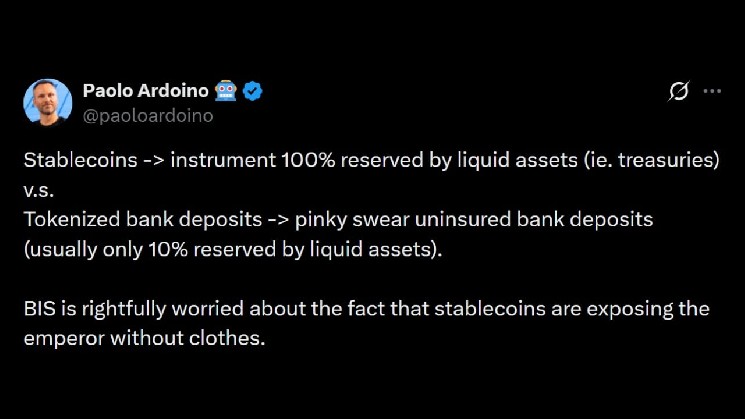
    Ardoino argued that the BIS’s concerns overlook what he views as a key distinction between the two forms of digital money. He said stablecoins are generally backed almost entirely by U.S. Treasury securities, while tokenized bank deposits are typically backed by only around 10% in liquid assets.

    “BIS is rightfully worried about the fact that stablecoins are exposing the emperor without clothes. Why someone should choose to put his savings into a fractional reserve product while stablecoins are fully reserved?” Ardoino declared.

    Stablecoin adoption expands in emerging markets

    Stablecoins have continued to gain popularity and adoption. Tether’s $USDT, with a market capitalization of more than $183 billion at the time of writing, has become an important financial product in emerging markets.

    Ardoino said there were economies “heavily relying on $USDT, for both internal and foreign commerce.”

    Stablecoins become a U.S. policy flashpoint

    The debate over stablecoins has also reached the highest levels of U.S. politics, becoming a contentious issue in discussions over the Digital Asset Market Clarity Act, known as the CLARITY ACT.

    Banks have raised concerns about deposit flight if cryptocurrency exchanges are permitted to offer rewards on stablecoin holdings. Ardoino suggested that broader awareness of stablecoin reserves could accelerate a shift away from traditional bank deposits.

    “What happens to financial system if people start realizing that stablecoins are safer and move their savings into the better asset class? We’re in the Find Out phase.” Ardoino concluded, hinting at large-scale deposits-for-stablecoins substitution.

  • Russia’s Largest Bank Issues Statement on Bitcoin and Ethereum

    Russia’s Largest Bank Issues Statement on Bitcoin and Ethereum

    Russia’s largest bank, Sberbank, is preparing to expand its cryptocurrency-backed loan products by accepting Ethereum (ETH) and Tether (USDT) as collateral alongside Bitcoin (BTC).

    According to Russian news agency TASS, Sberbank Deputy Chairman of the Board Anatoly Popov said the bank would continue developing lending products secured by digital assets. Popov noted that Sberbank already has practical experience working with cryptocurrencies.

    Sberbank Plans to Expand Crypto-Backed Loans

    Popov said Sberbank would adapt its existing products once Russia’s new cryptocurrency regulatory framework fully takes effect. The bank would then gradually expand its digital asset-related services in line with the new rules.

    Under Sberbank’s plans, Bitcoin would not be the only cryptocurrency eligible for use as collateral. Ethereum and the dollar-backed stablecoin Tether could also be added to the bank’s cryptocurrency-backed lending products in the future.

    However, implementation will depend on regulatory approval. Popov said the Russian Central Bank would specifically need to permit ETH and USDT to circulate publicly before they could be accepted as loan collateral.

    This is not investment advice.