Tag: SWIFT

  • Ripple-Finastra Deal Connects 11,000 SWIFT Members

    Ripple-Finastra Deal Connects 11,000 SWIFT Members

    Ripple-Finastra Partnership Opens Potential Pathway Into Global Banking Infrastructure

    Ripple’s strategic partnership with Finastra is attracting renewed attention from market analysts, who suggest the deal could provide the blockchain payments firm with a scalable entry point into a vast network of financial institutions. The collaboration gains additional significance following Finastra’s recent designation as a Nacha Preferred Partner for ACH experience, ISO 20022 migration, and risk and fraud prevention.

    Finastra’s Payment Modernization Suite

    Finastra’s modern ACH solutions — including Global PAYplus and Payments To Go — are engineered to help financial institutions manage rising payment volumes, support Same Day ACH, and modernize legacy payment processes. These capabilities align with the industry-wide push toward ISO 20022 adoption and real-time payment infrastructure upgrades.

    Distribution Potential Across 11,000 SWIFT-Connected Institutions

    For Ripple, the strategic value lies in distribution. Finastra supplies banking software and payments infrastructure to financial institutions worldwide. This established footprint could allow Ripple to integrate its technology into platforms already embedded in bank operations, potentially reducing the need to negotiate individual relationships with each institution.

    Industry observers frequently reference the 11,000 SWIFT member figure when discussing this partnership’s reach. However, the Ripple-Finastra agreement does not grant Ripple direct access to all 11,000 SWIFT members. Such a claim would exceed what the partnership formally establishes. Instead, Finastra’s global network provides Ripple with a potential route into a much larger ecosystem of institutions connected to the international payments infrastructure — a distinction that makes the opportunity more credible rather than less.

    Finastra as a Strategic Distribution Channel

    Finastra’s payments infrastructure emphasizes high-volume processing, automation, ISO 20022 readiness, and legacy system modernization — all priorities for banks upgrading their payment stacks. Many institutions require solutions that integrate with existing infrastructure rather than replace it entirely, creating a natural opening for Ripple’s interoperability-focused technology.

    Ripple has steadily expanded beyond its original XRP-centric identity, building a broader institutional presence across payments, digital assets, and financial infrastructure. Partnerships with established banking technology providers accelerate this strategy by placing Ripple’s capabilities closer to the systems financial institutions already rely on daily.

    Institutional Reach: The Core Value Proposition

    The Finastra relationship addresses one of the most persistent challenges in enterprise blockchain adoption: distribution. If Ripple can embed its technology into platforms serving thousands of financial institutions, it may avoid the slow, resource-intensive process of pursuing each bank individually. A single strategic infrastructure partnership could unlock opportunities across multiple downstream institutions simultaneously.

    Finastra’s new Nacha Preferred Partner status further strengthens its position within the evolving payments landscape, particularly around ACH modernization, ISO 20022 compliance, and fraud prevention frameworks.

    Outlook: Closer to Traditional Finance Plumbing

    The bullish case centers on Ripple moving closer to the core plumbing of traditional finance. The 11,000-SWIFT-member narrative should be interpreted as potential reach rather than guaranteed access. As Ripple continues embedding its technology into established financial infrastructure, its institutional footprint could extend well beyond the banks it signs directly — making the Ripple-Finastra connection a partnership warranting close observation.

  • Morgan Stanley calls Ripple “key player” for replacing the interbank system Swift

    Morgan Stanley calls Ripple “key player” for replacing the interbank system Swift


    • Morgan Stanley sees Ripple’s technology the modern alternative to the aging old systems from Swift.
    • The DLT of Ripple reduces fraud and delays and is equally well received by banks and right -wing experts.

    Large financial institutions are increasingly signaling their support for blockchain-based solutions to overhaul the global payment systems. Morgan Stanley has again spoken with a remarkable recommendation in which Ripple is referred to as a convincing alternative to Swift.

    This recognition underlines the growing interest in the distributed Ledger technology (DLT) as a solution for the long existing inefficiencies in cross-border transactions. In view of the increasing pressure on the financial markets, Ripple’s model is very important for both industry leaders and in academic circles.

    Morgan Stanley emphasizes Ripple’s disruptive potential

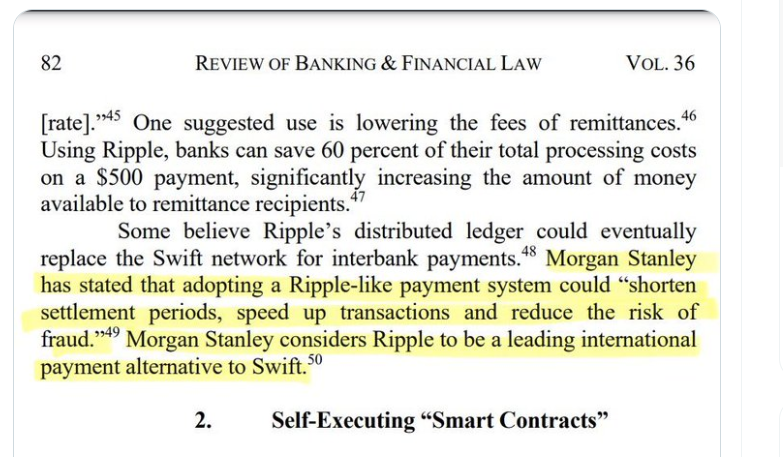
    Morgan Stanley’s analysis, originally in her report Blockchain in Banking: Disruptive Threat or Tool? Published in Volume 36 of the Boston University Review of Banking & Financial Law.

    According to the bank’s findings, the introduction of a “ripple-like payment system” could shorten the settlement times, accelerate transactions and reduce fraud risks-important pain points in today’s global payment infrastructure.

    In the report, in particular, it is emphasized that the Ripple DLT model makes correspondence banking superfluous, a procedure on which Swift is still relating to. This traditional method often leads to delays when processing 3-5 days.

    In contrast, the infrastructure of Ripple offers almost immediate handling while at the same time drastic reduction in operating costs. Morgan Stanley found that Ripple’s approach has the potential to change the way in which banks handle international payments, since it enables real -time processing without intermediate institutions.

    Industry -wide recognition for Ripple is growing

    The growing institutional recognition of Ripple’s payment model is not limited to Morgan Stanley. JPMorgan has already identified Ripple and XRP as important players in solving inefficiencies in cross -border payments.

    According to her analysis, $ 120 billion is lost in the current system due to delays, currency reductions and liquidity traps. At $ 23.5 trillion, which are moved every year by outdated networks, such inefficiencies are no longer portable.

    In the JPMorgan report, Ripple, Swift and the CLS Group were compared. It was emphasized that Swift is still heavily dependent on an outdated infrastructure and that the CLS Group only supports 18 currencies worldwide.

    In the meantime, the real-time system of Ripple, which is based on the XRP Ledger, was recognized for its efficiency despite the concerns about the volatility of cryptocurrencies. With the earlier conclusion of Morgan Stanley, these observations coincide that Ripple is one of the most serious candidates for modernizing international banking.

    In the legal examination of the Boston University, Ripple was cited as part of a wider blockchain revolution in addition to the Smart Contract capabilities of Ethereum. The paper underlines the potential of DLT to improve compliance with regulations, transparency and regulatory supervision in the entire financial sector. Such academic recognition further strengthens Ripple’s position as a credible alternative to conventional systems.

    While Ripple continues to develop his own Swift alternative, institutional support from leading banks such as Morgan Stanley and JPMorgan gives additional weight to its vision. These developments indicate that the perspective of the traditional financial actors changes to blockchain – not as a threat, but as an instrument for eliminating the inefficiency of the global banking system. With the increasing distribution of blockchain, the dynamics behind the cross -border payment solutions from Ripple increase in both companies and science.