Tag: Strait of Hormuz

  • Iran Ran Strait of Hormuz ‘Toll Booth’ Through Bitcoin Exchange, US Says

    Iran Ran Strait of Hormuz ‘Toll Booth’ Through Bitcoin Exchange, US Says

    Key Highlights

    • The U.S. Treasury’s Office of Foreign Assets Control (OFAC) has designated Iranian crypto exchange BitBank, freezing its U.S.-based assets and imposing secondary sanctions that threaten foreign firms processing its transactions.
    • Iran’s Economy Ministry developed HormuzSafe, a platform offering insurance, traffic control, and emergency response to vessels in the Strait of Hormuz for payment, which shipping lawyers argue violates transit rights under the UN Law of the Sea.
    • Wednesday’s designation did not include specific cryptocurrency wallet addresses, unlike previous OFAC actions such as the January Zedcex designation that listed seven Tron wallets for compliance screening.

    OFAC Targets Iranian Exchange BitBank With Secondary Sanctions

    The U.S. Department of the Treasury’s Office of Foreign Assets Control (OFAC) moved Wednesday to designate Iranian cryptocurrency exchange BitBank, invoking secondary sanctions that significantly expand the enforcement reach beyond U.S. borders. The designation freezes any property or interests in property belonging to BitBank that fall within U.S. jurisdiction and prohibits U.S. persons from engaging in transactions with the entity. However, the more consequential measure is the attachment of secondary sanctions, which expose non-U.S. financial institutions and cryptocurrency exchanges to the risk of losing access to the American financial system if they facilitate transactions for BitBank.

    Secondary Sanctions Extend Enforcement to Foreign Intermediaries

    Under the secondary sanctions framework, a cryptocurrency exchange operating in Dubai or a bank in Istanbul that processes funds flows connected to BitBank can be severed from the U.S. financial system, even if no American party is directly involved in the transaction. This extraterritorial leverage is designed to compel global compliance by making the cost of servicing designated Iranian entities the potential loss of dollar-denominated clearing and correspondent banking relationships. For offshore platforms that serve Iranian users, the primary threat is not prosecution in a U.S. court but the severance of critical dollar access.

    Iran’s HormuzSafe Platform Draws Legal Scrutiny

    Separately, local reports indicate that Iran’s Economy Ministry has developed a platform called HormuzSafe, which advertises insurance coverage, traffic control coordination, and emergency response services to commercial vessels transiting the Strait of Hormuz in exchange for payment. Shipping lawyers consulted on the arrangement have characterized it as a violation of transit passage rights guaranteed under the United Nations Convention on the Law of the Sea (UNCLOS). The convention stipulates that ships enjoy the right of unimpeded transit passage through straits used for international navigation, and coastal states may not hamper or condition that passage on the payment of fees for services not rendered.

    Absence of Wallet Addresses Complicates Compliance Operations

    Notably, Wednesday’s OFAC designation against BitBank did not publish any associated cryptocurrency wallet addresses. This omission contrasts with previous enforcement actions, such as the January designation of the exchange Zedcex, where OFAC listed seven specific Tron blockchain addresses. Compliance teams at exchanges and financial institutions typically ingest these on-chain identifiers into transaction screening software to automatically flag and block interactions with sanctioned entities. Without published addresses, firms must rely on name-based matching and counter-party due diligence, which are less precise and more resource-intensive.

    Why This Matters

    The dual developments underscore the intensifying intersection of maritime geopolitics and cryptocurrency regulation in the Persian Gulf. The HormuzSafe initiative signals Tehran’s intent to monetize its strategic control over the Strait of Hormuz—a chokepoint for roughly 20% of global oil consumption—by creating a paid-services layer that challenges established international maritime law. Simultaneously, OFAC’s use of secondary sanctions against BitBank reflects a broader U.S. strategy to degrade Iran’s capacity to circumvent financial restrictions through digital assets. The absence of blockchain addresses in the latest designation may indicate either an intelligence gap or a deliberate tactic to force exchanges into broader, risk-averse de-risking of Iranian-linked counterparties. Market participants should monitor whether OFAC supplements the designation with on-chain identifiers in subsequent updates and whether HormuzSafe gains traction among commercial shipping operators.

    Frequently Asked Questions

    What are secondary sanctions and how do they affect non-U.S. companies?

    Secondary sanctions authorize the U.S. government to penalize foreign persons and entities that engage in significant transactions with sanctioned targets, even if those transactions have no U.S. nexus. A foreign exchange or bank that processes payments for BitBank risks being cut off from the U.S. financial system, including losing its correspondent banking relationships and ability to clear dollar transactions.

    Why did OFAC not include cryptocurrency wallet addresses in the BitBank designation?

    The source does not specify the reason. However, OFAC has included wallet addresses in prior designations, such as the seven Tron addresses published with the Zedcex action in January. The absence may reflect incomplete blockchain intelligence or a strategic choice to pressure compliance teams into broader de-risking of Iranian-linked activity.

    What is HormuzSafe and why do shipping lawyers say it violates international law?

    HormuzSafe is a platform developed by Iran’s Economy Ministry offering insurance, traffic control, and emergency response to vessels in the Strait of Hormuz for a fee. Legal experts argue that conditioning transit passage on payment for such services contravenes the UN Convention on the Law of the Sea, which guarantees ships the right of unimpeded transit passage through international straits without tolls or mandatory service fees.

  • $100 Oil Could Be Bitcoin’s Next Problem

    $100 Oil Could Be Bitcoin’s Next Problem

    Oil Surges Toward $100 as Iran Tensions Escalate

    Brent crude reached a seven-week high near $99 a barrel this week, while West Texas Intermediate climbed above $92. The rally follows Iran’s announcement that it plans to declare a maritime “exclusion zone” around the Strait of Hormuz, warning it will stop ships attempting to pass without permission. This escalation comes after U.S. strikes targeted three Iranian oil tankers over the weekend. Iran has promised a “more intense” response, and Brent prices have surged close to 20% over the past month.

    Why Rising Crude Creates an Inflation Problem

    Oil functions as more than transportation fuel. It feeds directly into shipping costs, plastics manufacturing, fertilizer production, and food supply chains. When crude prices spike this rapidly, the increases appear at gas pumps within days and in grocery bills within weeks. U.S. inflation was already running above the Federal Reserve’s 2% target before this latest geopolitical flare-up. Fed Chair Kevin Warsh has maintained a hawkish stance through the summer, and traders are now pricing in genuine odds of a rate hike rather than a cut, a scenario that appeared unthinkable a year ago.

    The Federal Reserve Faces a Policy Trap

    The Fed balances two sometimes conflicting mandates: controlling inflation and maintaining a healthy labor market. A cooling jobs picture typically argues for lower rates. However, if oil-driven inflation continues climbing, cutting rates risks exacerbating price pressures. Should oil remain near $100, the Fed may delay cuts it would otherwise implement, or hold rates higher for longer than markets currently anticipate. Some forecasters now place the probability of a September rate hike above 50%.

    How Higher Rates Pressure Bitcoin

    Bitcoin offers no yield comparable to bonds or savings accounts. When interest rates and Treasury yields rise, investors gain a superior risk-free alternative, prompting capital to flow out of assets like Bitcoin and into fixed income or cash. Higher rates also tighten overall financial system liquidity, the total pool of money available to chase risk assets. Reduced liquidity generally translates to weaker demand for Bitcoin. When U.S. strikes on Iranian tankers pushed oil higher this week, Bitcoin slipped toward $79,700. A similar pattern emerged on September 2, when renewed conflict drove Brent higher and Bitcoin fell roughly 1.5%.

    Bitcoin’s Safe-Haven Narrative Faces Reality Check

    A Middle East war might appear to be the type of event that drives investors toward Bitcoin as a hedge. In practice, that correlation has not materialized. Bitcoin has largely moved in tandem with equities during this conflict, declining when tensions escalate and stabilizing when they ease. Geopolitical fear alone does not drive capital into Bitcoin. Instead, Bitcoin responds to the direction of interest rates, yields, and overall market liquidity. Geopolitical events matter to Bitcoin only to the extent they alter those financial conditions.

    Potential Bullish Reversal Scenario

    One scenario could eventually benefit Bitcoin. If sustained $100+ oil chokes consumer spending and slows the economy severely enough, the Fed may ultimately be forced to cut rates aggressively to support growth, even with inflation remaining elevated. Should expensive energy damage growth sufficiently to compel aggressive monetary easing, the resulting easier financial conditions could become supportive for Bitcoin. However, a sharp economic slowdown could still pressure risk assets before that liquidity benefit emerges.

    The Critical $100 Oil Threshold

    The $100 per barrel mark represents a psychological and policy inflection point. Below that level, this episode likely remains a volatility event: Bitcoin dips on headlines and recovers as tensions ease. Above it, and sustained, the situation becomes a macroeconomic problem that reshapes Fed policy for months. In that environment, Bitcoin’s trajectory depends less on Iran and more on what Jerome Powell’s successor decides to do next.

  • US Strikes on Iran Send Brent Crude Toward $95 a Barrel

    US Strikes on Iran Send Brent Crude Toward $95 a Barrel

    Oil prices surged in midafternoon trading Tuesday after the United States launched a new round of airstrikes on Iran, as investors assessed the risk of renewed conflict in the Persian Gulf and potential disruption to energy supplies.

    Brent crude futures (BZ=F), the international benchmark, rose more than 4% to above $94 a barrel. US West Texas Intermediate crude futures (CL=F) climbed 4.5% to approach $90 a barrel.

    US airstrikes target Iran’s Revolutionary Guard sites

    The US military said Tuesday that it had launched renewed airstrikes against several sites in Iran linked to the country’s Islamic Revolutionary Guard Corps, according to US Central Command. Regional media and other local reports said explosions were heard near the cities of Bandar Abbas and Chabahar.

    President Trump said the strikes were retaliation for alleged attempts by the IRGC to place mines in the Strait of Hormuz. The United States has spent weeks attempting to clear the waterway to support the safe passage of vessels. Trump also cited attempted Iranian strikes on locations inside Jordan.

    “If the failed Nation of Iran retaliates for this very justified attack, they will be hit again at a much harder and higher level, but it will not be the biggest attack of them all, that is waiting in the wings and, when it is over, there will be very little left of the Islamic Republic of Iran!” Trump said on Tuesday.

    An Iranian spokesperson and other leaders have said through state-affiliated media that Iran would retaliate. Potential targets include US military bases and American economic interests in the region.

    Oil tanker attacks heighten Strait of Hormuz concerns

    The US strikes followed attacks on two oil supertankers attempting to leave the Strait of Hormuz early Tuesday. One tanker was owned by a Saudi Arabian shipping company and the other by a South Korean company. Both vessels were hit by projectiles, according to a maritime risk consultancy.

    No group has claimed responsibility for the tanker attacks. They occurred after a weekend escalation in US-Iran hostilities, including a series of US airstrikes on Iran’s Larak Island, a small landmass inside the Strait of Hormuz. US Central Command has said the Iranian military was preparing rockets capable of carrying sea mines into the waterway.

    Iran’s military responded over the weekend with drone strikes inside Jordan and the United Arab Emirates. Iran also said it had seized a bulk carrier near the port of Bandar Abbas, inside the Strait of Hormuz.

    The weekend fighting marked the first significant return to direct military action in roughly a month. It renewed concerns about the global energy system, even as Persian Gulf oil production has recovered to about two-thirds of prewar levels, according to Goldman Sachs. Much of the region’s oil is being exported through pipelines to the Red Sea and the Gulf of Oman.

    Before the war, the Strait of Hormuz carried roughly one-fifth of global oil trade.

    A view of a new anti-US billboard featuring President Trump alongside a slogan reading “Great Victory, Strait of Hormuz,” outside a train station in southern Tehran, Iran, on Sept. 1, 2026, amid new tensions between Iran and the US. (Morteza Nikoubazl/NurPhoto via Getty Images) · NurPhoto via Getty Images

    Pipeline plans could reduce reliance on the strait

    US Treasury Secretary Scott Bessent said Tuesday that the Strait of Hormuz would soon be “worthless” because of existing pipeline capacity and plans by the United Arab Emirates, Saudi Arabia, Iraq and other Gulf nations to build routes around the waterway.

    “That will be bypassed in two years,” Bessent said in a fireside chat at the G20 finance chiefs meeting in Asheville, N.C. “In two years, the Strait of Hormuz will be like a worthless piece of water.”

    Conflict threatens inflation and Treasury markets

    The latest strikes come at a sensitive time for US economic and political leaders. Investors are turning their attention to the Federal Reserve’s September meeting after Fed Chairman Kevin Warsh identified inflation as the central focus of monetary policy.

    Any further escalation could increase inflationary pressure through higher energy prices. Market-implied odds of a Federal Reserve interest-rate hike in September have risen to about 70%.

    Politically, the White House is two months away from critical midterm elections for the Republican Party. The war, now in its sixth month, continues to lose support among US voters, according to several major polls.

    News of the airstrikes and rising oil prices pushed the yield on two-year US Treasurys up about five basis points, reflecting expectations for a tighter fiscal path ahead for the Federal Reserve. Ten-year and 30-year Treasury yields rose four and two basis points, respectively, on Tuesday.

    Jake Conley is a breaking news reporter covering US equities for Yahoo Finance. Follow him on X at @byjakeconley or email him at [email protected].

    Click here for in-depth analysis of the latest stock market news and events moving stock prices

    Read the latest financial and business news from Yahoo Finance

  • Bitcoin Holds Steady as US Strikes on Iran Rattle Stocks and Send Oil Prices Higher

    Bitcoin Holds Steady as US Strikes on Iran Rattle Stocks and Send Oil Prices Higher

    Bitcoin remained above $78,000 on Monday despite fresh U.S. strikes on Iran, higher oil prices and losses across major stock indexes. The cryptocurrency traded near $78,623, down 0.7% over 24 hours, after falling to an intraday low of about $77,162, according to CoinGecko.

    Despite the daily decline, Bitcoin is on track to finish August more than 24% higher. That would make it the cryptocurrency’s strongest monthly performance since 2017.

    Bitcoin holds steady as geopolitical risks rise

    The weekend saw the first exchange of U.S.-Iran strikes since late July, renewing concerns about shipping through the Strait of Hormuz and driving crude oil prices higher.

    West Texas Intermediate futures rose 2.6% to approximately $85.60 a barrel. U.S. equities moved lower, with the S&P 500 down 0.5% at around 7,673 and the Nasdaq Composite falling 0.4% to about 26,289.

    Iliya Kalchev, an analyst at Nexo Dispatch, said Bitcoin’s resilience was more significant than its August gain. Kalchev noted that a hawkish Federal Reserve and an active geopolitical escalation rarely affect risk assets in the same week, making Bitcoin’s ability to hold its ground against both pressures a notable signal.

    Kalchev also pointed to derivatives data indicating that traders may be repositioning rather than adding significant new capital. Twenty-four-hour trading volume more than doubled to $183 billion, while open interest remained broadly unchanged.

    Fed policy weighs on crypto markets

    Bitcoin also faced pressure from Fed Chair Kevin Warsh’s hawkish address at Jackson Hole. Expectations for a September rate hike climbed to approximately 58%, compared with about 35% before his remarks.

    Gold also declined, slipping to nearly $4,440 as the stronger interest-rate outlook outweighed its typical safe-haven appeal.

    Bitcoin’s August rally lost momentum late last week following Warsh’s comments. Spot Bitcoin ETFs ended a nine-day streak of inflows, while Ethereum funds continued to attract investor money.

    Ethereum traded near $2,448 on Monday, registering a modest decline while remaining on course for an August gain approaching 30%.

    Market attention now shifts to Friday’s U.S. jobs report and the August consumer price index reading scheduled for September 11.

  • Bitcoin Holds Above $78K as U.S.–Iran Clash Pushes Oil Prices Higher

    Bitcoin Holds Above $78K as U.S.–Iran Clash Pushes Oil Prices Higher

    Bitcoin traded near $77,900 on Aug. 31 as renewed fighting between the United States and Iran pushed oil prices higher and pressured global equity markets. The cryptocurrency remained relatively stable despite sharp moves across energy, bond and stock markets after U.S. strikes on Iran’s Larak Island.

    Bitcoin holds near $78,000 as oil prices climb

    Bitcoin was down approximately 0.4% over 24 hours after trading between $77,162 and $79,343. The limited move contrasted with a stronger reaction in other markets following the strikes.

    An unnamed U.S. official confirmed that American forces targeted two Iranian rocket launchers. According to Reuters, the official claimed Iran’s Islamic Revolutionary Guard Corps was preparing rockets carrying sea mines for deployment in the Strait of Hormuz.

    Iran said the attack killed and wounded soldiers and civilians. The Revolutionary Guards promised a “response and punishment,” but did not immediately provide casualty figures or details of further action.

    Brent crude climbed approximately 2.7% to $90.51 per barrel during Monday’s Asian session. West Texas Intermediate traded near $85.23 after gaining more than 2%.

    The oil price increases reflected renewed concern about shipping through the Strait of Hormuz, a key route for global oil and liquefied natural gas movements. Military activity near the waterway can therefore affect energy prices and inflation expectations.

    Asian equities declined, while Nasdaq 100 futures fell between 0.5% and 0.7% across early market readings. Gold also failed to attract sustained safe-haven demand, falling approximately 0.8% to around $4,418 per ounce in the cited market snapshot.

    Bitcoin remained close to $78,000. Its stability does not prove that $BTC has permanently become a geopolitical hedge, but it shows that the latest escalation did not trigger the immediate cryptocurrency sell-off seen during some earlier risk events.

    Bitcoin’s daily chart also pointed to short-term strength. $BTC traded near $78,084, comfortably above the Bollinger Bands’ $72,471 midpoint but below the $86,255 upper band. The bands widened after the latest rally, indicating higher volatility.

    The relative strength index stood at 69.91, just below overbought territory, after recently crossing 70. The reading reflects strong momentum but also leaves Bitcoin vulnerable to consolidation. Daily volume of about 4,200 $BTC remained below the initial breakout spike, suggesting buyers may need stronger participation to challenge $80,000.

    Bitcoin ($BTC) price chart, source: crypto.news

    Bitcoin also held above $62,000 during July’s U.S.–Iran strikes, even as oil, bonds and Asian stocks recorded larger moves.

    Bitcoin outperformed gold and Nasdaq in August

    Bitcoin gained approximately 23% during August, compared with reported advances of 9% for gold and 4% for the Nasdaq. The cryptocurrency was therefore the strongest performer among the three assets over the month.

    The broader crypto market showed less resilience on Monday. XRP declined approximately 0.8%, while Solana lost around 0.6%. Ether traded near $1,625 as traders reduced exposure to several major altcoins.

    Part of Bitcoin’s monthly performance followed renewed institutional demand through U.S. spot exchange-traded funds. The products accumulated approximately $2.8 billion across eight consecutive inflow sessions during the recovery from Bitcoin’s August lows.

    The streak ended on Friday. U.S. spot Bitcoin ETFs recorded an estimated $201.9 million in net outflows on Aug. 28, according to Farside. The reversal indicates that ETF demand should not be characterized as uninterrupted.

    Bitcoin’s rally from approximately $63,500 had previously been supported by eight consecutive ETF inflow sessions, although declining futures exposure indicated that leverage was not the only source of demand.

    Federal Reserve policy adds uncertainty to Bitcoin’s outlook

    The geopolitical escalation followed Federal Reserve Chair Kevin Warsh’s restrictive policy message at the Jackson Hole symposium on Aug. 28.

    Warsh said inflation remained too high, while labor markets were stable and economic output was solid. According to his published remarks, he said most Federal Open Market Committee members preferred to await more information before deciding whether another policy change was appropriate.

    Markets interpreted the speech as increasing the possibility of another interest-rate rise. Fed funds futures placed the probability of a September increase near 57% to 60%, up from approximately 35% before the address. The estimate represents market pricing rather than a Federal Reserve commitment.

    Higher oil prices could further complicate the outlook. Sustained energy price increases can raise transportation and production costs, making it more difficult for inflation to return toward the Federal Reserve’s 2% objective.

    Sept. 4 jobs report is the next major Bitcoin catalyst

    The next major U.S. market catalyst is the August employment report, scheduled for Sept. 4 at 8:30 a.m. ET, according to the Bureau of Labor Statistics calendar.

    Strong employment data could reinforce expectations for tighter monetary policy. A weaker report could reduce rate-hike forecasts, although the market response would also depend on wage growth and unemployment.

    Bitcoin’s immediate technical range remains between support around $77,000 and resistance extending from approximately $79,400 to $80,800. These levels are market observations rather than guaranteed reversal points.

    The durability of Bitcoin’s relative strength will depend on whether it remains stable if oil prices continue rising, equity losses deepen or interest-rate expectations move higher. ETF flows and the Sept. 4 labor report will provide the next evidence.

  • Bitcoin Barely Moves as U.S. Hits Iran, Sending Oil Prices Higher and Stocks Lower

    Bitcoin Barely Moves as U.S. Hits Iran, Sending Oil Prices Higher and Stocks Lower

    Geopolitical tensions have returned to financial markets, pushing oil prices higher. Bitcoin, however, remained steady during Asian trading hours, demonstrating resilience and continuing to outperform gold and equities—a trend that has persisted throughout August.

    Oil prices climbed on both sides of the Atlantic after the United States attacked an Iranian island in the Strait of Hormuz, a major oil-tanker route that has faced disruption since the conflict began six months ago. Iran responded with retaliatory action.

    Oil rises as markets react to Strait of Hormuz tensions

    WTI crude futures jumped nearly 2% to $85.10, while Brent crude rose 1.9% to $92.39, according to TradingView. Gold fell 0.8% to $4,418 per ounce, and Nasdaq futures slipped 0.5% amid declines across Asian equity markets.

    Bitcoin outperforms gold and stocks

    Bitcoin traded near $77,580, remaining largely unchanged since midnight UTC, according to CoinDesk. $BTC’s price has risen 23% this month, compared with a 9% gain for gold and a 4% increase for the Nasdaq.

    Other major cryptocurrencies traded slightly lower. Payments-focused $XRP ($XRP) declined 0.8%, while Solana (SOL) fell 0.6%.

    Bitcoin’s continued outperformance may be linked to strong inflows into spot exchange-traded funds and expectations of aggressive Federal Reserve intervention following the Treasury’s bond buyback program.

  • Stock Market Today: Live Updates

    Stock Market Today: Live Updates

    U.S. stock futures fell early Monday after the United States struck Iranian rocket launchers on Larak Island in the Strait of Hormuz, renewing fears of a broader Middle East escalation.

    Dow Jones Industrial Average futures fell 155 points, or 0.29%. S&P 500 futures slipped 0.36%, while Nasdaq-100 futures declined 0.4%.

    Asian markets retreat

    South Korea’s benchmark Kospi pared earlier losses but still finished 0.52% lower. Japan’s Nikkei 225 declined 0.57%, Hong Kong’s Hang Seng Index fell 0.71%, and mainland China’s CSI 300 slipped 0.81%. Australia’s S&P/ASX 200 dropped 0.26%.

    Wall Street set to close out strong month

    Wall Street is on track to complete a month of gains led by technology stocks. The Dow was up 2.1% in August, putting it on pace for a fifth consecutive monthly advance. The S&P 500 and Nasdaq Composite were headed for their first monthly gains since May, rising 3% and 4%, respectively.

    Both the S&P 500 and the Dow reached all-time highs earlier in August. Technology stocks led the market higher, with shares linked to artificial intelligence outperforming. The S&P 500 technology sector gained nearly 6% for the month, while Nvidia rose more than 8%. Microsoft and Micron Technology advanced 11% and 13%, respectively.

    August remained a turbulent month, however, as inflation concerns pushed Treasury yields to multiyear highs. The Treasury Department attempted to slow the sell-off by saying it would increase debt repurchases, but yields at the long end of the curve remained elevated.

    Federal Reserve Chairman Kevin Warsh also expressed concern about inflation on Friday, noting that, “while this summer’s [inflation] readings were better than expected, they do not tell me that underlying trends have meaningfully improved.”

    “Although we doubt this was intended to foreshadow September’s tightening given his distaste for signaling, his hawkish discussion makes a 25bp September hike more likely than not. Given his inflation metrics, our baseline calls for another in December,” wrote Barclays economist Jonathan Millar in a note.

    Middle East tensions lift oil prices

    Escalating tensions in the Middle East contributed to volatile trading during August. On Sunday, U.S. Central Command confirmed to MS NOW that the United States had struck two rocket launchers on Iran’s Larak Island.

    Crude oil prices rose in early trading after the attack. U.S. oil gained 2.1% to $85.14 per barrel, while Brent futures climbed 2% to $89.90.

    Jobs report due Friday

    Investors will receive fresh insight into the health of the U.S. economy this week, with the August jobs report scheduled for Friday morning. Monthly manufacturing and services-sector data are also due.

    Source: www.cnbc.com

  • Trump Threatens to Blow Up Iran’s Kharg Island as Hostilities Escalate

    Trump Threatens to Blow Up Iran’s Kharg Island as Hostilities Escalate

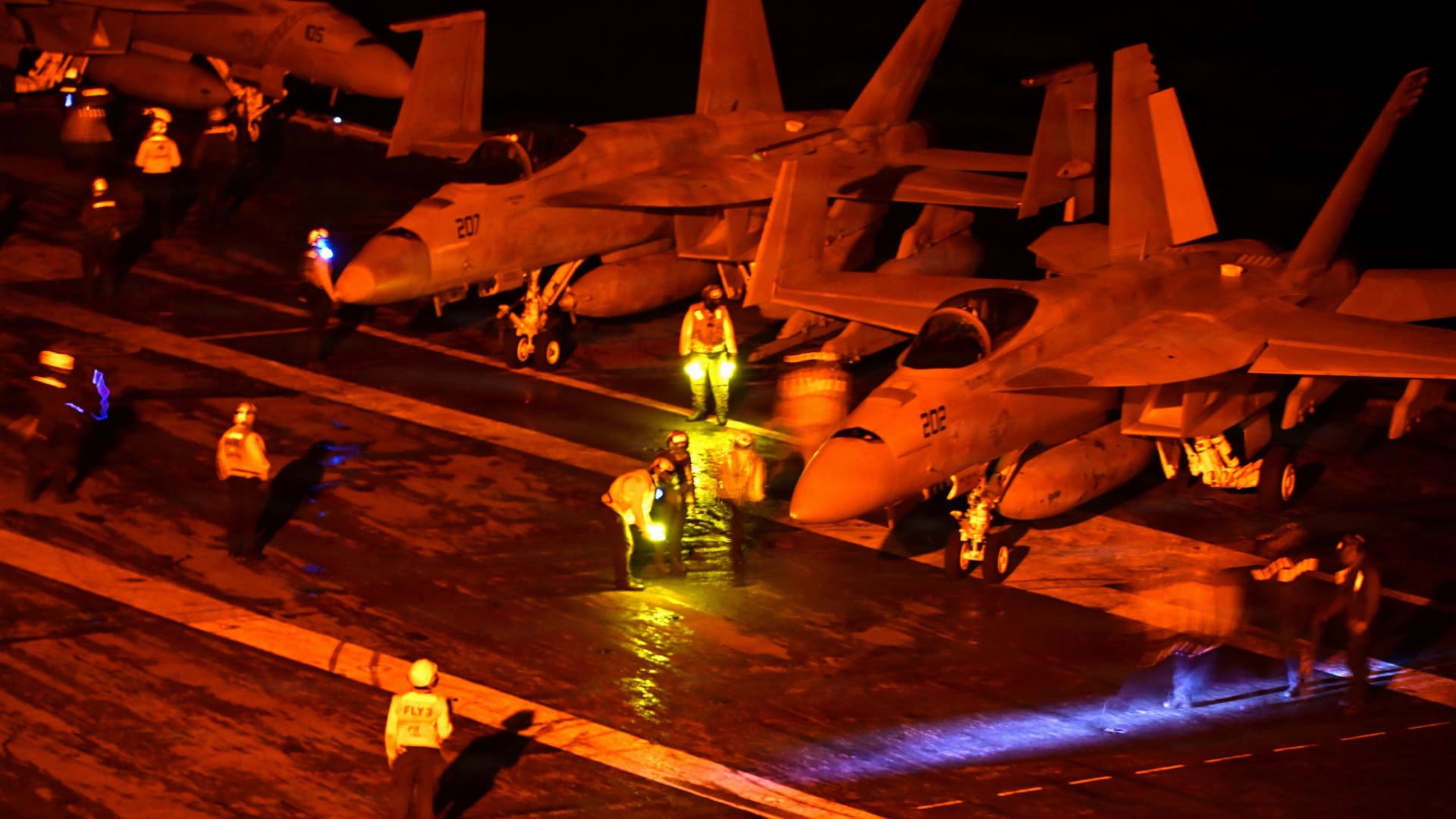
    F/A-18 Super Hornets on the flight deck of the USS George Washington in the Indian Ocean on Aug. 18, 2026.
    F/A-18 Super Hornets on the flight deck of the USS George Washington in the Indian Ocean on Aug. 18, 2026. U.S. Navy | Via Reuters

    U.S. President Donald Trump extended his military threats against Iran to Kharg Island, the country’s main oil export terminal, saying it is “going to be blown to smithereens!”

    The warning followed a weekend exchange of attacks between the United States and Iran, as hostilities between the two countries intensified again.

    U.S. strikes Iranian rocket launchers on Larak Island

    U.S. forces struck two Iranian rocket launchers on Larak Island on Sunday after American officials said Iran’s Revolutionary Guard forces were preparing rockets carrying sea mines for launch into the Strait of Hormuz. U.S. Central Command confirmed the strike to MS NOW.

    “Earlier today U.S. forces struck two Iranian launchers on Larak Island. Islamic Revolutionary Guard Corps forces were observed preparing to launch rockets with sea mines into the Strait of Hormuz,” Navy Capt. Tim Hawkins, a U.S. Central Command spokesperson, said in a statement.

    “Last week, CENTCOM completed clearing sea mines from the strait’s international shipping routes. U.S. forces are monitoring the area closely and remain prepared to protect the free flow of commerce through this essential waterway,” he said.

    Sunday’s attack was the first publicly acknowledged U.S. strike on Iranian positions since late July, according to The Associated Press. The conflict has continued for six months and severely disrupted vessel traffic through the Strait of Hormuz, a critical route for global energy shipments.

    Iran reports attacks on U.S. bases in Jordan

    Iran’s Revolutionary Guard Corps said the U.S. attack on Larak Island killed and wounded several Iranian soldiers. Iranian media reports said Iran responded by attacking American military bases in Jordan.

    The IRGC said a combined missile and drone operation targeted the King Hussein and Al Azraq bases. Iranian military forces reportedly said the strikes “destroyed the technical and repair infrastructure, as well as the enemy fighter deployment sites,” causing “heavy damage,” while vowing increasingly forceful responses.

    Larak is a small Iranian island in the Strait of Hormuz that has become an important military and shipping-control point for Tehran. The Revolutionary Guards use the island to monitor vessel traffic through one of the world’s most important maritime routes.

    Shipping remains disrupted in the Strait of Hormuz

    The U.S. Navy has maintained a blockade against Iranian ports in an effort to pressure the regime to reopen the waterway. Iran has continued targeting vessels that avoid the northern shipping lane near its coast.

    Another tanker was struck by an unknown projectile while traveling inbound through the Strait of Hormuz on Saturday, using the southern lane along the Omani coast, according to the UK Maritime Trade Operations. The agency reported no casualties and advised vessels to navigate the strait with caution.

  • Living Nostradamus Predicts When Iran Conflict Will End

    Living Nostradamus Predicts When Iran Conflict Will End

    Psychic Athos Salomé Warns Iran Conflict Is Only Beginning

    Global trade was upended earlier this year when Israel and the United States launched joint strikes on Iran, resulting in the death of the country’s Supreme Leader and thousands of casualties. Iran retaliated with a wave of military strikes on U.S. allies and shut down the Strait of Hormuz, a critical shipping lane for global oil and gas supplies. Although a ceasefire is currently holding, ongoing disruption in the busy strait continues.

    Brazilian paranormal consultant Athos Salomé, often dubbed the “Living Nostradamus” for his claims of predicting events such as the COVID-19 pandemic, the death of Queen Elizabeth II, and cyberattacks at the Paris 2024 Olympics, has now suggested the conflict is far from over.

    Instagram/athos_salome

    Shift to a ‘War of Attrition’

    Speaking to The Mirror, Salomé contradicted recent optimism from former President Donald Trump, who predicted the war would end “very quickly” (per BBC). Instead, Salomé forecasts a prolonged, unconventional struggle.

    “There is still much that may unfold against Iran,”

    “Tehran’s response and the potential deployment of allied cells in the region indicate that the conflict could erupt into a war of attrition never before seen,”

    “One marked by the development of new defensive technologies and devastating cyberattacks.”

    Describing a ‘Technological Occupation’

    Salomé described the next phase as a “technological occupation,” arguing that the U.S. aims to cripple Iran’s energy revenue without a ground invasion.

    “The United States does not intend to invade Iran militarily.”

    “Rather, it seeks to disable Iran’s ability to export energy, ensuring that discounted Iranian oil never again reaches China.”

    Geopolitical Chessboard: Targeting China’s Energy Pillars

    Expanding his analysis, Salomé outlined a broader strategic map for 2026.

    “The geopolitical chessboard of 2026 shows the United States moving against the three pillars supporting China’s energy supply – Iran (The Immediate Target), Venezuela (The Captured Piece), and Russia (The Truce Factor).”

    Iranian billboards depicting the closure of the Strait of Hormuz (AFP via Getty Images)

    Contrasting Prediction: Chinese Mystic Foresees U.S. Defeat

    Salomé is not the only mystic weighing in. In March, Chinese mystic Professor Xueqin Jiang offered a starkly different outlook, predicting an Iranian victory.

    “There’s absolutely no way America can win this war,”

    Professor Jiang said of a scenario involving a U.S. military invasion.

    “The United States [would] lose this war, which will forever change the global order.”

    Outcome Remains Uncertain

    With both sides still claiming victory and the ceasefire fragile, the trajectory of the conflict remains unclear. Analysts and observers continue to monitor developments closely.

  • Iran Retaliates After US Strikes, Defying Trump’s Warning It Could Be Hit ‘Much Harder’

    Iran Retaliates After US Strikes, Defying Trump’s Warning It Could Be Hit ‘Much Harder’

    The US military carried out additional strikes on Iran on Tuesday, prompting Tehran to launch attacks toward Jordan, Bahrain and Kuwait despite President Donald Trump’s warning that Iran would be “hit much harder” if it retaliated.

    The latest exchange followed overnight US-Iranian attacks into Monday, the first direct strikes between the two countries in more than a month. The escalation risked reigniting a damaging conflict after weeks of relative military calm.

    After the new US strikes were announced, Trump warned that Iran would face more severe military action if it retaliated against what he called a “very justified attack.”

    “They will be hit again at a much harder and higher level, but it will not be the biggest attack of them all, that is waiting in the wings and, when it is over, there will be very little left of the Islamic Republic of Iran!” he wrote Tuesday on Truth Social.

    Iran vowed a “crushing” response and launched ballistic missiles toward Jordan and drones toward Bahrain and Kuwait, saying it was targeting US military assets.

    Tehran also claimed that shrapnel from one of the US strikes hit a wedding celebration in southern Iran, killing at least four people, including a toddler.

    In a statement to CNN, a US military spokesperson said US Central Command (CENTCOM) had seen reports of the claim and denied targeting civilians in Iran.

    “We are aware of reports, which originated from Iranian state media. The U.S. military never targets civilians, unlike the IRGC,” Capt. Timothy Hawkins, a CENTCOM spokesperson, said Wednesday, referring to Iran’s Islamic Revolutionary Guard Corps.

    US strikes target IRGC facilities

    CENTCOM said the US strikes were carried out in response to recent attempted Iranian attacks “against commercial shipping in the Strait of Hormuz and American troops deployed to the region,” according to a post on X.

    Since the US strikes on Sunday, two tankers have been hit by projectiles, according to maritime intelligence group Marisks and the traffic monitoring agency United Kingdom Maritime Trade Operations (UKMTO). Iran and the US remain engaged in a protracted confrontation over the narrow waterway, which is critical to global energy supplies.

    CENTCOM said Tuesday’s strikes targeted “air defense sites, radar systems, maritime assets and facilities, mine laying capabilities, and communications sites” associated with the IRGC. The strikes began at 12 p.m. ET, and CENTCOM announced they were complete more than six hours later.

    The renewed fighting came despite Trump’s earlier indication that he planned to move away from a military campaign and focus instead on increasing economic pressure on Iran.

    “I’m not trying to force Iran to the bargaining table,” Trump wrote on Truth Social on Tuesday night, after Iran retaliated. “I like our position now much better, with almost total control of the Hormuz Strait, and their economy totally collapsing.”

    Oil futures climbed above $94 a barrel after the US announced the new strikes.

    Iran launches attacks toward regional allies

    Jordan said it intercepted 10 Iranian missiles, while three others landed in remote areas far from populated locations. No casualties were reported, according to Jordan’s military.

    Kuwait and Bahrain said they activated air defense systems to intercept Iranian drones. Tehran also claimed to have launched a combined missile and drone attack on Erbil in Iraq’s autonomous Kurdistan region.

    Iran’s attacks came as Pakistan’s officials said they were “not discouraged” by the increase in violence. Pakistan’s Foreign Ministry “remains engaged” with Tehran and Washington, spokesperson Tahir Andrabi told reporters Wednesday. He said the strikes “should not be termed as a failure of the mediatory process.”

    Reports of casualties and damage in Iran

    The US attacks struck multiple locations across Iran.

    Seven people were killed in strikes on Khuzestan province, which borders Iraq, Iran’s state-run Islamic Republic News Agency (IRNA) reported, citing a regional official.

    The Iranian port cities of Chabahar and Konarak on the Gulf of Oman, which host major commercial, maritime and military infrastructure, also came under attack. Explosions were heard east of Bandar Abbas and around Qeshm Island in the Strait of Hormuz, according to state-linked media.

    Iran’s state-run Press TV reported that the strikes also hit Jiroft Airport in southeastern Iran and a fishmeal factory on Qeshm Island.

    Separately, an explosion was heard in Asaluyeh, a key gas and petrochemical hub on Iran’s Persian Gulf coast, according to the semi-official Fars News Agency.

    Iranian authorities claimed that several people, including a 4-year-old child, were killed and at least 68 others wounded when shrapnel fell on a building hosting a wedding celebration in the coastal village of Kouhestak in southern Iran’s Sirik county, Press TV reported.

    Footage released by Iran’s semi-official Tasnim News Agency, which purportedly showed the aftermath of a US strike, showed heavy smoke above rubble as people shouted. CNN geolocated the footage to a residential neighborhood in Kouhestak but said it could not independently verify the details of the alleged strike.

    Video also showed that a large communications tower in Kouhestak was badly damaged Tuesday night. The tower was about 135 meters (442 feet) from the building where the wedding reception was held.

    At least 19 of the wounded were children under 10, including seven boys and 12 girls, the Iranian Students’ News Agency quoted a regional health official as saying.

    Iranian Foreign Ministry spokesperson Esmaeil Baghaei condemned the attack as part of a “catalogue of atrocities” committed by the US and criticized the global community’s “normalization of bombing.” In a post on X on Wednesday, Baghaei also denounced CENTCOM’s denial of targeting civilians in Iran, calling the strike a “brutal war crime.”

    The alleged attack received extensive coverage in Iranian state media and prompted outrage on Iranian social media, followed by the rapid publication of a Lego-style animated video, a format that has become a recurring feature of Iranian wartime propaganda.

    Kouhestak is about 37 kilometers (22 miles) from Minab, where Iran says a US strike hit an elementary school in February, killing at least 168 children and 14 teachers.

    Struggle over the Strait of Hormuz

    The fighting resumed as the US and Iran remained locked in a dispute over the Strait of Hormuz. Tehran claims the right to control the waterway, while Washington says it is an international waterway.

    The strait has been a chokepoint for global energy supplies since the war began, although more oil has flowed through it in recent weeks.

    The US said it launched strikes on Sunday because Iran was attempting to use rockets to lay new sea mines in the strait. Tehran responded by firing at what it described as US military targets in the Middle East.

    Trump told Fox News on Tuesday that the US had notified Arab allies in the Persian Gulf before the latest strikes. He also criticized Iran’s leadership, saying: “I think an agreement with them isn’t worth the paper it’s written on,” before adding: “They don’t stop: They’re crazy, and they’re stupid.”

    Trump told Fox News that the US targeted radar systems Iran had attempted to rebuild. “They tried to rebuild their radar because they can’t see anything,” he said. “We waited until it was almost built, and then we hit it.”

    The Trump administration has repeatedly dismissed concerns about Iran’s long-term control of the strait.

    “In two years, the Strait of Hormuz will be like a worthless piece of water — the oil will be going on pipelines across land,” Treasury Secretary Scott Bessent told Larry Kudlow on Tuesday during an interview at a Group of 20 meeting. He was referring to plans by Arab states in the gulf to build infrastructure that would bypass the strait.

    Bessent also said the Treasury Department’s efforts to isolate Iran’s economy from the rest of the world would eventually force the regime to surrender, describing his role as helping to “make sure that they want to have a deal.”

    “We are going to economically asphyxiate this regime,” Bessent said. “The world is tired of this pariah state, or this rogue state, and they are willing to make it a pariah.”

    He added that after initially targeting a bank in Dubai over its alleged ties to Iran, the Treasury Department was likely to sanction two more banks in the next couple of weeks.