Tag: Stablecoins

  • Ripple CEO, Wall Street Heavyweights Head to Swell 2026: Agenda Revealed

    Ripple CEO, Wall Street Heavyweights Head to Swell 2026: Agenda Revealed

    Key Highlights

    • Swell 2026 merges Ripple’s Swell and Apex conferences into a three-day event in New York (October 27–29) with over 100 speakers and 80 sessions.
    • High-profile speakers include Ripple CEO Brad Garlinghouse, CME Group’s Terrence Duffy, Bullish CEO Tom Farley, actor Matt Damon, and executives from BNY, Coinbase, Robinhood, Barclays, State Street, and Jump Trading.
    • Agenda focuses on institutional crypto adoption: tokenized real-world assets, stablecoin infrastructure, AI-driven payments, post-quantum security, and the first year of spot XRP ETFs.

    Swell 2026 Agenda Unveiled: Ripple Merges Flagship Conferences for New York Event

    Ripple has published the full agenda for Swell 2026, a three-day conference running October 27–29 in New York City that combines the company’s Swell and Apex events for the first time. The program features more than 100 speakers across 80 sessions and three stages, targeting the intersection of traditional finance and blockchain infrastructure.

    The announcement was made via the official Swell X account on September 16, 2026:

    The Swell 2026 agenda is live.Join us in New York, October 27–29, with Brad Garlinghouse, Terrence Duffy of CME Group, Tom Farley of Bullish, Matt Damon of @Water, leaders from @BNYglobal, @coinbase, @RobinhoodApp, @Barclays, @StateStreet, @jumptrading and many more.See the…
    — Swell (@RippleSwell) September 16, 2026

    Speaker Lineup Bridges Traditional Finance and Crypto

    The roster reflects Ripple’s strategy of convening decision-makers from both established financial institutions and digital-asset natives. Confirmed participants include:

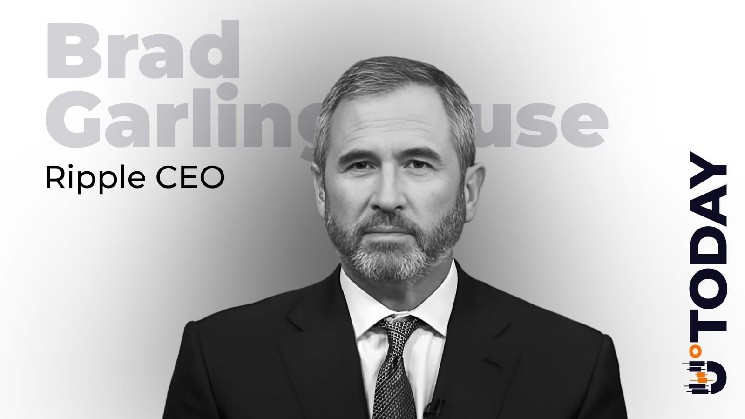
    • Brad Garlinghouse, CEO, Ripple
    • Terrence Duffy, Chairman and CEO, CME Group
    • Tom Farley, CEO, Bullish
    • Matt Damon, Actor and Co-founder, Water.org
    • Senior leaders from BNY, Coinbase, Robinhood, Barclays, State Street, and Jump Trading

    Three Thematic Tracks Define the Program

    Content is organized around three core pillars that signal where institutional crypto is heading:

    Liquidity and Settlement

    Sessions will examine how blockchain rails are reshaping cross-border payments, wholesale settlement, and the role of regulated market infrastructure.

    Tokenization of Real-World Assets

    A major focus on bringing traditional assets—treasuries, commodities, credit—on-chain with bank-grade compliance and custody.

    Stablecoins in Bank-Grade Production

    Practical discussions on issuance, regulation, interoperability, and adoption by financial institutions.

    Day 1 Highlights: Opening Remarks, AI Agents, and XRPL Roadmap

    The opening day packs several high-signal sessions:

    • Brad Garlinghouse delivers opening remarks followed by a 20-minute conversation.
    • Monica Long, Ripple President, converses with Johann Kerbrat, SVP and GM of Crypto at Robinhood.
    • Terrence Duffy (CME Group) takes the main stage for a dedicated conversation.
    • Aanchal Malhotra, Ripple research scientist, presents on the next frontier for XRPL research.
    • Jasmine Cooper, Head of Product at RippleX, outlines the XRPL roadmap for building an institutional DeFi stack.
    • Panel “What Happens When AI Moves Money” features Massimo Cervesato (Mastercard), Nilesh Dusane (AWS), Henri Stern (Privy co-founder), and Edward Woodford (ZeroHash) on AI agents, crypto infrastructure, and payments.
    • Mayukha Vadari, Ripple software engineer, introduces a new paradigm for building on the XRP Ledger with “smart features.”
    • David Schwartz, Ripple CTO Emeritus, and JA Akinyele discuss “Building What’s Next for XRPL.”
    • Jack McDonald, Ripple SVP of Stablecoins, and Brett Tejpaul, Coinbase Institutional co-CEO, cover advancement of crypto infrastructure.

    Day 2: Garlinghouse and Farley on Stage

    Day two features a main-stage conversation between Brad Garlinghouse and Tom Farley, CEO of Bullish, offering further insights into exchange infrastructure and institutional market structure.

    Additional Agenda Themes

    Beyond the day-one highlights, the program also addresses:

    • The first year of spot XRP ETFs — market dynamics, flows, and regulatory evolution.
    • AI agents that move money — autonomous economic agents, payment rails, and risk frameworks.
    • Post-quantum security — preparing blockchain cryptography for quantum-era threats.

    Why This Matters

    Swell 2026 signals a maturation milestone for enterprise blockchain adoption. By merging Swell (Ripple’s traditional finance-focused conference) with Apex (its developer-centric event), Ripple is explicitly positioning the XRP Ledger and its associated infrastructure—stablecoins, tokenization, custody—as production-ready for banks, asset managers, and market infrastructure providers. The speaker roster, heavy on C-suite executives from CME Group, BNY, Barclays, State Street, and major crypto exchanges, indicates that institutional deployment is moving from pilot to scale. Agenda topics like spot XRP ETFs, AI-agent payments, and post-quantum cryptography reflect the three vectors—capital markets, automation, and long-term security—that will define the next phase of crypto integration into global finance.

    Frequently Asked Questions

    When and where is Swell 2026 taking place?

    Swell 2026 runs October 27–29, 2026, in New York City. It combines Ripple’s Swell and Apex conferences into a single three-day event.

    Who are the headline speakers?

    Key speakers include Ripple CEO Brad Garlinghouse, CME Group Chairman Terrence Duffy, Bullish CEO Tom Farley, actor Matt Damon (Water.org), and executives from BNY, Coinbase, Robinhood, Barclays, State Street, and Jump Trading.

    What are the main themes on the agenda?

    The program centers on liquidity and settlement, tokenization of real-world assets, and stablecoins in bank-grade production. Additional tracks cover the first year of spot XRP ETFs, AI agents that move money, post-quantum security, and the XRP Ledger roadmap.
  • Deutsche Bank Bets Big on Digital Assets, Potentially Reshaping European Crypto

    Deutsche Bank Bets Big on Digital Assets, Potentially Reshaping European Crypto

    Deutsche Bank Prepares Digital Asset Custody Launch for European Institutions

    Deutsche Bank is advancing into digital assets with plans to offer custody services to institutional and corporate clients across Europe later this year. The bank will hold wallets and private keys, enabling clients to safeguard and transfer Bitcoin (BTC), Ether (ETH), USD Coin (USDC), EURC, and EURAU without building their own custody infrastructure.

    Banking Framework for Digital Asset Access

    The service aims to place digital assets within a regulated banking framework, incorporating key protections such as private key storage, wallet control, and transaction approval controls. This approach could provide European institutions an easier entry point into crypto markets through existing banking relationships. While the initial asset list remains limited, tokenized financial instruments are expected to follow at a later stage.

    Regulatory approval remains a prerequisite between the announcement and launch, making the approval process and subsequent adoption critical developments to monitor.

    Regulated Custody Demand Driven by Institutional Allocation Trends

    Institutional interest has shifted beyond simple investment exposure to focus on regulated access mechanisms. According to a 2026 Coinbase-EY survey of over 350 decision-makers, 73% plan to increase allocations to digital assets. Within that study, 81% preferred spot exposure through registered vehicles such as ETFs and ETPs.

    This preference creates strong demand for regulated custody providers. Although hundreds of European-based MiCA-authorized cryptocurrency companies currently operate, very few major banks function as custodians. Deutsche Bank can therefore bridge crypto custody with established banking relationships across Europe, targeting asset managers, hedge funds, brokers, corporations, and sovereign institutions.

    Stablecoins Could Transform Custody into Recurring Settlement Channel

    Stablecoins have the potential to evolve Deutsche Bank’s custody service from a static storage product into an active settlement rail. USDC currently maintains approximately $74 billion in circulation, according to DeFiLlama data, demonstrating deep existing demand.

    EURC provides institutions a euro-denominated alternative within the same custody framework. Together, these stablecoins could support treasury transfers, business payments, and cross-border settlements alongside basic asset storage. If repeated transfers materialize, the activity would generate transaction flows beyond passive custody.

    Tokenized Assets May Extend Financial Rail Functionality

    Future addition of tokenized assets could further expand the service’s utility. Purchases, redemptions, and transfers of tokenized instruments would create additional flow opportunities. Consequently, stablecoins and tokenization combined could position a custody service provider as an active financial rail for institutional clients.

  • BoE Official: Stablecoin Growth Could Strengthen Dollar Dominance, Boost US Treasury Demand

    BoE Official: Stablecoin Growth Could Strengthen Dollar Dominance, Boost US Treasury Demand

    Bank of England Financial Policy Committee member Carolyn Wilkins warned Tuesday that the rapid growth of dollar-denominated stablecoins could further entrench the U.S. dollar’s global dominance while creating new channels of financial volatility.

    Speaking at Queen’s University Belfast, Wilkins outlined how stablecoins pegged to the greenback simplify cross-border settlement, expand international access to dollar-linked assets, and drive demand for U.S. Treasurys held as reserves by issuers.

    Stablecoin Issuers Now Major Buyers of U.S. Debt

    The scale of this dynamic is already significant. According to data cited by Wilkins, the two largest stablecoin operators—Tether’s USDT and Circle’s USDC—held nearly $150 billion in Treasury bills at the end of 2025 and purchased roughly $33 billion during the year.

    “This gives the currency what Wilkins described as a “considerable first-mover advantage.””

    Redemption Risk Could Amplify Market Stress

    However, Wilkins emphasized that the relationship cuts both ways. At sufficient scale, mass stablecoin redemptions could force issuers to liquidate Treasury holdings rapidly, potentially amplifying volatility in an already stressed market.

    UK Pushes Pound Stablecoins as Dollar Dominates

    Wilkins’ comments come as total stablecoin circulation exceeds $300 billion, with the U.S. dollar accounting for 98% of that value. By contrast, British pound-denominated stablecoins have struggled to gain traction.

    UK regulators have moved to close the gap this year. The Financial Conduct Authority launched a dedicated regulatory sandbox to test prospective stablecoin issuers and finalized issuance rules in June. The Bank of England has also conducted experiments, including a recent test of whether stablecoins and a simulated digital pound could operate together for cross-border trade payments.

    The shift reflects a more accommodating stance from the Bank of England after industry criticism that its earlier proposals risked stifling innovation.

  • Ethereum Layer 1 Sets Record 25.9 TPS as Q2 Transactions Hit 203.9 Million

    Ethereum Layer 1 Sets Record 25.9 TPS as Q2 Transactions Hit 203.9 Million

    Ethereum’s Layer-1 network achieved fresh usage milestones in the second quarter of 2026, even as the count of monthly active users contracted sharply. According to Token Terminal data, the blockchain processed 203.9 million transactions during the quarter, representing a 68.4% increase year-over-year. Average throughput also hit a record high of 25.9 transactions per second.

    Transaction Volume Surges Despite User Decline

    Despite the surge in on-chain activity, monthly active users fell 30% quarter-over-quarter to 9.2 million. This divergence indicates that the remaining user base generated significantly more transactions per capita. Network fees climbed 31.6% to $52.5 million, while ETH burn revenue more than doubled to $17.1 million, underscoring the intensified economic activity on the base layer.

    Tokenization Bolsters Ethereum’s Dominance

    Ethereum’s position as the primary settlement layer for tokenized assets strengthened further. The market for tokenized assets on Ethereum averaged $203.1 billion during Q2. Stablecoins continued to dominate this segment, accounting for $176.8 billion, while tokenized funds reached $20.8 billion. Notably, tokenized U.S. Treasury funds hit a record average of $7.5 billion.

    The network retained the largest share of both stablecoins and tokenized funds among leading blockchain ecosystems. Total value locked (TVL) across Ethereum’s ecosystem averaged $287.2 billion, though this figure declined 9.2% compared to the previous quarter.

    Staking Growth Signals Network Confidence

    Participation in network security reached a new high, with Ethereum’s staking ratio climbing to a record 32%. The number of addresses holding ETH also expanded, rising 6.6% to 312.1 million. These metrics suggest a deepening commitment from token holders to secure the proof-of-stake consensus mechanism.

    ETH Price Reaction and Outlook

    At the time of reporting, ETH trades around $2,538, marking a 1.18% gain over the preceding 24 hours. The combination of stronger network usage, rising staking participation, and expanding tokenization activity could provide fundamental support for Ethereum’s long-term market position.

    Related: Strive Adds 469 BTC, Bringing Bitcoin Holdings to 25,000

  • Ethereum Liquidity Surges: Can ETH Steal Bitcoin’s Spotlight in Q4?

    Ethereum Liquidity Surges: Can ETH Steal Bitcoin’s Spotlight in Q4?

    Bitcoin’s August Surge Masks Weak Spot Demand and Liquidity Concerns

    Bitcoin closed August over 25% higher compared to the previous month, recording its best monthly performance since November 2024. However, the stablecoin market cap only managed to grow by 0.5% and failed to hold above $310 billion, which suggests that the inflow of liquidity is happening at a slow pace.

    On-Chain Metrics Reveal Lack of Spot Buying Pressure

    The same pattern is evident on the on-chain level. As the chart below shows, Bitcoin rose by around 45% from its recent low, but there is a lack of spot demand, as evidenced by the 90-day CVD being neutral. Liquidity across exchanges is also weak, as seen in Binance’s stablecoin reserves, which dropped nearly $7 billion from their cycle peak above $50 billion.

    Source: CryptoQuant

    Technical Bullishness Contrasts with Speculative Positioning Risks

    So, while Bitcoin’s technical structure has turned bullish, liquidity and spot demand remain muted. At the same time, rising Open Interest suggests growing speculative positioning, which makes $BTC vulnerable to a long squeeze if $80k resolves as the ceiling, especially with the FOMC meeting approaching.

    Ethereum’s Liquidity Divergence Signals Potential Shift from Bitcoin

    However, the bigger signal may be the growing liquidity divergence between Bitcoin and Ethereum. If capital continues to rotate towards $ETH and away from $BTC, this could set up the conditions for altcoins to outperform Bitcoin in the coming Q4, particularly as macro volatility drives risk appetite shifts. If this trend holds, it could provide the first confirmation that Bitcoin’s [$BTC] current rally is a bull trap.

    Ethereum Derives Liquidity from Both Speculation and On-Chain Utility

    Unlike Bitcoin, Ethereum is capable of deriving liquidity from both speculative demand and on-chain utility. The promise of Ethereum as a platform for stablecoins, tokenized assets, and DeFi creates additional demand for the asset.

    For instance, the total stablecoin supply in the Euro minted on the Ethereum blockchain increased by 347.3% over the past three years to reach $848.1 million. Ethereum hosts 69.4% of the total, surpassing all other blockchains combined by more than double. Similarly, stablecoins on the Robinhood Chain exceeded the $1 billion mark, illustrating the strong demand for on-chain liquidity.

    Record ETH Staking Underscores Capital Commitment to Ethereum

    In addition, as depicted in the chart below, staking $ETH is yet another example of increased demand for Ethereum. According to the chart, the amount of $ETH staked saw yet another ATH. Specifically, 42.95 million $ETH or $105.96 billion were deposited across all validators, representing 35.21% of $ETH’s supply.

    Source: ValidatorQueue

    Capital Flows Into Ethereum Ecosystem Drive ETH/BTC Ratio Higher

    Taken together, improving stablecoin liquidity and record $ETH staking suggest that capital is flowing into the Ethereum ecosystem. Not only are traders fueling demand, but holders are also locking up significant amounts on-chain and committing them to the network.

    This helps explain why the $ETH/$BTC ratio keeps trending higher. While Bitcoin is seeing rising bull trap fears and weak spot buy, Ethereum has seen increased liquidity and capital inflows. If the divergence persists, then $ETH/$BTC ratio could very well have the momentum to break above 0.031.

    Altcoin Outperformance Potential in Q4 Hinges on Sustained Liquidity Rotation

    More importantly, a sustained rotation of liquidity into Ethereum [$ETH] can spill over into the broader altcoin market. And if Bitcoin continues to lose liquidity share to $ETH, it could be a major catalyst for altcoins to outperform $BTC in the fourth quarter.

    Final Summary

    • Ethereum is seeing more liquidity, with stablecoin growth and record $ETH staking showing stronger demand.
    • If this trend continues, $ETH could keep gaining on $BTC and help drive an altcoin rally in Q4.
  • Bessent Urges Senate to Advance CLARITY Act as Crypto Rules Stall

    Bessent Urges Senate to Advance CLARITY Act as Crypto Rules Stall

    Treasury Secretary Scott Bessent is pressing the Senate to advance the CLARITY Act when lawmakers return from their August recess, renewing pressure on Congress to establish a comprehensive regulatory framework for digital assets. In a post on X, Bessent warned that further delays could weaken U.S. leadership in crypto and limit the government’s ability to prevent digital assets from being misused.

    In July, I called on the Senate to advance the Clarity Act — a bill to establish a comprehensive regulatory framework for digital assets and upgrade our ability to prevent bad actors from exploiting these critical technologies.When the Senate returns from August recess, I…

    — Treasury Secretary Scott Bessent (@SecScottBessent) September 9, 2026

    Senate Faces September Test

    Bessent made the appeal, urging senators to “remain at the negotiating table” and agree to a motion to proceed with the bill. The legislation still faces disagreements over crypto holdings, stablecoin rewards, and measures targeting illicit finance. Senate Majority Leader John Thune filed a cloture motion in August, setting the stage for a possible vote on Sept. 15. The bill needs at least 60 votes to advance, making Democratic support crucial.

    Regulation and National Security

    The CLARITY Act would divide digital-asset oversight between the SEC and CFTC while adding consumer-protection and anti-money-laundering requirements. Bessent has argued that clearer rules could encourage crypto companies and investment to remain in the U.S. Administration officials have also said stronger regulations could support dollar-backed stablecoins and make digital assets harder to use for illicit finance. If lawmakers fail to advance the bill, the U.S. would remain without a broad framework for crypto market oversight.

    Related Coverage

  • Beyond the Crypto Rally: 4 Trends to Watch This Cycle

    Beyond the Crypto Rally: 4 Trends to Watch This Cycle

    When crypto prices surge, market commentary often focuses on green candles and central bank policy. But beneath the immediate rally, a deeper structural shift is unfolding on-chain.

    Robinhood CEO Vlad Tenev brought global attention to this shift with the launch of Robinhood Chain, joining a broader movement by major platforms to bring mainstream retail equity investors directly into native on-chain execution.

    Macroeconomic stress provides the backdrop, but technological innovation is the catalyst. Beneath the price action, four key trends are defining the current crypto cycle and reshaping how global wealth is owned, accessed, and stored.

    Trend 1: The Retail Ownership Supercycle

    At a recent White House summit, Vlad Tenev summarised his platform’s mission in a single word: “ownership.” Broad asset ownership is essential to a free and prosperous society, and Robinhood Chain is putting that principle into practice.

    Novel mechanisms such as The Index illustrate how this model works. Holding the single token automatically delivers fractional tokenised equities directly to a user’s wallet. In just a few clicks, crypto-native traders can gain diversified exposure to traditional stock portfolios, extending their investments beyond crypto alone.

    Retail culture is a crucial force behind this movement. Memecoins such as Popcat, Pepe, and Doge demonstrated strong mass-market retail appetite on tier-one exchanges. Today, that same energy is driving on-chain execution.

    On Robinhood Chain, Cashcat has emerged as the leading token and unofficial mascot. Coinbase’s listing of Basecat on Base, together with community-led initiatives built around Cate on Solana, points to a broader, multi-chain “cat season.”

    These community movements are becoming a primary onboarding engine for crypto and tokenised real-world asset ownership.

    Trend 2: CeDeFi and Infrastructure Convergence

    While Robinhood Chain renewed retail interest in on-chain markets, another major development was taking shape at the infrastructure level. In previous cycles, centralised exchanges focused on building isolated, walled-garden blockchains and proprietary wallets. This cycle marks a fundamental shift toward Centralised-Decentralised Finance, or CeDeFi, through direct liquidity integration.

    Two parallel moves demonstrate this trend: Robinhood’s integration of Lighter and VALR’s integration of Hyperliquid.

    If Robinhood’s mission is to expand ownership for everyday retail investors, VALR’s focus is global access. By connecting directly to Hyperliquid’s high-performance order book, VALR gave more than two million users across Africa and emerging markets seamless access to over 200 liquid markets spanning crypto, equities, stock indices, commodities, precious metals, and foreign exchange.

    Trend 3: The Two-Phase Transformation of Money

    This expansion of global market access is laying the foundation for a much larger monetary transition. The evolution of money is unfolding in two distinct phases.

    Phase 1 is already taking place through stablecoins. While the long-term outlook for fiat currency appears bleak, stablecoins make it easier to store, transfer, and spend value. They are becoming practical payment and settlement rails for everyday users, global companies, and international trade.

    However, stablecoins only digitise fiat currency; they do not protect against chronic currency debasement. When it becomes clear to everyone that inflation is indeed not transitory, but long-lasting and ever-worsening, Phase 2 will take hold. The transition to sound money will be swift and violent, with stablecoins providing the off-ramp.

    Tokenised gold such as XAUt and, fundamentally, Bitcoin are natural destinations for this capital. The transition is still in its early stages.

    Trend 4: Agentic Finance and Human Purpose

    Alongside the evolution of money, agentic finance is gaining momentum. Autonomous AI agents and algorithmic execution systems are expected to handle increasingly complex market mechanics, liquidity deployment, and trading strategies.

    The full impact of AI on the global economy is still unfolding. Personally, I would rather focus on painting and tending a rose garden, letting the world figure out the question of AI and robots. Optimistically, that is the true promise of technology anyway: outsourcing the mundane to machines so humans can focus on service, kindness, creativity, and contemplation.

    Beyond Rotation: The Conviction Cycle

    Speculative token-hopping and short-term player-versus-player trading have shaped much of recent crypto culture. Yet, amid this cycle of constant rotation, a simple phrase is taking root: “believe in something.”

    The platforms, protocols, and participants that endure through the next phase of the market will not be those chasing fleeting trends. In addition to ownership and access, this cycle will be defined by conviction.

    About the Author

    Ben Caselin is Chief Marketing Officer at VALR.com, Africa’s largest crypto exchange and infrastructure provider by trade volume. Headquartered in Johannesburg, VALR serves over 1900 corporate and institutional clients and more than 1.9 million traders worldwide.

    Drawing on years of experience in the digital asset sector, primarily in Hong Kong, the UAE, and South Africa, Ben focuses on driving Bitcoin adoption in emerging markets. He advocates for an approach to innovation grounded in spiritual principles.

    Source: cryptonews.net

  • Tether CEO Slams BIS Push for Tokenized Bank Deposits

    Tether CEO Slams BIS Push for Tokenized Bank Deposits

    The debate over how to represent fiat money onchain is intensifying, with Tether CEO Paolo Ardoino challenging the Bank for International Settlements’ (BIS) preference for tokenized bank deposits over stablecoins.

    Ardoino criticized recent comments from Pablo Hernandez de Cos, general manager of the BIS, who argued that stablecoins are not an effective substitute for fiat money. De Cos cited concerns including limited redeemability, supply constraints, interoperability challenges and the potential facilitation of crime.

    Instead, De Cos described tokenized bank deposits as a “more direct path to harness ​tokenisation while preserving the monetary system’s foundations.”

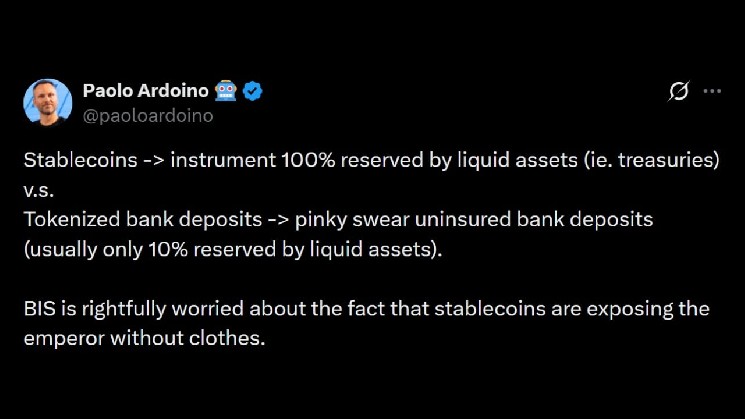
    Ardoino argued that the BIS’s concerns overlook what he views as a key distinction between the two forms of digital money. He said stablecoins are generally backed almost entirely by U.S. Treasury securities, while tokenized bank deposits are typically backed by only around 10% in liquid assets.

    “BIS is rightfully worried about the fact that stablecoins are exposing the emperor without clothes. Why someone should choose to put his savings into a fractional reserve product while stablecoins are fully reserved?” Ardoino declared.

    Stablecoin adoption expands in emerging markets

    Stablecoins have continued to gain popularity and adoption. Tether’s $USDT, with a market capitalization of more than $183 billion at the time of writing, has become an important financial product in emerging markets.

    Ardoino said there were economies “heavily relying on $USDT, for both internal and foreign commerce.”

    Stablecoins become a U.S. policy flashpoint

    The debate over stablecoins has also reached the highest levels of U.S. politics, becoming a contentious issue in discussions over the Digital Asset Market Clarity Act, known as the CLARITY ACT.

    Banks have raised concerns about deposit flight if cryptocurrency exchanges are permitted to offer rewards on stablecoin holdings. Ardoino suggested that broader awareness of stablecoin reserves could accelerate a shift away from traditional bank deposits.

    “What happens to financial system if people start realizing that stablecoins are safer and move their savings into the better asset class? We’re in the Find Out phase.” Ardoino concluded, hinting at large-scale deposits-for-stablecoins substitution.

  • From Hawala to SWIFT: Inside the 1,000-Year Battle to Move Money Safely

    From Hawala to SWIFT: Inside the 1,000-Year Battle to Move Money Safely

    For a thousand years, the financial industry has sought ways to move wealth virtually. Yet each time innovators develop a faster or more secure method of transferring capital, malicious actors respond with new and sometimes highly sophisticated attack vectors.

    For more than 50 years, the messaging network created by the Society for Worldwide Interbank Financial Telecommunications (Swift) has served as the dominant infrastructure for cross-border settlement, routing approximately $5 trillion each day. However, the bank-owned organization is under growing pressure to evolve as it works to increase transaction speed, lower costs and compete with an expanding range of blockchain-based alternatives.

    In recent years, stablecoins and tokenized deposits have emerged as potential “SWIFT killers”, a phrase coined in a 2017 Brave New Coin analysis of Ripple, the blockchain network designed to facilitate cross-border transactions.

    Swift took almost nine years to respond. Last month, it unveiled a blockchain ledger. Soon afterward, HSBC and Standard Chartered completed the first live transaction using the system, settling it in seconds rather than days.

    Swift’s potential inspiration

    In the 8th century, Islamic merchants transporting goods between Baghdad, Cairo and the Indian subcontinent faced a serious security problem. Moving gold physically was dangerous because bandits were waiting to target travelers, and even heavily armed escorts could not fully solve the risk.

    Source: cryptonews.net

  • The Next Trillion-Dollar Currency May Not Be a Stablecoin

    The Next Trillion-Dollar Currency May Not Be a Stablecoin

    A new CoinDesk analysis examines why the next trillion-dollar currency could emerge outside the stablecoin model used today—and why it may not have a name yet.

    What the CoinDesk Analysis Says

    The development is significant because it could alter the outlook for the next trillion-dollar currency. However, the available reporting identifies a specific development without establishing that it represents a completed, industry-wide shift.

    The figures and descriptions remain limited to the scope and claims presented in the source. Further evidence is needed before drawing broader conclusions about the digital-asset market.

    Why It Matters for Digital Assets

    Crypto infrastructure is increasingly linking payments, financial markets and software systems. These connections may create new opportunities for adoption, while also raising questions about security, regulation, liquidity and operational reliability.

    Those factors will help determine whether the reported development advances beyond an initial test, study or proposal. They will also indicate whether the system can support broader participation from users and institutions.

    What Comes Next

    The key milestones will be additional disclosures, implementation details and evidence of adoption by users or institutions. Until those details emerge, the development should be viewed as a dated event rather than a prediction about market prices or a guarantee of future adoption.

    BlockchainReporter has previously covered related digital-asset infrastructure in earlier reporting.

    Source: cryptonews.net