Tag: Solana Transaction V1

  • Critical Week Ahead: Economic Data and Altcoin Events Detailed in Day-by-Day, Hour-by-Hour Schedule

    Critical Week Ahead: Economic Data and Altcoin Events Detailed in Day-by-Day, Hour-by-Hour Schedule

    The cryptocurrency market ended last week in negative territory as hawkish U.S. economic data increased the probability of a Federal Reserve interest rate hike. Bitcoin declined more than 3% over the week, with altcoins recording comparable losses. Below is the curated cryptocurrency calendar for the week of September 14–18, compiled by Bitcoinsistemi.com. All times are listed in UTC+3 (Turkey time).

    Monday, September 14

    • Ubpit will delist the STORJ and JASMY tokens.
    • Spark is discontinuing its SparkLend lending protocol on the Gnosis Chain.
    • The Standard Reserve, an on-chain reserve protocol, is launching.

    Tuesday, September 15

    • GHST – DAO onchain voting begins.
    • Voting on the Clarity Act commences in the United States.
    • Solana is rolling out Transaction V1 on its mainnet-beta network.
    • Withdrawal deadline for the DeFi yield protocol Pyra.

    Wednesday, September 16

    • European Blockchain Convention takes place.
    • The ARC mainnet goes live.
    • VET – Interstellar receives a major update.
    • The SEC and CFTC are scheduled to release new rules.
    • The Standing Committee on Finance of the Indian Parliament holds a key session on virtual digital asset regulation.
    • 21:00 – Federal Reserve announces its interest rate decision.
    • 21:30 – Fed Chairman Kevin Warsh holds a press conference.

    Thursday, September 17

    • 15:30 – U.S. Initial Jobless Claims (Expected: 209k, Previous: 206k).

    Friday, September 18

    • 06:00 – Bank of Japan announces its interest rate decision; a 25 basis point increase is expected.

    Disclaimer: This content is for informational purposes only and does not constitute investment advice.

  • Solana Breaks 10-Month Slump as Institutional Investment Surges

    Solana Breaks 10-Month Slump as Institutional Investment Surges

    Solana traded near $106 on Sunday afternoon after reaching $110.38 on Aug. 27, its highest price since late January. $SOL has gained roughly 46% this month and is about 80% above its June low, pushing Solana’s market value back toward $61 billion.

    Institutional Money Starts Chasing Solana

    The rally ended 10 consecutive monthly declines and gave Solana its strongest month since 2024. However, $SOL remains well below its January 2025 all-time high ($ATH) near $293, making August a comeback rather than a period of price discovery. Solana would need to rise another 63.5% to reclaim that record.

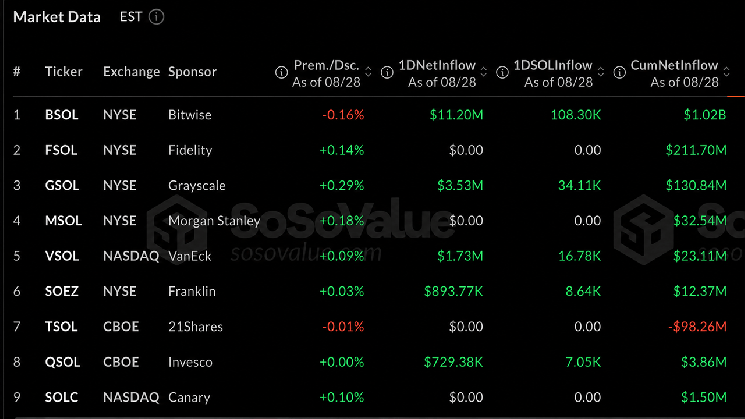
    Regulated investment products have provided a visible source of buying demand. U.S. spot Solana exchange-traded funds (ETFs) have attracted roughly $1.34 billion in cumulative net inflows since launching in October 2025, according to data from sosovalue.com. Bitwise’s BSOL Solana fund, which also operates as a staking ETF, has surpassed $1 billion in assets under management.

    Solana ETF statistics via sosovalue.com on Sunday, Aug. 30, 2026.

    Another major distribution channel is also approaching. On Aug. 27, Charles Schwab announced plans to add spot $SOL, avalanche (AVAX) and chainlink (LINK) to Schwab Crypto in the coming months. Schwab oversees more than $12 trillion in client assets across approximately 39 million brokerage accounts.

    Corporate buyers are entering the market as well. Defi Development Corp. purchased 19,000 $SOL at an average price of $98.14, increasing its holdings to approximately 2.33 million $SOL. Goldman Sachs also disclosed roughly $88 million in Solana ETF exposure in its latest regulatory filing.

    Solana Governance Vote Could Tighten Future Supply

    Solana has completed its first binding onchain governance vote. SGP-0002, dubbed “Double Disinflation,” passed with 67% support from participating stakeholders, narrowly exceeding the required two-thirds threshold.

    The proposal doubles Solana’s annual disinflation rate from 15% to 30%. In practical terms, new $SOL will enter circulation at a much slower rate sooner, while the network retains its eventual 1.5% inflation floor. Estimates suggest the change could reduce issuance by roughly 18.9 million $SOL over six years.

    The impact will not be immediate. Developers must still complete the software work and activate the policy across the network, making implementation the next key checkpoint for traders monitoring Solana’s future supply.

    Record Network Traffic Tests Solana’s Capacity

    The price rally also coincided with heavy network activity. The Kobeissi Letter reported on Aug. 25 that Solana processed a record 4.2 billion transactions in July, 13.5% more than in June and roughly 91% above December 2025 levels. Between Aug. 17 and Aug. 23, the network processed approximately 1.32 billion non-vote transactions, setting another weekly record.

    Blockworks data image showing Solana’s transfer count via The Kobeissi Letter’s X post on Aug. 25.

    Additional capacity is already scheduled. Transaction V1, planned for Sept. 9, will increase the maximum transaction size from 1,232 bytes to 4,096 bytes, giving applications considerably more space to package data within individual transactions.

    Storage costs could also decline. Solana’s planned rent reduction may eventually cut the deposit required to store data onchain by 90%, lowering expenses for developers building token accounts, non-fungible tokens and tokenized real-world assets.

    September Could Determine Whether Solana’s Rally Continues

    Leverage amplified August’s move, with more than $16 million in Solana short positions liquidated during the breakout toward $109, according to Coinglass.com derivatives data. Forced buying can accelerate a rally, but the same mechanism can intensify losses when momentum reverses.

    September will present a more difficult test. $SOL traders will monitor the first rent reduction, the Transaction V1 upgrade on Sept. 9, faster transaction times and progress toward the planned Alpenglow consensus upgrade in October. These milestones could help determine whether August marked the beginning of a larger Solana recovery or simply produced the token’s sharpest rebound in nearly a year.

    Feature and hero image via sosovalue.com metrics.

  • Solana Sets September 9 Date for Transaction V1

    Solana Sets September 9 Date for Transaction V1

    Solana is preparing several major network upgrades, including a larger transaction format, lower account rent, faster slot times and the proposed Alpenglow consensus redesign. Solana Foundation Vice President of Technology Jacob Creech outlined the expected timeline on Aug. 30, while stressing that the changes will use separate activation processes.

    There are a lot of major changes happening soon– Next week: First step down in rent reduction– Sept 9: Transaction V1 goes live– Dropping slot time even further– October: AlpenglowThen we all meetup at Scale or Die in NovemberSolana development will never be the same

    — Jacob Creech (@jacobvcreech) August 29, 2026

    Transaction V1 raises Solana’s transaction limit to 4,096 bytes

    Transaction V1 is scheduled to go live on Sept. 9. The upgrade will increase Solana’s maximum serialized transaction size from 1,232 bytes to 4,096 bytes, or roughly 3.3 times the current limit, according to Solana’s official upgrade roadmap.

    The larger transaction format could support zero-knowledge proofs, complex multisignature instructions, BLS signatures and cross-chain operations. The SIMD-0296 proposal identifies these as potential use cases.

    Developers will need to opt into the V1 format. Existing legacy and version-zero transactions will remain valid, but Transaction V1 will not support address lookup tables. Applications will therefore need to select the format that best fits each transaction.

    The upgrade also requires wallets, application programming interfaces and other infrastructure to support larger data payloads. The proposal acknowledges potential bandwidth and network-fragmentation risks, making coordinated testing important before broader adoption.

    Solana rent reduction begins with one of five stages

    Solana’s first rent-reduction stage will not deliver the full planned 90% cut immediately. The network has outlined five stages that would eventually reduce the rent calculation from 6,960 lamports per byte to 696 lamports per byte.

    Solana uses rent-exempt balances to limit uncontrolled growth in onchain state. Applications lock $SOL when creating accounts that store data. The funds are generally recoverable when an account closes, making rent more like a refundable deposit than a recurring network fee.

    Lower rent requirements would reduce the amount of $SOL developers must lock when creating token accounts, program accounts and other onchain data. That could lower entry costs for applications managing large numbers of user accounts.

    Agave 4.2 included the required code, but Solana placed the changes behind independent feature gates. Validators can activate the rent, transaction-size and slot-time upgrades separately after testing.

    Faster Solana slot times have a separate schedule

    Solana has already reduced its target slot time to 350 milliseconds from 400 milliseconds. The network plans additional stages at 300, 250 and eventually 200 milliseconds.

    Creech did not provide dates for the remaining reductions. Each change requires a separate feature activation, allowing network developers to monitor validator performance before moving to the next target.

    Shorter slots could improve transaction confirmation speeds and increase how often validators produce blocks. They also create greater timing and networking demands for validators. Solana plans to adjust resource limits proportionally during the rollout.

    Transaction V1 and reduced slot times form part of Solana’s broader performance roadmap, but they remain technically distinct. Describing Sept. 9 as the activation date for both upgrades would overstate Creech’s announcement.

    Alpenglow remains targeted for October

    Alpenglow is Solana’s proposed consensus redesign. Solana says the upgrade aims to reduce transaction finality to approximately 150 milliseconds compared with the longer confirmation process under the current consensus system.

    The official roadmap lists Alpenglow as “in development,” while Agave 4.3 is expected in October. Creech’s post supports October as the current target, but neither statement confirms a guaranteed mainnet activation date.

    Before then, Solana is expected to begin the first rent-reduction stage and activate Transaction V1 on Sept. 9. Further slot-time reductions will depend on separate validator activations, while Alpenglow must complete testing and secure the required network support.

    No verified market movement was directly attributed to Creech’s announcement at publication time.