Tag: Solana governance

  • Solana Breaks 10-Month Slump as Institutional Investment Surges

    Solana Breaks 10-Month Slump as Institutional Investment Surges

    Solana traded near $106 on Sunday afternoon after reaching $110.38 on Aug. 27, its highest price since late January. $SOL has gained roughly 46% this month and is about 80% above its June low, pushing Solana’s market value back toward $61 billion.

    Institutional Money Starts Chasing Solana

    The rally ended 10 consecutive monthly declines and gave Solana its strongest month since 2024. However, $SOL remains well below its January 2025 all-time high ($ATH) near $293, making August a comeback rather than a period of price discovery. Solana would need to rise another 63.5% to reclaim that record.

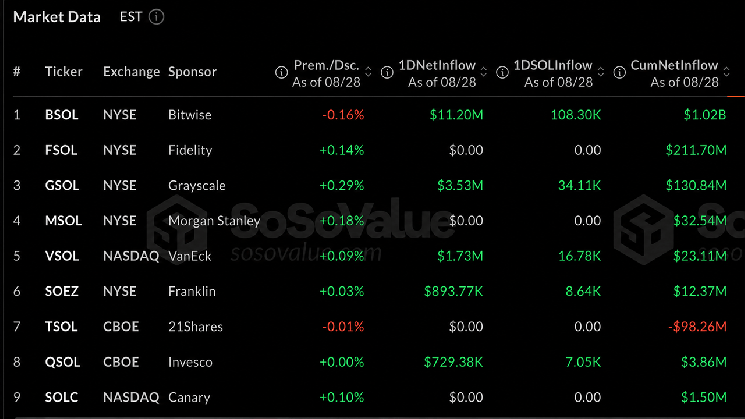
    Regulated investment products have provided a visible source of buying demand. U.S. spot Solana exchange-traded funds (ETFs) have attracted roughly $1.34 billion in cumulative net inflows since launching in October 2025, according to data from sosovalue.com. Bitwise’s BSOL Solana fund, which also operates as a staking ETF, has surpassed $1 billion in assets under management.

    Solana ETF statistics via sosovalue.com on Sunday, Aug. 30, 2026.

    Another major distribution channel is also approaching. On Aug. 27, Charles Schwab announced plans to add spot $SOL, avalanche (AVAX) and chainlink (LINK) to Schwab Crypto in the coming months. Schwab oversees more than $12 trillion in client assets across approximately 39 million brokerage accounts.

    Corporate buyers are entering the market as well. Defi Development Corp. purchased 19,000 $SOL at an average price of $98.14, increasing its holdings to approximately 2.33 million $SOL. Goldman Sachs also disclosed roughly $88 million in Solana ETF exposure in its latest regulatory filing.

    Solana Governance Vote Could Tighten Future Supply

    Solana has completed its first binding onchain governance vote. SGP-0002, dubbed “Double Disinflation,” passed with 67% support from participating stakeholders, narrowly exceeding the required two-thirds threshold.

    The proposal doubles Solana’s annual disinflation rate from 15% to 30%. In practical terms, new $SOL will enter circulation at a much slower rate sooner, while the network retains its eventual 1.5% inflation floor. Estimates suggest the change could reduce issuance by roughly 18.9 million $SOL over six years.

    The impact will not be immediate. Developers must still complete the software work and activate the policy across the network, making implementation the next key checkpoint for traders monitoring Solana’s future supply.

    Record Network Traffic Tests Solana’s Capacity

    The price rally also coincided with heavy network activity. The Kobeissi Letter reported on Aug. 25 that Solana processed a record 4.2 billion transactions in July, 13.5% more than in June and roughly 91% above December 2025 levels. Between Aug. 17 and Aug. 23, the network processed approximately 1.32 billion non-vote transactions, setting another weekly record.

    Blockworks data image showing Solana’s transfer count via The Kobeissi Letter’s X post on Aug. 25.

    Additional capacity is already scheduled. Transaction V1, planned for Sept. 9, will increase the maximum transaction size from 1,232 bytes to 4,096 bytes, giving applications considerably more space to package data within individual transactions.

    Storage costs could also decline. Solana’s planned rent reduction may eventually cut the deposit required to store data onchain by 90%, lowering expenses for developers building token accounts, non-fungible tokens and tokenized real-world assets.

    September Could Determine Whether Solana’s Rally Continues

    Leverage amplified August’s move, with more than $16 million in Solana short positions liquidated during the breakout toward $109, according to Coinglass.com derivatives data. Forced buying can accelerate a rally, but the same mechanism can intensify losses when momentum reverses.

    September will present a more difficult test. $SOL traders will monitor the first rent reduction, the Transaction V1 upgrade on Sept. 9, faster transaction times and progress toward the planned Alpenglow consensus upgrade in October. These milestones could help determine whether August marked the beginning of a larger Solana recovery or simply produced the token’s sharpest rebound in nearly a year.

    Feature and hero image via sosovalue.com metrics.

  • Kraken and Galaxy Flipped Late as Solana Approved Major Supply Cut

    Kraken and Galaxy Flipped Late as Solana Approved Major Supply Cut

    Solana’s proposal to double the network’s annual disinflation rate has been marked as accepted after receiving 176.29 million $SOL For, 66.19 million $SOL Against and 20.63 million $SOL Abstain, according to Validator Info.

    The result gives Solana validators and stakers a mandate to accelerate the network’s move toward lower issuance. It does not, however, immediately change $SOL’s monetary schedule. The next phase depends on implementation through SIMD-0550, coordination among Solana clients, feature gating and eventual activation.

    That distinction now defines the outcome. Solana’s first major governance cycle has moved beyond whether SGP-0002 would pass and toward a more consequential question: whether a narrow, high-stakes vote can become a clean consensus change.

    Solana’s vote passed, but the margin depends on the denominator

    The final public tally produces two different-looking margins from the same vote balances.

    Validator Info records 176.29 million $SOL For, equivalent to about 67.0% of the 263.12 million $SOL in displayed turnout. That headline figure explains why the vote appeared to come down to the final moments.

    Solana’s governance-proposal policy excludes Abstain from the approval denominator. Under that rule, For is measured only against For plus Against.

    That creates a decisive-stake total of 242.48 million $SOL. A two-thirds threshold based on that figure is approximately 161.65 million $SOL, meaning the 176.29 million $SOL For balance exceeded the policy threshold by about 14.64 million $SOL. On that basis, support stood at approximately 72.7%.

    The rounded vote buckets total 263.11 million $SOL, while the page reports 263.12 million $SOL in turnout. The derived percentages and margin are therefore approximate.

    The arithmetic does not remove the political drama; it explains it. The vote appeared razor-thin when measured across all ballots, while Solana’s written rule produced a wider cushion because abstentions did not count against approval.

    The confusion reflects a broader issue that CryptoSlate highlighted before voting opened: Solana’s public governance interfaces did not always present the same participation and threshold logic. An earlier 60% quorum display issue did not indicate that voting had been corrupted, but it foreshadowed the legitimacy concerns that could arise if the interface, repository and public debate relied on different figures.

    Late validator shifts drove the debate on X

    Helius CEO Mert Mumtaz, one of the proposal’s most visible supporters, said on X that “500 calls” brought votes in during the final seconds and that the proposal passed by a “literal hair.”

    Validators linked to Kraken and Galaxy shifted toward a majority For position shortly before voting closed. Kraken 2, described as representing about 2% of votes, changed from Against to For, while Galaxy moved from mostly Abstain to a majority For position near the deadline.

    Kraken’s larger validator recast 8.92 million $SOL from 100% Against to 90.34% For and 9.66% Against. Galaxy shifted from 92% Abstain to 58.36% For.

    Acceptance does not mean implementation

    SGP-0002 is a governance mandate. The technical path runs through SIMD-0550, which remains the vehicle for implementing the faster disinflation schedule. A consensus-affecting emissions change must still be specified, tested and coordinated across Solana clients before activation.

    Solana’s governance process separates proposal acceptance from subsequent implementation and activation. The vote establishes a policy direction, but validators still need a consensus-safe implementation path before the new schedule can take effect in production.

    SGP-0002 calls for Solana to double annual disinflation from 15% to 30% while keeping the terminal inflation rate at 1.5%. The proposal’s model estimates that approximately 18.89 million fewer $SOL would be issued over six years, potentially affecting staking yields.

    That estimate assumes specific staking-participation ranges, validator costs, commission levels and voting costs. The eventual dollar value of foregone issuance will vary with the price of $SOL, validator economics, staking participation and the timing of implementation.

    Solana Company announced its opposition to SGP-0002 before voting ended, arguing against changing the issuance schedule during the first governance cycle. Staking on company-held $SOL generated 99.4% of its more than $2.5 million in second-quarter revenue, making the vote a direct test of how validator economics interact with delegated governance.

    The vote also exposed a broader divide between builders and scarcity advocates seeking faster issuance reductions, and staking operators or yield-sensitive participants concerned about lower nominal rewards.

    Solana’s governance legitimacy now depends on execution

    SGP-0002 was accepted with 176.29 million $SOL For and 66.19 million $SOL Against. Solana has demonstrated that its new governance system can produce a binding directional signal, but it has also shown how much narrative risk emerges when the denominator, interface and social debate do not align clearly.

    Solana’s governance model allows validators to vote with delegated stake by default, while native stakers can override that choice. Solana and Cardano governance advocates have argued that this structure reduces the risk of voter apathy, but it also increases the need for delegators to monitor the representatives voting with their stake.

    Passive stake flowed through validators unless delegators intervened. That design can make governance more decisive, but it also makes validator incentives, labeling and late vote changes more important to public trust.

    If SIMD-0550 advances cleanly, clients converge on identical arithmetic and a feature gate activates without controversy, the vote could represent Solana’s first successful move toward a more active monetary-policy process.

    If implementation stalls, the result could instead show that passing a governance mandate is easier than turning it into production consensus.

    SGP-0002 has passed and been accepted. It gives Solana a mandate to double annual disinflation, but the emissions change will not become active until the technical implementation and activation process catches up.

  • Solana Price Surges Past $110 as ETF Inflows Hit Record Highs

    Solana Price Surges Past $110 as ETF Inflows Hit Record Highs

    Solana (SOL) surged to $106.91, marking a 19.8% gain over the past week and reaching its highest level since January 31. The token has now recovered roughly 80% from its June low, erasing much of the year’s earlier decline. During the session, SOL briefly touched an intraday high of $110 before settling around the $106 mark.

    Record ETF Volume Signals Strong Institutional Demand

    The Bitwise Solana Staking ETF (BSOL) posted its highest single-day trading volume on record, surpassing $126 million and breaking the previous record set just days earlier. The fund has now facilitated $500 million in total trading volume over the past seven sessions.

    • $126 million+ in single-day BSOL volume, a record for any Solana ETF
    • $500 million traded across BSOL over the last 7 sessions
    • US spot Solana ETFs have posted 7 consecutive days of inflows, including $9.14 million on August 26
    • Cumulative net ETF inflows now stand near $1.26 billion, about 2.2% of $SOL’s market cap

    Treasury Buying Resumes

    Solana treasury company DeFi Dev Corp resumed SOL purchases, acquiring 19,000 SOL for $1.86 million at an average price of $98.14. The company’s treasury now holds 2.33 million SOL, valued at approximately $182 million.

    Leverage Driving the Rally’s Acceleration

    $SOL gained roughly 19% over the past week, with futures volume reaching $14.6 billion against just $1.7 billion in spot volume, a gap he said points to leverage playing a major role in the rally’s acceleration.

    Governance Votes Could Reshape SOL’s Token Economics

    Validators are currently voting on proposals that could alter Solana’s supply dynamics. One proposal would accelerate disinflation and reduce planned issuance, while another could significantly increase the amount of SOL burned through network fees. Wess noted that if both measures pass, $105 could shift from a short-term spike into a new base level for the token.

    Key Technical Levels to Watch

    $100 has emerged as the level to hold. If support there stays intact, the $110-$115 zone is the next area traders are watching. A failure to hold $100 would raise questions about how much of the rally is leverage-driven momentum versus durable institutional demand.