Tag: SEC

  • XRP Spot Trading Volume Surges to $1.36 Billion as Price Climbs 7% to $1.41

    XRP Spot Trading Volume Surges to $1.36 Billion as Price Climbs 7% to $1.41

    Key Highlights

    • XRP spot trading volume surged to approximately $1.36 billion over a 24-hour weekend period, according to CoinGlass data.
    • The token’s price rallied roughly 7% to reclaim the $1.41 level, signaling renewed buyer interest.
    • Total tracked turnover across exchanges approached $4.9 billion on CoinMarketCap, indicating broad-based market participation.

    Weekend Volume Spike Propels XRP Above $1.40

    XRP demonstrated significant market momentum over the weekend as spot trading volume climbed to approximately $1.36 billion in a single 24-hour window, data from CoinGlass shows. The surge in on-exchange activity coincided with a price appreciation of roughly 7%, enabling the digital asset to retake the psychologically important $1.41 threshold. The move marks a notable recovery for the token, which has traded in a relatively tight range throughout the preceding weeks.

    Exchange Data Points to Broad-Based Participation

    While CoinGlass recorded the spot volume at $1.36 billion, aggregated figures from CoinMarketCap painted an even more expansive picture of market engagement. Total tracked turnover across all monitored trading venues approached $4.9 billion during the same period. The disparity between spot and total tracked volumes suggests heightened activity in derivatives markets, including perpetual futures and options, alongside traditional spot buying and selling. Such elevated derivatives turnover often accompanies strong directional conviction among traders.

    Technical Reclamation of Key Resistance

    The push above $1.41 represents a technical breakthrough for XRP, as the level had previously acted as resistance during multiple testing episodes in recent sessions. Reclaiming this price point shifts the near-term market structure in favor of bulls, potentially opening a path toward the next cluster of seller liquidity near the $1.50-$1.55 zone. Market observers will be watching closely for follow-through volume during the traditional Asian and European trading sessions to validate the sustainability of the weekend advance.

    Why This Matters

    Weekend trading sessions in cryptocurrency markets are typically characterized by lower liquidity and thinner order books, making the observed volume spike particularly noteworthy. A $1.36 billion spot volume print during a traditionally quiet period suggests institutional or algorithmic participants were actively accumulating positions, rather than retail-driven speculation alone. The concurrent rise in total tracked turnover to nearly $4.9 billion underscores that the move was supported across both spot and derivative venues, reducing the likelihood of a false breakout driven solely by leveraged positioning. For XRP, which remains entangled in ongoing regulatory proceedings in the United States, sustained trading above $1.40 could improve market sentiment and attract renewed interest from market makers and liquidity providers who have remained cautious amid legal uncertainty.

    Frequently Asked Questions

    What drove the sudden increase in XRP trading volume over the weekend?

    The source data attributes the volume surge to heightened spot and derivatives activity across major exchanges, though it does not specify a single catalyst. Such moves often follow technical breakouts, macroeconomic news, or developments in the Ripple Labs vs. SEC legal case.

    Is the $1.41 price level significant for XRP?

    Yes. The $1.41 mark has acted as a key resistance level in recent trading. Reclaiming it on high volume is viewed by technical analysts as a bullish signal that could precede further upside toward the $1.50-$1.55 region, provided buying pressure sustains.

    How does CoinGlass data differ from CoinMarketCap’s total tracked turnover?

    CoinGlass reported $1.36 billion in spot volume specifically, while CoinMarketCap’s $4.9 billion figure represents aggregate turnover across spot, futures, and options markets. The gap highlights substantial derivatives activity accompanying the spot rally.
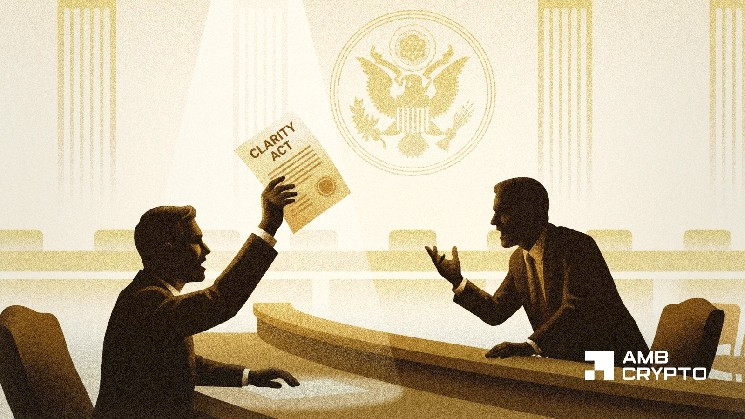
  • Industry Doubts Democrats’ Effort to Restart Stalled CLARITY Act Talks: ‘It’s all talk!’

    Industry Doubts Democrats’ Effort to Restart Stalled CLARITY Act Talks: ‘It’s all talk!’

    Key Highlights

    • Moderate Senate Democrats led by Kirsten Gillibrand and Ruben Gallego pledged renewed bipartisan talks on the CLARITY Act after a 49-50 procedural vote failure.
    • Prediction markets assign less than a 30% probability of passage within two years, while JPMorgan analysts see a narrow but existing legislative window.
    • SEC Chair Paul Atkins and CFTC leaders committed to fast-tracking rulemaking to provide regulatory certainty regardless of legislative outcome.

    Moderate Democrats Vow Renewed Push After CLARITY Act Stalls

    A coalition of moderate Senate Democrats, spearheaded by Senators Kirsten Gillibrand and Ruben Gallego, signaled determination to revive the stalled CLARITY Act following a procedural defeat that underscored deep partisan fractures over digital asset regulation. The legislation, which has been under negotiation for approximately two years, failed to advance on a 49-50 vote after Democrats uniformly blocked the procedural step required to proceed. Notably, seven moderate Democrats who were anticipated to support the measure withheld their votes, citing insufficient ethics provisions as the primary objection.

    This week was a setback, but not the end of that important work. We remain committed to working in a bipartisan fashion to get this legislation passed.

    According to reporting by Eleanor Terrett, the commitment to new talks follows intensive behind-the-scenes efforts to reignite negotiations and potentially fast-track the crypto legislation before the current congressional session concludes. However, the path forward remains highly uncertain, with prediction market platform Kalshi assigning less than a 30% probability of enactment over the next two years.

    Industry Skepticism and Analyst Perspectives

    The Democrats’ recommitment has been met with pronounced skepticism from segments of the crypto industry and pro-crypto analysts. Nate Geraci, a prominent industry observer, characterized the renewed bipartisan rhetoric as “all talk” devoid of substantive action, drawing a sharp contrast with the regulatory posture of the previous administration.

    All talk at this point…There was no ‘working in a bipartisan fashion’ on crypto during the Biden admin. It was purely anti-crypto & regulation by enforcement. So it’s all talk. Actions speak louder than words.

    Despite the legislative impasse, JPMorgan analysts maintain that the bill is not definitively dead, identifying a narrow window for potential passage. This assessment reflects the complex legislative calculus where bipartisan cooperation remains theoretically possible but politically fraught, particularly given the ethics provisions that drove Democratic opposition.

    Regulatory Agencies Pivot to Rulemaking

    In a significant development for market participants, both the Securities and Exchange Commission and the Commodity Futures Trading Commission have pledged to accelerate rulemaking initiatives to establish clear regulatory frameworks for the digital asset sector. This administrative pivot aims to provide a degree of certainty that the legislative process has thus far failed to deliver.

    I have been unequivocal: with or without legislation, we will act decisively within the SEC’s statutory authority to deliver certainty for American investors.

    SEC Chair Paul Atkins’ declaration underscores the agency’s intent to utilize existing statutory authority to address regulatory gaps. The CFTC has echoed this commitment to expedited rulemaking. However, industry participants face a critical unresolved question: whether the next administration will uphold, modify, or reverse these forthcoming regulatory frameworks, introducing a new layer of policy uncertainty.

    Why This Matters

    The CLARITY Act’s stall represents more than a single legislative failure; it encapsulates the broader struggle to define a coherent federal framework for digital assets in the United States. With Congress deadlocked, the locus of regulatory action has shifted decisively to the SEC and CFTC, placing immense importance on the rulemaking agendas of Chair Atkins and his CFTC counterparts. For market participants, the immediate practical impact is a reliance on administrative rulemaking rather than statutory clarity—a dynamic that introduces durability risks should political winds shift after the next election cycle. The narrow legislative window identified by JPMorgan suggests that the lame-duck period or early next session may represent the last best chance for a comprehensive statutory solution before regulatory policy becomes entirely dependent on executive branch interpretation.

    Frequently Asked Questions

    Why did the CLARITY Act fail to advance in the Senate?

    The bill failed on a 49-50 procedural vote after all Democrats, including seven moderate senators expected to support it, voted against advancing the legislation. They cited insufficient ethics provisions as the reason for their opposition.

    What is the likelihood of the CLARITY Act passing in the near future?

    Prediction market Kalshi assigns less than a 30% probability of passage within the next two years. JPMorgan analysts believe the bill is not dead but face a narrow window for enactment.

    How will the SEC and CFTC respond to the legislative stall?

    Both agencies have committed to fast-tracking rulemaking to provide regulatory certainty. SEC Chair Paul Atkins stated the SEC will act decisively within its statutory authority “with or without legislation” to deliver clarity for investors.

  • Kevin O’Leary says Congress will revisit CLARITY early next year as crypto tax bill advances

    Kevin O’Leary says Congress will revisit CLARITY early next year as crypto tax bill advances

    Key Highlights

    • Kevin O’Leary predicts the Clarity Act will resurface in the Senate as early as the first quarter of next year despite failing to secure the 60 votes needed to advance on Tuesday.
    • The Shark Tank investor characterized the 49- vote outcome as expected, stating the bill’s chances of passing were “zero” in the current session.
    • O’Leary cites the House Ways and Means Committee’s advancement of the Digital Asset Tax Certainty Act as a catalyst that will force lawmakers to revisit comprehensive crypto market structure legislation.

    O’Leary Frames Failed Senate Vote as Temporary Setback for Crypto Legislation

    Speaking at the Avalanche Summit in New York on Thursday, veteran investor and Shark Tank host Kevin O’Leary offered a measured assessment of the Clarity Act’s recent procedural defeat in the U.S. Senate. The legislation, which aimed to establish a comprehensive federal framework for digital asset markets by defining the respective jurisdictions of the Securities and Exchange Commission (SEC) and the Commodity Futures Trading Commission (CFTC), fell short of the 60-vote threshold required to proceed on Tuesday, garnering only 49 votes.

    Investor Says Outcome Was Predictable

    O’Leary did not mince words regarding the bill’s immediate prospects. “The chances of CLARITY passing, in my view, were zero, and that’s what happened,” O’Leary said. The comments underscore a pragmatic view among market participants that the current political calendar and partisan dynamics made passage unlikely during the current legislative window. However, the investor was quick to distinguish between a legislative defeat and a permanent death knell for the regulatory framework.

    House Tax Bill Seen as Catalyst for Future Action

    The basis for O’Leary’s optimism regarding the bill’s eventual return lies in parallel legislative movement on the House side. This week, the House Ways and Means Committee advanced the Digital Asset Tax Certainty Act. That legislation seeks to codify tax treatment for specific crypto activities, including staking, mining, small transactions, and broker reporting requirements. O’Leary argued that the advancement of tax-specific rules without a corresponding market structure framework creates an incomplete regulatory picture that Congress will be compelled to resolve.

    He suggested that the interplay between the two chambers makes a return to the Clarity Act—or a similar market structure bill—inevitable. With the tax bill moving forward, lawmakers will face pressure to define the regulatory perimeter for the assets being taxed, a gap the Clarity Act was designed to fill.

    Why This Matters

    The failed cloture vote on the Clarity Act highlights the persistent difficulty of passing standalone crypto market structure legislation in a closely divided Senate. However, the simultaneous progress of the Digital Asset Tax Certainty Act in the House signals a shift toward a piecemeal legislative approach. By addressing tax compliance first, Congress is laying groundwork that may necessitate a market structure bill later to prevent regulatory arbitrage and jurisdictional confusion between the SEC and CFTC. For industry stakeholders, O’Leary’s prediction of a Q1 2025 return suggests the policy debate is entering a holding pattern rather than a conclusion, with the next Congress likely to take up the mantle.

    Frequently Asked Questions

    What was the vote count for the Clarity Act in the Senate?

    The Clarity Act received 49 votes in favor of proceeding, falling 11 votes short of the 60-vote supermajority required to invoke cloture and advance the legislation.

    What is the Digital Asset Tax Certainty Act?

    Advanced by the House Ways and Means Committee, this bill aims to establish clear tax rules for digital asset activities including staking, mining, small transactions, and broker reporting requirements.

    When does Kevin O’Leary expect the Clarity Act to return?

    O’Leary stated he believes the legislation could return as soon as the first quarter of next year.

  • CLARITY Act Update After Failure: SEC Chair Breaks Silence, Says ‘Stay Tuned’

    CLARITY Act Update After Failure: SEC Chair Breaks Silence, Says ‘Stay Tuned’

    SEC Chairman Paul Atkins expressed gratitude to stakeholders across the administration, Congress, investors, and innovators who have advanced the CLARITY Act, while confirming the agency will proceed with regulatory action regardless of the legislation’s fate.

    “I have been unequivocal: with or without legislation, we will act decisively within the SEC’s statutory authority to deliver certainty for American investors and for the entrepreneurs shaping our technological future,” Atkins said. “Stay tuned.”

    A Pattern of Agency-Level Action

    Atkins’ remarks followed a separate announcement outlining the SEC’s latest regulatory proposals, which he characterized as reflecting a focus on keeping Commission rules within the agency’s statutory authority while aligning with current and anticipated market practices.

    The SEC proposed rescinding Rule 14a-8, arguing the rule exceeds the agency’s statutory scope and intrudes into matters of state law. The Commission also proposed amendments to Rule 14a-4(c), aimed at giving companies more flexibility and shareholders greater control over proposals eligible for discretionary proxy voting authority.

    House Advances Crypto Tax Legislation

    Separately, the House Ways and Means Committee advanced the Digital Asset Tax Certainty Act in a 38-5 vote. The bill would ease tax treatment for small cryptocurrency transactions, clarify how stablecoins are handled, and address rules governing mining, staking, and wash sales. The legislation still requires full House approval before moving to the Senate.

    The proposed legislation would eliminate capital gains tax on crypto transactions and network fees under $10, with certain exceptions, and also covers staking, mining, tokenized assets, wash sales, and rules for crypto brokers.

    Strategic Bitcoin Reserve Bill Under Consideration

    Alongside the tax bill, lawmakers are also considering the Strategic Bitcoin Reserve Bill, which would lock up the roughly $25 billion in Bitcoin currently held by the U.S. government for a period of 20 years.

    Shifting Legislative Momentum

    With the CLARITY Act stalled in the Senate, momentum in Washington has shifted toward narrower, more targeted measures. The current approach combines agency rulemaking from the SEC on one front with House-level tax and reserve legislation on the other, rather than pursuing the comprehensive market structure framework the CLARITY Act was designed to deliver.

  • SEC, CFTC Expand Oversight After Clarity Act Stalls

    SEC, CFTC Expand Oversight After Clarity Act Stalls

    The Senate failed to advance the CLARITY Act in a closely watched vote yesterday, prompting an immediate shift in industry focus toward regulatory action by the Securities and Exchange Commission (SEC) and the Commodity Futures Trading Commission (CFTC). With comprehensive market-structure legislation stalled, attention is turning to what the agencies can achieve under existing authority.

    Industry Reaction: Setback, Not Surprise

    Speaking at the Avalanche Summit, Charley Cooper, President of Ava Labs and former CFTC Chief of Staff and Chief Operating Officer, characterized the failed vote as expected. “I can only speculate because I wasn’t in the room,” he said about the failed vote, “but I think there were multiple issues that came into play.” Cooper cited concerns over yield-bearing stablecoins and the difficulty of moving partisan legislation in a midterm election year. “Wasn’t a surprise,” he added.

    Cooper anticipates that agency rulemaking will gain urgency but cautioned on the timeline. “You’re probably looking at… six-plus months before you really begin to see these rules being done in earnest.” Despite the delay, he rejected the notion that the industry should pause. “The failure of the CLARITY Act to pass does not mean there’s a set of things we’re not allowed to do in crypto,” he said. “As an industry, we cannot sit on our hands waiting for permission to do things. That’s how industries die, and I can tell you crypto is well out of the box.” Cooper emphasized that Avalanche is not changing course and will meet clients “where their risk tolerance takes them.”

    Regulators Signal Intent to Act

    Both the SEC and CFTC signaled Wednesday that they intend to move forward independently. SEC Chairman Paul Atkins stated that “with or without legislation, we will act decisively within the SEC’s statutory authority to deliver certainty for American investors and for the entrepreneurs shaping our technological future.” The SEC had previously proposed Regulation Crypto Assets in August, establishing a framework for certain investment contracts involving crypto assets.

    CFTC Chairman Michael Selig was similarly explicit following the Senate vote. He said the agency would work “using our existing statutory authorities,” adding that the CFTC is “locked in and ready to ship its rules for the new frontier of finance.” The two agencies have already been coordinating through Project Crypto, including a joint interpretation issued in March clarifying how federal securities laws apply to certain crypto assets.

    Legislation vs. Rulemaking: Permanence Concerns

    Agency action, however, lacks the permanence of legislation. Atkins acknowledged this limitation in August, calling legislation “indispensable” to creating rules that cannot easily be reversed by a future regulator.

    That message was reinforced during the summit’s CLARITY Act panel. Representatives from the Digital Chamber, Blockchain Association, Crypto Council for Innovation, and DeFi Education Fund described the vote as a setback rather than a terminal failure. Panelists noted that many policy issues had been resolved with congressional staff before political disputes erupted in the final hours. They pointed to ethics conflicts as a remaining obstacle and said developer protections under the Blockchain Regulatory Certainty Act had also become politically contentious.

    Near-Term Outlook: Agency Action Leads

    The industry expects the SEC and CFTC to move quickly with existing rulemaking efforts. With Congress scheduled to recess in early October, agency action is seen as the more likely near-term path. While the absence of legislation may slow real-world-asset tokenization and other institutional projects, panelists and executives agreed the work will continue regardless.

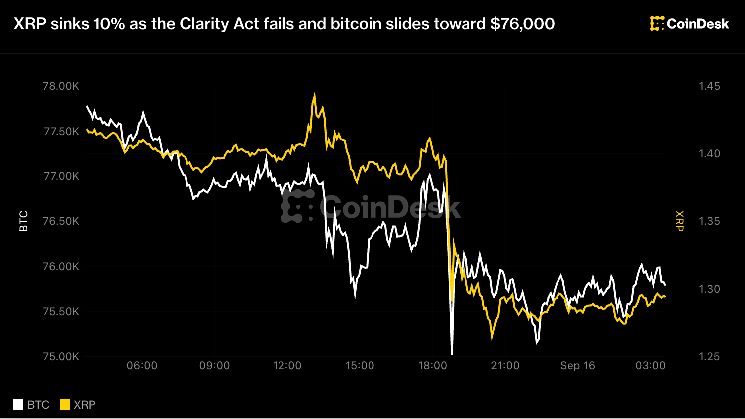
  • XRP Sinks 10% as Clarity Act Fails, Bitcoin Slides Toward $76,000

    XRP Sinks 10% as Clarity Act Fails, Bitcoin Slides Toward $76,000

    XRP led a broad cryptocurrency sell-off Wednesday morning, plunging nearly 10% to $1.30 during Asian trading hours after the U.S. Senate failed to advance the Clarity Act, according to CoinDesk data.

    Major Tokens Slide Across the Board

    Ether followed with a decline of nearly 5% to approximately $2,410. Solana dropped 5% to just above $97, while Dogecoin fell nearly 5%. Zcash and Hyperliquid’s HYPE each slipped close to 4%, and Bitcoin retreated nearly 3% to just above $76,000. BNB and Tron proved the most resilient, each down only about 1%.

    Clarity Act Fails on Cloture Vote

    The legislation fell short on a 49-50 cloture vote, the procedural threshold requiring 60 senators to move a bill to debate. Multiple Republicans joined Democrats in voting against the measure. Negotiators had produced more than 600 pages of compromise text, but the provision that ultimately derailed the bill centered on ethics language designed to prevent senior government officials from maintaining crypto business interests.

    Senator Slotkin Cites Ethics Concerns

    Senator Elissa Slotkin, a Michigan Democrat, explained her opposition by stating the “the ethics provisions in this bill are simply too thin,” pointing to President Donald Trump, his children and his Cabinet earning money in crypto.

    She also said the Commodity Futures Trading Commission lacks the staffing to implement the law, and that the bill left gaps on money laundering and terrorist financing.

    Today, I voted no on the Clarity Act, legislation meant to regulate cryptocurrency in America.The ethics provisions in this bill are simply too thin. President Trump, his children, and his Cabinet are making billions of dollars in the crypto space, in part from bilking everyday…

    — Sen. Elissa Slotkin (@SenatorSlotkin) September 15, 2026

    Crypto Equities Hit Harder Than Tokens

    Publicly traded crypto companies suffered steeper losses than the underlying assets. Coinbase shares fell nearly 9% to $174.42, while Circle dropped more than 9% to $88.26. Galaxy Digital declined 8% and Gemini slid 7%. Bullish and Riot Platforms each lost 5%, eToro fell 4%, and Robinhood, MARA Holdings, CleanSpark, IREN and Core Scientific all dropped between 3% and 4%.

    Regulatory Path Forward Shifts to SEC

    Attention now turns to the regulators the bill was intended to constrain. The Securities and Exchange Commission is already advancing its proposed Reg Crypto framework and rules for tokenized securities, which now represents the primary pathway to the regulatory certainty the industry sought from Congress.

    Political and Market Implications

    Industry political action committees, including Fairshake, must now decide how to approach senators who voted against the legislation ahead of the November 3 election. A new Congress will convene in January 2027.

    Meanwhile, the Federal Reserve is scheduled to announce its rate decision later Wednesday, with traders leaning toward a quarter-point hike. The decision lands on a market that has just watched its legislative push collapse and is already selling risk assets.

  • CLARITY Act Vote Stalls in Senate

    CLARITY Act Vote Stalls in Senate

    Senate Stalls CLARITY Act, Amplifying Crypto Regulatory Uncertainty

    The U.S. Senate failed to advance the CLARITY Act today, a development that injects fresh uncertainty into the digital asset regulatory landscape. According to a report from Fireblocks, the legislative stall threatens to disrupt the independent rulemaking timelines of both the Securities and Exchange Commission (SEC) and the Commodity Futures Trading Commission (CFTC), leaving traders and investors navigating a prolonged period of ambiguity.

    Legislative Gridlock Complicates Agency Timelines

    The CLARITY Act was designed to establish clearer jurisdictional boundaries between the SEC and CFTC regarding digital assets, providing a statutory framework many argue is essential for fostering innovation and investor confidence. With the bill stalled, both agencies continue to draft rules through their existing notice-and-comment processes—a timeline that extends roughly two years into the future.

    Fireblocks highlights that this legislative vacuum forces market participants to operate under overlapping and potentially conflicting regulatory regimes for the foreseeable future. The lack of congressional action effectively cedes the pace and shape of crypto regulation to agency-level proceedings, which may not align with industry needs or market realities.

    Mixed Market Signals Reflect Cautious Sentiment

    The broader cryptocurrency market is currently exhibiting mixed momentum across major assets, a pattern consistent with heightened regulatory sensitivity. The absence of decisive price action suggests traders are adopting a wait-and-see posture, recalibrating strategies around the extended horizon for regulatory clarity.

    Key factors influencing near-term sentiment include:

    • Potential revival of CLARITY Act discussions in the Senate
    • Upcoming SEC and CFTC rule proposals and comment deadlines
    • Shifts in trading volumes tied to regulatory news flow

    What Market Participants Should Monitor

    Stakeholders should track any signals of renewed legislative momentum around the CLARITY Act, as well as formal rulemaking publications from the SEC and CFTC. The interplay between congressional action and agency rulemaking will likely dictate market structure, compliance costs, and the competitive landscape for digital asset services in the U.S. over the next two years.

    This article is for informational purposes only and does not constitute financial advice.

  • Bitcoin, Ethereum, XRP Plunge After CLARITY Act Fails in Senate Vote

    Bitcoin, Ethereum, XRP Plunge After CLARITY Act Fails in Senate Vote

    Bitcoin, Ethereum, XRP Face Selling Pressure After Senate CLARITY Act Vote Fails

    Major cryptocurrencies including Bitcoin (BTC), Ethereum (ETH), and XRP came under fresh selling pressure Thursday after the U.S. Senate failed to advance the CLARITY Act, a key piece of digital-asset market structure legislation.

    Senate Procedural Vote Falls Short of 60-Vote Threshold

    A procedural vote on the bill did not secure the 60 votes needed to overcome a filibuster, effectively stalling the legislation. The defeat concludes months of negotiations between Republicans and Democrats over the regulatory framework for digital assets.

    Market Reaction Reflects Regulatory Uncertainty

    The immediate market reaction underscores how sensitive crypto prices remain to policy developments in Washington. Traders had been monitoring the CLARITY Act closely, viewing its passage as a potential catalyst for institutional adoption and clearer compliance guidelines.

    According to the latest market data, the three assets erased earlier gains following news of the vote’s failure, with selling pressure accelerating during the U.S. trading session.

    What the CLARITY Act Would Have Done

    The bipartisan bill aimed to establish clear jurisdictional boundaries between the Securities and Exchange Commission (SEC) and the Commodity Futures Trading Commission (CFTC) for digital asset oversight. It also sought to define when a token qualifies as a security versus a commodity — a distinction that has been central to enforcement actions and industry uncertainty.

    Outlook for Crypto Regulation in Congress

    With the legislative calendar tightening ahead of the November elections, the path forward for comprehensive crypto market structure legislation remains unclear. Market participants will now watch for potential attachment to must-pass spending bills or renewed bipartisan efforts in the next session.

  • SEC Setback as CLARITY Act Fails to Advance in Senate

    SEC Setback as CLARITY Act Fails to Advance in Senate

    CLARITY Act Stalls in Senate, Putting Spotlight on SEC and CFTC Crypto Authority

    The CLARITY Act failed to advance in the Senate on September 15, 2026, dealing a blow to legislative efforts aimed at establishing a structured regulatory framework for digital assets. The setback was highlighted by Coinbase CEO Brian Armstrong, who expressed disappointment while noting that existing regulatory tools remain available to provide clarity.

    What Happened: Legislative Gridlock Shifts Focus to Agency Action

    The broader cryptocurrency market is showing mixed signals against this backdrop of regulatory uncertainty. The Securities and Exchange Commission (SEC) and the Commodity Futures Trading Commission (CFTC) have previously indicated they possess the authority to implement necessary rules without the CLARITY Act, which was designed to create more structured guidelines for the industry.

    As the regulatory landscape evolves, stakeholders will be closely monitoring how these agencies leverage their existing powers to bring definition to the crypto environment.

    Key Takeaways

    • The CLARITY Act did not advance in the Senate as of September 15, 2026.
    • Brian Armstrong emphasizes the ongoing need for regulatory clarity.
    • The SEC and CFTC are expected to act under existing authorities.
    • Future regulatory frameworks may emerge without congressional approval.
    • The current situation underscores the urgency for clear crypto regulations.

    Market Snapshot: Traders Await Guidance

    Market activity currently shows a standstill, with no reported volume or significant price changes. The lack of movement reflects uncertainty as traders await clearer guidance on regulatory developments. The SEC and CFTC’s ability to act on their own authority may prompt shifts in market sentiment once clarity is established.

    Regulatory Primer: SEC vs. CFTC Jurisdiction

    The SEC is the primary regulatory body overseeing securities markets in the U.S. Its jurisdiction includes enforcing securities laws and ensuring fair practices in financial markets, including cryptocurrencies. The CFTC regulates commodity futures and options markets. Both agencies are pivotal in shaping the future of crypto regulation.

    What to Watch Next

    Traders and industry participants should monitor several key catalysts:

    • Potential announcements from the SEC and CFTC regarding new regulations or enforcement priorities.
    • Any clarification from either agency on their stance toward digital assets under existing authorities.
    • Bipartisan discussions that could revive the CLARITY Act or similar legislation, as political movements may influence regulatory momentum.

    If the SEC and CFTC begin to clarify their positions on crypto under current mandates, it could significantly impact market dynamics and provide the certainty the industry has been seeking.

  • Clarity Act Fails to Pass, Sparking Investor Concern

    Clarity Act Fails to Pass, Sparking Investor Concern

    Crypto Derivatives Face Uncertainty After Clarity Act Failure

    The collapse of the Clarity Act has triggered significant concern across the cryptocurrency derivatives market, with sophisticated investors warning that regulatory ambiguity may drive institutional capital away from speculative trading products.

    Market Reaction: Volumes Vanish Amid Regulatory Void

    Trading activity has ground to a near halt. According to market data cited by crypto commentator Pentosh1, derivatives volumes dropped to $0 in the last 24 hours, signaling a abrupt withdrawal of liquidity as participants digest the legislative setback. The absence of trading reflects a cautious stance from both retail and institutional actors reassessing exposure in the absence of clear regulatory guardrails.

    Institutional Hesitation Grows

    The Clarity Act was designed to establish a coherent regulatory framework for digital assets, aiming to encourage deeper institutional engagement. Its failure removes a anticipated pathway for compliance, leaving fund managers, market makers, and custodians without the legal certainty required to scale derivatives operations.

    Pentosh1 notes that sophisticated investors are worried that institutions may refrain from engaging with speculative derivatives, a dynamic that could amplify price swings as hedging and market-making capacity contracts.

    Sentiment Turns Fragile

    Social media chatter has shifted toward anxiety-driven memes and speculation, underscoring a broader loss of confidence. Traders are questioning the viability of leveraged positions and structured products in an environment where regulatory risk is now the dominant variable.

    What Comes Next

    Market participants are now monitoring:

    • Regulatory signals from the SEC, CFTC, and congressional leadership
    • Derivatives exchange responses — including potential product delistings or margin hikes
    • Institutional custody and prime brokerage announcements

    Analysts warn that prolonged uncertainty could trigger liquidation cascades if leveraged positions are unwound en masse. The coming weeks will determine whether the market stabilizes around alternative compliance models or enters a deeper retrenchment.

    Bottom Line

    The Clarity Act’s failure has injected a new layer of systemic risk into crypto derivatives. Without legislative clarity, institutional participation — critical for depth, stability, and innovation — remains on hold. Traders should prepare for elevated volatility and fragmented liquidity until a new regulatory signal emerges.