Tag: SEC tokenized stocks

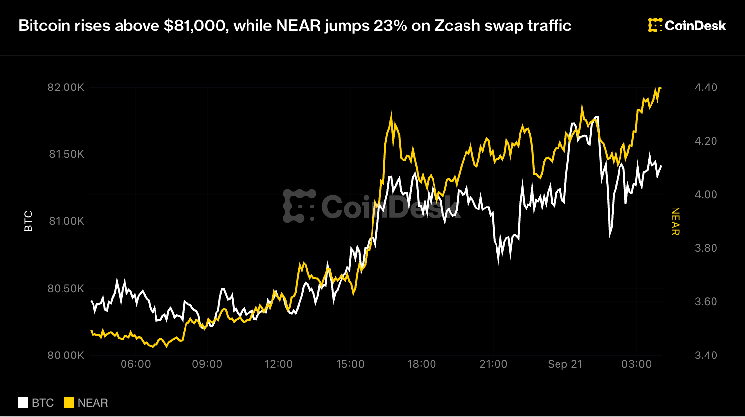
  • Bitcoin Surges Past $81,000 as NEAR Jumps 23% on Zcash Swap Traffic

    Bitcoin Surges Past $81,000 as NEAR Jumps 23% on Zcash Swap Traffic

    Key Highlights:

    • Bitcoin holds above $81,000 in Monday Asian trading, extending gains after the SEC greenlit onchain trading of tokenized U.S. equities.
    • NEAR token surges roughly 23% to above $4 as its cross-chain swap service, NEAR Intents, becomes a primary routing layer for Zcash (ZEC) volume.
    • Major consumer wallets ZODL and Vizor have integrated NEAR Intents, driving a sixfold jump in daily ZEC volume routed through the protocol in the past week.

    Bitcoin Consolidates Above $81K as SEC Tokenized Stock Ruling Lifts Sentiment

    Bitcoin traded just above $81,000 during Monday morning hours in Asia, marking a gain of less than 1% over the preceding 24 hours according to CoinDesk data. The cryptocurrency has been adding to its recovery since Thursday, when the U.S. Securities and Exchange Commission cleared a regulatory path for the onchain trading of tokenized U.S. stocks. The move is widely seen as a landmark step toward bridging traditional equity markets with blockchain-based settlement, providing a fresh catalyst for digital-asset risk appetite.

    NEAR Token Leads Major-Cap Gains on Cross-Chain Routing Demand

    The standout performer among major tokens was NEAR, which climbed approximately 23% to trade just above $4. The rally traces directly to NEAR Intents, a swap service built on the NEAR blockchain that enables a wallet to exchange one token for another across different chains without requiring the user to move funds between networks first. The abstraction of cross-chain complexity has turned NEAR into a de facto routing layer for one of the most heavily traded assets in the market.

    Wallet Integrations Drive Sixfold Volume Spike for ZEC

    Major consumer wallets, including ZODL and Vizor, have plugged NEAR Intents into their interfaces to offer Zcash (ZEC) swaps. Since those integrations went live, daily ZEC volume routed through the service has jumped sixfold in a single week. The surge in order flow has created a positive feedback loop for the NEAR token itself, which has followed the traffic as the underlying settlement and gas asset for the routing activity.

    Broader Market Moves Remain Measured

    Outside of NEAR’s outsized move, the rest of the major-cap complex posted modest advances. ZEC itself gained 3% to just above $1,500, while BNB rose 2% to nearly $777. Ether and HYPE each added roughly 2%. The remaining large-cap cohort — XRP, DOGE, SOL, and TRX — all rose 1% or less, indicating a market digesting the SEC news selectively rather than chasing a broad risk-on impulse.

    Why This Matters

    The SEC’s decision to allow onchain trading of tokenized U.S. equities represents a structural shift: it legitimizes the use of public blockchains as settlement rails for regulated securities. For protocols like NEAR that have invested in chain-abstraction infrastructure, the ruling arrives as tailwinds build for cross-chain liquidity aggregation. The sixfold volume increase on NEAR Intents demonstrates real user demand for seamless interoperability — a prerequisite if tokenized stocks are to trade natively onchain at scale. Watch for further wallet integrations and whether other Layer 1s deploy similar intent-based routing to capture order flow.

    Frequently Asked Questions

    What is NEAR Intents and why is it driving NEAR’s price higher?

    NEAR Intents is a cross-chain swap service on the NEAR blockchain that lets users trade tokens across different networks without manually bridging funds. Wallets ZODL and Vizor have integrated it for ZEC swaps, causing a sixfold volume spike that increases demand for NEAR as the routing layer’s native gas and settlement token.

    How did the SEC’s tokenized stock decision affect Bitcoin?

    Bitcoin has extended gains since Thursday’s SEC ruling, trading above $81,000 on Monday. The decision is viewed as a bullish regulatory signal for the broader digital-asset ecosystem, though Bitcoin’s own move has been modest — up less than 1% in 24 hours — suggesting the market is still calibrating the long-term implications.

    Which other major tokens moved on Monday?

    ZEC gained 3% to above $1,500; BNB rose 2% to near $777; Ether and HYPE each added about 2%; while XRP, DOGE, SOL, and TRX all rose 1% or less.

  • Matt Hougan Compares Tokenization’s Rise to Nvidia’s Early AI Surge

    Matt Hougan Compares Tokenization’s Rise to Nvidia’s Early AI Surge

    Key Highlights

    • The SEC has established a temporary regulatory framework allowing tokenized U.S. stocks to trade on blockchain infrastructure, preserving shareholder rights such as dividends and voting.
    • S&P Global agreed to acquire OpenZeppelin, whose smart-contract technology has facilitated over $37 trillion in transferred value across stablecoins, tokenized funds, and DeFi applications.
    • Bitwise CIO Matt Hougan compares tokenization’s current stage to NVIDIA’s early AI trajectory, arguing the sector is entering a multi-year transformation rather than a fleeting trend.

    Tokenization Advances Toward Mainstream Financial Infrastructure

    Tokenization has moved closer to the center of U.S. financial-market development, giving Bitwise Chief Investment Officer Matt Hougan a fresh reason to compare the sector with the early stages of the artificial-intelligence boom. On September 17, 2026, Hougan argued that the world is moving onchain and described tokenization as a multi-year transformation rather than a short-lived market theme. His perspective arrives as two significant institutional milestones coincide: the Securities and Exchange Commission opening a regulated pathway for tokenized equities and S&P Global announcing its agreement to acquire blockchain security firm OpenZeppelin.

    SEC Creates Regulated Pathway for Tokenized Stocks

    The SEC’s latest action provides a regulated path for certain venues to trade tokenized U.S. stocks on blockchain-based infrastructure. The framework covers tokenized National Market System stocks that preserve shareholder rights such as dividends and voting, while synthetic products that only track stock prices remain outside the exemption. Issuers also receive a 30-day period to object to third-party tokenization of their securities.

    The SEC’s temporary exemption lasts up to five years and applies under specific conditions, including limits around participating venues, eligible securities, and trading activity. The agency said the framework is intended to facilitate innovation while it considers broader policy. This creates a clearer lane for companies developing blockchain-based equity infrastructure and signals growing regulatory comfort with onchain financial rails.

    S&P Global Acquires OpenZeppelin in Major Institutional Signal

    The regulatory move arrived alongside S&P Global’s agreement to acquire OpenZeppelin, adding another substantial institutional signal. OpenZeppelin’s smart-contract technology supports major stablecoins, tokenized funds, and DeFi applications. The company says its contracts have facilitated more than $37 trillion in transferred value and that it has completed more than 900 security engagements. The acquisition underscores how traditional financial infrastructure providers are positioning themselves for a tokenized future.

    NVIDIA Parallel Highlights Tokenization’s Early Stage

    Hougan’s analogy rests on the idea that technology megatrends can continue expanding after investors first recognize them. He notes that ChatGPT launched in November 2022 while NVIDIA traded around $16. About a year later, NVIDIA had reached $46, a 176% increase, making the scale of the AI opportunity more visible. Hougan observed that NVIDIA now trades around $219 and used that progression to argue that recognizing a major shift does not mean the opportunity has already passed.

    Tokenization is a mega trend. Just today, the SEC created a pathway for tokenized stocks to trade in the US, S&P acquired @OpenZeppelin, and DeFi assets are ripping. If you had doubts before, today should put them to rest. The world is moving onchain.
    The thing about…

    — Matt Hougan (@Matt_Hougan) September 17, 2026

    The comparison does not establish that tokenization will follow NVIDIA’s price path. Instead, it highlights Hougan’s view that blockchain-based financial rails can become a long-duration market transition. As traditional financial firms add tokenized products and established infrastructure providers enter the sector, the onchain model is gaining more connections to conventional capital markets.

    Why This Matters

    The convergence of regulatory clarity and institutional acquisition marks a pivotal moment for tokenization. The SEC’s framework addresses a longstanding barrier by defining how tokenized equities can operate within existing securities law while preserving core shareholder protections. Simultaneously, S&P Global’s purchase of OpenZeppelin brings a leading smart-contract auditing and infrastructure provider under the umbrella of a traditional financial data and ratings giant. Together, these developments suggest that tokenization is transitioning from experimental pilots to production-grade financial infrastructure. Market participants should watch for the first venues to launch under the SEC exemption, the integration of OpenZeppelin’s technology into S&P’s offerings, and whether other major financial infrastructure firms pursue similar acquisitions or partnerships.

    Frequently Asked Questions

    What does the SEC’s new framework allow for tokenized stocks?

    The SEC’s temporary exemption creates a regulated pathway for venues to trade tokenized National Market System stocks on blockchain infrastructure for up to five years. The framework requires preservation of shareholder rights including dividends and voting, excludes synthetic products that only track prices, and gives issuers a 30-day window to object to third-party tokenization.

    Why is S&P Global acquiring OpenZeppelin significant?

    The acquisition brings OpenZeppelin’s smart-contract security expertise—which has underpinned over $37 trillion in transferred value across stablecoins, tokenized funds, and DeFi—into a traditional financial infrastructure leader. It signals that established institutions are investing directly in the technical foundations of onchain finance.

    What is Matt Hougan’s NVIDIA comparison meant to illustrate?

    Hougan uses NVIDIA’s trajectory from ChatGPT’s launch (when NVIDIA traded around $16) to its subsequent rise (reaching $46 within a year and approximately $219 later) to argue that recognizing a transformative technology trend early does not mean the investment opportunity has passed. He views tokenization as being in a similar early-adoption phase with multi-year growth potential.