Tag: Ryan Stannard

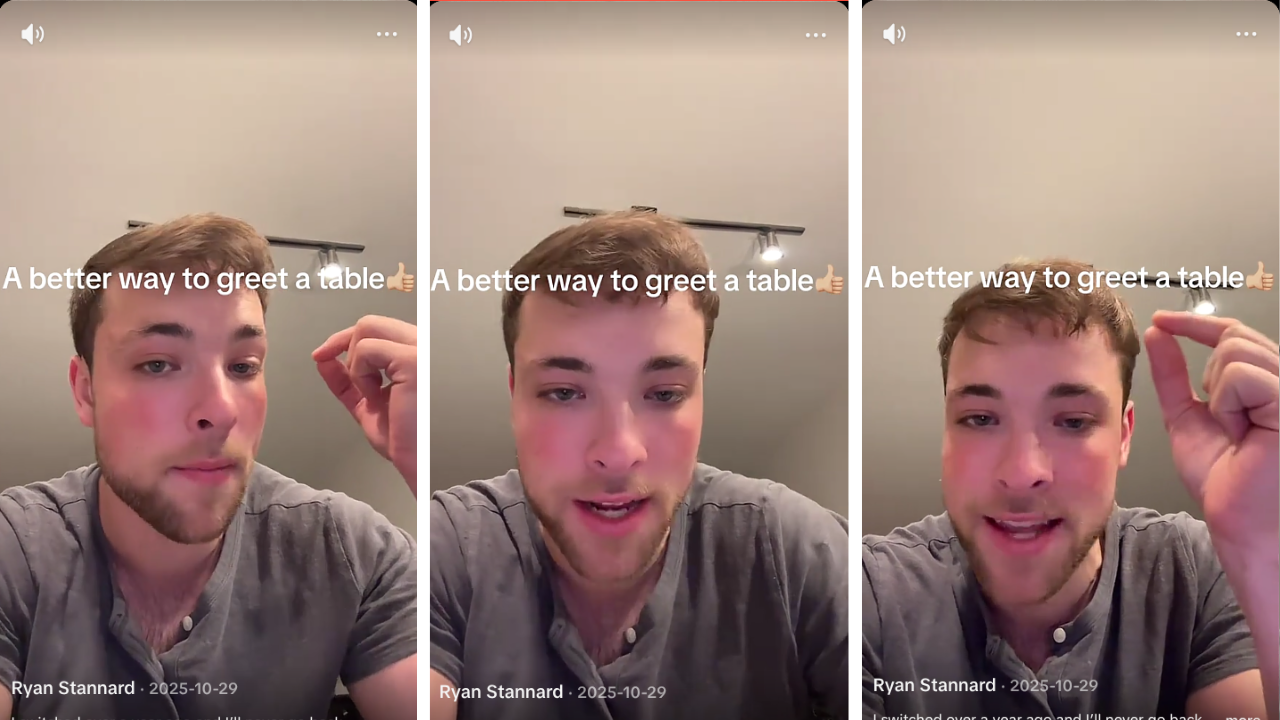
  • Server Reveals Better Way to Greet Tables Than Introducing Yourself: ‘Meet Their Needs First’

    Server Reveals Better Way to Greet Tables Than Introducing Yourself: ‘Meet Their Needs First’

    Key Highlights:

    • TikTok creator Ryan Stannard (@ryan_stannard4) argues servers should greet tables with “Hey guys. How’s our day going?” instead of introducing themselves first, claiming the standard introduction gets servers forgotten.
    • Stannard’s method prioritizes taking food and drink orders before revealing his name, citing a psychological principle that people remember names better after their immediate needs are met.
    • The video sparked debate, with some commenters supporting the approach while others—including self-identified guests—said they prefer efficient service without small talk.

    Server’s Viral TikTok Challenges Standard Restaurant Greeting Script

    TikTok creator Ryan Stannard, known as @ryan_stannard4, has ignited a conversation about restaurant service etiquette with a video that has amassed over 1.6 million views and nearly 1,000 comments. Drawing on his experience as a server, Stannard contends that the industry-standard greeting—introducing oneself by name before taking orders—is a strategic error that causes servers to blend into the background and potentially lose tips.

    The Case Against the Standard Introduction

    Stannard opened his critique by targeting the ubiquitous server script. “Hi, my name is __, I’ll be taking care of you today,” he said, characterizing this approach as a bad start. His reasoning centers on volume and differentiation: with multiple servers working the same floor, all using near-identical language, none of them stand out. He argues that a greeting must sound different from everyone else’s to capture attention and build rapport quickly.

    In place of the scripted introduction, Stannard demonstrated his preferred opener: “Hey guys. How’s our day going?” He explained that opening with a question forces engagement. The table almost invariably responds in kind—“And how’s your day going?”—creating a natural opening for the server to reply with energy. Stannard suggested responses such as “Phenomenal” or “Fantastic” or “Stupendous. Thank you for asking.” At that point, he said, “you now have their attention.”

    Psychological Timing: Orders First, Name Later

    The core of Stannard’s method is a deliberate reordering of the interaction sequence. He does not disclose his name until after taking the guests’ food and drink orders. He frames this as a psychological fact: a person is more likely to remember a server’s name after their immediate needs—deciding what to eat and drink—have been addressed. If the server introduces themselves first, Stannard argues, the guests are mentally preoccupied with the menu and forget the name within minutes.

    He also described his approach as more natural and less “carbon-copied” than the standard introduction. He said it saves time and makes the interaction more efficient while keeping the conversation “short, sweet, and to the point.” Waiting to introduce himself, he believes, makes it more likely that guests will remember his name when it matters—at tip calculation time.

    Why This Matters: Service Psychology Meets Social Media Scrutiny

    The debate Stannard sparked reflects a longstanding tension in hospitality between scripted consistency and authentic connection. Corporate training programs have long mandated the name-first introduction as a brand standard, equating it with professionalism and accountability. Stannard’s challenge, amplified by TikTok’s algorithm, puts that orthodoxy to a public stress test. The reaction split—some servers adopting the tactic, some guests rejecting the forced familiarity—highlights that “good service” is not a monolith. For operators, the takeaway may be less about adopting one viral script and more about empowering staff to read the table and adapt, rather than reciting a line that guests have heard a thousand times. The Daily Dot was unable to independently verify the claims made in the video, which are based solely on @ryan_stannard4’s experience and perspective as a restaurant server, as shared on TikTok.

    Frequently Asked Questions

    What is Ryan Stannard’s suggested alternative to the standard server greeting?
    He recommends opening with “Hey guys. How’s our day going?” and delaying his name introduction until after taking food and drink orders.
    Why does Stannard believe introducing yourself first hurts tips?
    He argues guests are focused on the menu and forget the server’s name within minutes; psychologically, people retain names better after their own needs are met.
    How did commenters react to the video?
    Reactions were mixed. One commenter wrote, “I usually get interrupted with ‘Waters to start please.’” Another guest responded, “Please no! As a guest… I don’t want to answer small talk questions. Just get my order right, bring the sauces I asked for, and refill my drink before it’s completely empty and we’re golden!”

  • Server Shares Trick to Keep Restaurant Guests Happy During Rush: ‘Reset Their Mental Clock’

    Server Shares Trick to Keep Restaurant Guests Happy During Rush: ‘Reset Their Mental Clock’

    Key Highlights

    • TikTok creator and longtime server Ryan Stannard (@ryan_stannard4) shared a technique called “resetting their mental clock” to manage multiple tables during busy shifts, earning over 31,800 likes.
    • The method involves briefly acknowledging every table—even while en route to another—to reassure guests they haven’t been forgotten, which Stannard says resets their internal wait-time expectations.
    • Commenters offered conflicting strategies, from treating all tables as a single party to citing strict corporate greet-time standards that make Stannard’s approach impractical in some restaurants.

    Server’s Viral ‘Mental Clock’ Technique Sparks Debate Among Restaurant Workers

    Ryan Stannard, a longtime server who shares industry advice under the handle @ryan_stannard4 on TikTok, recently posted a video outlining a simple but potentially powerful tactic for juggling a full section. The clip, which had amassed 31,800 likes and 207 comments at the time of publication, centers on a concept Stannard calls “resetting their mental clock.” The premise: when a server’s section fills up, the instinct may be to focus entirely on the table currently being served. Stannard argues that taking a few seconds to make eye contact, offer a quick greeting, and verbally acknowledge every other table—telling them “I’ll be right with you”—fundamentally changes the guest’s perception of the wait.

    How the ‘Reset’ Works in Practice

    According to Stannard, the moment a server acknowledges a waiting table, the customer’s internal countdown—their “mental clock”—restarts because they now know service is imminent. This brief intervention, he contends, buys the server valuable time to complete tasks at the POS, run food, or finish taking an order elsewhere without the pressure of guests feeling abandoned. The advice resonated with a segment of the commentariat. One user declared, “Rule #1 of serving: COMMUNICATE,” while another reinforced the psychology: “Just saying hello to your tables will buy you some time. As long as they know someone is coming to take care of them, they will calm people down.”

    Industry Veterans Push Back With Alternative Workflows

    Not every restaurant professional found the technique universally applicable. A detailed dissenting comment laid out a contrasting, assembly-line workflow: “Negative! You treat it all like one party. You greet table one, write all their drinks down ask them if they want appetizers. Then you got a table two you do the same thing, followed by table 3. Stop by POS station ringing all appetizers for every table plus any alcoholic beverages then you go to the kitchen and you make everybody’s drinks,” the commenter wrote. Others pointed to rigid corporate metrics that leave no room for discretionary check-ins. One server explained, “Truthfully, I understand what you mean, but the restaurant I work at has a 30 second greet, and 1 min non alc standard. I love to swing by and grab as many first rounds as possible but unfortunately if I’m getting shopped it’ll look bad on my part,” referencing mystery-shopper evaluations tied to specific time standards.

    When Guests Refuse to Let Go

    A third friction point emerged from the unpredictable human element: tables that monopolize the server’s time. One commenter described a scenario where guests claim readiness but then deliberate at length, effectively trapping the server. “What happens if a table says they are ready, take what feels like 10 mins to order and won’t let you walk away. I’ll say ‘I can give yall some more time’ and they say no that they are ready right now and it feels like you can’t walk away, even though other tables are waiting on you. This happened to me on Saturday and ruined my whole flow,” they wrote. The thread collectively illustrates that no single heuristic—whether Stannard’s mental-clock reset, a batched greeting system, or strict adherence to corporate timers—can account for every variable in a dining room.

    Why This Matters

    The conversation around Stannard’s video underscores a persistent tension in hospitality labor: the gap between individualized, experience-based heuristics and the standardized, metric-driven protocols imposed by many restaurant groups. As labor markets tighten and guest expectations rise—fueled in part by social media reviews—servers are increasingly forced to navigate contradictory demands: provide personalized, attentive service while hitting rigid speed-of-service targets measured by mystery shoppers and POS analytics. The viral spread of this debate on TikTok also highlights how frontline workers are using the platform to crowdsource operational knowledge, effectively creating an informal, peer-to-peer training network that bypasses traditional management structures. For operators, the takeaway is clear: any service standard must leave enough autonomy for staff to handle the real-time variability—chatty tables, kitchen bottlenecks, staffing gaps—that no script can fully anticipate.

    Frequently Asked Questions

    What exactly is the “reset their mental clock” technique?
    It is a brief, proactive acknowledgment—eye contact, a greeting, and a verbal assurance such as “I’ll be right with you”—given to every table in a server’s section, even while the server is actively engaged with another party. The goal is to restart the guest’s internal wait timer so they feel seen rather than forgotten.
    Why do some servers say the technique doesn’t work in their restaurant?
    Many chain and corporate restaurants enforce strict service-time benchmarks (e.g., a 30-second initial greet, one-minute non-alcoholic beverage delivery) that are measured by mystery shoppers. Deviating to check on other tables can cause a server to miss those metrics and face disciplinary action.
    Has The Daily Dot verified the claims made in the TikTok video and comments?
    No. The publication explicitly states it was unable to independently verify the experiences described by Ryan Stannard or the commenters; the article is based solely on the content of the TikTok post and the ensuing discussion.
  • Man Claims Restaurant Workers Have ‘No Excuse to Be Broke’: ‘Hustle Until You Have $10K in the Bank’

    Man Claims Restaurant Workers Have ‘No Excuse to Be Broke’: ‘Hustle Until You Have $10K in the Bank’

    Key Highlights

    • TikTok creator Ryan Stannard (@ryan_stannard4) argues restaurant workers can achieve financial success through hustle, shift pickup, and saving habits, recommending workers build a $10,000 safety net.
    • The video sparked polarized debate, with commenters citing low base wages, toxic management, slow seasons, and federal minimum wage disparities as structural barriers to Stannard’s advice.
    • The Daily Dot could not independently verify Stannard’s earnings claims; the discourse reflects broader tensions around tipped labor economics and workplace conditions in the U.S. restaurant industry.

    TikTok Creator Sparks Debate With Claim That Restaurant Workers Have ‘No Excuse to Be Broke’

    TikTok content creator Ryan Stannard, who posts under the handle @ryan_stannard4, published a video reflecting on his experience in the restaurant industry and asserting that financial struggle among hospitality workers is largely a matter of personal accountability. The video, which had garnered 12,000 likes and 151 comments at the time of reporting, outlines a series of behavioral changes Stannard believes can transform a restaurant job into a lucrative career.

    Stannard’s Framework: Shift Pickup, Tip Maximization, and a $10,000 Target

    In the video, Stannard lists several strategies he says enabled his own success. He encourages workers to pick up colleagues’ shifts, work harder to increase tip earnings, and adopt a mindset of financial discipline. “Little steps in the right direction are still steps. Set a goal, hit the goal, raise the goal.” he wrote in the video’s caption. Stannard explicitly states he would rather clean restaurant bathrooms than struggle to pay bills, framing undesirable tasks as a necessary trade-off for income stability. He recommends that workers “hustling” until they accumulate $10,000 in their bank accounts, a threshold he says provides a critical financial safety net and peace of mind.

    Commenters Challenge Structural Realities of Tipped Labor

    The response on TikTok was sharply divided. A significant portion of commenters pushed back against Stannard’s characterization, arguing that his experience does not reflect the structural realities faced by many hospitality employees. One commenter wrote, “Except my manager expects me to clean the toilets for my regular wage every shift and will still complain about paying me if it takes time to do,” highlighting unpaid or underpaid side work. Another pointed to geographic and role-based wage disparities: “UNLESS you work at a slow restaurant/its slow season or if you’re a host on federal minimum wage.”

    Others emphasized the difficulty of securing high-volume positions in the current economy. “Most people struggle to even find a position in the industry that ACTUALLY either pay well, or is a spot busy enough to make them money,” one user wrote. The discussion touched on the federal tipped minimum wage of $2.13 per hour, which persists in numerous states, and the volatility of tip income during seasonal downturns or in lower-traffic establishments.

    Support for Savings Discipline Amid Skepticism on Universality

    Not all feedback was critical. Several commenters validated the core savings principle while contesting the universality of Stannard’s operational advice. “Might be the best advice he’s given. Although no ones paying their servers to clean toilets. That’s just wherever he worked. but the saving part is spot on. I saved up 11k in one year and I didn’t have to pick up doubles or give up all my weekends,” one user commented. Another offered a complementary perspective on professional conduct: “It is genuinely so easy to be one of the better servers at any restaurant. Don’t come into work under the influence whatsoever, trade cuts to close, don’t stand around and talk on shift, make your complete focus your tables and the money you make and you will see how easy it is to rise through the ranks.”

    Why This Matters: The Tipped Wage Debate in Context

    The viral exchange encapsulates a long-standing policy and cultural debate in the United States over the subminimum wage for tipped workers. Under the Fair Labor Standards Act, employers may pay tipped employees as little as $2.13 per hour federally, provided tips bring total compensation to the standard minimum wage; if they do not, the employer is legally required to make up the difference. However, enforcement is inconsistent, and wage theft investigations by the Department of Labor frequently cite restaurant violations. The discourse also reflects post-pandemic labor market shifts: while some urban fine-dining servers report record earnings, many casual-dining and rural workers face reduced hours, tip pooling dilution, and rising living costs that outpace gratuity income. Stannard’s $10,000 benchmark aligns with common personal-finance guidance for an emergency fund, yet the feasibility of reaching it varies dramatically by concept, region, and schedule control.

    Frequently Asked Questions

    Who is Ryan Stannard and what platform did he use?
    Ryan Stannard is a TikTok creator who posts under the username @ryan_stannard4. He shared a video discussing his perspective on earning potential and financial habits for restaurant workers.
    What specific financial goal does Stannard recommend for restaurant workers?
    Stannard advises workers to “hustle” until they have $10,000 in their bank accounts, which he says will help them feel more financially secure.
    Why did some TikTok users disagree with Stannard’s advice?
    Commenters cited structural barriers including the federal tipped minimum wage of $2.13 per hour, slow seasons, low-traffic restaurants, unpaid side work such as cleaning bathrooms at base pay, and difficulty securing high-earning positions in the current economy.