Tag: RWA tokenization

  • ONDO Price Prediction: Can 38% Rally Propel Price Toward $0.80?

    ONDO Price Prediction: Can 38% Rally Propel Price Toward $0.80?

    Key Highlights

    • ONDO token has surged approximately 38.5% from a falling wedge breakout near $0.35 to current levels around $0.55, confirming a major technical reversal after months of decline from its $1.00 peak.
    • Strategic partnerships with BlackRock for on-chain investment portfolios and broader institutional adoption from firms like ARK Invest are fundamentally supporting the tokenized asset narrative driving ONDO’s recovery.
    • On-chain metrics from Glassnode show active addresses tripling from 1,800 to 5,700 and transfers surging from 5,000 to nearly 37,000, confirming genuine network adoption accompanying the price rally.

    ONDO Token Stages Major Technical Breakout Amid Institutional Tokenization Wave

    Falling Wedge Pattern Confirms Bullish Reversal

    The ONDO token has emerged as one of the stronger performers in the tokenized asset sector, climbing from a low near $0.21 to approximately $0.54 in recent months. According to crypto analyst World Of Charts, the asset has already delivered more than 35% gains from its breakout zone, with the price appreciating roughly 38.5% since clearing a falling wedge pattern that originated around the $0.35 level.

    The technical setup is straightforward: ONDO spent months declining after peaking near $1.00, forming a falling wedge pattern along the way. The pattern broke decisively to the upside when buyers pushed the price above the upper trendline. The breakout gained credibility when ONDO subsequently retested the $0.35 breakout area and held it as support. Since that successful retest, the token has continued higher and now trades comfortably above both its Daily Simple Moving Average and 4-hour SMA.

    Key Resistance and Support Levels Identified

    From a technical standpoint, traders are monitoring several critical price levels. Immediate resistance sits at $0.5512 on the 4-hour chart, with a break above potentially opening the path toward $0.6126 and $0.6596. The larger resistance zone around $0.7397 represents the next major hurdle if bullish momentum sustains.

    However, momentum indicators suggest caution. The daily Relative Strength Index (RSI) reads 74.28, while the 4-hour RSI stands at 78.75, placing both timeframes in overbought territory. While this doesn’t guarantee a decline, it leaves room for a pause or pullback. On the downside, initial support lies at $0.5015, followed by $0.4519. A deeper correction could bring the 4-hour SMA 100 at $0.3879 and daily SMA 100 at $0.3605 into play, though ONDO currently remains above both moving averages.

    Institutional Adoption Provides Fundamental Tailwinds

    BlackRock Partnership Anchors Real-World Asset Strategy

    Beyond technical factors, ONDO is benefiting from a broader tokenization trend reshaping traditional finance. The protocol partnered with BlackRock to launch three on-chain investment portfolios utilizing strategies developed by the asset management giant. These products are available to eligible investors outside the United States and represent a significant step toward migrating traditional financial products onto blockchain infrastructure.

    Regulatory Developments Signal Mainstream Integration

    The tokenization industry continues advancing on multiple fronts. ARK Invest is tokenizing its venture fund through Securitize on Ethereum, demonstrating that major investment firms are actively exploring blockchain-based investment products. Simultaneously, the Federal Reserve proposed two stablecoin-related frameworks under the GENIUS Act—one addressing reserve requirements, custody, capital, and risk management standards for supervised issuers, and another creating a framework for banks under Federal Reserve oversight to apply for stablecoin issuance.

    The Commodity Futures Trading Commission (CFTC) also clarified that registered derivatives firms can hold certain customer investments as tokens and use blockchain records for federal recordkeeping requirements. While none of these developments guarantee ONDO price appreciation, they collectively demonstrate that tokenization continues moving deeper into traditional finance—the core market ONDO is targeting.

    On-Chain Activity Validates Price Recovery

    Network Metrics Show Genuine Adoption Growth

    Data from Glassnode adds another dimension to the bullish case. Active addresses have climbed from roughly 1,800 to about 5,700, while the ONDO price moved from around $0.40 to above $0.52 during the same period. Transaction activity followed a similar trajectory, with transfers increasing from approximately 5,000 to nearly 37,000—marking one of the strongest increases visible on the network.

    The correlation between network activity and price is significant. More active addresses indicate more participants interacting with the protocol, while higher transfer volumes point to heavier network usage. This doesn’t guarantee future gains, but it confirms that the price recovery has been accompanied by measurable growth in fundamental network activity.

    Why This Matters

    The ONDO rally illustrates the convergence of technical breakout patterns with fundamental institutional adoption in the real-world asset (RWA) tokenization sector. As major financial institutions like BlackRock and ARK Invest embrace blockchain infrastructure, and regulatory frameworks for digital assets mature under the GENIUS Act and CFTC guidance, protocols positioned at the intersection of traditional finance and DeFi stand to benefit disproportionately. The current overbought conditions suggest a near-term consolidation or pullback is probable, but the structural tailwinds—validated by on-chain metrics—support a constructive medium-term outlook for tokenized asset platforms.

    Frequently Asked Questions

    What are the key price levels to watch for ONDO?

    Immediate resistance sits at $0.5512 on the 4-hour chart. A break above could target $0.6126, then $0.6596, with the major resistance zone at $0.7397. Key support levels are $0.5015 and $0.4519, with the 4-hour SMA 100 at $0.3879 and daily SMA 100 at $0.3605 as deeper support.

    How is BlackRock involved with ONDO?

    Ondo partnered with BlackRock to launch three on-chain investment portfolios using strategies developed by the asset management firm. These products are available to eligible investors outside the United States.

    What do on-chain metrics indicate about ONDO’s current rally?

    Glassnode data shows active addresses increased from ~1,800 to ~5,700 and transfers surged from ~5,000 to nearly 37,000 during the price move from $0.40 to above $0.52, confirming genuine network adoption accompanying the price recovery.
  • Binance Bitcoin Reserves Hit 2-Year High — Is Selling Pressure Building?

    Binance Bitcoin Reserves Hit 2-Year High — Is Selling Pressure Building?

    Binance Bitcoin Holdings Surge to 693,000 BTC, Highest Level in Nearly Two Years

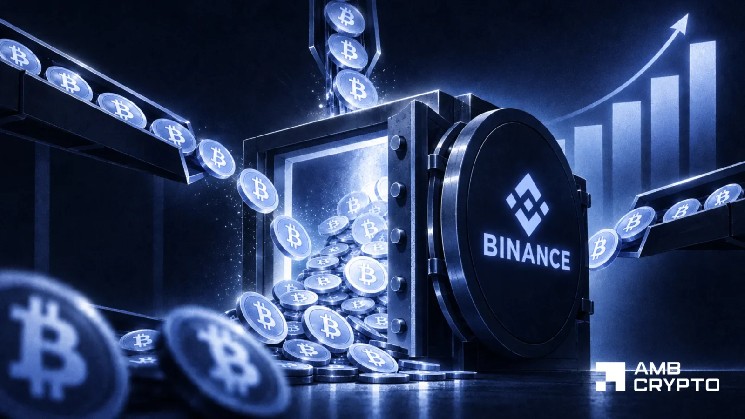
    Binance’s Bitcoin (BTC) reserves have climbed above 693,000 BTC, marking the highest level in almost two years. According to data from CryptoQuant, the exchange’s holdings have risen by approximately 77,000 BTC since the end of April.

    Why Are Investors Moving Bitcoin to Binance?

    The most straightforward explanation for this surge is that investors transferred Bitcoin to Binance during periods of strong price appreciation—primarily the May rally and the more recent August rally. When traders anticipate selling, they often move BTC from personal or cold wallets to exchanges to facilitate large trade execution.

    While a rising exchange balance can signal that potential selling supply is building up, it is not a definitive confirmation of an imminent sell-off.

    Three Key Drivers Behind the Inflow

    1. Deep Liquidity Attracts Large Orders

    Binance’s deep liquidity makes it the preferred platform for traders executing substantial BTC orders. Large trades can be filled with minimal market price impact, drawing significant volume to the exchange.

    2. SAFU Fund Deployment

    The Secure Asset Fund for Users (SAFU)—Binance’s emergency protection mechanism—intends to deploy $1 billion to secure roughly 15,000 BTC to help the Bitcoin community through the current transitional period.

    3. Rise in Scams and Hacks

    Total losses from scams and hacks have already crossed $1.732 billion in 2026. Following incidents such as the ColdCard exploit—where the attacker is still moving stolen Bitcoin—some holders have temporarily moved funds to established third-party platforms for safety.

    Is This an Early Warning Sign of a Sell-Off?

    The surge coincides with Bitcoin’s supply growth accelerating in 2026 at a faster pace than in several previous years. By around day 250, the 2026 supply growth line has reached roughly 6–7 million BTC. Compared with 2025 and earlier years at similar points, the 2026 pace appears relatively strong, suggesting more BTC is entering the market.

    Source: CryptoQuant

    However, this influx has also generated FUD (fear, uncertainty, and doubt). If a large portion of the over 693,000 BTC held on Binance eventually moves into the market for sale, it could increase available supply and potentially create additional downward pressure on price.

    BNB Price Action: $725 Reclaim Critical for Recovery

    At press time, BNB was trading at $712.97 after a modest daily and weekly decline, but with a monthly gain of over 16%. AMBCrypto recently reported that BNB is testing the $700 support level.

    • Holding above $700 could stabilize the price.
    • A break below $700 could push BNB toward $680–$690.
    • For a recovery, BNB must first reclaim $725, followed by resistance around $750.

    Optimism remains, however, as BNB Chain gains momentum in real-world asset (RWA) tokenization. Tokenized-asset holders have risen 320% in 30 days, with the user base potentially reaching 800,000.

    Bitcoin Price Context

    Bitcoin’s price was down at $76,983.20 at press time. Yet unrealized profit remains elevated near $120K, indicating underlying bullish support in the market.

    Source: CryptoQuant

    Key Takeaways

    • Binance’s deep liquidity is the primary reason it became the first choice for Bitcoin holders.
    • Rising scams and hacks explain why some holders temporarily moved Bitcoin to established third-party platforms.
  • Solana Price Rises for First Time in 10 Months: What’s Next for SOL?

    Solana Price Rises for First Time in 10 Months: What’s Next for SOL?

    Solana (SOL) is showing renewed momentum across multiple key metrics, with August marking the network’s first positive monthly close in nearly a year. The shift coincides with record-breaking growth in real-world asset (RWA) tokenization and continued dominance in memecoin trading volume.

    Technical Breakthrough: First Green Monthly Candle in 10 Months

    After flashing red on the charts for almost a year, Solana finally finished a month in the green in August. The gains were powered by the monthly MACD, which moved close to a bullish crossover at press time. Additionally, SOL‘s monthly Relative Strength Index (RSI) broke a downtrend that had remained intact for nearly two years.

    While this technical improvement signals a potential trend change, analysts caution that SOL remains well below its previous all-time highs. A single green monthly candle does not confirm a full trend reversal, though it provides a foundation for bulls to build upon after months of sustained selling pressure.

    RWA Ecosystem Hits $4.35 Billion All-Time High

    Solana’s real-world asset ecosystem crossed $4.35 billion in total value locked, setting a new all-time high. The number of RWA holders on the network also climbed above 420,000, placing Solana among the market’s largest chains for tokenized assets despite competition from Ethereum (ETH) and other Layer 1 networks targeting the same institutional market.

    Memecoin Volume Dominance: 67% of Multichain DEX Activity

    On September 7, Solana captured approximately 67% of spot decentralized exchange (DEX) memecoin volume across tracked chains. This figure nearly triples Robinhood’s 23% share, while BNB Chain accounted for another 9%.

    Memecoin trading has historically been one of Solana’s strongest drivers of on-chain activity. Sustained dominance in this sector could continue to support transaction demand and liquidity across the broader ecosystem.

    Key Takeaways

    • August 2024: First positive monthly candle for SOL in 10 months.
    • RWA Milestone: $4.35 billion total value locked, 420,000+ holders.
    • Volume Leadership: 67% share of multichain memecoin DEX volume (Sept 7).
  • Crypto Has Survived Its Harshest Winter as Fundamentals Remain Solid

    Crypto Has Survived Its Harshest Winter as Fundamentals Remain Solid

    Binance founder Changpeng Zhao, widely known as CZ, delivered an upbeat assessment of the cryptocurrency industry at the Bitcoin Asia 2026 event in Hong Kong, saying the sector has moved beyond its most difficult period. He told attendees that crypto’s fundamentals remain strong as the market continues to develop amid changing regulatory conditions worldwide.

    RWA Tokenization Emerges as a Major Crypto Opportunity

    Zhao identified real-world asset (RWA) tokenization as one of the cryptocurrency industry’s most promising areas. He said bringing assets on-chain could remove traditional time and cross-border barriers, making it easier for investors around the world to connect with them.

    On-chain assets could also improve liquidity for small and mid-sized investments that often struggle to attract capital through traditional financial channels. Zhao’s comments reflect the broader push to connect traditional finance with blockchain technology, an area that has attracted growing institutional interest in recent years.

    Crypto Regulation Remains Uneven Worldwide

    Zhao offered a mixed assessment of the global regulatory landscape. He described the United Arab Emirates as the most advanced jurisdiction for crypto regulation and said the United States is making rapid progress on rules governing stablecoins and cryptocurrency exchanges.

    He characterized Japan as friendly toward the industry and said Hong Kong is developing quickly as a crypto hub. Singapore, by contrast, was described as relatively conservative. Governments worldwide continue to weigh the potential benefits of blockchain innovation against the need for investor protection.

    Decentralized Exchanges Have Matured

    Zhao also discussed the development of decentralized exchanges, or DEXs. He said the sector has matured substantially over the past eight years, both technologically and in terms of user awareness.

    According to Zhao, the cryptocurrency industry could make an even greater leap forward if regulators around the world adopt more accommodating policies. His assessment reflects confidence in the resilience of the crypto ecosystem despite previous market downturns and continuing legal challenges involving major industry participants.

    What CZ’s Bitcoin Asia 2026 Comments Mean for Crypto

    CZ’s remarks at Bitcoin Asia 2026 point to a cautiously optimistic outlook for the cryptocurrency market. Regulatory uncertainty remains a significant challenge, but the continued strength of crypto’s underlying fundamentals and the potential of RWA tokenization offer a more positive perspective on the sector’s next stage.

    For investors and cryptocurrency users, the central message is that the industry has moved beyond its most severe downturn and is positioning itself for further growth.

    Frequently Asked Questions

    What did CZ say about the crypto winter?

    CZ said the cryptocurrency industry has already overcome its harshest winter and that its fundamentals remain solid, indicating that the sector is entering a recovery phase.

    Which region did CZ consider the most advanced in crypto regulation?

    He identified the United Arab Emirates as the most advanced jurisdiction for crypto regulation. He also highlighted rapid progress in the United States on stablecoin and exchange rules.

    Why is RWA tokenization considered promising?

    RWA tokenization can reduce time and cross-border constraints, connect assets with global investors and improve liquidity for small and mid-sized investments. These benefits make it a significant opportunity for the cryptocurrency and traditional finance sectors.

    Related Reading

    • BitMine Acquires 53,000 ETH as Analyst Lee Sees Rising Institutional Accumulation in Ethereum
    • Bitcoin’s Worst Phase Is Over, Says Former Credit Suisse Executive: $150K Target by 2027
    • CZ Says Rising X Follower Count Has Been a Consistent Early-Cycle Signal
    • Hyperliquid in Talks With Kraken Parent to Enter U.S. Market, Bloomberg Reports
    • Binance Founder Changpeng Zhao Changes Stance on RWA Tokenization, Sees Growth Ahead
  • Tokenized Assets Are More Active Than the Data Shows

    Tokenized Assets Are More Active Than the Data Shows

    Estimates of how much tokenized real-world assets (RWAs) are actually being used in decentralized finance (DeFi) range from less than 1% to 7%, 11.7% and nearly 20%. All of these figures were published this year, and each can be defended. The problem is that they do not measure the same thing.

    The lowest estimate receives the most attention. Of the roughly $51 billion in tokenized real-world assets on public blockchains, it suggests that only a single-digit percentage is actively used. The figure is often cited as evidence that onchain finance remains a toy: a great deal of tokenized “value,” but very little of it operating in public markets.

    That criticism is not without merit. An asset that moves onchain, incurs transaction fees and gains no additional utility is a worse product than the traditional asset it replicates. However, the statistic used to support that criticism is nearly meaningless—not because the percentage is too low, but because both sides of the calculation are misleading.

    Where tokenized RWA utilization figures come from

    The sub-1% estimate covers only three tokenized money market funds, rather than the broader market. BlackRock’s BUIDL, Circle’s USYC and Franklin Templeton’s iBENJI hold a combined $7.2 billion and have approximately $50 million deployed.

    Expanding the sample produces a utilization rate of 11.7% according to DeFiLlama. Using CoinShares’ $7.4 billion second-quarter estimate against RWA.xyz’s $38 billion total produces a figure of about 19%. The resulting 20-fold gap reflects the lack of agreement over what should be measured, not necessarily a change in the underlying market.

    Why the denominator distorts the calculation

    According to Bernstein research, private credit accounts for approximately 47% of the $51 billion in tokenized real-world assets onchain. Private credit also tends to move infrequently in traditional finance. Tokenization does not change its redemption schedule or its holder base.

    Including private credit in the denominator of a metric intended to measure composability is therefore a category error rather than evidence of disappointing adoption. A meaningful assessment of DeFi usage must distinguish between assets designed for frequent onchain activity and assets whose underlying structure makes limited movement normal.