Tag: Robinhood Chain

  • PENDLE Breaks Out as Updates Fuel Price Rally

    PENDLE Breaks Out as Updates Fuel Price Rally

    Pendle Launches Institutional Strategy with Permissioned Markets Pilot and Robinhood Chain Expansion

    Pendle is making headlines today after unveiling an institutional strategy backed by new infrastructure designed to connect compliant participants with its growing yield-trading ecosystem. The proposed Permissioned Markets Pilot aims to create a controlled access pathway for institutions seeking entry into whitelist-gated PT/YT markets, addressing compliance requirements that have traditionally restricted institutional involvement in decentralized finance.

    Permissioned Markets Pilot Targets Institutional Access

    Pendle plans to launch the pilot within the next two months, with discussions with potential partners currently underway. Beyond simply attracting a new user category, the initiative is expected to increase trading volume and generate revenue through Pendle’s existing market infrastructure. A successful integration could reinforce demand for the $PENDLE token by strengthening the relationship between protocol usage, token accrual, and revenue generation.

    Robinhood Chain Integration Expands Distribution

    Complementing its institutional push, Pendle expanded its ecosystem to Robinhood Chain on September 7, adding a new distribution channel for its yield markets. The integration broadened Pendle’s reach while supporting its effort to build infrastructure for diverse market participants. Following the launch, trading activity surged, with the token’s 24-hour volume rising 47% to $64.47 million. This broader market distribution provides wider access to Pendle’s yield-trading products as activity establishes across the new chain.

    Binance Deposit Introduces Near-Term Supply Concerns

    Despite the bullish fundamental developments, Pendle faces potential near-term supply pressure from activity involving the project’s own treasury holdings. According to data from CryptoQuant, Pendle Finance deposited approximately 600,000 $PENDLE (worth nearly $1.32 million) into Binance during the token’s recent price rally. The deposit increased immediately accessible exchange supply, though the transfer alone does not confirm subsequent selling activity.

    However, buyers appear capable of absorbing the available supply. The 90-day Spot Taker CVD (Cumulative Volume Delta) shows signs of taker-buy dominance, suggesting aggressive spot market buying could cushion against potential pressure from the Binance transaction. Persistent taker dominance may help absorb any additional supply entering the market.

    Price Action Confirms Breakout Structure Above $2.152

    Technical analysis from TradingView reinforces the stronger demand outlook. $PENDLE reclaimed the $2.152 resistance level and pushed toward $2.255 on the daily timeframe, with the former resistance now acting as immediate support. The next major overhead target sits at $2.500.

    Directional strength expanded sharply during the breakout, supporting the price structure. The +DI (Positive Directional Indicator) stands at 36.33, considerably above the -DI (Negative Directional Indicator) at 4.22, keeping directional control firmly with buyers. Meanwhile, the ADX (Average Directional Index) hit 52.44, indicating a particularly strong directional trend as the token extends above its reclaimed key level.

    A strong hold above $2.152 would maintain the breakout structure and potentially support another attempt toward $2.500. However, losing the reclaimed support would weaken the setup and increase the possibility of a pullback toward the $1.689 area.

    Final Summary

    • Pendle’s institutional and Robinhood Chain expansions have strengthened the broader demand outlook for $PENDLE.
    • $PENDLE holding $2.152 would keep the breakout structure favorable toward the $2.500 target.

  • PONS Crypto Rises 46% as Market Cap Surpasses $300 Million—Is a $1 Billion Valuation Next?

    PONS Crypto Rises 46% as Market Cap Surpasses $300 Million—Is a $1 Billion Valuation Next?

    $PONS Price Rally Continues as Robinhood Chain Activity Surges

    $PONS debuted on Robinhood Chain after several launchpads became operational, but it has emerged as the leading platform by trading volume, revenue and price performance.

    The altcoin has reached new highs each day since August 23. $PONS gained 49% over the past 24 hours and 425% over the past seven days, while trading volume remained elevated at approximately $116 million.

    What Is Driving the $PONS Rally?

    Growing market reach is one of the main factors behind the token’s surge. $PONS has been listed on multiple decentralized and centralized exchanges. One day after its debut on Hyperliquid DEX, the token was listed on Bybit, where its perpetual contracts offer leverage of up to 20x.

    Analysis of activity on Robinhood shows that $PONS ranks among the platform’s top-trending products for both activity and sentiment. It accounts for 7% of Robinhood’s mindshare, behind Ethereum [ETH], Bitcoin [BTC] and Solana [SOL].

    According to KAITO AI, two-thirds of all tokens launched on Robinhood Chain went through $PONS. More than 517,000 tokens have been created, with combined trading volume exceeding $4 billion.

    Source: KAITO AI

    $PONS has also generated the highest fees of any launchpad on the chain, with daily revenue exceeding $500 million. The platform used 80% of those fees to buy back the token, tightening its supply.

    As the buyback and burning activity continued, nearly one-third of the token supply was permanently removed.

    Whale Holdings Support $PONS Momentum

    Capital inflows have remained strong even among whales who have already secured substantial gains. For example, a whale who purchased both $CASHCAT and $PONS continued to hold profits from the latter.

    After selling the entire $CASHCAT position and locking an initial $113,000 stake in $PONS, the whale still held 9.1 million $PONS tokens, representing $4.20 million in unrealized profits.

    Source: Lookonchain

    Bonk Guy, who bought 1% of the supply when the token had a $6 million market capitalization, is also still holding. The position generated $5 million in profits last week.

    Can $PONS Reach a $1 Billion Valuation?

    Continued interest from whales and key opinion leaders could help $PONS approach a $1 billion valuation. The token has posted new highs for 10 consecutive days, while its Bollinger Bands point to elevated volatility.

    The cumulative volume delta also confirms strong buying activity. More than 2.18 million $PONS tokens had been purchased at press time.

    Source: $PONS/USDT on TradingView

    However, the psychological $0.50 level could present a short-term challenge. If buyers push the token above that threshold, $PONS could open a path toward $1.

    Key Takeaways

    • $PONS gained 49% in 24 hours and reached a new peak near $0.49, while platform trading volume exceeded $4 billion.
    • The token has maintained a 10-day rally as bulls target a $1 billion valuation.
    • The $0.50 level could become a key test if buying momentum begins to weaken.
  • Bitcoin Holds Near $78,000 as Arbitrum Surges 30% on Robinhood Chain Revenue

    Bitcoin Holds Near $78,000 as Arbitrum Surges 30% on Robinhood Chain Revenue

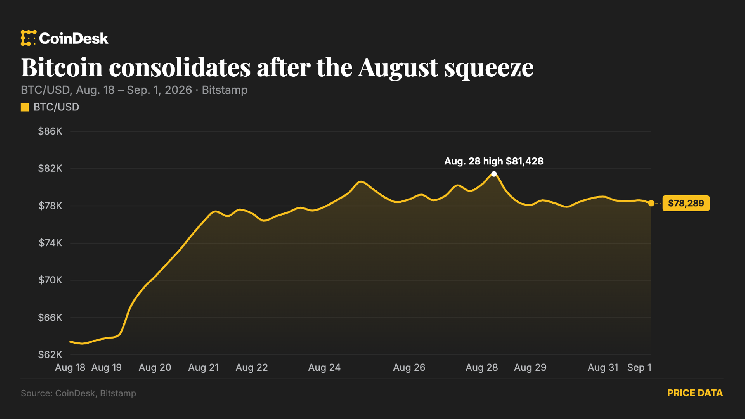
    Bitcoin is trading near $78,000, down 0.4% since midnight UTC and about 0.7% over the past seven days as the market consolidates after a short squeeze lifted the price from below $63,000 to nearly $81,400 last week.

    Bitcoin’s relative strength has remained intact despite the calmer conditions. Nasdaq 100 futures are down 0.5% since midnight, meaning bitcoin is once again outperforming equities.

    Spot bitcoin exchange-traded funds recorded $3.04 billion in net inflows across nine consecutive sessions, their longest streak since April. The run ended Friday with a $202 million outflow before resuming Monday with $217 million in fresh inflows, according to SoSoValue data.

    Altcoins are mixed in the latest session. The Altcoin Season index has fallen to 26 out of 100 from 34 on Friday, its lowest reading in more than 90 days.

    Crypto derivatives positioning remains balanced

    Balanced positioning: The 24-hour taker buy-sell volume ratio in crypto futures markets has remained balanced for a second consecutive day. Open interest has held near $136 billion, while trading volume has declined 7%. The combination suggests traders are adding neither significant long nor short exposure and are waiting for a clearer market signal.

    Arbitrum leads gainers: Arbitrum’s $ARB is the best-performing token among the top 100 cryptocurrencies over the past 24 hours, gaining nearly 30%. The rally is supported by increased futures participation, with open interest rising more than 10%. The data points to a buildup of long positions as $ARB attempts to establish support above chart resistance at 11 cents. Annualized funding rates near 8% suggest the market is not overheated.

    Monero open interest continues to rise: Open interest in privacy-focused Monero futures has climbed to 640,000 tokens, the highest level since February 2024. The signals are mixed. Funding rates have dropped to 15% from more than 50%, suggesting bullish positions are no longer overcrowded. However, the 24-hour open-interest-adjusted cumulative volume delta is negative, indicating bearish leadership. XMR has already pulled back to around $525 from Monday’s high of $548.

    Demand for $TRX shorts: Tron’s $TRX stands out with funding rates at minus 80%, signaling crowded bearish positioning. Short sellers are accepting a high cost to maintain their positions. $TRX is trading near 33 cents after falling for a third consecutive day.

    Light positioning in bitcoin and ether: Open interest in $BTC and $ETH remains subdued, hovering near multi-week lows.

    Volatility cools: Bitcoin’s and ether’s 30-day implied volatility indexes, BVIV and EVIV, have reversed their mid-August spikes, pointing to calmer market conditions.

    Options flow turns bullish: In options listed on Deribit, the $80,000 bitcoin call expiring Sept. 25 was the most-traded position over the past 20 hours. A call represents a bullish bet on the underlying asset. For ether, the $2,500 call attracted the most activity.

    Arbitrum leads the altcoin market

    Arbitrum’s surge is the clearest standout across the altcoin sector. The rally is linked to Robinhood Chain, which operates as a dedicated Arbitrum chain and sends 10% of net protocol revenue to the Arbitrum ecosystem.

    Offchain Labs co-founder Steven Goldfeder said Monday that Robinhood Chain’s 24-hour transaction revenue had exceeded $2 million, up from approximately $1.22 million the previous day. At that pace, Arbitrum’s share would amount to roughly $73 million annually.

    ARK Invest’s Lorenzo Valente calculated that gross revenue on Robinhood Chain rose from $54,676 on Aug. 22 to $1.088 million on Aug. 30, an increase of nearly 20 times. Arbitrum’s share increased from $5,400 to $108,000 over the same period.

    Curve DAO’s CRV$0.3586 rose 14% over 24 hours to approximately 35.13 cents on $119 million in trading volume. The move forms part of the broader decentralized finance rally that has lifted lending and decentralized exchange tokens through the second half of August.

    Uniswap’s $UNI extended its gains, rising 8% since midnight to around $5.80 after advancing 12% over the previous 24 hours. The token is now up 34% over the past seven days on $519 million in volume.

    Among the day’s smaller movers, Aave’s AAVE$126.93 gained 1.9% to $126.54, while Morpho’s MORPHO$2.5549 rose 2%. The moves suggest decentralized finance assets are holding up better than the broader crypto market during Tuesday’s session.

  • Robinhood Chain Sets Record with $875M in DEX Volume as Tokenized Stocks Surge

    Robinhood Chain Sets Record with $875M in DEX Volume as Tokenized Stocks Surge

    Robinhood Chain processed a record 5.52 million transactions on Aug. 30 as decentralized exchange activity and tokenized stock trading reached new highs.

    DEX volume on the network climbed to a record $875 million, according to the Wu Blockchain Data Center. Uniswap v4 accounted for $432 million of the total, while Uniswap v3 generated a further $357 million.

    Activity also surged on Pons, Robinhood Chain’s largest token launchpad. The platform recorded 22,600 token creations and $187 million in trading volume on Aug. 30, with both figures representing all-time highs.

    Source: Wu Blockchain Data Centre

    Tokenized Stocks Drive New DEX Volume

    The most significant development may be the source of the network’s growing activity.

    Data from Token Terminal shows that the seven most-traded tokenized stocks generated $4.3 billion in decentralized exchange volume over the past 30 days. Three of those assets are traded on Robinhood Chain.

    Uniswap alone has processed approximately $1.5 billion in tokenized stock volume on Robinhood Chain in around six weeks.

    Source: Token Terminal

    The figures point to a broader shift in the real-world asset market. Tokenized equities give investors blockchain-based access to traditional securities while also generating trading fees for decentralized exchanges, issuance revenue for asset providers, and transaction demand for the networks that support them.

    For decentralized finance, tokenized stocks create a new category of activity beyond crypto-native assets. Decentralized markets can increasingly capture trading tied to securities originating in traditional finance, rather than competing only for memecoin, stablecoin, or perpetual-futures volume.

    Robinhood Chain Revenue Surges

    The impact is already visible in blockchain application revenue. On Aug. 31, applications on Robinhood Chain generated $2.66 million over 24 hours, ahead of Hyperliquid L1 at approximately $1.7 million and Ethereum at $1.27 million.

    Robinhood Chain’s 24-hour revenue was also nearly six times higher than Base’s approximately $438,000 during the same period.

    A single day of revenue does not establish a lasting lead, particularly against networks with deeper liquidity and longer operating histories. However, the figures show how quickly tokenized securities can influence blockchain economics when trading volumes reach scale.

    Robinhood Chain’s recent growth suggests that tokenized stocks could become more than a distribution product for investors. They may also develop into a significant source of fees, liquidity, and transaction demand across the decentralized finance ecosystem.

  • Beyond the Crypto Rally: 4 Trends to Watch This Cycle

    Beyond the Crypto Rally: 4 Trends to Watch This Cycle

    When crypto prices surge, market commentary often focuses on green candles and central bank policy. But beneath the immediate rally, a deeper structural shift is unfolding on-chain.

    Robinhood CEO Vlad Tenev brought global attention to this shift with the launch of Robinhood Chain, joining a broader movement by major platforms to bring mainstream retail equity investors directly into native on-chain execution.

    Macroeconomic stress provides the backdrop, but technological innovation is the catalyst. Beneath the price action, four key trends are defining the current crypto cycle and reshaping how global wealth is owned, accessed, and stored.

    Trend 1: The Retail Ownership Supercycle

    At a recent White House summit, Vlad Tenev summarised his platform’s mission in a single word: “ownership.” Broad asset ownership is essential to a free and prosperous society, and Robinhood Chain is putting that principle into practice.

    Novel mechanisms such as The Index illustrate how this model works. Holding the single token automatically delivers fractional tokenised equities directly to a user’s wallet. In just a few clicks, crypto-native traders can gain diversified exposure to traditional stock portfolios, extending their investments beyond crypto alone.

    Retail culture is a crucial force behind this movement. Memecoins such as Popcat, Pepe, and Doge demonstrated strong mass-market retail appetite on tier-one exchanges. Today, that same energy is driving on-chain execution.

    On Robinhood Chain, Cashcat has emerged as the leading token and unofficial mascot. Coinbase’s listing of Basecat on Base, together with community-led initiatives built around Cate on Solana, points to a broader, multi-chain “cat season.”

    These community movements are becoming a primary onboarding engine for crypto and tokenised real-world asset ownership.

    Trend 2: CeDeFi and Infrastructure Convergence

    While Robinhood Chain renewed retail interest in on-chain markets, another major development was taking shape at the infrastructure level. In previous cycles, centralised exchanges focused on building isolated, walled-garden blockchains and proprietary wallets. This cycle marks a fundamental shift toward Centralised-Decentralised Finance, or CeDeFi, through direct liquidity integration.

    Two parallel moves demonstrate this trend: Robinhood’s integration of Lighter and VALR’s integration of Hyperliquid.

    If Robinhood’s mission is to expand ownership for everyday retail investors, VALR’s focus is global access. By connecting directly to Hyperliquid’s high-performance order book, VALR gave more than two million users across Africa and emerging markets seamless access to over 200 liquid markets spanning crypto, equities, stock indices, commodities, precious metals, and foreign exchange.

    Trend 3: The Two-Phase Transformation of Money

    This expansion of global market access is laying the foundation for a much larger monetary transition. The evolution of money is unfolding in two distinct phases.

    Phase 1 is already taking place through stablecoins. While the long-term outlook for fiat currency appears bleak, stablecoins make it easier to store, transfer, and spend value. They are becoming practical payment and settlement rails for everyday users, global companies, and international trade.

    However, stablecoins only digitise fiat currency; they do not protect against chronic currency debasement. When it becomes clear to everyone that inflation is indeed not transitory, but long-lasting and ever-worsening, Phase 2 will take hold. The transition to sound money will be swift and violent, with stablecoins providing the off-ramp.

    Tokenised gold such as XAUt and, fundamentally, Bitcoin are natural destinations for this capital. The transition is still in its early stages.

    Trend 4: Agentic Finance and Human Purpose

    Alongside the evolution of money, agentic finance is gaining momentum. Autonomous AI agents and algorithmic execution systems are expected to handle increasingly complex market mechanics, liquidity deployment, and trading strategies.

    The full impact of AI on the global economy is still unfolding. Personally, I would rather focus on painting and tending a rose garden, letting the world figure out the question of AI and robots. Optimistically, that is the true promise of technology anyway: outsourcing the mundane to machines so humans can focus on service, kindness, creativity, and contemplation.

    Beyond Rotation: The Conviction Cycle

    Speculative token-hopping and short-term player-versus-player trading have shaped much of recent crypto culture. Yet, amid this cycle of constant rotation, a simple phrase is taking root: “believe in something.”

    The platforms, protocols, and participants that endure through the next phase of the market will not be those chasing fleeting trends. In addition to ownership and access, this cycle will be defined by conviction.

    About the Author

    Ben Caselin is Chief Marketing Officer at VALR.com, Africa’s largest crypto exchange and infrastructure provider by trade volume. Headquartered in Johannesburg, VALR serves over 1900 corporate and institutional clients and more than 1.9 million traders worldwide.

    Drawing on years of experience in the digital asset sector, primarily in Hong Kong, the UAE, and South Africa, Ben focuses on driving Bitcoin adoption in emerging markets. He advocates for an approach to innovation grounded in spiritual principles.

    Source: cryptonews.net

  • FOMO Breaks Into the Top 5 U.S. Finance Apps, Surpassing Kalshi and Cash App

    FOMO Breaks Into the Top 5 U.S. Finance Apps, Surpassing Kalshi and Cash App

    Fomo has grown from a public beta launched in May 2025 into one of the highest-ranking finance apps in the United States, reaching beyond the crypto market to compete with established banking and payments platforms.

    Fomo Breaks Into the U.S. Finance App Charts

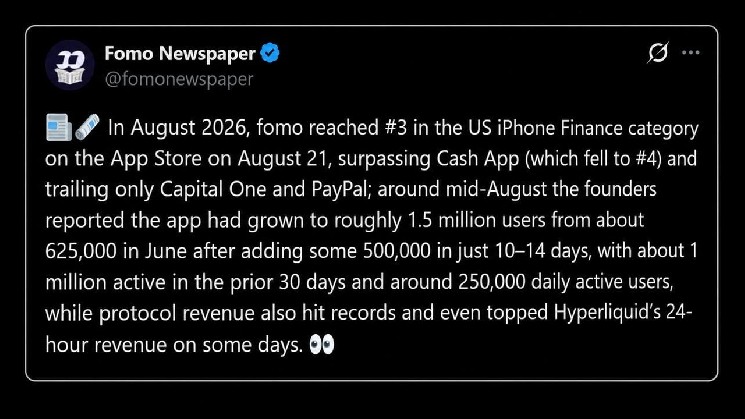
    Founded by Paul Erlanger and Se Yong Park, Fomo climbed into the top five U.S. finance apps on Apple’s App Store by August 21. The crypto trading app surpassed Cash App and briefly reached third place, ahead of prediction-market competitor Kalshi. It currently ranks among the top 15.

    App Store finance rankings are typically dominated by major banks and payment companies rather than crypto-native startups. Fomo’s rise into the top 15 therefore places it alongside brands with significantly longer operating histories and broader mainstream recognition.

    Fomo Raises $94 Million in Equity Funding

    In November 2025, Fomo closed a $17 million Series A led by Benchmark. Instead of presenting the round to institutional funds, Erlanger and Park created a wishlist of 200 preferred angel investors. A total of 140 investors participated, including Polygon Labs chief executive Marc Boiron, Solana co-founder Raj Gokal and former Coinbase chief technology officer Balaji Srinivasan.

    The Series A was followed by a $75 million Series B. By then, Fomo had more than 600,000 users and had processed over $4 billion in trading volume, bringing the company’s total disclosed equity funding to approximately $94 million.

    How Fomo Makes Crypto Trading Social

    Fomo’s core appeal centers less on technical charts and more on social discovery. Users can see what people they follow are trading in real time, monitor leaderboards and copy trading signals. They can also fund trades instantly through Apple Pay.

    The product is designed to make crypto trading feel more like a social media experience than a traditional financial terminal. Fomo supports trading across Solana, Base, BNB Chain, Monad and Robinhood Chain, giving the app exposure across multiple blockchain ecosystems.

    The app has earned a 4.6-to-4.8-star rating on Apple’s App Store, based on more than 14,000 reviews. On Google Play, it holds a 4.7 rating and has surpassed one million installs.

    Fomo Benefits From Robinhood Chain’s Growth

    Fomo’s expansion is closely linked to growing interest in Robinhood Chain, the brokerage’s layer-2 network. The network launched its public mainnet on July 1 and has since become one of the most closely watched efforts to bring retail trading onchain.

    Fomo is one of several consumer-focused apps seeking to capture activity on the network. Its growth forms part of a broader wave of “social trading” products built around the idea that following friends, rather than studying charts, can encourage casual users to place their first trades.

    Industry observers increasingly view apps such as Fomo as accessible entry points for a new and less experienced generation of retail traders—the same audience that helped Robinhood build its stock-trading business.

    Source: cryptonews.net

  • Uniswap Stock Token Volume on Robinhood Chain Surpasses $1.5 Billion in Six Weeks

    Uniswap Stock Token Volume on Robinhood Chain Surpasses $1.5 Billion in Six Weeks

    Uniswap has processed approximately $1.5 billion in stock-token trading on Robinhood Chain since the platform launched about six weeks ago, according to data from Crypto Briefing. The decentralized exchange now represents 99% of stock-token liquidity on Robinhood’s proprietary layer-2 network, highlighting the rapid adoption of tokenized equities across the DeFi ecosystem.

    Uniswap Sets Record for Stock-Token Trading

    Uniswap’s daily stock-token trading volume exceeded $130 million on Aug. 29, setting a new record, according to the report. The milestone follows the exchange surpassing $1 billion in cumulative volume in mid-August, signaling accelerating demand from users.

    Approximately 60% of the trading activity takes place outside regular U.S. stock-market hours. The figure underscores the 24/7 nature of crypto markets and the appeal of tokenized assets to traders worldwide.

    Tokenized Equities Bring Traditional Finance to DeFi

    The rapid growth of stock tokens on Robinhood Chain reflects the expanding convergence of traditional finance and decentralized trading. Tokenized equities can enable fractional ownership and round-the-clock trading, offering flexibility that conventional stock exchanges cannot provide.

    Regulatory clarity remains a key concern. Tokenized securities may need to comply with existing securities laws across multiple jurisdictions. Uniswap’s dominant position also raises questions about liquidity concentration and systemic risk in the emerging stock-token market.

    What Uniswap’s Growth Means for Crypto and TradFi Investors

    The surge in Uniswap’s stock-token volume demonstrates demand for hybrid financial products that combine traditional assets with blockchain-based trading. It also highlights the technical capabilities of layer-2 networks such as Robinhood Chain, which offer lower fees and faster settlement than the Ethereum mainnet.

    As more platforms explore tokenized equities, competition could intensify. Increased competition may lead to improved pricing and more innovative features for users, although liquidity distribution and regulatory compliance will remain important considerations.

    Frequently Asked Questions

    What is Robinhood Chain?

    Robinhood Chain is a proprietary layer-2 blockchain developed by Robinhood. It is designed to provide faster and cheaper transactions for tokenized assets, including stocks.

    How does Uniswap dominate stock-token trading on Robinhood Chain?

    Uniswap accounts for 99% of stock-token liquidity on Robinhood Chain. This means it provides most of the trading pairs and liquidity pools for these assets, attracting the majority of trading volume.

    What are the risks of trading stock tokens on decentralized exchanges?

    Risks include regulatory uncertainty, potential smart-contract vulnerabilities and increased volatility resulting from 24/7 trading. Investors should conduct thorough research and understand the legal status of tokenized securities in their jurisdiction.

    Related Reading

    • BIT-Linked Addresses Boost ETH Long to 29,500 on Hyperliquid, Data Shows
    • Avici Hack Losses Surpass $1M as Stolen Funds Laundered via Tornado Cash
    • Stock-Token Trading on DEXs Tops 4% as Uniswap Volume Climbs $325M in a Week
    • Decentralized Perp Exchange Volume Climbs 9.1% to $423B, Hyperliquid Dominates with 58% Share
    • Ethena expands beyond crypto to tap booming equity perpetuals market
  • Uniswap Price Eyes Bigger Rally as Robinhood Activity Surges

    Uniswap Price Eyes Bigger Rally as Robinhood Activity Surges

    Uniswap is gaining momentum as trading activity on Robinhood Chain reaches record levels. The decentralized exchange has processed roughly $130 million in daily stock-token transactions, nearly ten times more than a month ago, highlighting the growing connection between on-chain markets and traditional financial assets.

    Robinhood Chain Activity Accelerates

    Trading volume is now split almost evenly between Uniswap v3 and Uniswap v4. While v3 continues to support deep concentrated-liquidity pools, v4 is gaining traction through custom hooks, dynamic routing and lower transaction costs.

    The broader takeaway is that upgraded decentralized exchange infrastructure is now handling substantial equity-trading activity. That gives the Uniswap price outlook more substance than a routine token rally driven solely by market sentiment.

    UNI Price Has Climbed More Than 90%

    The UNI price has risen from around $2.40 in June to roughly $4.60 in August, representing a gain of more than 90%. Its earlier price history provides additional context for the current move.

    A liquidation-driven move in late 2020 was followed by a parabolic rally toward Uniswap’s all-time high of approximately $44. A similar liquidity-grab pattern is now appearing in 2026 UNI price action, although it remains uncertain whether history will repeat itself.

    If follow-up demand continues to support the UNI token price, $7.82 could become the first major resistance level. That price aligns with the weekly 200-day exponential moving average. A sustained breakout above it could place $11 and eventually $22 among the next potential targets.

    HOOD Stock Adds Context to the Uniswap Setup

    Robinhood’s stock offers another relevant comparison. HOOD previously formed a cup-and-handle pattern before advancing toward an all-time high near $154.

    After declining approximately 58% to $64 in 2026, the stock reversed higher from April and has since followed an ascending trendline. If that support continues to hold, HOOD could potentially move back toward $154 and enter another price-discovery phase.

    For now, the Uniswap price outlook is supported by improving trading activity on Robinhood Chain. However, $7.82 remains the key level bulls must overcome before the larger upside targets become relevant.

    Source: cryptonews.net