
Tag: Protocol revenue

  • PUMP Surges 18% After SEC Clarification, 398M Token Buybacks

    PUMP Surges 18% After SEC Clarification, 398M Token Buybacks

    Key Highlights

    • SEC staff clarified that tokens with protocol revenue and buybacks are not automatically securities, applying the Howey test focused on economic reality over terminology.
    • $PUMP surged 18% to $0.0045 with a 57% volume spike, while protocol inflows reversed to $24 million and buybacks continued removing 16.79% of supply.
    • Technical indicators signal bullish momentum, but persistent profit-taking and positive exchange netflows suggest selling pressure could challenge the uptrend.

    SEC Clarification Triggers Market Reassessment of Token Economics

    The U.S. Securities and Exchange Commission staff has issued guidance that could reshape how protocol-native tokens with revenue-sharing mechanisms are classified under federal securities law. According to the clarification, the agency applies the classic Howey test—assessing whether an investment of money in a common enterprise expects profits derived from the managerial efforts of others—while emphasizing economic substance over labeling. The guidance explicitly states that token buyback programs and liquid staking receipts, by themselves, do not convert an otherwise non-security commodity into a security. This distinction provides a regulatory foothold for protocols like $PUMP that generate genuine revenue and return value to holders through on-chain buybacks and burns.

    $PUMP Price Action and Capital Flows Reflect Renewed Optimism

    Reacting to the SEC’s stance, $PUMP rebounded sharply from a $0.0038 low, reclaiming the $0.004 psychological level and rallying to a daily high of $0.0046. At press time, the token traded near $0.0045, marking an 18% intraday gain accompanied by a 57% surge in spot trading volume. On-chain data from DefiLlama shows protocol USD inflows swung to $24 million, reversing four consecutive days of outflows that had briefly pushed net flows negative. The project’s treasury continues to execute its buyback strategy: after generating $3.2 million in revenue, $PUMP allocated $1.6 million to purchase 398 million tokens, per Lbexplorer. Cumulatively, the team has bought and burned $463.79 million worth of supply, removing 16.79% of tokens from circulation.

    Profit-Taking and Exchange Flows Signal Near-Term Resistance

    Despite the bullish catalyst, selling pressure remains elevated. On September 26, spot sell volume reached 2.68 billion tokens against 2.54 billion in buy volume, producing a negative buy-sell delta of -144.5 million—a clear indication of aggressive distribution, according to Coinalyze. Exchange netflows corroborate this trend: Coinglass data shows spot netflows have stayed positive for three straight days, climbing to $1.49 million following the rebound. Sustained positive netflows typically suggest holders are moving tokens to exchanges to sell, which could cap upside if demand does not absorb the supply.

    Technical Outlook: Bullish Structure Faces Supply Overhang

    Momentum indicators paint a constructive picture. The Trend Strength Index (TSI) on the $PUMP/USDT pair formed a bullish crossover and rose to 6.8, while the Aroon Oscillator has held near 42 for two consecutive sessions, reflecting stabilizing upside momentum, per TradingView. If current conditions persist, the next resistance zones are $0.0048 and the $0.005 psychological level. However, the confluence of active profit-taking and exchange inflows means a failure to hold above $0.004 could see price revisit the $0.0038 support.

    Why This Matters

    The SEC’s clarification arrives at a pivotal moment for revenue-generating DeFi protocols. By confirming that buybacks and liquid staking do not automatically trigger securities classification—provided the Howey test’s “managerial effort” prong is not met—the guidance reduces regulatory uncertainty for tokens that function more like commodity-like assets with cash-flow rights. For $PUMP specifically, the combination of regulatory tailwinds, accelerating buybacks, and improving capital flows creates a fundamental backdrop that could sustain re-rating if the protocol continues to demonstrate real revenue growth. Market participants will now watch whether inflows can outpace exchange deposits and whether the token can convert technical momentum into a higher-low structure above $0.004.

    Frequently Asked Questions

    Does the SEC guidance mean all tokens with buybacks are now non-securities?

    No. The SEC stated it applies the Howey test to each asset based on economic reality. A token is a security if investors expect profits primarily from the managerial efforts of founders or promoters. Buybacks and liquid staking alone do not make a commodity a security, but the overall structure and marketing of the token still matter.

    How much of $PUMP supply has been burned so far?

    According to Lbexplorer data cited in the report, the team has bought and burned $463.79 million worth of $PUMP, removing 16.79% of the total supply from circulation.

    What are the key price levels to watch for $PUMP next?

    Immediate resistance sits at $0.0048, followed by the $0.005 psychological level. On the downside, a break below $0.004 could trigger a retest of the recent $0.0038 low, especially if exchange netflows remain positive and sell volume continues to exceed buy volume.
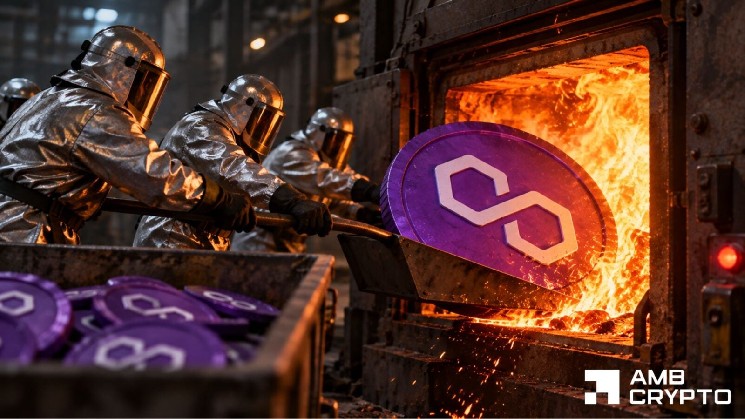

  • Polygon to Burn 100M POL as Revenue Hits $24.5M, Token Impact Uncertain

    Polygon to Burn 100M POL as Revenue Hits $24.5M, Token Impact Uncertain

    Key Highlights

    • Polygon Foundation CEO Sandeep Nailwal announced a plan to permanently burn 100 million $POL tokens, representing approximately 1% of the circulating supply, pending Security Council approval.
    • The burn mechanism is fueled by protocol revenue that reached $24.5 million year-to-date, with DeFiLlama data confirming annual revenue crossing $25 million—a two-year high.
    • $POL price surged 10% on the announcement, contributing to a weekly 20% recovery, though whale sell-offs of over 30 million tokens and resistance at the 50-week moving average ($0.11) pose near-term headwinds.

    Polygon Unveils Aggressive $POL Deflationary Strategy Ahead of Anticipated Bull Cycle

    Polygon Foundation CEO Sandeep Nailwal took to X on Friday to outline a bold tokenomics shift designed to position the network for the next cryptocurrency market upswing. The centerpiece of the announcement is a proposal to permanently remove 100 million $POL tokens from circulation—a figure equivalent to roughly 1% of the current circulating supply. The initiative is funded directly by the protocol’s own revenue streams, which Nailwal highlighted have reached $24.5 million year-to-date. The proposal currently awaits final sign-off from the Polygon Security Council before implementation can begin, after which the foundation intends to conduct manual quarterly burns.

    Polygon is printing revenue. $24.5m YTD. We are deploying a change that lets anyone in the community trigger its burn.

    — Sandeep Nailwal, CEO, Polygon Foundation

    Revenue Growth and Competitive Positioning Drive the Burn Mechanism

    The burn capacity is anchored in Polygon’s evolving revenue model. Base fees on the network automatically accumulate $POL in a collector wallet, which currently holds 121 million $POL valued at approximately $1.2 million. According to data from DeFiLlama, the protocol’s annualized revenue has surpassed $25 million, marking a two-year high. Nailwal asserted that Polygon’s strategic pivot toward payments—specifically stablecoin-based transfers—has yielded fee traction three times that of Arbitrum and five times that of Near Protocol. This revenue foundation is what makes the recurring burn mechanism sustainable, moving beyond a one-time event to a structural deflationary feature.

    Market Reaction: Price Surge Meets Technical Resistance and Whale Selling

    The announcement catalyzed an immediate market response, with $POL surging 10% on Friday. The move extended the token’s weekly gain to 20%, aided by a broader market tailwind as Bitcoin reclaimed the $80,000 level. However, the rally unfolds against a backdrop of significant technical hurdles. The token had previously rallied 80% in Q3, climbing from $0.07 to $0.11, before a sharp pullback in late August. Since September, price action has consolidated above the $0.09 support level, which coincides with the 200-day Moving Average.

    Overhead Resistance and On-Chain Signals Temper Optimism

    While the daily Relative Strength Index (RSI) remained below overbought territory at press time—suggesting room for further upside—the Average True Range (ATR) was flat, signaling low volatility that could make a decisive breakout difficult. The $0.11 level represents a critical confluence of resistance: it marked the local high of the August rally and aligns with the 50-week Moving Average, which previously capped gains. Adding to the selling pressure, on-chain analytics from Santiment revealed that key whale wallets dumped over 30 million $POL in the last three days. This profit-taking activity could stall the recovery, increasing the probability of a retest of the $0.09 support if the $0.11 barrier holds. Conversely, a clean break above the 50-week MA could signal the start of the next major recovery leg.

    Why This Matters

    Polygon’s move signals a maturation of Layer 2 tokenomics, shifting from inflationary emissions to a revenue-backed, deflationary model. By tying token burns directly to protocol fees—generated largely through stablecoin payment volume—Polygon creates a direct feedback loop between network utility and token scarcity. This contrasts with many peers that rely solely on staking rewards or fixed supply caps. The initiative also underscores the growing importance of real-yield metrics in crypto valuation; DeFiLlama’s verification of $25M+ annual revenue provides a tangible fundamental anchor. For investors, the interplay between the new burn mechanism, whale distribution patterns, and the $0.11 technical resistance will be the key variables determining whether $POL can convert short-term speculative interest into a sustained trend reversal.

    Frequently Asked Questions

    What triggers the $POL token burn and how much will be removed?

    The burn is triggered by protocol revenue accumulated in the collector wallet, which currently holds 121 million $POL. The initial proposal seeks to permanently burn 100 million $POL—approximately 1% of circulating supply—pending Security Council approval, followed by manual quarterly burns thereafter.

    How does Polygon’s revenue compare to competing Layer 2 networks?

    According to CEO Sandeep Nailwal, Polygon’s fee traction from stablecoin-based payments is currently 3x that of Arbitrum and 5x that of Near Protocol. DeFiLlama data corroborates this, showing Polygon’s annualized revenue crossing $25 million, a two-year high.

    What are the key price levels to watch for $POL following the burn announcement?

    Immediate resistance sits at $0.11, which aligns with the 50-week Moving Average and the August local high. Support is established at $0.09, reinforced by the 200-day Moving Average. A break above $0.11 could signal trend continuation, while rejection may lead to a retest of $0.09, especially given recent whale selling of over 30 million tokens.

  • Jito (JTO) Price Falls Despite $24M Spot Buying – Bears at Risk

    Jito (JTO) Price Falls Despite $24M Spot Buying – Bears at Risk

    Jito’s native token JTO is showing a notable divergence between its price action and spot market behavior, according to data from CoinGlass. While the token has declined approximately 9.69% this week, spot market data reveals consistent accumulation over the past four days, suggesting investors are treating the pullback as a buying opportunity.

    Spot Accumulation Amid Price Decline

    The spot market has recorded net inflows of $2.02 million across exchanges over the four-day period, with total buy volume reaching roughly $24.72 million. This persistent accumulation, where outflows (accumulation) exceed inflows (distribution), typically signals a bullish near-term outlook as market participants anticipate future outperformance.

    The single largest accumulation day occurred on August 25, accounting for the majority of the netflow. Notably, JTO’s price dropped 15.13% between the high and low of that day’s candle, per TradingView data. The combination of heavy buying during a sharp intraday decline indicates that investors may view the lower prices as an attractive entry point.

    On-Chain Capital Expansion

    On-chain metrics reinforce the accumulation narrative. Total Value Locked (TVL) across the Jito protocol has surged by $243.81 million since August 19, bringing the total to approximately $1.017 billion, according to DeFiLlama. TVL measures capital deposited to earn yield and is widely regarded as a gauge of confidence in a protocol’s long-term prospects.

    Protocol revenue has also climbed, with daily fees hitting roughly $504,000 — the highest level since May 11. This concurrent rise in TVL and fee generation suggests that capital commitments are being matched by genuine increases in protocol activity.

    Funding Rate Signals Growing Short Positions

    Despite the bullish spot and on-chain signals, derivatives data warrants caution. CoinGlass reports that the funding rate has fallen from 0.0143% to 0.0060%, indicating a growing dominance of short positions in the perpetual futures market. If this trend continues and the funding rate flips negative, it could exert additional downside pressure on JTO in the near term.

    For now, the market remains in a clear accumulation phase, with spot buyers absorbing supply even as leveraged traders build bearish bets.

    Key Takeaways

    • Spot investors purchased roughly $24.72 million worth of JTO over four days, driving a netflow of $2.02 million.
    • TVL has grown $243.81 million to $1.017 billion, accompanied by a multi-month high in protocol fees.
    • Funding rate decline signals rising short interest, presenting a potential headwind if the trend accelerates.

    Sources: CoinGlass, DeFiLlama, TradingView