Stacks’ expanding role in Bitcoin DeFi could strengthen demand for $STX, positioning the token as a higher-potential, higher-risk Bitcoin investment. Its investment case depends on whether Stacks can attract more Bitcoin capital and activity while converting that growth into recurring demand for the native token.
The central question for any crypto investment is what creates demand beyond speculation. For $STX, demand comes from several roles within Stacks, a Bitcoin layer designed for smart contracts and Bitcoin-native financial applications. The token pays network fees, participates in the Proof of Transfer consensus system, can earn $BTC rewards through Stacking and is expected to serve as the capacity asset for Stacks’ proposed self-custodial Bitcoin Staking product.
This gives $STX a different profile from tokens whose utility is largely tied to governance or incentive emissions. It also makes $STX a potential higher-beta Bitcoin play: its price may respond to broader Bitcoin market conditions while also reflecting the growth of Bitcoin-native applications on Stacks. That combination can amplify gains when both narratives strengthen, but it can also lead to sharper downside volatility.
The opportunity remains dependent on execution. Bitcoin has a market capitalization of roughly $1.32 trillion, compared with approximately $86 million in DeFi total value locked on Stacks and an $STX market capitalization of about $300 million. Bitcoin Staking, arguably the most important future demand driver in the $STX investment thesis, was still operating on a private testnet as of July 16, 2026.
What $STX does in the Stacks economy
Stacks extends Bitcoin with smart contracts and financial applications while using Bitcoin as its settlement layer. $STX is the native asset that supports this economy through three primary functions.
First, $STX pays transaction fees. Every transaction executed on Stacks requires the token, including swaps, lending activity and smart-contract interactions. This creates a direct relationship between network usage and demand for $STX as gas.
Second, $STX supports Stacking, the network’s existing mechanism for earning $BTC rewards. Token holders can temporarily lock their $STX and participate in the Proof of Transfer system, or PoX. Stacks miners commit $BTC while competing to produce blocks and receive newly issued $STX rewards. The Bitcoin committed by miners is then distributed to eligible Stackers.
This structure differs from many conventional proof-of-stake models. Stacking rewards are paid in Bitcoin rather than newly issued $STX. New $STX issuance continues through the network’s reward schedule, but Stacking rewards themselves come from the $BTC miners commit through PoX.
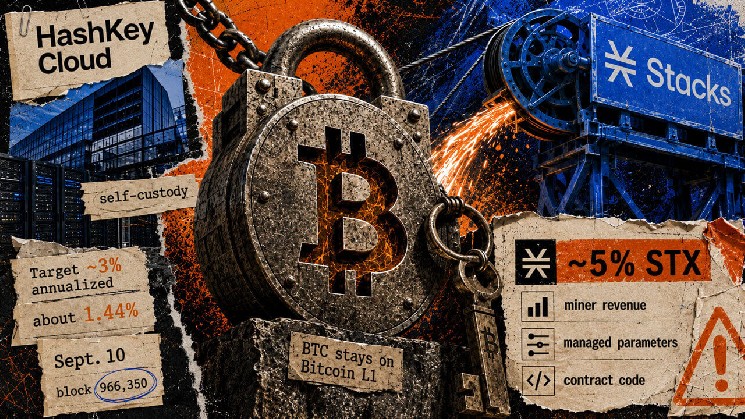
Third, $STX is being developed as a capacity asset for Bitcoin Staking. Under the proposed system, $BTC holders would create protocol bonds by locking Bitcoin on Bitcoin Layer 1 and pairing it with an $STX commitment worth approximately 5% of the Bitcoin position. The amount of $STX committed would determine how much Bitcoin Staking capacity a participant could access.
Together, these functions create three potential sources of demand for $STX: network transactions, existing Stacking participation and future Bitcoin Staking capacity.
Institutional and investment access to Stacks
In May this year, UTXO Management allocated $BTC to Bitcoin Stacking on Stacks as its inaugural institutional participant. The integration allows institutional Bitcoin holders to earn $BTC-denominated yield without moving assets off the Bitcoin base layer.
Stacks has also attracted early backing from investors including Union Square Ventures, Digital Currency Group, Lux Capital, Winklevoss Capital and Naval Ravikant. Investors can access $STX through the Grayscale Stacks Trust, while 21Shares operates a physically backed Stacks ETP that incorporates Stacking rewards. $STX is also included among the assets tracked in the Coinbase 50 Index category.
These products do not guarantee adoption or price appreciation. However, they provide investment and custody routes that many smaller crypto tokens do not have.
$STX tokenomics: Supply is not fixed
Any assessment of the $STX price outlook must consider supply as well as potential demand.
One favorable factor is the relatively small gap between reported circulating supply and current total supply. CoinMarketCap recently reported approximately 1.815 billion $STX in circulation, while market data providers showed market capitalization and fully diluted valuation at nearly identical levels. This indicates that $STX does not currently have the large reported circulating-to-total-supply gap often associated with future venture or team token unlocks.
However, it would be inaccurate to describe $STX as having a fully fixed or fully distributed supply.
$STX has no hard maximum supply. The network continues issuing tokens through its mining reward schedule, and supply parameters can change through the Stacks Improvement Proposal governance process. The Stacks Foundation also notes that separate ecosystem treasury emissions were introduced through SIP-031.
These factors mean that headline inflation figures require context when evaluating the token’s long-term supply profile.
How $STX generates $BTC yield
The most established utility behind $STX is its ability to generate Bitcoin-denominated rewards through Proof of Transfer.
Unlike staking systems that create more of the same token to reward participants, PoX connects two different assets. Miners compete for the right to produce Stacks blocks by committing Bitcoin and receive $STX block rewards plus transaction fees. Eligible $STX Stackers receive $BTC from that miner activity.
Stacks says the mechanism has distributed more than 4,200 $BTC to stakers since the network launched PoX in January 2021. The figure shows that Bitcoin-denominated rewards are an established feature rather than merely a planned utility. Individual returns vary according to miner commitments, the amount of $STX participating and the selected Stacking method.
The current Stacking dashboard recently displayed a reward APY of about 7.17%, based on the previous full cycle, alongside more than 581 million $STX locked. The rate changes between cycles and should not be treated as a guaranteed return.
How Bitcoin Staking could affect $STX demand
Bitcoin Staking would extend the same economic system to $BTC holders.
Under the planned self-custodial configuration, participants would lock Bitcoin directly on Bitcoin Layer 1 using a timelock while retaining control of their keys. They would then pair the $BTC with $STX worth approximately 5% of the Bitcoin position. Stacks currently targets around 3% annualized $BTC yield during the bootstrap phase, although realized returns may vary with miner economics and available reward capacity.
For the $STX token, the approximately 5% pairing requirement is the key feature.
At a Bitcoin price of roughly $65,960, 5,000 $BTC entering protocol bonds would represent about $330 million in Bitcoin. A 5% $STX requirement would correspond to approximately $16.5 million in $STX value.
Stacks DeFi creates another source of demand
$STX combines exposure to the broader Bitcoin cycle with token-specific demand from activity on Stacks. Improving Bitcoin sentiment may support $STX alongside the wider crypto market, while growth in Stacking, Bitcoin Staking and Stacks-based finance could provide an additional demand driver. The same structure can produce greater volatility when either part of the thesis weakens.
The Bitcoin Staking thesis becomes more important if incoming capital has productive applications to access after reaching Stacks. That ecosystem already exists, although it remains small compared with major smart-contract networks.
DeFiLlama currently tracks roughly $86 million in Stacks DeFi TVL. Zest Protocol accounts for about $68.5 million of that total, making lending one of the network’s largest existing use cases.
Zest reports around 800 $BTC deposited and says it has processed more than 1,500 liquidations without bad debt. Its Stacks market allows assets including sBTC, $STX and liquid-staked $STX to serve as collateral for borrowing.
Stacking DAO offers liquid Stacking products that allow $STX holders to retain DeFi liquidity while participating in Stacking strategies. DeFiLlama recently recorded approximately $13.8 million in value locked in the protocol.
The key connection for $STX holders is not simply that these applications exist. Every onchain transaction across the Stacks economy requires $STX for network fees.
A larger lending market would mean more transactions. Increased trading, stablecoin use, liquid Stacking and Bitcoin-focused financial products would also add network activity. This gives $STX a demand channel that operates separately from the protocol-bond mechanism.
$STX powers the Stacks economy today and is designed to provide capacity for Bitcoin Staking as the network expands.
FAQ
What is $STX and what is it used for?
$STX is the native token of Stacks. It pays transaction fees across the network, can be locked through Stacking to participate in the Proof of Transfer system and earn $BTC rewards, and is expected to serve as the paired capacity asset for Bitcoin Staking protocol bonds.
How do investors earn yield with $STX?
$STX holders can participate in Stacking independently or through supported pools and services. Proof of Transfer distributes $BTC committed by Stacks miners to eligible participants. Holders can also use liquid Stacking products and other DeFi applications, although these strategies introduce additional smart-contract, market and protocol risks.
Is $STX a good investment?
The answer depends on an investor’s risk tolerance and view of Stacks adoption. The fundamental case includes existing network utility, $BTC-denominated Stacking rewards, substantial $STX participation in Stacking, established investment products and a proposed Bitcoin Staking mechanism that could create direct token demand.
Risks include ongoing token issuance, governance changes to emissions, $STX price volatility, relatively modest current DeFi activity and the fact that self-custodial Bitcoin Staking has not yet launched on mainnet.
What does it mean to call $STX a higher-beta Bitcoin play?
It means $STX may make larger price moves than Bitcoin in either direction. Its price is sensitive to the broader Bitcoin cycle, but it also reflects expectations around activity and adoption on Stacks. When Bitcoin conditions and Stacks adoption improve together, those forces can amplify demand for $STX. When sentiment weakens, its smaller market capitalization and liquidity can also contribute to sharper declines.
How does Bitcoin Staking affect $STX demand?
Under the current design, a Bitcoin Staking protocol bond requires $BTC to be paired with $STX worth approximately 5% of the Bitcoin position. Greater $BTC participation would therefore require greater $STX capacity. The paired $STX would also remain locked during the approximately six-month bonding period, potentially reducing immediately usable supply while the bonds remain active.
Where can you buy $STX?
$STX trades on major centralized exchanges including Binance, Coinbase, Kraken, Upbit and KuCoin. Availability, trading pairs and regulatory restrictions differ by jurisdiction, so investors should check the requirements of their chosen platform before purchasing.