Tag: Prediction markets

  • Another Appeals Court Rules Against Kalshi, Finds Sports Contracts Subject to State Regulations

    Another Appeals Court Rules Against Kalshi, Finds Sports Contracts Subject to State Regulations

    Key Highlights

    • A federal appeals court ruled that Kalshi’s sports-event contracts are not federally regulated swaps, rejecting the prediction market’s argument that they fall under Commodity Futures Trading Commission jurisdiction.
    • The three-judge panel agreed Kalshi had standing to sue but determined its contracts do not depend on events “associated with a potential financial, economic, or commercial consequence” as required by statute.
    • The decision intensifies the regulatory clash between states and federally regulated prediction markets over taxation, age restrictions (18 vs. 21), and market competition since the 2024 election.

    Appeals Court Rejects Kalshi’s Swap Classification for Sports Contracts

    A three-judge federal appeals panel delivered a significant setback to prediction market operator Kalshi on Friday, ruling that its sports-event contracts do not qualify as federally regulated swaps under the Commodity Exchange Act. The decision marks a pivotal moment in the escalating regulatory battle between state gambling regulators and federally overseen prediction markets that have surged in prominence following the 2024 presidential election.

    Core Legal Dispute Centers on Statutory Definition

    The court acknowledged that Kalshi had legal standing to bring its case, but parted ways with the platform on the central statutory interpretation. In its written opinion, the panel stated: “While we agree with Kalshi that its sports-event contracts are conditioned on the occurrence of ‘event[s],’ we conclude that Kalshi’s contracts do not depend on events that are ‘associated with a potential financial, economic, or commercial consequence’ within the meaning of the statute.” This distinction effectively removes Kalshi’s sports offerings from the protective umbrella of federal derivatives regulation, leaving them exposed to state-level gambling enforcement.

    New York Giants Example Illustrates Judicial Reasoning

    To clarify its reasoning, the ruling employed a concrete illustration involving the New York Giants. The court explained that the classification hinges on how the “event” is defined. If the event is defined as the Giants winning a Super Bowl, then that outcome would be described as “that event having occurred.” However, the panel determined that such a sporting outcome lacks the requisite financial, economic, or commercial consequence necessary to transform the contract into a regulated swap.

    Why This Matters

    The ruling arrives amid intensifying friction between state gambling authorities and prediction markets like Kalshi, PredictIt, and Polymarket. Since the 2024 election cycle drove unprecedented volume and public attention to these platforms, states have moved aggressively to bring them under local regulatory frameworks. State regulators argue that prediction markets offer functionally identical products to licensed sportsbooks—wagering on game outcomes—yet enjoy structural advantages: they avoid state gaming taxes, operate under lighter compliance burdens, and in many cases accept customers as young as 18, whereas state-licensed operators universally enforce a 21-year-old minimum. Friday’s decision strengthens states’ hand by confirming that, at least for sports-event contracts, federal derivatives law does not preempt their authority. The case is likely to accelerate legislative and enforcement efforts in multiple states seeking to either tax, restrict, or ban these markets outright.

    Frequently Asked Questions

    What specific products did the court rule on?

    The ruling addresses Kalshi’s sports-event contracts—derivative-style instruments that pay out based on the outcomes of sporting events such as the Super Bowl. It does not directly address the platform’s political, economic, or weather-related contracts.

    Does this mean Kalshi must shut down its sports markets immediately?

    The decision removes the federal regulatory shield Kalshi claimed for these products. While not an injunction, it clears the path for state regulators to pursue enforcement actions, cease-and-desist orders, or litigation to halt the offering of sports contracts within their jurisdictions.

    How does the age restriction difference affect the regulatory fight?

    State gambling laws uniformly set the minimum betting age at 21. Kalshi and some other prediction platforms have allowed users as young as 18. States cite this discrepancy as a consumer-protection concern and a competitive inequity, arguing that younger adults are being exposed to gambling-like products without the safeguards required of licensed operators.

  • New York Sues Polymarket, Accusing Prediction Market of Illegal Gambling

    New York Sues Polymarket, Accusing Prediction Market of Illegal Gambling

    Key Highlights

    • New York Attorney General Letitia James and Governor Kathy Hochul filed a lawsuit Thursday accusing Polymarket of operating an unlicensed gambling business in violation of state law.
    • The complaint alleges Polymarket avoided licensing requirements and taxes that fund public schools, youth sports, and problem gambling treatment, while allowing users aged 18 to 20 to participate despite a legal minimum age of 21 for mobile sports betting.
    • The case intensifies a regulatory turf war between state authorities and the Commodity Futures Trading Commission, which argues it holds exclusive federal authority over prediction markets offering event contracts.

    New York Takes Legal Action Against Polymarket

    New York Attorney General Letitia James and Governor Kathy Hochul jointly filed a lawsuit on Thursday against Polymarket, a crypto-based prediction market platform, alleging it operates an unlicensed gambling operation within the state. The legal action marks the latest escalation in New York’s broader enforcement campaign against gambling-adjacent digital platforms and highlights a deepening jurisdictional conflict between state regulators and federal agencies over the classification and oversight of event-contract markets.

    According to the complaint, an investigation by the Attorney General’s office concluded that Polymarket’s markets satisfy New York’s legal definition of gambling because users stake money on uncertain outcomes they cannot control. The suit asserts that Polymarket never obtained a license from the New York State Gaming Commission, enabling the platform to avoid the taxes that licensed casinos and mobile sportsbooks pay—revenue that helps fund public schools, youth sports programs, and problem gambling treatment services.

    Regulatory Turf War Intensifies

    The lawsuit arrives amid an active debate among federal regulators regarding the proper framework for crypto-powered prediction markets. Polymarket and its rival Kalshi maintain they are not gambling sites but rather federally regulated exchanges offering “event contracts,” a type of derivative that would place them under the jurisdiction of the Commodity Futures Trading Commission (CFTC) rather than state gaming laws. The CFTC has sided with the platforms; in 2026 it sued nine states arguing that it should possess exclusive nationwide authority over the industry.

    Thursday’s complaint also alleges that Polymarket permits users aged 18 to 20 to access its platform, while New York law requires mobile sports bettors to be at least 21 years old. “By skirting New York’s laws, Polymarket is targeting the most vulnerable,” James said. Hochul added that the company had “knowingly” violated state law and put underage users at risk.

    Remedies Sought and Enforcement Pattern

    The state is asking a court to bar Polymarket from operating as an unlicensed gambling business in New York. It also seeks disgorgement of the company’s alleged illegal gains, restitution for harmed users, and fines equal to three times those gains. The action follows a pattern of recent enforcement by New York authorities: James and Hochul sued rival prediction market Kalshi in July, and James sued Coinbase and Gemini in April over similar claims. Earlier this month, James secured an $8 million settlement from the leading operator of sweepstakes casinos.

    Polymarket launched in the United States in December 2025, initially allowing users to bet on sporting events with plans to expand into markets covering a wide range of topics. The platform’s rapid growth and the unresolved jurisdictional questions surrounding event contracts suggest further legal and regulatory clashes are likely.

    Why This Matters

    The Polymarket lawsuit crystallizes a pivotal policy dispute: whether prediction markets constitute gambling subject to state licensing and consumer-protection regimes, or financial derivatives subject to exclusive federal oversight by the CFTC. The outcome will shape market access, tax revenue allocation, and consumer safeguards—particularly for younger users—across the United States. As New York pursues parallel actions against Kalshi, Coinbase, and Gemini, the state is signaling a coordinated strategy to assert its authority over crypto-adjacent wagering platforms, setting the stage for court rulings that could define the regulatory perimeter for years to come.

    Frequently Asked Questions

    What specific laws does New York allege Polymarket violated?
    The state contends Polymarket meets New York’s legal definition of gambling because users stake money on uncertain outcomes they cannot control, and that the platform operated without a license from the New York State Gaming Commission, evading taxes and allowing users aged 18–20 to participate despite a statutory minimum age of 21 for mobile sports betting.
    How does this case relate to the CFTC’s position on prediction markets?
    The CFTC argues it holds exclusive federal authority over event-contract markets and has sued nine states to enforce that view. Polymarket and Kalshi claim their products are federally regulated derivatives, not gambling, creating a direct conflict between state enforcement actions and federal regulatory policy.
    What remedies is New York seeking in the lawsuit?
    The state requests a court order barring Polymarket from operating as an unlicensed gambling business in New York, disgorgement of alleged illegal gains, restitution for harmed users, and civil penalties equal to three times those gains.
  • U.S. Regulator Warns of Cheating Risks in ‘Mention Markets’ on Prediction Platforms

    U.S. Regulator Warns of Cheating Risks in ‘Mention Markets’ on Prediction Platforms

    Key Highlights

    • The CFTC issued a staff advisory warning that “mention markets” — betting on what a specific individual might say or do — are “presumptively readily susceptible to manipulation.”
    • The regulator distinguishes these markets from standard event contracts because outcomes depend on “the discrete conduct of a named person” rather than independently generated, externally verifiable events.
    • Prediction platform operators including Kalshi and Polymarket are reminded they may only list derivative contracts that are not readily susceptible to manipulation.

    CFTC Targets ‘Mention Markets’ in New Supervisory Advisory

    The Commodity Futures Trading Commission has drawn a sharp regulatory line around a growing category of prediction-market contracts, issuing a staff advisory on Tuesday that labels wagers on an individual’s future statements or actions as “presumptively readily susceptible to manipulation.” The guidance, released by the agency’s Division of Market Oversight, signals a potential narrowing of the event-contract universe that can clear the CFTC’s supervisory hurdles, directly affecting operators such as Kalshi and Polymarket.

    How ‘Mention Markets’ Differ From Standard Event Contracts

    Unlike traditional event contracts that settle on “independently generated, externally verifiable outcomes that are outside the control of any single person,” the CFTC staff advisory explains that mention markets pivot on “the discrete conduct of a named person, and that conduct may be neither independently generated nor externally verifiable.” Because the outcome hinges on one person’s behavior — or the actions of those in their orbit — the agency warns that the individual or people around them could shift the result based on their own knowledge of the betting activity.

    Regulatory Reminder: Only Non-Manipulable Contracts Permitted

    The advisory serves as a formal reminder to prediction-platform operators that they are “only allowed to trade derivative contracts that are not readily susceptible to manipulation.” By classifying mention markets as presumptively problematic, the CFTC is effectively placing the burden on exchanges to demonstrate why any contract tied to a specific person’s conduct should be permitted, or to delist such markets altogether. The move underscores the agency’s focus on market integrity as prediction platforms expand their offerings beyond traditional economic and political indicators.

    Why This Matters

    The CFTC’s advisory arrives as prediction markets gain mainstream traction and attract significant volume during major news cycles. By targeting contracts tied to individual conduct, the regulator is addressing a structural vulnerability: markets where a single actor — or their associates — can influence the outcome create clear incentives for insider trading and market manipulation. For platforms like Kalshi and Polymarket, the guidance implies a compliance review of existing “mention market” listings and stricter vetting for future contracts. The decision also sets a precedent for how U.S. regulators may treat novel event-contract categories as the sector evolves, balancing innovation with the statutory mandate to prevent manipulation and protect market participants.

    Frequently Asked Questions

    What are “mention markets” according to the CFTC?
    Mention markets are wagers on what a specific, named individual might say or do — for example, whether a public figure will utter a certain phrase or take a particular action. The CFTC considers these distinct from standard event contracts because the outcome depends on the discrete conduct of one person.
    Why does the CFTC consider mention markets prone to manipulation?
    The advisory states that because the outcome pivots on “the discrete conduct of a named person,” that person or people around them could influence the result based on their own knowledge of the betting, making the market “presumptively readily susceptible to manipulation.”
    What must prediction platforms like Kalshi and Polymarket do in response?
    Operators are reminded they may only list derivative contracts that are not readily susceptible to manipulation. They will likely need to review existing mention-market contracts for compliance and apply stricter criteria before launching similar markets in the future.
  • Polymarket $10 Million Fraud Scare Tests Whether Growth Outran Compliance

    Polymarket $10 Million Fraud Scare Tests Whether Growth Outran Compliance

    Key Highlights

    • Polymarket faced a $10 million fraud attempt in February involving stolen debit cards and an 80% deposit rejection rate, prompting the resignation of its U.S. compliance chief and the firing of the U.S. division CEO and other compliance executives.
    • Despite the fraud episode and ongoing CFTC investigations into potential insider trading on events including Biden pardons and Iran contracts, a Sullivan & Cromwell review concluded Polymarket complied with regulations, and the company says fraud rates normalized by May after adding controls and hiring former Amazon finance chief Warren Jenson as CFO.
    • Prediction markets generated $63.5 billion in volume in 2025, with Polymarket and Kalshi handling $52.7 billion in the first 86 days of 2026, drawing heightened scrutiny from senators, JPMorgan, and the New York City Council over marketing practices and regulatory compliance.

    Fraud Attempt Exposes Compliance Gaps at $21 Billion Valuation

    In February, Polymarket became the target of a coordinated fraud attempt that sought to extract at least $10 million from its U.S. application, according to reporting by the Wall Street Journal. Attackers linked stolen debit cards to thousands of newly created accounts, placed wagers, and attempted to cash out to accounts they controlled. At the peak of the activity, more than 80% of deposits were rejected as fraudulent—a rate vastly exceeding the industry norm of roughly 1%. The bulk of the suspicious activity was traced to seven users, with one individual making nearly 4,000 deposits. The episode reached senior management quickly, and CEO Shaney Coplan reportedly instructed employees to proceed with business expansion plans regardless of any subsequent sanctions.

    Leadership Shakeup and Internal Warnings

    The fallout was immediate. Andrew Clifford, who oversaw compliance in the United States, resigned after publishing an internal report detailing the fraud issues. Justin Hertzberg, CEO of Polymarket’s U.S. division, was dismissed along with other executives responsible for regulatory compliance and anti-money-laundering policies. Some employees had warned that relaxing the rule requiring withdrawals to be sent back to the original funding source could increase money-laundering risk, but executives maintained that other internal controls were sufficient. A subsequent review by law firm Sullivan & Cromwell concluded that Polymarket had complied with applicable regulations.

    Strengthened Controls and Ongoing Investigations

    Polymarket says it has since bolstered its defenses. The company added risk personnel, including a former FBI agent, hired former Amazon finance chief Warren Jenson as its first chief financial officer, limited the number of debit-card users it could link, and engaged fraud-prevention firm Riskified. The company states that fraud rates returned to industry norms by May. However, the fraud episode is only one facet of mounting scrutiny. The New York Times reported that more than 80 Polymarket accounts have been flagged for questionable trading across nearly 30 subjects, including 13 users who wagered $140,000 on an Israeli military action against Iran and profited more than $600,000.

    CFTC Probes Insider Trading Allegations and Market Integrity

    Federal investigation activity has intensified. WIRED reported that Commodity Futures Trading Commission Chairman Michael Selig authorized investigations into trades made on Polymarket associated with Biden pardons, contracts with Iran, and Google’s search results. Additionally, a U.S. Special Forces soldier has been accused of using classified information to gain over $400,000 from bets related to Venezuelan President Nicolás Maduro. The CFTC has indicated that misuse of material nonpublic information could constitute a violation of commodities law. Blockchain analytics firm Chainalysis notes that the transparency of blockchain technology enables law enforcement to trace suspicious operations and investigate wallet connections.

    Marketing Practices Draw Congressional and Banking Scrutiny

    Polymarket’s promotional tactics have also attracted regulatory attention. A June 25 letter from Senators John Curtis and Adam Schiff asked the CFTC to investigate allegations that Polymarket paid creators to stage trades on lookalike websites without clearly disclosing the payments. The Wall Street Journal detailed how fake bets were promoted online. In August, JPMorgan closed Polymarket’s bank account over regulatory concerns, and the New York City Council opened a probe into prediction-market marketing practices.

    Why This Matters

    The stakes extend well beyond a single company. Prediction markets generated $63.5 billion in volume in 2025, while Kalshi and Polymarket together handled $52.7 billion in the first 86 days of 2026, according to Artemis. Intercontinental Exchange’s stake in Polymarket was valued at approximately $1.6 billion, representing roughly 22% of the company. Academic research underscores the systemic implications: a Stanford-SMU study found that Polymarket’s five-minute Bitcoin contracts were associated with settlement-time spikes in spot order flow and sharp price reversals, with retail traders absorbing most losses during manipulated cycles. The effect was far weaker in 15-minute contracts. For banks, regulators, and institutional traders, weak controls at major prediction-market platforms can raise the cost of entering the sector, fragment liquidity across jurisdictions, and slow the broader integration of prediction markets with crypto finance.

    Frequently Asked Questions

    Did Polymarket actually lose $10 million in the fraud attempt?

    No. The $10 million figure represents the amount attackers attempted to steal using stolen debit cards. Polymarket’s systems rejected more than 80% of deposits as fraudulent at the peak, and the company states it did not lose the funds.

    What regulatory actions are currently targeting Polymarket?

    The CFTC has authorized investigations into trades linked to Biden pardons, Iran contracts, and Google search results. Senators Curtis and Schiff have requested a CFTC probe into undisclosed payments to creators for staged trades. JPMorgan closed Polymarket’s bank account, and the New York City Council is investigating prediction-market marketing practices.

    How large is the prediction market sector, and who are the major players?

    Prediction markets generated $63.5 billion in volume in 2025. Polymarket and Kalshi together processed $52.7 billion in the first 86 days of 2026. Intercontinental Exchange holds a stake in Polymarket valued at roughly $1.6 billion, representing about 22% of the company.

  • CFTC Exempts Crypto and Prediction Markets Software Providers from Broker Classification

    CFTC Exempts Crypto and Prediction Markets Software Providers from Broker Classification

    Key Highlights

    • The CFTC issued a no-action letter exempting eligible crypto and prediction market software providers from broker registration requirements, provided they maintain zero trade discretion, never hold user assets, and avoid volume-based commissions.
    • The relief builds on a March precedent granting Phantom Technologies no-action relief, allowing Phantom Wallet to partner with Kalshi as a non-custodial passive interface without registering as an introducing broker.
    • The move comes alongside the SEC’s new “Innovation Exemption” for on-chain tokenized stock trading and UK FCA guidance on crypto authorization, signaling multi-jurisdictional regulatory momentum despite the Clarity Act’s Senate defeat.

    CFTC Grants Broad No-Action Relief for Non-Custodial Software Providers

    The U.S. Commodity Futures Trading Commission (CFTC) has issued a sweeping no-action letter that exempts eligible cryptocurrency and prediction market software developers from the requirement to register as brokers. The announcement, made today, establishes a formal regulatory safe harbor for developers who operate as passive, non-custodial interfaces connecting users to regulated trading platforms. A “no-action” position represents an official regulator statement that it will not pursue enforcement actions against an entity for a specific activity, providing critical legal certainty in a sector long plagued by ambiguity.

    Strict Conditions Define the Safe Harbor

    The relief is conditional and narrowly tailored to preserve user sovereignty and prevent conflicts of interest. To qualify, a developer must maintain zero discretion over trades, ensuring the user retains absolute control over every transaction. The developer must never assume custody of users’ assets at any point. Critically, the developer is banned from taking volume-based dynamic commissions, meaning they cannot take a “cut” of the trading volume passing through their software. These guardrails are designed to distinguish passive technology providers from active intermediaries who manage risk or hold funds.

    Phantom Technologies Precedent Paves the Way

    The CFTC’s decision codifies a precedent set in March when the agency granted its first no-action position to a passive software provider, Phantom Technologies. That relief allowed Phantom Wallet to integrate with Kalshi, a regulated prediction market platform, operating strictly as a non-custodial, passive interface without registering as an introducing broker. Phantom CEO Brandon Millman welcomed today’s broader policy on X, stating: “In March, Phantom became the first passive software provider to receive no-action relief from the CFTC. We’re grateful to the CFTC for working with us to chart a new path for non-custodial software providers to connect people with regulated markets, all while the provider never…”

    Industry Adoption and Parallel Regulatory Moves

    Major prediction market operators including Crypto.com and ProphetX have reportedly adopted similar non-custodial partnership models to expand their reach while remaining within the new legal provisions. The CFTC’s action arrives amid a flurry of regulatory developments. Earlier this week, the Clarity Act failed to secure a majority on the Senate floor, yet agencies continue to fill the void. Today, the U.S. Securities and Exchange Commission (SEC) unveiled its “Innovation Exemption” rule, permitting the on-chain trading of certain tokenized stocks. Simultaneously, the UK Financial Conduct Authority (FCA) published guidance clarifying which crypto activities require formal authorization, reflecting a coordinated international effort to define the regulatory perimeter.

    Why This Matters

    The CFTC’s no-action letter represents a significant inflection point for decentralized finance (DeFi) infrastructure and prediction markets in the United States. By explicitly legitimizing non-custodial front-end software, the regulator has removed a major legal overhang that discouraged developers from building interfaces for regulated markets. This bridges the gap between user-friendly, self-custodial wallets and compliant, exchange-based liquidity. The parallel moves by the SEC and UK FCA suggest a maturing global regulatory approach that favors activity-based, risk-proportionate rules over blanket prohibitions. For users, the immediate benefit is access to regulated prediction markets and tokenized assets through familiar, non-custodial wallets without surrendering control of private keys. For the industry, it establishes a viable compliance pathway that could unlock a wave of institutional-grade product development on public blockchains.

    Frequently Asked Questions

    What specific activities does the CFTC no-action letter cover?

    The letter covers software developers who partner with regulated platforms to provide non-custodial interfaces for crypto and prediction market trading. The developer must have zero trade discretion, never hold user assets, and cannot charge volume-based commissions or take a “cut” of trading volume.

    How does this differ from the Phantom Technologies relief granted in March?

    The March relief was a company-specific no-action letter for Phantom Technologies to operate with Kalshi. Today’s announcement establishes a general, reusable framework that any eligible developer meeting the stated conditions can rely upon, rather than requiring individual applications.

    Does this mean all crypto wallet providers are now exempt from registration?

    No. The exemption applies only to developers meeting all three strict conditions: zero trade discretion, non-custodial architecture, and no volume-based fees. Wallets that custody assets, execute trades on behalf of users, or charge percentage-based fees on volume do not qualify and remain subject to existing registration requirements.

  • Robinhood Crypto Trading Volume Jumps 61% in August

    Robinhood Crypto Trading Volume Jumps 61% in August

    Robinhood Crypto Volume Surges 61% in August, but Prediction Markets Steal the Show

    Robinhood Markets reported a sharp rebound in cryptocurrency trading activity during August, though the standout growth story remains its rapidly expanding prediction market business.

    Crypto Trading Rebounds From July Lows

    Notional crypto trading volume—the total dollar value of assets bought and sold on the platform—jumped 61% month over month to $17.5 billion in August, according to operating data released Thursday. The increase follows a sluggish July, when volume sat at $10.9 billion.

    Despite the monthly gain, August volume remained 38% below the $28.1 billion recorded in the same month last year, highlighting the persistent year-over-year decline in retail crypto engagement.

    Platform Breakdown: App vs. Bitstamp

    • Robinhood App: $7.4 billion in volume, up 72% from July but down 46% year over year.
    • Bitstamp: $10.1 billion in volume, up 53% month over month. Robinhood acquired the exchange in 2025.

    Combined, the two platforms averaged $565 million per day in crypto trading volume during the month.

    Broader Platform Metrics Show Strength

    Crypto represents a small slice of Robinhood’s overall balance sheet. Key platform-wide figures for August include:

    • Total platform assets: $384 billion, up 26% year over year.
    • Funded customers: 28.6 million (users with at least one transaction in the trailing 45 days).
    • Margin loans: $21.5 billion, up 72% from a year ago.

    Event Contracts Emerge as Breakout Business

    The most striking growth metric isn’t crypto at all. Event contracts—Robinhood’s prediction market bets on outcomes like Federal Reserve rate decisions or sports results—traded 4.7 billion times in August.

    While that represents a 23% decline from July, it marks a roughly 15-fold increase from the 300 million contracts traded in August 2025. Each contract functions as a binary wager: buy a “yes” for a few cents, and it pays $1 if correct, zero if wrong.

    That explosive growth has turned prediction markets into Robinhood’s fastest-growing revenue line. In the company’s record quarter reported in July, event contract revenue surged more than tenfold year over year to $156 million, overtaking crypto as a source of transaction income.

    Infrastructure and Partnerships

    Robinhood operates these products through partner exchanges Kalshi and ForecastEx, as well as its own joint venture Rothera. As of the July earnings report, Rothera had processed more than 3.5 billion contracts since its June launch.

    Regulatory Scrutiny Intensifies on Capitol Hill

    The rapid rise of prediction markets has drawn legislative attention. Since January, lawmakers have introduced more than 10 bills targeting the sector, including the PREDICT Act, which would prohibit members of Congress, the president, and other senior officials from trading contracts tied to political events.

    Critics argue that placing sports and political wagers alongside retirement accounts blurs the line between investing and gambling—a tension regulators are still working to resolve.

    Robinhood Chain Gains Traction on Ethereum Layer 2

    The company’s blockchain bet is also accelerating. Robinhood Chain, an Ethereum Layer 2 network designed to process transactions faster and cheaper before settling to the mainnet, logged $1.6 billion in daily trading volume on decentralized exchanges as of September 1—a 61% increase in just four days.

    Market Reaction and Upcoming Catalysts

    Despite the strong operating data, Robinhood shares (HOOD) slipped 0.83% on Thursday. Analysts at Mizuho and StoneX raised their price targets this week, citing the company’s broader growth trajectory.

    Robinhood’s next quarterly earnings report is expected November 4.

  • Riot Games Holds Sponsorship Talks With Polymarket, Kalshi

    Riot Games Holds Sponsorship Talks With Polymarket, Kalshi

    Riot Games Explores Prediction Market Sponsorships Ahead of League of Legends World Championship

    Riot Games has entered discussions with prediction market operators Kalshi and Polymarket regarding potential esports sponsorship agreements, according to a Bloomberg report published on September 11. The talks come weeks before the League of Legends World Championship kicks off in October.

    Riot Evaluates Emerging Prediction Market Space

    The Tencent-owned developer, which operates competitive tournaments for League of Legends and Valorant, has not committed to either platform. Sources familiar with the private discussions told Bloomberg that any agreement would involve Riot’s esports business.

    “Prediction markets are an emerging space that we’re evaluating with a focus on safeguarding competitive integrity, potential value for teams, impact on the fan experience, and alignment with our broader ecosystem goals,” Riot Games spokesperson Joe Hixson told Bloomberg.

    Kalshi declined to comment on the discussions, while Polymarket did not respond to Bloomberg’s request for comment.

    Official Esports Data Requirement Through GRID

    Any prediction market sponsor approved by Riot would be required to obtain official betting data through GRID Esports, one person familiar with the discussions told Bloomberg. GRID already maintains ties to Polymarket, having partnered with the prediction market operator in June. That agreement granted Polymarket access to official esports data and included plans for faster streams, a redesigned esports section, and data taken directly from game servers.

    The requirement would place official game data within any sponsorship arrangement as Riot considers bringing prediction markets closer to its competitive ecosystem.

    Massive Esports Betting Market Drives Interest

    League of Legends and Valorant tournaments draw millions of viewers globally, with esports audiences skewing younger than those of traditional sports. Riot has previously cited Sportradar data showing betting tied to its two major titles reached $10.7 billion in 2024. Most of that activity took place through unregulated markets and unlicensed bookmakers, according to Riot.

    The company began permitting sponsorships from traditional sports betting operators in 2025, subject to restrictions intended to protect competitive integrity. Prediction markets already offer contracts on esports matches, allowing traders to take positions on game outcomes without a formal sponsorship relationship with Riot.

    Kalshi has been recruiting for an esports-focused position tasked with forming league partnerships and increasing its presence in the sector. Polymarket had employees working on esports by at least 2025, according to LinkedIn information cited by Bloomberg.

    Prediction Markets Expand Across Professional Sports

    The Riot discussions would extend a series of deals bringing prediction markets into professional sports and entertainment. At the end of August, Kalshi secured an exclusive U.S. Open partnership with the U.S. Tennis Association. The agreement gave the company prediction market partner status and restricted competing platforms from advertising at the tournament venue and across its television coverage.

    Kalshi had already gained FIFA World Cup exposure through an agreement with ADI Predictstreet, FIFA’s official prediction market partner for the 2026 tournament. The World Cup partnership placed Kalshi branding alongside ADI Predictstreet across stadium, television and digital coverage during the competition.

    Polymarket has pursued a similar strategy, signing agreements spanning Major League Baseball, the Bundesliga and other sports properties. Its Bundesliga agreement made Polymarket the league’s exclusive U.S. prediction market partner and included the use of market data during pay-per-view programming.

    NBA star LeBron James became one of the latest prominent athletes connected with the company when he confirmed a Polymarket partnership through a video posted on X on September 5. The initial campaign is expected to focus on American football, according to CNBC.

    Record Trading Volumes Fuel Competition

    Prediction market operators have been competing for sports users as trading activity across the sector has climbed. Combined monthly volume across Kalshi, Polymarket and Polymarket US reached a record $50.59 billion in July, with Kalshi accounting for $37.7 billion.

    Integrity Concerns Shape Riot’s Evaluation

    Riot’s consideration of prediction market sponsors comes as sports organizations take different positions on partnerships with the sector. The National Football League has held back from signing prediction market sponsorships, citing concerns over inadequate regulation and ongoing legal challenges, Bloomberg reported earlier this month.

    Riot has its own concerns because betting activity can create integrity risks around professional matches. Its evaluation of prediction markets is therefore considering competitive integrity alongside the possible financial benefits for esports teams and effects on fans, according to Hixson.

    Sponsorship income remains an important source of revenue for esports organizations. NewZoo estimates that sponsorships can account for as much as 60% of an organization’s revenue, while the industry has historically struggled to generate sufficient income from merchandise and ticket sales.

    Prediction market companies have spent heavily to place their brands around major sporting events while developing systems intended to detect prohibited trading. Kalshi uses its proprietary Poirot detection system and has worked with Solidus Labs, IC360 and the Wharton Forensic Analytics Lab on surveillance and integrity controls. Polymarket has developed Vergence AI, an integrity monitoring system created with support from Palantir and TWG AI.

    Regulatory Battles Continue Across States

    Sports contracts remain one of the main sources of regulatory pressure on Kalshi and Polymarket in the United States. State gaming regulators and attorneys general have argued that contracts tied to game winners, player statistics and other sporting outcomes amount to sports betting and should fall under state gambling laws. Prediction market operators have countered that their event contracts are derivatives subject to federal oversight.

    The dispute has produced different outcomes across U.S. courts. A Washington state judge in July granted a preliminary injunction blocking Kalshi from offering sports prediction markets to residents after finding the state was likely to succeed in arguing that the products violated local gambling laws. Kalshi has faced similar challenges in New York and Michigan, while lawsuits involving prediction market regulation have spread across numerous states.

    Baltimore sued both Kalshi and Polymarket in August, accusing the companies of offering unlicensed sports betting. The city’s case against Kalshi named Coinbase, Robinhood and Webull over their role in distributing sports event contracts.

    Despite the legal disputes, sports have become a major source of activity for prediction markets. During the 2026 FIFA World Cup, monthly sports prediction volume reached $9.5 billion on Kalshi and $5.3 billion on Polymarket, according to Defirate data reported in June.

    Riot’s discussions are taking place weeks before the League of Legends World Championship begins in October. No sponsorship agreement with either Kalshi or Polymarket has been announced.

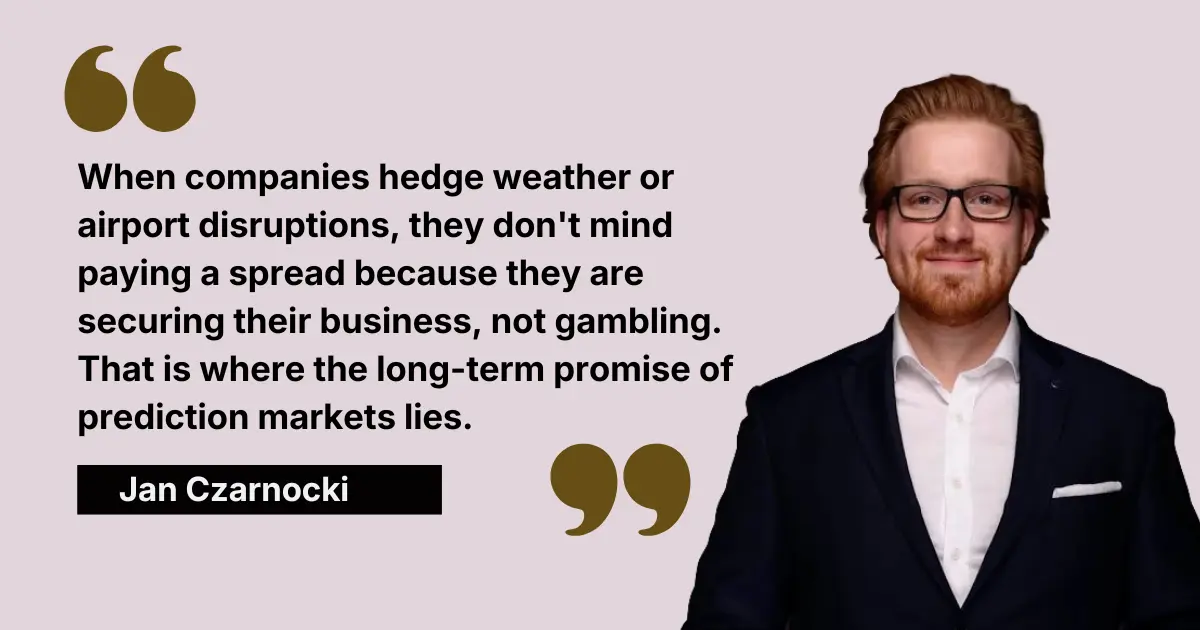
  • Jan Czarnocki of Elastics on Institutional Prediction Markets: “The best future is where sharps are the underwriters of insurance policies for big institutional players”

    Jan Czarnocki of Elastics on Institutional Prediction Markets: “The best future is where sharps are the underwriters of insurance policies for big institutional players”

    Elastics Executive Predicts Prediction Markets Will Displace Traditional Commercial Insurance

    Jan Czarnocki, Chief of Staff and General Counsel at Elastics, appeared on the NEXTPredict Podcast to outline a transformative vision for prediction markets. According to Czarnocki, these platforms are poised to evolve well beyond retail sports betting and eventually displace traditional commercial insurance models.

    Shift Toward Corporate Risk Management and Event Hedging

    During the discussion, Czarnocki explained the structural shift toward corporate risk management and event hedging. He described a future where skilled forecasters from leading prediction platforms take on underwriting roles traditionally held by insurance institutions.

    “The best future is where sharps from Polymarket and Kalshi are actually the underwriters of insurance policies for big institutional players…”

    This perspective signals a fundamental change in how institutional risk could be priced and managed, leveraging the collective intelligence and market efficiency of decentralized prediction markets.

  • World Expands Solana’s Betting Economy as Prediction Markets Reach 1 Million Users

    World Expands Solana’s Betting Economy as Prediction Markets Reach 1 Million Users

    World, a prediction market protocol built on Solana, has formally launched its standalone platform to more than one million users from its waitlist. The rollout moves the service out of its preliminary phase inside the Phantom wallet, where it had operated since July 2026, and onto a dedicated web interface.

    Market Catalog Exceeds 150,000 Contracts

    The platform now hosts over 150,000 markets spanning sports, politics, crypto, economy, and culture. Sports coverage includes NFL regular-season games, seven professional soccer leagues, and Formula 1. Political contracts feature the 2026 U.S. midterm elections. Each market uses a binary “yes” or “no” structure priced between $0 and $1, with prices reflecting the probability estimated by participants. Winning outcomes settle at $1; losing outcomes settle at $0.

    Non-Custodial Architecture and On-Chain Liquidity

    World operates under a non-custodial model, meaning it does not hold user-deposited funds. Traders do not need a brokerage account or centralized exchange verification. Users pay standard Solana network fees when opening or closing positions. Orders are routed directly to decentralized liquidity providers within the ecosystem.

    Ramzy Ali, Head of Decentralized Finance at the Solana Foundation, explained that the model retains 100% of liquidity directly on-chain. Data provided by the protocol confirms that operations avoid centrally controlled off-chain order books.

    Automated Settlement via Chainlink Infrastructure

    Contract resolution and settlement are powered by Chainlink Data Streams and the Chainlink Runtime Environment (CRE). This integration automates the processing of final outcomes when an event concludes or a deadline is reached. Technical documentation from the firm indicates the mechanism eliminates the need for human panels or token-holder voting committees.

    Johann Eid, Chief Business Officer at Chainlink Labs, noted that the demand seen on the waitlist reflects strong interest in fast, transparent on-chain settlements. For sporting events, the network requires verified final scores; for monetary policy contracts, the system processes official Federal Reserve decisions.

    Regulatory Status and Undisclosed Metrics

    As of publication, World has not disclosed official figures for daily trading volume, exchange fees, or cumulative open interest. The company has also not specified whether it holds registrations with the U.S. Commodity Futures Trading Commission (CFTC). Consequently, effective access for U.S.-based traders remains subject to local jurisdictional regulations.

    Expansion Roadmap: Equities, Commodities, and Weather Derivatives

    World’s announced roadmap includes the introduction of directional contracts on traditional equities. Future plans call for markets tied to commodities such as gold, silver, crude oil, and natural gas, as well as weather derivatives for major metropolitan areas.

  • Trump Jr.’s Firm Leads $1 Billion Polymarket Fundraising Round at $21 Billion Valuation: Report

    Trump Jr.’s Firm Leads $1 Billion Polymarket Fundraising Round at $21 Billion Valuation: Report

    Donald Trump Jr.’s venture capital firm, 1789 Capital, is leading a $1 billion funding round for prediction market Polymarket, valuing the company at $21 billion, a firm spokesperson said Monday.

    1789 Capital is contributing about $300 million to the round, spokesperson Alexa Henning said. The firm has already invested roughly $200 million in Polymarket.

    The latest funding values Polymarket 40% higher than its previous valuation of about $15 billion just months ago, highlighting the rapid growth of prediction markets.

    Polymarket and Kalshi expand prediction market business

    Polymarket and rival platform Kalshi allow users to wager on outcomes ranging from statements a president may make in a speech to which contestants on a reality television show might get married. Both companies have expanded sharply over the past year.

    The Trump family’s involvement in the sector has grown alongside the industry. Trump Jr. became an adviser to Kalshi in 2025 and received shares valued at more than $300,000. He also advises Polymarket separately.

    President Donald Trump has taken an increasingly favorable position toward prediction markets during the same period. Michael Selig, Trump’s appointee to lead the Commodity Futures Trading Commission, which regulates prediction markets, has praised the companies and sued states seeking to regulate them.

    In May, Trump wrote on Truth Social that prediction markets would thrive under his leadership.