Tag: Polymarket

  • New York Sues Polymarket, Accusing Prediction Market of Illegal Gambling

    New York Sues Polymarket, Accusing Prediction Market of Illegal Gambling

    Key Highlights

    • New York Attorney General Letitia James and Governor Kathy Hochul filed a lawsuit Thursday accusing Polymarket of operating an unlicensed gambling business in violation of state law.
    • The complaint alleges Polymarket avoided licensing requirements and taxes that fund public schools, youth sports, and problem gambling treatment, while allowing users aged 18 to 20 to participate despite a legal minimum age of 21 for mobile sports betting.
    • The case intensifies a regulatory turf war between state authorities and the Commodity Futures Trading Commission, which argues it holds exclusive federal authority over prediction markets offering event contracts.

    New York Takes Legal Action Against Polymarket

    New York Attorney General Letitia James and Governor Kathy Hochul jointly filed a lawsuit on Thursday against Polymarket, a crypto-based prediction market platform, alleging it operates an unlicensed gambling operation within the state. The legal action marks the latest escalation in New York’s broader enforcement campaign against gambling-adjacent digital platforms and highlights a deepening jurisdictional conflict between state regulators and federal agencies over the classification and oversight of event-contract markets.

    According to the complaint, an investigation by the Attorney General’s office concluded that Polymarket’s markets satisfy New York’s legal definition of gambling because users stake money on uncertain outcomes they cannot control. The suit asserts that Polymarket never obtained a license from the New York State Gaming Commission, enabling the platform to avoid the taxes that licensed casinos and mobile sportsbooks pay—revenue that helps fund public schools, youth sports programs, and problem gambling treatment services.

    Regulatory Turf War Intensifies

    The lawsuit arrives amid an active debate among federal regulators regarding the proper framework for crypto-powered prediction markets. Polymarket and its rival Kalshi maintain they are not gambling sites but rather federally regulated exchanges offering “event contracts,” a type of derivative that would place them under the jurisdiction of the Commodity Futures Trading Commission (CFTC) rather than state gaming laws. The CFTC has sided with the platforms; in 2026 it sued nine states arguing that it should possess exclusive nationwide authority over the industry.

    Thursday’s complaint also alleges that Polymarket permits users aged 18 to 20 to access its platform, while New York law requires mobile sports bettors to be at least 21 years old. “By skirting New York’s laws, Polymarket is targeting the most vulnerable,” James said. Hochul added that the company had “knowingly” violated state law and put underage users at risk.

    Remedies Sought and Enforcement Pattern

    The state is asking a court to bar Polymarket from operating as an unlicensed gambling business in New York. It also seeks disgorgement of the company’s alleged illegal gains, restitution for harmed users, and fines equal to three times those gains. The action follows a pattern of recent enforcement by New York authorities: James and Hochul sued rival prediction market Kalshi in July, and James sued Coinbase and Gemini in April over similar claims. Earlier this month, James secured an $8 million settlement from the leading operator of sweepstakes casinos.

    Polymarket launched in the United States in December 2025, initially allowing users to bet on sporting events with plans to expand into markets covering a wide range of topics. The platform’s rapid growth and the unresolved jurisdictional questions surrounding event contracts suggest further legal and regulatory clashes are likely.

    Why This Matters

    The Polymarket lawsuit crystallizes a pivotal policy dispute: whether prediction markets constitute gambling subject to state licensing and consumer-protection regimes, or financial derivatives subject to exclusive federal oversight by the CFTC. The outcome will shape market access, tax revenue allocation, and consumer safeguards—particularly for younger users—across the United States. As New York pursues parallel actions against Kalshi, Coinbase, and Gemini, the state is signaling a coordinated strategy to assert its authority over crypto-adjacent wagering platforms, setting the stage for court rulings that could define the regulatory perimeter for years to come.

    Frequently Asked Questions

    What specific laws does New York allege Polymarket violated?
    The state contends Polymarket meets New York’s legal definition of gambling because users stake money on uncertain outcomes they cannot control, and that the platform operated without a license from the New York State Gaming Commission, evading taxes and allowing users aged 18–20 to participate despite a statutory minimum age of 21 for mobile sports betting.
    How does this case relate to the CFTC’s position on prediction markets?
    The CFTC argues it holds exclusive federal authority over event-contract markets and has sued nine states to enforce that view. Polymarket and Kalshi claim their products are federally regulated derivatives, not gambling, creating a direct conflict between state enforcement actions and federal regulatory policy.
    What remedies is New York seeking in the lawsuit?
    The state requests a court order barring Polymarket from operating as an unlicensed gambling business in New York, disgorgement of alleged illegal gains, restitution for harmed users, and civil penalties equal to three times those gains.
  • U.S. Regulator Warns of Cheating Risks in ‘Mention Markets’ on Prediction Platforms

    U.S. Regulator Warns of Cheating Risks in ‘Mention Markets’ on Prediction Platforms

    Key Highlights

    • The CFTC issued a staff advisory warning that “mention markets” — betting on what a specific individual might say or do — are “presumptively readily susceptible to manipulation.”
    • The regulator distinguishes these markets from standard event contracts because outcomes depend on “the discrete conduct of a named person” rather than independently generated, externally verifiable events.
    • Prediction platform operators including Kalshi and Polymarket are reminded they may only list derivative contracts that are not readily susceptible to manipulation.

    CFTC Targets ‘Mention Markets’ in New Supervisory Advisory

    The Commodity Futures Trading Commission has drawn a sharp regulatory line around a growing category of prediction-market contracts, issuing a staff advisory on Tuesday that labels wagers on an individual’s future statements or actions as “presumptively readily susceptible to manipulation.” The guidance, released by the agency’s Division of Market Oversight, signals a potential narrowing of the event-contract universe that can clear the CFTC’s supervisory hurdles, directly affecting operators such as Kalshi and Polymarket.

    How ‘Mention Markets’ Differ From Standard Event Contracts

    Unlike traditional event contracts that settle on “independently generated, externally verifiable outcomes that are outside the control of any single person,” the CFTC staff advisory explains that mention markets pivot on “the discrete conduct of a named person, and that conduct may be neither independently generated nor externally verifiable.” Because the outcome hinges on one person’s behavior — or the actions of those in their orbit — the agency warns that the individual or people around them could shift the result based on their own knowledge of the betting activity.

    Regulatory Reminder: Only Non-Manipulable Contracts Permitted

    The advisory serves as a formal reminder to prediction-platform operators that they are “only allowed to trade derivative contracts that are not readily susceptible to manipulation.” By classifying mention markets as presumptively problematic, the CFTC is effectively placing the burden on exchanges to demonstrate why any contract tied to a specific person’s conduct should be permitted, or to delist such markets altogether. The move underscores the agency’s focus on market integrity as prediction platforms expand their offerings beyond traditional economic and political indicators.

    Why This Matters

    The CFTC’s advisory arrives as prediction markets gain mainstream traction and attract significant volume during major news cycles. By targeting contracts tied to individual conduct, the regulator is addressing a structural vulnerability: markets where a single actor — or their associates — can influence the outcome create clear incentives for insider trading and market manipulation. For platforms like Kalshi and Polymarket, the guidance implies a compliance review of existing “mention market” listings and stricter vetting for future contracts. The decision also sets a precedent for how U.S. regulators may treat novel event-contract categories as the sector evolves, balancing innovation with the statutory mandate to prevent manipulation and protect market participants.

    Frequently Asked Questions

    What are “mention markets” according to the CFTC?
    Mention markets are wagers on what a specific, named individual might say or do — for example, whether a public figure will utter a certain phrase or take a particular action. The CFTC considers these distinct from standard event contracts because the outcome depends on the discrete conduct of one person.
    Why does the CFTC consider mention markets prone to manipulation?
    The advisory states that because the outcome pivots on “the discrete conduct of a named person,” that person or people around them could influence the result based on their own knowledge of the betting, making the market “presumptively readily susceptible to manipulation.”
    What must prediction platforms like Kalshi and Polymarket do in response?
    Operators are reminded they may only list derivative contracts that are not readily susceptible to manipulation. They will likely need to review existing mention-market contracts for compliance and apply stricter criteria before launching similar markets in the future.
  • Polymarket $10 Million Fraud Scare Tests Whether Growth Outran Compliance

    Polymarket $10 Million Fraud Scare Tests Whether Growth Outran Compliance

    Key Highlights

    • Polymarket faced a $10 million fraud attempt in February involving stolen debit cards and an 80% deposit rejection rate, prompting the resignation of its U.S. compliance chief and the firing of the U.S. division CEO and other compliance executives.
    • Despite the fraud episode and ongoing CFTC investigations into potential insider trading on events including Biden pardons and Iran contracts, a Sullivan & Cromwell review concluded Polymarket complied with regulations, and the company says fraud rates normalized by May after adding controls and hiring former Amazon finance chief Warren Jenson as CFO.
    • Prediction markets generated $63.5 billion in volume in 2025, with Polymarket and Kalshi handling $52.7 billion in the first 86 days of 2026, drawing heightened scrutiny from senators, JPMorgan, and the New York City Council over marketing practices and regulatory compliance.

    Fraud Attempt Exposes Compliance Gaps at $21 Billion Valuation

    In February, Polymarket became the target of a coordinated fraud attempt that sought to extract at least $10 million from its U.S. application, according to reporting by the Wall Street Journal. Attackers linked stolen debit cards to thousands of newly created accounts, placed wagers, and attempted to cash out to accounts they controlled. At the peak of the activity, more than 80% of deposits were rejected as fraudulent—a rate vastly exceeding the industry norm of roughly 1%. The bulk of the suspicious activity was traced to seven users, with one individual making nearly 4,000 deposits. The episode reached senior management quickly, and CEO Shaney Coplan reportedly instructed employees to proceed with business expansion plans regardless of any subsequent sanctions.

    Leadership Shakeup and Internal Warnings

    The fallout was immediate. Andrew Clifford, who oversaw compliance in the United States, resigned after publishing an internal report detailing the fraud issues. Justin Hertzberg, CEO of Polymarket’s U.S. division, was dismissed along with other executives responsible for regulatory compliance and anti-money-laundering policies. Some employees had warned that relaxing the rule requiring withdrawals to be sent back to the original funding source could increase money-laundering risk, but executives maintained that other internal controls were sufficient. A subsequent review by law firm Sullivan & Cromwell concluded that Polymarket had complied with applicable regulations.

    Strengthened Controls and Ongoing Investigations

    Polymarket says it has since bolstered its defenses. The company added risk personnel, including a former FBI agent, hired former Amazon finance chief Warren Jenson as its first chief financial officer, limited the number of debit-card users it could link, and engaged fraud-prevention firm Riskified. The company states that fraud rates returned to industry norms by May. However, the fraud episode is only one facet of mounting scrutiny. The New York Times reported that more than 80 Polymarket accounts have been flagged for questionable trading across nearly 30 subjects, including 13 users who wagered $140,000 on an Israeli military action against Iran and profited more than $600,000.

    CFTC Probes Insider Trading Allegations and Market Integrity

    Federal investigation activity has intensified. WIRED reported that Commodity Futures Trading Commission Chairman Michael Selig authorized investigations into trades made on Polymarket associated with Biden pardons, contracts with Iran, and Google’s search results. Additionally, a U.S. Special Forces soldier has been accused of using classified information to gain over $400,000 from bets related to Venezuelan President Nicolás Maduro. The CFTC has indicated that misuse of material nonpublic information could constitute a violation of commodities law. Blockchain analytics firm Chainalysis notes that the transparency of blockchain technology enables law enforcement to trace suspicious operations and investigate wallet connections.

    Marketing Practices Draw Congressional and Banking Scrutiny

    Polymarket’s promotional tactics have also attracted regulatory attention. A June 25 letter from Senators John Curtis and Adam Schiff asked the CFTC to investigate allegations that Polymarket paid creators to stage trades on lookalike websites without clearly disclosing the payments. The Wall Street Journal detailed how fake bets were promoted online. In August, JPMorgan closed Polymarket’s bank account over regulatory concerns, and the New York City Council opened a probe into prediction-market marketing practices.

    Why This Matters

    The stakes extend well beyond a single company. Prediction markets generated $63.5 billion in volume in 2025, while Kalshi and Polymarket together handled $52.7 billion in the first 86 days of 2026, according to Artemis. Intercontinental Exchange’s stake in Polymarket was valued at approximately $1.6 billion, representing roughly 22% of the company. Academic research underscores the systemic implications: a Stanford-SMU study found that Polymarket’s five-minute Bitcoin contracts were associated with settlement-time spikes in spot order flow and sharp price reversals, with retail traders absorbing most losses during manipulated cycles. The effect was far weaker in 15-minute contracts. For banks, regulators, and institutional traders, weak controls at major prediction-market platforms can raise the cost of entering the sector, fragment liquidity across jurisdictions, and slow the broader integration of prediction markets with crypto finance.

    Frequently Asked Questions

    Did Polymarket actually lose $10 million in the fraud attempt?

    No. The $10 million figure represents the amount attackers attempted to steal using stolen debit cards. Polymarket’s systems rejected more than 80% of deposits as fraudulent at the peak, and the company states it did not lose the funds.

    What regulatory actions are currently targeting Polymarket?

    The CFTC has authorized investigations into trades linked to Biden pardons, Iran contracts, and Google search results. Senators Curtis and Schiff have requested a CFTC probe into undisclosed payments to creators for staged trades. JPMorgan closed Polymarket’s bank account, and the New York City Council is investigating prediction-market marketing practices.

    How large is the prediction market sector, and who are the major players?

    Prediction markets generated $63.5 billion in volume in 2025. Polymarket and Kalshi together processed $52.7 billion in the first 86 days of 2026. Intercontinental Exchange holds a stake in Polymarket valued at roughly $1.6 billion, representing about 22% of the company.

  • Bitwise CIO: Bitcoin Rally Could Continue Unless Debt Concerns Ease

    Bitwise CIO: Bitcoin Rally Could Continue Unless Debt Concerns Ease

    Bitcoin Price Rally Driven by US Debt Concerns, Not Crypto Regulation, Says Bitwise CIO Matt Hougan

    Bitcoin’s recent price surge appears to be fueled primarily by mounting concerns over the United States fiscal outlook rather than progress on cryptocurrency-specific legislation, according to analysis from Bitwise Chief Investment Officer Matt Hougan.

    Inverse Correlation Between Regulatory Odds and Bitcoin Price

    Hougan shared a chart on social media platform X demonstrating a striking divergence between regulatory expectations and market performance. Between July 1 and September 15, the probability of the US Clarity Act passing this year plummeted from 39% to 18% on prediction market Polymarket. During that same period, Bitcoin’s price increased by approximately 38%.

    The data suggests that market expectations regarding cryptocurrency regulatory developments are not aligning with Bitcoin’s price movement. Hougan argues that concerns about the US debt outlook have become a significant factor in current market pricing.

    Clarity Act Stalls in Senate

    The Clarity Act represents one of several legislative proposals aimed at establishing a clearer regulatory framework for crypto assets in the United States. Its progress through Congress has been hindered by procedural hurdles.

    A previous cloture vote in the US Senate failed to secure the necessary support to advance the bill to the next legislative stage. The cloture procedure is designed to end debate on a bill, paving the way for consideration by the full Senate.

    Macro Factors Trump Sector-Specific News

    Hougan’s assessment indicates that Bitcoin’s recent performance is linked not only to developments within the crypto sector but also to broader macroeconomic factors, particularly the US fiscal outlook and investor debt concerns. However, the future trajectory of Bitcoin’s price depends on numerous market conditions beyond any single narrative.

    This article is for informational purposes only and does not constitute investment advice.

  • Bitwise CIO: Bitcoin Rally May Persist Unless Debt Concerns Subside

    Bitwise CIO: Bitcoin Rally May Persist Unless Debt Concerns Subside

    Bitwise Chief Investment Officer Matt Hougan suggests Bitcoin’s price rally could persist while U.S. debt concerns remain unresolved, pointing to a divergence between crypto regulatory expectations and actual market performance.

    In a post on social platform X, Hougan shared a chart tracking the relationship between legislative odds and Bitcoin’s price action from July 1 to September 15. The data shows the probability of the Clarity Act passing this year fell from 39% to 18% on the prediction market Polymarket. Over that same window, Bitcoin climbed roughly 38%.

    Regulatory Odds Drop While Bitcoin Rallies

    The disconnect indicates that expectations around U.S. crypto legislation are not driving Bitcoin’s recent gains. Instead, Hougan argues that worries over the U.S. fiscal trajectory and mounting debt have become a dominant force in market pricing.

    The Clarity Act is a bipartisan bill designed to establish a clearer regulatory framework for digital assets. Its progress has stalled after a Senate cloture vote — intended to end debate and advance the bill to a full floor vote — failed to secure the necessary 60-vote threshold.

    Macro Factors Eclipse Sector-Specific News

    Hougan’s analysis underscores a broader shift: Bitcoin’s price action is increasingly correlated with macroeconomic sentiment, particularly investor anxiety over U.S. government borrowing and long-term fiscal sustainability, rather than developments specific to the crypto industry.

    Still, the firm cautions that Bitcoin’s future path depends on a wide range of market conditions, and the current dynamic could shift quickly.

    This article is for informational purposes only and does not constitute investment advice.

  • CFTC Probes Polymarket Trades Linked to Biden Pardons, Iran, Google, Report Says

    CFTC Probes Polymarket Trades Linked to Biden Pardons, Iran, Google, Report Says

    CFTC Opens Three Insider Trading Investigations Into Polymarket

    The Commodity Futures Trading Commission has launched at least three previously unreported investigations into suspected insider trading on the prediction market platform Polymarket, according to a report from WIRED. The probes target event contracts tied to presidential pardons issued by former President Joe Biden, Iran-related geopolitical outcomes, and Google’s 2025 Year in Search rankings.

    First Probe Follows NPR Report on Pardon Markets

    CFTC Chairman Michael Selig approved the first investigation in early May. The action followed an NPR report detailing a trader who earned more than $300,000 from pardon-related markets after correctly predicting several preemptive pardons.

    Second Investigation Targets Iran Contracts

    A second investigation was approved at the end of May. This probe centers on Iran-related contracts and was prompted by a 60 Minutes report on accounts that reportedly earned $2.4 million with a 98% win rate.

    Third Probe Examines Google Search Rankings

    In July, the CFTC approved a third investigation into suspected insider trading involving Google’s 2025 Year in Search ranking. An agency official said the probe would examine additional individuals and noted that the Southern District of New York was conducting a parallel investigation.

    CFTC enforcement officials clarified that this investigation is separate from an existing case against former Google engineer Michele Spagnuolo, who allegedly made more than $1.2 million trading Polymarket contracts based on confidential information about Google’s 2025 Year in Search rankings.

    Polymarket’s U.S. Return Under CFTC Oversight

    Polymarket has been working to rebuild its reputation in the United States after four years of operating outside the country. In late 2025, the company relaunched in the U.S. following the acquisition of QCEX, granting Americans limited access to its event contracts under CFTC oversight.

    Previous DOJ and CFTC Probe Concluded

    The Justice Department, alongside the CFTC, previously examined whether the crypto prediction market circumvented restrictions on U.S. traders imposed under a 2022 settlement with the CFTC. The authorities ended that probe in July 2024.

  • Riot Games Holds Sponsorship Talks With Polymarket, Kalshi

    Riot Games Holds Sponsorship Talks With Polymarket, Kalshi

    Riot Games Explores Prediction Market Sponsorships Ahead of League of Legends World Championship

    Riot Games has entered discussions with prediction market operators Kalshi and Polymarket regarding potential esports sponsorship agreements, according to a Bloomberg report published on September 11. The talks come weeks before the League of Legends World Championship kicks off in October.

    Riot Evaluates Emerging Prediction Market Space

    The Tencent-owned developer, which operates competitive tournaments for League of Legends and Valorant, has not committed to either platform. Sources familiar with the private discussions told Bloomberg that any agreement would involve Riot’s esports business.

    “Prediction markets are an emerging space that we’re evaluating with a focus on safeguarding competitive integrity, potential value for teams, impact on the fan experience, and alignment with our broader ecosystem goals,” Riot Games spokesperson Joe Hixson told Bloomberg.

    Kalshi declined to comment on the discussions, while Polymarket did not respond to Bloomberg’s request for comment.

    Official Esports Data Requirement Through GRID

    Any prediction market sponsor approved by Riot would be required to obtain official betting data through GRID Esports, one person familiar with the discussions told Bloomberg. GRID already maintains ties to Polymarket, having partnered with the prediction market operator in June. That agreement granted Polymarket access to official esports data and included plans for faster streams, a redesigned esports section, and data taken directly from game servers.

    The requirement would place official game data within any sponsorship arrangement as Riot considers bringing prediction markets closer to its competitive ecosystem.

    Massive Esports Betting Market Drives Interest

    League of Legends and Valorant tournaments draw millions of viewers globally, with esports audiences skewing younger than those of traditional sports. Riot has previously cited Sportradar data showing betting tied to its two major titles reached $10.7 billion in 2024. Most of that activity took place through unregulated markets and unlicensed bookmakers, according to Riot.

    The company began permitting sponsorships from traditional sports betting operators in 2025, subject to restrictions intended to protect competitive integrity. Prediction markets already offer contracts on esports matches, allowing traders to take positions on game outcomes without a formal sponsorship relationship with Riot.

    Kalshi has been recruiting for an esports-focused position tasked with forming league partnerships and increasing its presence in the sector. Polymarket had employees working on esports by at least 2025, according to LinkedIn information cited by Bloomberg.

    Prediction Markets Expand Across Professional Sports

    The Riot discussions would extend a series of deals bringing prediction markets into professional sports and entertainment. At the end of August, Kalshi secured an exclusive U.S. Open partnership with the U.S. Tennis Association. The agreement gave the company prediction market partner status and restricted competing platforms from advertising at the tournament venue and across its television coverage.

    Kalshi had already gained FIFA World Cup exposure through an agreement with ADI Predictstreet, FIFA’s official prediction market partner for the 2026 tournament. The World Cup partnership placed Kalshi branding alongside ADI Predictstreet across stadium, television and digital coverage during the competition.

    Polymarket has pursued a similar strategy, signing agreements spanning Major League Baseball, the Bundesliga and other sports properties. Its Bundesliga agreement made Polymarket the league’s exclusive U.S. prediction market partner and included the use of market data during pay-per-view programming.

    NBA star LeBron James became one of the latest prominent athletes connected with the company when he confirmed a Polymarket partnership through a video posted on X on September 5. The initial campaign is expected to focus on American football, according to CNBC.

    Record Trading Volumes Fuel Competition

    Prediction market operators have been competing for sports users as trading activity across the sector has climbed. Combined monthly volume across Kalshi, Polymarket and Polymarket US reached a record $50.59 billion in July, with Kalshi accounting for $37.7 billion.

    Integrity Concerns Shape Riot’s Evaluation

    Riot’s consideration of prediction market sponsors comes as sports organizations take different positions on partnerships with the sector. The National Football League has held back from signing prediction market sponsorships, citing concerns over inadequate regulation and ongoing legal challenges, Bloomberg reported earlier this month.

    Riot has its own concerns because betting activity can create integrity risks around professional matches. Its evaluation of prediction markets is therefore considering competitive integrity alongside the possible financial benefits for esports teams and effects on fans, according to Hixson.

    Sponsorship income remains an important source of revenue for esports organizations. NewZoo estimates that sponsorships can account for as much as 60% of an organization’s revenue, while the industry has historically struggled to generate sufficient income from merchandise and ticket sales.

    Prediction market companies have spent heavily to place their brands around major sporting events while developing systems intended to detect prohibited trading. Kalshi uses its proprietary Poirot detection system and has worked with Solidus Labs, IC360 and the Wharton Forensic Analytics Lab on surveillance and integrity controls. Polymarket has developed Vergence AI, an integrity monitoring system created with support from Palantir and TWG AI.

    Regulatory Battles Continue Across States

    Sports contracts remain one of the main sources of regulatory pressure on Kalshi and Polymarket in the United States. State gaming regulators and attorneys general have argued that contracts tied to game winners, player statistics and other sporting outcomes amount to sports betting and should fall under state gambling laws. Prediction market operators have countered that their event contracts are derivatives subject to federal oversight.

    The dispute has produced different outcomes across U.S. courts. A Washington state judge in July granted a preliminary injunction blocking Kalshi from offering sports prediction markets to residents after finding the state was likely to succeed in arguing that the products violated local gambling laws. Kalshi has faced similar challenges in New York and Michigan, while lawsuits involving prediction market regulation have spread across numerous states.

    Baltimore sued both Kalshi and Polymarket in August, accusing the companies of offering unlicensed sports betting. The city’s case against Kalshi named Coinbase, Robinhood and Webull over their role in distributing sports event contracts.

    Despite the legal disputes, sports have become a major source of activity for prediction markets. During the 2026 FIFA World Cup, monthly sports prediction volume reached $9.5 billion on Kalshi and $5.3 billion on Polymarket, according to Defirate data reported in June.

    Riot’s discussions are taking place weeks before the League of Legends World Championship begins in October. No sponsorship agreement with either Kalshi or Polymarket has been announced.

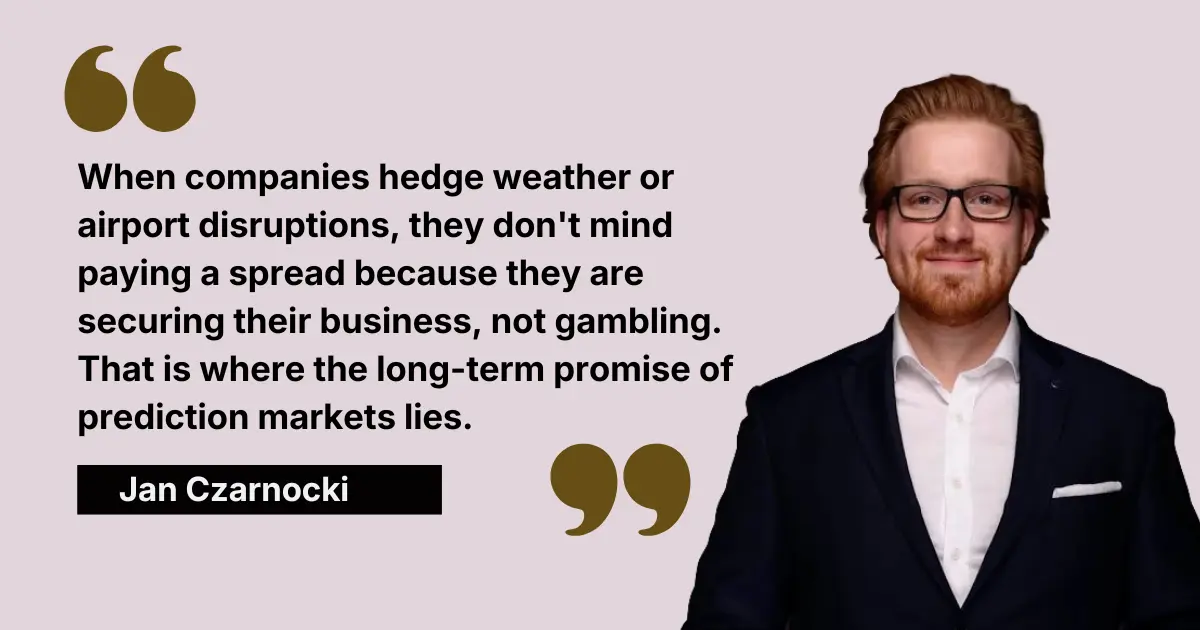
  • Jan Czarnocki of Elastics on Institutional Prediction Markets: “The best future is where sharps are the underwriters of insurance policies for big institutional players”

    Jan Czarnocki of Elastics on Institutional Prediction Markets: “The best future is where sharps are the underwriters of insurance policies for big institutional players”

    Elastics Executive Predicts Prediction Markets Will Displace Traditional Commercial Insurance

    Jan Czarnocki, Chief of Staff and General Counsel at Elastics, appeared on the NEXTPredict Podcast to outline a transformative vision for prediction markets. According to Czarnocki, these platforms are poised to evolve well beyond retail sports betting and eventually displace traditional commercial insurance models.

    Shift Toward Corporate Risk Management and Event Hedging

    During the discussion, Czarnocki explained the structural shift toward corporate risk management and event hedging. He described a future where skilled forecasters from leading prediction platforms take on underwriting roles traditionally held by insurance institutions.

    “The best future is where sharps from Polymarket and Kalshi are actually the underwriters of insurance policies for big institutional players…”

    This perspective signals a fundamental change in how institutional risk could be priced and managed, leveraging the collective intelligence and market efficiency of decentralized prediction markets.

  • Former Amazon CFO Warren Jenson Joins Polymarket as Finance Chief

    Former Amazon CFO Warren Jenson Joins Polymarket as Finance Chief

    Polymarket Appoints Finance Veteran Warren Jenson as CFO to Drive U.S. Expansion

    Prediction market platform Polymarket has named Warren Jenson as its new Chief Financial Officer, a strategic hire aimed at accelerating the company’s U.S. expansion and strengthening global operations. Jenson will report directly to Founder and Chief Executive Officer Shayne Coplan.

    Seasoned Executive to Oversee Financial Strategy and Infrastructure

    In his new role, Jenson will oversee financial operations, capital planning, and long-term business strategy. He is also tasked with building the financial infrastructure required for Polymarket’s next stage of growth. The appointment signals the company’s intent to professionalize its leadership as it navigates an increasingly competitive landscape.

    Decades of Leadership Across Global Enterprises

    Jenson brings extensive experience from several major global corporations. He previously served as CFO at Amazon, Electronic Arts, Delta Air Lines, and NBC. Additionally, he held senior leadership positions at Nielsen and LiveRamp. His track record spans technology, entertainment, aviation, and media sectors, providing Polymarket with a financial leader accustomed to scaling complex, high-growth organizations.

    Leadership Team Expansion Amid Market Competition

    The hire follows Polymarket’s recent recruitment of former Uber executive Travis VanderZanden as Chief Growth Officer. Together, the appointments reflect a deliberate effort to bolster the executive bench during a period of rapid evolution in the prediction market sector.

    Prediction Market Volumes Surge, Competitive Pressure Mounts

    Prediction markets have experienced significant growth in recent months. Combined August volumes at Kalshi and Polymarket reportedly reached $48.4 billion, according to data from Piper Sandler. However, Kalshi accounted for approximately $40 billion of that activity, placing pressure on Polymarket to regain market share.

    Regulated U.S. Exchange and Revenue Milestones

    Beyond leadership changes, Polymarket continues to develop its regulated U.S. exchange and global platform. The company recently surpassed $1 billion in annualized revenue, underscoring the commercial traction of its decentralized prediction market model.

    Related: Lummis Uses $42M Tether Lawsuit to Push Senate Toward CLARITY Act

  • Trump Jr.’s Firm Leads $1 Billion Polymarket Fundraising Round at $21 Billion Valuation: Report

    Trump Jr.’s Firm Leads $1 Billion Polymarket Fundraising Round at $21 Billion Valuation: Report

    Donald Trump Jr.’s venture capital firm, 1789 Capital, is leading a $1 billion funding round for prediction market Polymarket, valuing the company at $21 billion, a firm spokesperson said Monday.

    1789 Capital is contributing about $300 million to the round, spokesperson Alexa Henning said. The firm has already invested roughly $200 million in Polymarket.

    The latest funding values Polymarket 40% higher than its previous valuation of about $15 billion just months ago, highlighting the rapid growth of prediction markets.

    Polymarket and Kalshi expand prediction market business

    Polymarket and rival platform Kalshi allow users to wager on outcomes ranging from statements a president may make in a speech to which contestants on a reality television show might get married. Both companies have expanded sharply over the past year.

    The Trump family’s involvement in the sector has grown alongside the industry. Trump Jr. became an adviser to Kalshi in 2025 and received shares valued at more than $300,000. He also advises Polymarket separately.

    President Donald Trump has taken an increasingly favorable position toward prediction markets during the same period. Michael Selig, Trump’s appointee to lead the Commodity Futures Trading Commission, which regulates prediction markets, has praised the companies and sued states seeking to regulate them.

    In May, Trump wrote on Truth Social that prediction markets would thrive under his leadership.