Tag: Peter Brandt

  • Peter Brandt Labels XRP “Fool Coin” in Controversial Comments

    Peter Brandt Labels XRP “Fool Coin” in Controversial Comments

    Key Highlights

    • Veteran trader Peter Brandt reiterated his long-standing skepticism toward XRP, labeling it a “dumb coin” and questioning its tokenomics despite Ripple’s expanding bank partnerships.
    • Brandt draws a sharp fundamental distinction between Bitcoin as a “store of value” and XRP as a transaction-focused asset, arguing utility alone does not drive token price appreciation.
    • The trader expressed a more favorable view on Ethereum and Solana, calling Ethereum a “good asset” with upside potential, while maintaining Bitcoin as his preferred core portfolio holding.

    Brandt Doubles Down on XRP Skepticism Amid Ripple Progress

    Senior market trader Peter Brandt has reaffirmed his bearish stance on XRP, stating that recent developments within the Ripple ecosystem—including widespread collaborations with global banking institutions—have failed to alter his fundamental assessment of the asset. During a recent interview, Brandt was pressed on whether Ripple’s institutional momentum and technological advancements warranted a reassessment. He responded by maintaining his skepticism, emphasizing that structural questions surrounding the token’s supply dynamics and value accrual mechanism remain unresolved.

    A Fundamental Taxonomy: Store of Value vs. Transaction Utility

    Central to Brandt’s thesis is a categorical distinction between crypto assets based on their primary utility. He characterizes Bitcoin primarily as a “store of value,” acknowledging its current speculative trading nature while attributing to it monetary properties akin to digital gold. In contrast, he views XRP as an asset designed explicitly for transactional throughput and cross-border settlement. This classification leads him to a blunt appraisal: he directly referred to XRP as a “dumb coin,” arguing that its transactional efficiency does not inherently translate into investment merit.

    Utility Does Not Equal Value Accrual

    When challenged on XRP’s proven ability to facilitate cheap, rapid transactions, Brandt conceded the technical point but rejected the investment conclusion. He cited the U.S. dollar as a parallel: a fiat currency used globally for highly effective transactions that no holder expects to appreciate in value solely because of its velocity. “Just because something can be used in transactions doesn’t automatically mean it has to be more valuable,” Brandt stated. He posited that the critical unanswered question for XRP is at what inflection point transactional volume converts into genuine economic value for the token itself, rather than merely benefiting the Ripple network infrastructure.

    Diverging Views on Ethereum and Solana

    Brandt’s critique does not extend uniformly across the altcoin landscape. He spoke positively of Ethereum, describing it as a “good asset” and expressing confidence that both Ethereum and Solana possess the potential to reach higher valuation levels. He places these networks in a separate category from both Bitcoin and XRP—platforms upon which applications are built—suggesting they warrant a distinct valuation framework. Ultimately, Brandt disclosed a personal portfolio preference heavily weighted toward Bitcoin, reinforcing his conviction in the premier cryptocurrency’s monetary role over utility-focused alternatives.

    Why This Matters

    Peter Brandt’s commentary carries weight due to his decades-long track record in commodity and futures trading, offering a traditional market perspective on digital asset classification. His insistence on separating “store of value” narratives from “utility token” mechanics highlights a persistent debate in crypto valuation methodologies. As Ripple continues to secure regulatory clarity—most notably the July 2023 court ruling that XRP is not inherently a security—and expands its On-Demand Liquidity (ODL) corridors with financial institutions, the market is actively testing whether enterprise adoption creates token holder value. Brandt’s dollar analogy underscores a critical tokenomics question: velocity and utility are necessary but not sufficient conditions for price appreciation without a mechanism capturing that value (e.g., fee burns, staking yields, or supply constraints). Meanwhile, his endorsement of Ethereum and Solana reflects growing institutional comfort with smart contract platforms as programmable settlement layers, a narrative driving ETF filings and allocation shifts in 2024.

    Frequently Asked Questions

    What specific concerns did Peter Brandt raise about XRP’s tokenomics?
    Brandt highlighted “question marks regarding the total supply and whether it would expand in the future,” suggesting uncertainty over XRP’s emission schedule and escrow release mechanism undermines its credibility as a scarce store of value.
    How does Brandt differentiate Bitcoin from XRP and Ethereum?
    He categorizes Bitcoin as a “store of value” asset, XRP as a transaction-focused utility token, and Ethereum (alongside Solana) as an application platform layer—arguing each requires a distinct valuation framework rather than a one-size-fits-all approach.
    Does Peter Brandt hold any XRP or recommend it as an investment?
    No. Brandt explicitly maintained his skepticism, called XRP a “dumb coin,” and stated he prefers Bitcoin for the majority of his cryptocurrency portfolio. The source includes a disclaimer: “This is not investment advice.”

  • Peter Brandt Predicts Ethereum Rally to $8,600 Amid Vitalik Buterin’s Quantum Focus

    Peter Brandt Predicts Ethereum Rally to $8,600 Amid Vitalik Buterin’s Quantum Focus

    Key Highlights

    • Veteran trader Peter Brandt forecasts Ethereum could reach $8,600 in the long term following a near-term breakout.
    • Ethereum co-founder Vitalik Buterin is prioritizing privacy enhancements, cybersecurity upgrades, and full quantum resistance for the Layer-1 blockchain.
    • The convergence of bullish technical analysis and foundational protocol upgrades signals a dual catalyst for Ethereum’s next growth phase.

    Brandt’s Technical Outlook Targets $8,600 Ethereum

    Veteran commodity trader Peter Brandt, widely followed for his classical charting expertise, has set a long-term price target of $8,600 for Ethereum (ETH). According to Brandt’s analysis, this ambitious level becomes attainable once ETH completes a near-term breakout from its current consolidation pattern. The projection draws on principles of classical charting and trend continuation, suggesting that a decisive move above key resistance could unlock a multi-year uptrend measured by logarithmic scaling. Brandt’s track record in identifying major trend inflections across asset classes lends weight to the forecast among technical analysts and macro-oriented crypto investors.

    Buterin’s Roadmap Prioritizes Quantum Resistance and Privacy

    Simultaneously, Ethereum co-founder Vitalik Buterin has outlined a strategic pivot for the protocol’s base layer, emphasizing three critical pillars: enhanced privacy, strengthened cybersecurity, and full quantum resistance. In recent communications, Buterin stressed that making the Layer-1 blockchain “fully quantum-resistant” is no longer a theoretical exercise but an urgent engineering priority as advances in quantum computing accelerate. The roadmap also doubles down on privacy-preserving frameworks for transactions and smart contracts, alongside hardened client diversity and formal verification to mitigate exploit surfaces. These initiatives aim to future-proof Ethereum’s settlement layer against both emerging cryptographic threats and evolving regulatory expectations around data protection.

    Converging Catalysts: Technical Breakout Meets Protocol Evolution

    The alignment of Brandt’s breakout thesis with Buterin’s architectural overhaul presents a rare confluence of technical and fundamental catalysts. Historically, Ethereum’s most sustained rallies have coincided with major protocol milestones—such as the Merge, Shanghai, and Dencun upgrades—that expanded utility and reduced supply-side pressure. The current focus on quantum-resistant cryptography, including potential adoption of lattice-based signatures and STARK-based validity proofs, could differentiate Ethereum as the first major blockchain to credibly neutralize quantum risk. Meanwhile, privacy enhancements such as stealth addresses and zero-knowledge proofs at the base layer may unlock institutional DeFi adoption that has been constrained by transparency requirements.

    Why This Matters

    Ethereum’s trajectory is increasingly defined by the intersection of market structure and protocol resilience. A breakout to new all-time highs, as Brandt anticipates, would reinforce ETH’s status as a sovereign-grade store of value and the primary collateral layer for on-chain finance. Buterin’s quantum-resistance mandate addresses an existential timeline: NIST’s post-quantum cryptography standards are being finalized, and any blockchain that fails to migrate risks obsolescence. Privacy upgrades, meanwhile, respond to growing demand from enterprises and regulated financial entities that require selective disclosure without sacrificing composability. Together, these developments position Ethereum to capture the next wave of institutional capital allocation into digital assets, provided the technical execution matches the roadmap’s ambition.

    Frequently Asked Questions

    What is Peter Brandt’s price target for Ethereum and what triggers it?
    Peter Brandt projects a long-term target of $8,600 for Ethereum, contingent on a near-term breakout from current price consolidation. His analysis relies on classical charting principles and logarithmic trend extrapolation.
    What are Vitalik Buterin’s current priorities for the Ethereum protocol?
    Vitalik Buterin is prioritizing three core areas: enhancing user privacy, strengthening cybersecurity across clients and smart contracts, and making the Ethereum Layer-1 blockchain fully quantum-resistant against emerging computing threats.
    How do quantum-resistant upgrades affect Ethereum’s long-term viability?
    Quantum-resistant cryptography ensures Ethereum’s settlement layer remains secure against future quantum computers capable of breaking current elliptic-curve signatures. Proactive migration preserves asset integrity, validator security, and trust in the network as a permanent infrastructure layer.
  • XRP Surges 8.7% as Peter Brandt’s Chart Analysis Points to $5.40 Target

    XRP Surges 8.7% as Peter Brandt’s Chart Analysis Points to $5.40 Target

    Key Highlights

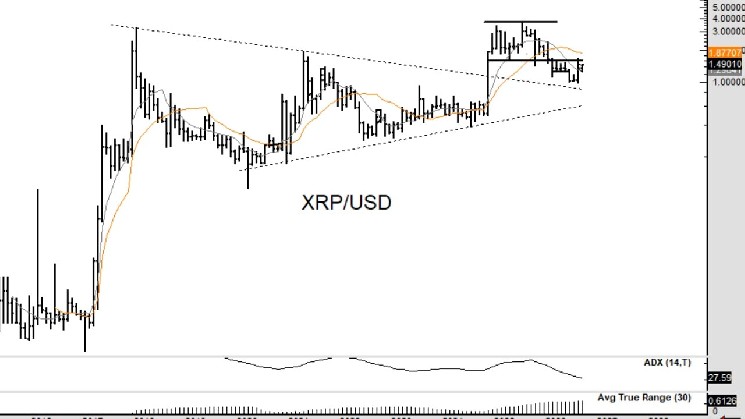
    • Veteran trader Peter Brandt projects XRP could reach $5.40 based on long-term monthly chart analysis, implying approximately 251% upside from current levels.
    • XRP surged 8.7% to $1.54 in 24-hour trading, reaching a session high of $1.57 before pulling back, with the token trading in an 11% range between $1.41 and $1.57.
    • Institutional developments accelerated as South African banking giant Absa launched digital asset custody built on Ripple technology, while the U.S. Senate rejected cloture on the CLARITY Act in a 49-50 vote.

    Peter Brandt’s Technical Analysis and $5.40 Price Target

    Veteran commodity trader Peter Brandt shared a bullish long-term projection for XRP on September 21, posting a monthly chart on X that he says implies an eventual advance to $5.40. The target would represent a substantial premium over recent trading ranges, requiring approximately 251% appreciation from the $1.54 level where XRP traded at the time of publication.

    Brandt, who entered the commodity trading business in 1976 and founded Factor Trading in 1980, emphasized the distinction between a public chart presentation and an executed trade. “This is my long-term chart of $XRP It implies an eventual advance to $5.40.” he wrote. “A claim of a ‘call’ or simple presentation of a chart is $NOT a trade. People who claim ‘trades’ need to provide proof or else the claims are BS. An X post is $NOT proof,” he added. His use of the term “eventual” frames the $5.40 objective as a long-term technical target rather than a near-term prediction, and he explicitly noted that proving an actual trade would require verifiable records showing entry, exit, and result.

    XRP Price Action and Market Performance

    Bitcoin.com Markets data confirmed XRP trading at $1.54, up 8.7% or $0.12 over the preceding 24 hours. The token established a session low of $1.41 early in the period before climbing steadily through most of the trading day. The advance peaked at $1.57 late in the session, after which XRP eased back to the $1.54 level, leaving it approximately 2% below its 24-hour high and roughly 9% above its low. The session’s full trading range spanned about 11% from low to high, reflecting heightened volatility accompanying the price discovery.

    Institutional Infrastructure Expansion and Regulatory Context

    The price rally coincided with significant institutional infrastructure developments. South African lender Absa, one of Africa’s largest banking groups, launched Absa Digital Asset Custody on September 21, built on Ripple’s custody technology. The launch occurred 11 months after Ripple and Absa announced their partnership, marking a concrete step in institutional adoption across the African continent.

    Asset manager 21Shares outlined a four-pillar investment case for XRP centered on regulatory clarity, institutional access, measurable utility, and fixed supply. The firm noted that while expanding XRP Ledger (XRPL) activity may not directly translate into sustained XRP demand, growing network activity could support demand through transaction fees, account reserves, and bridge transfers. 21Shares cited approximately $4 billion in tokenized assets and roughly $1.6 billion in RLUSD supply, with more than half circulating on the XRPL.

    On the regulatory front, the U.S. Senate rejected cloture on the CLARITY Act in a 49-50 vote. Ripple maintained that the failed vote did not alter XRP’s established legal position or disrupt demand across payments, stablecoins, and institutional markets, suggesting the token’s regulatory framework remains intact despite legislative setbacks.

    Why This Matters

    The convergence of technical analysis from a respected veteran trader, meaningful price appreciation with elevated volume, and tangible institutional infrastructure deployment creates a multi-layered bullish narrative for XRP. Brandt’s $5.40 target, while framed as a long-term technical implication rather than a trading recommendation, draws attention to the monthly chart structure that has historically preceded major trend advances in commodity and digital asset markets. The Absa custody launch demonstrates Ripple’s expanding institutional footprint beyond North America into African financial markets, while 21Shares’ analytical framework highlights the fundamental metrics—institutional access, on-chain utility, and regulatory standing—that professional allocators increasingly prioritize. The Senate’s CLARITY Act outcome, while a legislative disappointment for broader crypto regulatory clarity, appears to have had minimal immediate market impact on XRP specifically, reinforcing Ripple’s assertion that the token’s legal classification is settled. Market participants will likely monitor whether XRP can sustain above the $1.50 psychological level and build a higher base for the next leg toward Brandt’s long-term projection.

    Frequently Asked Questions

    What is Peter Brandt’s track record in technical analysis?

    Peter Brandt has over 45 years of commodity trading experience, founding Factor Trading in 1980 after beginning his career in 1976. He has managed institutional trading operations and authored two books on commodity trading and classical chart patterns, establishing him as a recognized authority in traditional technical analysis applied to digital assets.

    Does the Absa Digital Asset Custody launch directly increase XRP demand?

    Not necessarily. The custody service is built on Ripple’s technology infrastructure, but 21Shares notes that expanding XRPL activity may not translate directly into sustained XRP demand. However, the firm argues that growing network activity could support demand indirectly through transaction fees, account reserves, and bridge transfer mechanisms on the ledger.

    How significant was the Senate CLARITY Act vote for XRP specifically?

    According to Ripple, the failed cloture vote on the CLARITY Act did not change XRP’s established legal position or disrupt demand across its core use cases in payments, stablecoins, and institutional markets. The token’s regulatory classification remains intact regardless of the legislative outcome.

  • Peter Brandt’s Favorite Analyst Weighs In on Bitcoin: “It’s Important for It to Break Through This Level by the End of the Week”

    Peter Brandt’s Favorite Analyst Weighs In on Bitcoin: “It’s Important for It to Break Through This Level by the End of the Week”

    Key Highlights

    • Technical analyst Aksel Kibar identifies a weekly close above $82,800 as a critical threshold for Bitcoin, potentially confirming a bullish rectangular pattern reversal or double bottom formation.
    • Kibar emphasizes that formation breakouts validated by significant moving averages—such as the 52-week EMA—provide dual confirmation of both trend direction and pattern completion.
    • The analyst distinguishes between investor and trader timeframes, advising long-term participants to watch weekly candles while short-term traders monitor daily candlesticks for entry timing.

    Kibar Flags $82,800 as Pivotal Level for Bitcoin Pattern Completion

    Technical analyst Aksel Kibar has highlighted the $82,800 price level as a decisive inflection point for Bitcoin (BTC), stating that a weekly candle close above this mark could validate a major bullish chart structure. According to Kibar, the cryptocurrency may be completing either a rectangular pattern reversal or a double bottom formation, both of which have developed near the 52-week exponential moving average (EMA)—a long-term trend filter he has tracked for approximately one year.

    Kibar stressed that an intraday spike above $82,800 would not satisfy the technical requirements for confirmation. Instead, the formation demands a clear weekly candle close above the threshold. “The trend is confirmed, and at the same time, the breakout of the chart formation is also validated. This is how I evaluate the completion of formations,” Kibar stated, describing the dual signal generated when a pattern breakout coincides with a breach of a major moving average.

    Moving Averages as Context, Not Triggers

    The analyst clarified that he does not treat moving average crossovers as standalone buy or sell signals. “I am hesitant to consider moving averages as trading signals on their own… I do not view a price crossing a moving average as a direct buy or sell signal,” Kibar explained. He argued that the critical factor is price breaking the structural boundaries of identifiable technical formations, with moving averages serving as supplementary validation rather than primary triggers.

    Kibar also differentiated his analytical framework by timeframe. He characterized his current outlook as primarily investor-focused, relying on weekly intervals to assess pattern maturity. For market participants operating on shorter horizons, he suggested monitoring daily candlesticks to refine entry timing, acknowledging that execution tactics may differ between long-term positioning and active trading.

    Why This Matters

    The $82,800 level sits near the 52-week EMA, a widely watched institutional trend metric that often acts as a demarcation between bull and bear market regimes. A confirmed weekly close above both the pattern resistance and this moving average would represent a rare confluence of structure and trend confirmation—historically a precursor to sustained directional moves. For Bitcoin, which has chopped in a broad range for months, such a breakout could signal the end of accumulation and the start of a new markup phase. Market participants should watch for weekly candle closure data and volume confirmation to distinguish a valid breakout from a failed test.

    Frequently Asked Questions

    What specific price level does Aksel Kibar identify as critical for Bitcoin?
    A weekly candle close above $82,800 is required to confirm the potential rectangular pattern reversal or double bottom formation.
    Does Kibar use moving average crossovers as entry signals?
    No. Kibar explicitly states he does not view a price crossing a moving average as a direct buy or sell signal, but rather as contextual validation when combined with a chart pattern breakout.
    How does Kibar differentiate between investors and traders in his analysis?
    He frames his formation analysis from an investor’s perspective using weekly candles, while suggesting short-term traders monitor daily candlesticks for tactical entry timing.