Tag: Paul Atkins

  • SEC Commissioner Hester Peirce to Step Down October 2

    SEC Commissioner Hester Peirce to Step Down October 2

    Key Highlights

    • SEC Commissioner Hester Peirce, known as “Crypto Mom,” resigned effective October 2, 2025, leaving the commission with only two sitting members: Chairman Paul Atkins and Commissioner Mark Uyeda.
    • Peirce’s departure removes the leader of the SEC’s Crypto Task Force at a critical juncture as the agency advances token-classification FAQs and proposed Regulation Crypto Assets.
    • The White House has not yet named a successor, and confirmation timelines typically span six to twelve months, creating an extended leadership vacuum at the five-member commission.

    Peirce Announces Departure After Eight-Year Tenure

    SEC Commissioner Hester Peirce announced her resignation on September 25, posting her resignation letter on X with the caption “T minus 7,” a countdown to her final day at the agency on October 2. Peirce, widely known as “Crypto Mom” for her persistent push for clearer, rules-based digital-asset regulation, has served on the commission since January 2018. Her departure will leave the SEC with just two sitting commissioners, Chairman Paul Atkins and Commissioner Mark Uyeda, and no successor yet named by the White House.

    Eight Years of Dissent and Crypto Task Force Leadership

    Peirce spent more than eight years as the commission’s most consistent advocate for written crypto rules, frequently dissenting from what she characterized as enforcement-first decisions, including the agency’s earlier refusals to approve spot Bitcoin exchange-traded funds. In January 2025 she took charge of the Crypto Task Force, the group behind much of the SEC’s digital-asset policy work, including its warnings on securities risk in crypto yield vaults and onchain lending. Her second term expired on June 5, 2025, but SEC rules allow a commissioner to serve up to about 18 months past a term’s end when no replacement has been confirmed.

    Resignation Letter Emphasizes Regulatory Philosophy

    In the letter addressed to President Trump, Peirce called her tenure “the honor of my professional lifetime” and wrote that “maximizing people’s freedom to choose what is best for themselves and their families within sensible regulatory parameters designed to give them the confidence to transact with others is a delicate and vitally important task for the regulator.” She said she leaves confident that the agency’s work will continue under Atkins and Uyeda.

    A Two-Member Commission and the Road Ahead

    The resignation reduces the commission to two Republican members and removes the Crypto Task Force’s leader at a moment when the agency’s crypto agenda is running at full speed. The agency already carried a vacant seat after Democratic Commissioner Caroline Crenshaw departed in January, so Peirce’s exit leaves two empty spots on the five-member commission. The announcement landed the same day the SEC published new token-classification FAQs, part of a rulemaking push that has included its proposed Regulation Crypto Assets. The White House has not named a successor, and confirmation timelines can run six to twelve months. Peirce is expected to join Regent University School of Law in Virginia as an associate professor in November.

    Why This Matters

    Peirce’s departure creates significant uncertainty for the SEC’s digital-asset regulatory agenda at a pivotal moment. With only two commissioners remaining, the commission lacks a quorum for certain rulemaking actions, potentially slowing the progress of proposed Regulation Crypto Assets and other pending initiatives. The Crypto Task Force, which Peirce led since January 2025, has been instrumental in shaping the agency’s approach to token classification, yield products, and lending protocols. Her absence may alter the trajectory of enforcement priorities and rulemaking timelines. The extended vacancy period—potentially six to twelve months before a successor is confirmed—means the SEC will operate with a skeletal leadership structure during a period of intense industry scrutiny and legislative activity around digital assets. Market participants should monitor White House nomination signals and Senate Banking Committee scheduling for clues about the agency’s future direction.

    Frequently Asked Questions

    When does Hester Peirce’s resignation take effect?

    Peirce’s resignation takes effect on October 2, 2025, as indicated by her “T minus 7” countdown posted on September 25.

    Who will lead the SEC’s Crypto Task Force after Peirce’s departure?

    The source material does not specify a successor for the Crypto Task Force leadership role. With only Chairman Paul Atkins and Commissioner Mark Uyeda remaining, the task force’s future leadership structure remains uncertain.

    What is Hester Peirce’s next professional role?

    Peirce is expected to join Regent University School of Law in Virginia as an associate professor starting in November 2025.

  • Former SEC Acting Chair: Agency Dropped Crypto Cases to Avoid Credibility Issues

    Former SEC Acting Chair: Agency Dropped Crypto Cases to Avoid Credibility Issues

    Key Highlights

    • The SEC dismissed enforcement actions against major cryptocurrency firms including Kraken, Ripple Labs, and Coinbase in early 2025 to preserve agency credibility ahead of a planned “180-degree change” in regulatory policy.
    • Former Acting Chair Mark Uyeda stated that allowing litigators to argue positions in court that contradicted forthcoming Commission interpretations would have damaged the SEC’s institutional credibility.
    • With Commissioner Hester Peirce’s expected departure in November 2025, the Commission will operate with only two of its five presidentially appointed members, and no replacement nominations have been announced.

    Uyeda Defends SEC’s Decision to Drop Crypto Enforcement Actions

    Credibility Concerns Prompted Case Dismissals

    Speaking at the Psaros Center for Financial Markets and Policy’s Financial Markets Quality Conference on Wednesday, SEC Commissioner Mark Uyeda provided the most detailed explanation to date for the agency’s abrupt dismissal of high-profile cryptocurrency enforcement actions in early 2025. Uyeda, who served as acting chair from January to April 2025 following Gary Gensler’s resignation, revealed that the Commission dropped cases against Kraken, Ripple Labs, Coinbase, and other firms because it was preparing a “180-degree change” in rulemaking. He argued that proceeding with litigation authorized under the prior administration would have forced SEC attorneys to advocate positions in court that were directly contrary to the policy framework the Commission intended to adopt.

    Uyeda emphasized that the decision was driven by institutional integrity rather than political pressure. “I’m not about to have our litigators, even though they’re having cases that were authorized under the prior administration, stand up in court and have a commission interpretation be issued that is a 180-degree change from what they’d been arguing for that court,” said the commissioner. “I think that hurts [our] credibility as an agency.” He further noted that there had been “significant concerns” that the cases against crypto companies were not “justifiable under law,” suggesting the prior enforcement approach lacked solid legal footing.

    Political Context and Industry Reaction

    The case dismissals occurred against a highly charged political backdrop. President Donald Trump had campaigned on a promise to fire former SEC Chair Gary Gensler “on day one” if elected, and Gensler resigned on Inauguration Day 2025. Many critics characterized the SEC’s retreat from crypto enforcement as payback for the industry’s substantial financial support of Trump’s 2024 campaign. However, Uyeda’s remarks frame the decision as a deliberate, credibility-preserving maneuver necessitated by a fundamental policy reversal, rather than a transactional political favor.

    Looming Leadership Gap at the Commission

    Beyond the immediate policy shift, the SEC faces a structural leadership challenge. Uyeda has served as a commissioner since 2022 and currently sits on the leadership panel alongside Chair Paul Atkins and Commissioner Hester Peirce. With Peirce’s term set to expire in November 2025, the five-member Commission will be reduced to just two sitting commissioners—Uyeda and Atkins—unless the White House moves swiftly to nominate and confirm replacements. As of the conference date, the Trump administration has not announced any nominations for the vacant seats, raising questions about the Commission’s capacity to advance its rulemaking agenda or maintain quorum for certain actions.

    Why This Matters

    The SEC’s abandonment of its aggressive crypto enforcement posture marks a watershed moment in U.S. digital asset regulation. By prioritizing institutional credibility over litigation momentum, the Commission signals a shift from enforcement-led regulation to a rulemaking-first approach—a move long advocated by industry stakeholders who argued the prior strategy created regulatory uncertainty through “regulation by enforcement.” However, the ensuing leadership vacuum threatens to stall the very rulemaking process Uyeda cites as justification for the dismissals. With only two commissioners seated after November, the SEC may lack the quorum needed to propose or adopt new rules, potentially leaving the crypto industry in a prolonged regulatory limbo. The administration’s delay in nominating replacements will be a critical indicator of how quickly the promised policy overhaul can materialize.

    Frequently Asked Questions

    Which cryptocurrency enforcement cases did the SEC drop in early 2025?

    The SEC dismissed civil actions against Kraken, Ripple Labs, Coinbase, and several other crypto firms that had been filed during the tenure of former Chair Gary Gensler.

    Why did Commissioner Uyeda say the cases were dropped?

    Uyeda stated the dismissals were necessary to avoid having SEC litigators argue positions in court that would contradict a planned “180-degree change” in the Commission’s regulatory policy, which he said would have damaged the agency’s credibility.

    What is the current composition of the SEC leadership?

    As of the conference, the Commission is led by Chair Paul Atkins and Commissioners Mark Uyeda and Hester Peirce. Peirce’s departure in November 2025 will leave only two commissioners, and no nominations for the three vacant seats have been announced.

  • Industry Doubts Democrats’ Effort to Restart Stalled CLARITY Act Talks: ‘It’s all talk!’

    Industry Doubts Democrats’ Effort to Restart Stalled CLARITY Act Talks: ‘It’s all talk!’

    Key Highlights

    • Moderate Senate Democrats led by Kirsten Gillibrand and Ruben Gallego pledged renewed bipartisan talks on the CLARITY Act after a 49-50 procedural vote failure.
    • Prediction markets assign less than a 30% probability of passage within two years, while JPMorgan analysts see a narrow but existing legislative window.
    • SEC Chair Paul Atkins and CFTC leaders committed to fast-tracking rulemaking to provide regulatory certainty regardless of legislative outcome.

    Moderate Democrats Vow Renewed Push After CLARITY Act Stalls

    A coalition of moderate Senate Democrats, spearheaded by Senators Kirsten Gillibrand and Ruben Gallego, signaled determination to revive the stalled CLARITY Act following a procedural defeat that underscored deep partisan fractures over digital asset regulation. The legislation, which has been under negotiation for approximately two years, failed to advance on a 49-50 vote after Democrats uniformly blocked the procedural step required to proceed. Notably, seven moderate Democrats who were anticipated to support the measure withheld their votes, citing insufficient ethics provisions as the primary objection.

    This week was a setback, but not the end of that important work. We remain committed to working in a bipartisan fashion to get this legislation passed.

    According to reporting by Eleanor Terrett, the commitment to new talks follows intensive behind-the-scenes efforts to reignite negotiations and potentially fast-track the crypto legislation before the current congressional session concludes. However, the path forward remains highly uncertain, with prediction market platform Kalshi assigning less than a 30% probability of enactment over the next two years.

    Industry Skepticism and Analyst Perspectives

    The Democrats’ recommitment has been met with pronounced skepticism from segments of the crypto industry and pro-crypto analysts. Nate Geraci, a prominent industry observer, characterized the renewed bipartisan rhetoric as “all talk” devoid of substantive action, drawing a sharp contrast with the regulatory posture of the previous administration.

    All talk at this point…There was no ‘working in a bipartisan fashion’ on crypto during the Biden admin. It was purely anti-crypto & regulation by enforcement. So it’s all talk. Actions speak louder than words.

    Despite the legislative impasse, JPMorgan analysts maintain that the bill is not definitively dead, identifying a narrow window for potential passage. This assessment reflects the complex legislative calculus where bipartisan cooperation remains theoretically possible but politically fraught, particularly given the ethics provisions that drove Democratic opposition.

    Regulatory Agencies Pivot to Rulemaking

    In a significant development for market participants, both the Securities and Exchange Commission and the Commodity Futures Trading Commission have pledged to accelerate rulemaking initiatives to establish clear regulatory frameworks for the digital asset sector. This administrative pivot aims to provide a degree of certainty that the legislative process has thus far failed to deliver.

    I have been unequivocal: with or without legislation, we will act decisively within the SEC’s statutory authority to deliver certainty for American investors.

    SEC Chair Paul Atkins’ declaration underscores the agency’s intent to utilize existing statutory authority to address regulatory gaps. The CFTC has echoed this commitment to expedited rulemaking. However, industry participants face a critical unresolved question: whether the next administration will uphold, modify, or reverse these forthcoming regulatory frameworks, introducing a new layer of policy uncertainty.

    Why This Matters

    The CLARITY Act’s stall represents more than a single legislative failure; it encapsulates the broader struggle to define a coherent federal framework for digital assets in the United States. With Congress deadlocked, the locus of regulatory action has shifted decisively to the SEC and CFTC, placing immense importance on the rulemaking agendas of Chair Atkins and his CFTC counterparts. For market participants, the immediate practical impact is a reliance on administrative rulemaking rather than statutory clarity—a dynamic that introduces durability risks should political winds shift after the next election cycle. The narrow legislative window identified by JPMorgan suggests that the lame-duck period or early next session may represent the last best chance for a comprehensive statutory solution before regulatory policy becomes entirely dependent on executive branch interpretation.

    Frequently Asked Questions

    Why did the CLARITY Act fail to advance in the Senate?

    The bill failed on a 49-50 procedural vote after all Democrats, including seven moderate senators expected to support it, voted against advancing the legislation. They cited insufficient ethics provisions as the reason for their opposition.

    What is the likelihood of the CLARITY Act passing in the near future?

    Prediction market Kalshi assigns less than a 30% probability of passage within the next two years. JPMorgan analysts believe the bill is not dead but face a narrow window for enactment.

    How will the SEC and CFTC respond to the legislative stall?

    Both agencies have committed to fast-tracking rulemaking to provide regulatory certainty. SEC Chair Paul Atkins stated the SEC will act decisively within its statutory authority “with or without legislation” to deliver clarity for investors.

  • CLARITY Act Update After Failure: SEC Chair Breaks Silence, Says ‘Stay Tuned’

    CLARITY Act Update After Failure: SEC Chair Breaks Silence, Says ‘Stay Tuned’

    SEC Chairman Paul Atkins expressed gratitude to stakeholders across the administration, Congress, investors, and innovators who have advanced the CLARITY Act, while confirming the agency will proceed with regulatory action regardless of the legislation’s fate.

    “I have been unequivocal: with or without legislation, we will act decisively within the SEC’s statutory authority to deliver certainty for American investors and for the entrepreneurs shaping our technological future,” Atkins said. “Stay tuned.”

    A Pattern of Agency-Level Action

    Atkins’ remarks followed a separate announcement outlining the SEC’s latest regulatory proposals, which he characterized as reflecting a focus on keeping Commission rules within the agency’s statutory authority while aligning with current and anticipated market practices.

    The SEC proposed rescinding Rule 14a-8, arguing the rule exceeds the agency’s statutory scope and intrudes into matters of state law. The Commission also proposed amendments to Rule 14a-4(c), aimed at giving companies more flexibility and shareholders greater control over proposals eligible for discretionary proxy voting authority.

    House Advances Crypto Tax Legislation

    Separately, the House Ways and Means Committee advanced the Digital Asset Tax Certainty Act in a 38-5 vote. The bill would ease tax treatment for small cryptocurrency transactions, clarify how stablecoins are handled, and address rules governing mining, staking, and wash sales. The legislation still requires full House approval before moving to the Senate.

    The proposed legislation would eliminate capital gains tax on crypto transactions and network fees under $10, with certain exceptions, and also covers staking, mining, tokenized assets, wash sales, and rules for crypto brokers.

    Strategic Bitcoin Reserve Bill Under Consideration

    Alongside the tax bill, lawmakers are also considering the Strategic Bitcoin Reserve Bill, which would lock up the roughly $25 billion in Bitcoin currently held by the U.S. government for a period of 20 years.

    Shifting Legislative Momentum

    With the CLARITY Act stalled in the Senate, momentum in Washington has shifted toward narrower, more targeted measures. The current approach combines agency rulemaking from the SEC on one front with House-level tax and reserve legislation on the other, rather than pursuing the comprehensive market structure framework the CLARITY Act was designed to deliver.

  • SEC, CFTC Expand Oversight After Clarity Act Stalls

    SEC, CFTC Expand Oversight After Clarity Act Stalls

    The Senate failed to advance the CLARITY Act in a closely watched vote yesterday, prompting an immediate shift in industry focus toward regulatory action by the Securities and Exchange Commission (SEC) and the Commodity Futures Trading Commission (CFTC). With comprehensive market-structure legislation stalled, attention is turning to what the agencies can achieve under existing authority.

    Industry Reaction: Setback, Not Surprise

    Speaking at the Avalanche Summit, Charley Cooper, President of Ava Labs and former CFTC Chief of Staff and Chief Operating Officer, characterized the failed vote as expected. “I can only speculate because I wasn’t in the room,” he said about the failed vote, “but I think there were multiple issues that came into play.” Cooper cited concerns over yield-bearing stablecoins and the difficulty of moving partisan legislation in a midterm election year. “Wasn’t a surprise,” he added.

    Cooper anticipates that agency rulemaking will gain urgency but cautioned on the timeline. “You’re probably looking at… six-plus months before you really begin to see these rules being done in earnest.” Despite the delay, he rejected the notion that the industry should pause. “The failure of the CLARITY Act to pass does not mean there’s a set of things we’re not allowed to do in crypto,” he said. “As an industry, we cannot sit on our hands waiting for permission to do things. That’s how industries die, and I can tell you crypto is well out of the box.” Cooper emphasized that Avalanche is not changing course and will meet clients “where their risk tolerance takes them.”

    Regulators Signal Intent to Act

    Both the SEC and CFTC signaled Wednesday that they intend to move forward independently. SEC Chairman Paul Atkins stated that “with or without legislation, we will act decisively within the SEC’s statutory authority to deliver certainty for American investors and for the entrepreneurs shaping our technological future.” The SEC had previously proposed Regulation Crypto Assets in August, establishing a framework for certain investment contracts involving crypto assets.

    CFTC Chairman Michael Selig was similarly explicit following the Senate vote. He said the agency would work “using our existing statutory authorities,” adding that the CFTC is “locked in and ready to ship its rules for the new frontier of finance.” The two agencies have already been coordinating through Project Crypto, including a joint interpretation issued in March clarifying how federal securities laws apply to certain crypto assets.

    Legislation vs. Rulemaking: Permanence Concerns

    Agency action, however, lacks the permanence of legislation. Atkins acknowledged this limitation in August, calling legislation “indispensable” to creating rules that cannot easily be reversed by a future regulator.

    That message was reinforced during the summit’s CLARITY Act panel. Representatives from the Digital Chamber, Blockchain Association, Crypto Council for Innovation, and DeFi Education Fund described the vote as a setback rather than a terminal failure. Panelists noted that many policy issues had been resolved with congressional staff before political disputes erupted in the final hours. They pointed to ethics conflicts as a remaining obstacle and said developer protections under the Blockchain Regulatory Certainty Act had also become politically contentious.

    Near-Term Outlook: Agency Action Leads

    The industry expects the SEC and CFTC to move quickly with existing rulemaking efforts. With Congress scheduled to recess in early October, agency action is seen as the more likely near-term path. While the absence of legislation may slow real-world-asset tokenization and other institutional projects, panelists and executives agreed the work will continue regardless.

  • What Happens If the CLARITY Act Bill Doesn’t Pass?

    What Happens If the CLARITY Act Bill Doesn’t Pass?

    CLARITY Act Faces Critical Senate Vote as Industry Warns of Regulatory Vacuum

    With the Senate vote on the CLARITY Act just days away, Digital Chamber CEO Cody Carbone outlined the likely scenarios if the legislation fails to pass—and he isn’t sugarcoating the odds of a quick legislative fix.

    Don’t Expect a Lame-Duck Save

    Asked whether the bill could still advance during a lame-duck session or early in the next Congress, Carbone was blunt: “I think that is unlikely,” he said. If the bill cannot move forward in the coming weeks before the election, he expects a very different path to take shape.

    Regulators Move Fast

    Carbone said the most immediate response would come from regulators themselves. “You’re going to see the regulators moving fast and furious,” he said, pointing to SEC Chairman Paul Atkins, who is already signaling they’ll implement CLARITY’s goals through guidance and rulemaking rather than waiting on Congress. He expects that to start with an innovation exemption from the SEC, arriving quickly if the bill stalls.

    A “Skinny” Version Could Emerge

    The second path Carbone outlined involves breaking the bill apart. He reminded stakeholders that CLARITY isn’t one clean piece of legislation—it’s an amalgamation of roughly 40 to 50 separate bills merged into one package. That structure, he said, opens the door to pulling out individual provisions and attaching them to must-pass legislation later this year, citing the National Defense Authorization Act—which has passed every year for six decades—as a likely vehicle.

    Carbone was cautious about the odds of that approach working. “I don’t know if the latter will be successful,” he said, but he was confident regulators stepping in independently is the more likely outcome. “That will be the regulatory framework implementation for the next two years. It’ll likely be primarily agency action.”

    If CLARITY fails to clear its September 15 hurdle, Carbone’s read is that Washington doesn’t get a clean do-over anytime soon. Instead, expect regulators to fill the gap through rulemaking, with a slim chance that individual provisions get revived by riding along on unrelated must-pass bills before year’s end.

  • SEC Reviews Automatic Filing Pathways After Surge in Exotic Crypto and Event-Linked ETF Proposals

    SEC Reviews Automatic Filing Pathways After Surge in Exotic Crypto and Event-Linked ETF Proposals

    Wall Street is pushing the exchange-traded fund format into nearly every corner of finance. Investors can now find ETFs offering Bitcoin exposure, two- or three-times the daily performance of a stock, private assets, and contracts linked to elections or economic data.

    The ETF began as a low-cost way to own a diversified market portfolio. It has since become a distribution system for investments that once required a futures account, private placement, crypto exchange, or careful review of a structured-note prospectus.

    The Securities and Exchange Commission is examining how far that system can expand. In a June 30 request for public comment, the agency identified crypto assets, commodities, leveraged products, single-stock ETFs, blockchain-based investments, private assets, and event contracts. Comments are due Aug. 31.

    The review extends beyond any individual application. The SEC is assessing whether its existing rules give staff sufficient time and authority to evaluate products whose economic behavior can differ substantially from the diversified funds investors traditionally associate with ETFs.

    According to the SEC’s concept release, assets in U.S. ETFs grew from more than $4 trillion at the end of 2019 to more than $12 trillion at the end of 2025. Over the same period, the number of products increased from nearly 1,900 to more than 4,600.

    The ETF ticker can hide the product’s real risks

    An ETF packages a portfolio into shares that trade throughout the day on an exchange. Investors can buy that exposure through the same brokerage account they use for ordinary stocks.

    Through the creation-and-redemption process, authorized participants exchange large blocks of ETF shares for the underlying basket or its cash equivalent. This mechanism helps keep the market price close to the portfolio’s net asset value.

    What began as operational infrastructure became a retail investing habit. ETFs offer intraday trading, transparent pricing, broad brokerage access and, in many structures, more favorable tax treatment than comparable mutual funds.

    Asset managers also gained products that could be placed in model portfolios and trading applications. Each successful launch encouraged sponsors to put increasingly specialized exposures behind the same familiar interface.

    The regulatory framework developed around the original ETF model. Early funds needed individual exemptive orders for features such as exchange trading and in-kind redemptions, which did not fit neatly within rules designed for open-end mutual funds.

    In 2019, the SEC adopted Rule 6c-11. The rule allows qualifying ETFs registered under the Investment Company Act of 1940 to operate without seeking a separate order for every launch, provided they satisfy conditions involving portfolio information, trading data and the arbitrage mechanism.

    Rule 6c-11 made ETF launches faster and more standardized, helping the product count more than double by the end of 2025. A plain index fund, a concentrated thematic portfolio and a derivatives strategy can now look nearly identical on a brokerage screen, even though their holdings, valuation methods and potential losses may be very different.

    The term ETF describes the container, not necessarily the investment inside it.

    The common brokerage screen also obscures important legal distinctions. Many stock and bond ETFs are registered investment companies under the 1940 Act, while spot Bitcoin and Ethereum products commonly use commodity-trust structures registered under the Securities Act of 1933.

    Exchange-traded notes represent another category. They are unsecured debt obligations whose returns depend on the issuer’s promise. Brokerage platforms may display all three structures side by side under a broad exchange-traded product label.

    Those legal categories affect custody, board oversight, diversification, borrowing, derivatives use, valuation and the remedies available if an issuer or service provider fails. A familiar ticker makes an exposure easier to buy, but it does not remove those underlying differences. That is why the SEC is examining the conditions attached to the ETF wrapper as closely as the portfolio itself.

    Crypto expanded the ETF model

    Spot crypto products became a turning point because investors viewed an exchange listing as a bridge between an unfamiliar asset and an established brokerage account.

    The SEC’s approval of spot Bitcoin products in 2024 gave advisers and institutions access to a regulated trading venue, standardized disclosures and conventional custody relationships. The agency emphasized that its approval was not an endorsement of Bitcoin itself.

    In practice, the distinction between legal approval and perceived legitimacy became harder to see as the ETF menu expanded.

    Many investors see an ETF ticker at a major broker and assume that the underlying exposure has passed through a common regulatory filter. Yet one product may hold a broad equity basket while another owns a volatile commodity or rolls derivatives that can diverge from a reference asset. Crypto demonstrated the commercial value of that familiarity.

    Sponsors have since applied the same distribution model to staking, options overlays, token products promising a multiple of an asset’s daily move and baskets of digital assets. Each structure may serve a specific investment purpose, while introducing its own custody, valuation, trading-hours and concentration risks.

    Crypto markets trade around the clock, but ETF shares trade during exchange hours. The creation process must bridge those different trading schedules when prices move sharply overnight or over a weekend.

    Event-contract funds push the ETF model into even less familiar territory. They tie returns to election results, economic releases or other defined events while packaging the exposure in shares that trade like ordinary funds.

    CryptoSlate identified more than two dozen event-linked ETF proposals, illustrating how quickly a niche contract market could reach retail brokerage accounts once an ETF provides the distribution channel.

    The regulatory challenge is based on how the product functions. An event contract may trade on an exchange overseen by the Commodity Futures Trading Commission, while the fund shares and related disclosures fall within the SEC’s jurisdiction.

    That can place the risks across several rulebooks. Regulators may need to examine how a contract settles, who provides prices, what happens when trading is halted and whether the fund can meet redemptions near the event date.

    Those questions apply differently across the categories covered by the SEC’s concept release. A private-asset fund may face stale valuations and limited exit opportunities. A single-stock leveraged product may reset daily and compound away from its stated multiple over longer periods. A token-based product may depend on custody or staking arrangements with no close equivalent in a traditional index fund.

    A product-by-product framework could attach conditions to each source of risk more precisely than a single definition of novelty.

    The SEC’s ETF approval process faces new pressures

    The SEC must also determine whether its filing process gives staff enough time to review unfamiliar structures before they reach the market.

    Certain registration statements and post-effective amendments can become effective automatically after a statutory or rule-based waiting period. Some amendments filed under Rule 485 can take effect immediately when they meet specified conditions.

    These pathways make routine fund updates and launches more efficient, but they can also carry portfolios that SEC staff have not previously encountered.

    SEC Chair Paul Atkins said in May that several sponsors had agreed to delay novel ETF launches, including event-contract products, while the agency evaluated the issues.

    A voluntary delay gives staff additional time to assess current filings. A lasting policy could require rule amendments, enhanced disclosure conditions, a separate review process or a clearer boundary around which products qualify for automatic treatment.

    Each option carries a cost. Broad restrictions could slow conventional fund launches and give established issuers an advantage over smaller sponsors. A narrow rule could leave staff racing against automatic deadlines whenever a new payoff structure emerges.

    The SEC must also protect the arbitrage mechanism that keeps ETF shares close to net asset value. Disclosure alone cannot solve problems created by assets that are too difficult to price or acquire during the creation-and-redemption process.

    Crypto issuers have a direct interest in the outcome, even as event contracts draw much of the attention. New staking structures, tokenized securities, multi-asset baskets and products offering daily return multiples could face additional filing requirements depending on how the SEC defines novelty and which safeguards it requires.

    A framework focused on custody, valuation, liquidity and payoff complexity could give sponsors a clearer path to market. A wrapper-level restriction, by contrast, could group economically different crypto products together.

    The SEC has already published public comment letters and meeting records ahead of the Aug. 31 deadline. After the comment period closes, the agency will need to evaluate the submissions, determine whether its existing authority and disclosure standards are sufficient, and publish any proposed rule amendments through the normal notice-and-comment process.

    Existing products and pending applications will continue to provide data on premiums, discounts, trading quality and investor use during that review.

    ETFs conquered Wall Street by making investment exposure easy to distribute. The wrapper has become financial infrastructure for nearly every kind of portfolio. A brokerage customer can move from an S&P 500 fund to Bitcoin, a two-times stock position or an election-linked contract with a few taps, even though each investment enters a different economic world.

    The SEC now has to decide which exposures require a different regulatory gate before a familiar ticker persuades investors that the existing gate has already done all the work.
  • Ripple Quartals Report sets a new XRP price target-$ 3 possible

    Ripple Quartals Report sets a new XRP price target-$ 3 possible


    • XRP forms an interest bully wedge pattern and signals an outbreak towards $ 3.
    • The institutional interest increases with XRP ETF registrations and the ripple takeover of Hidden Road for $ 1.25 billion.

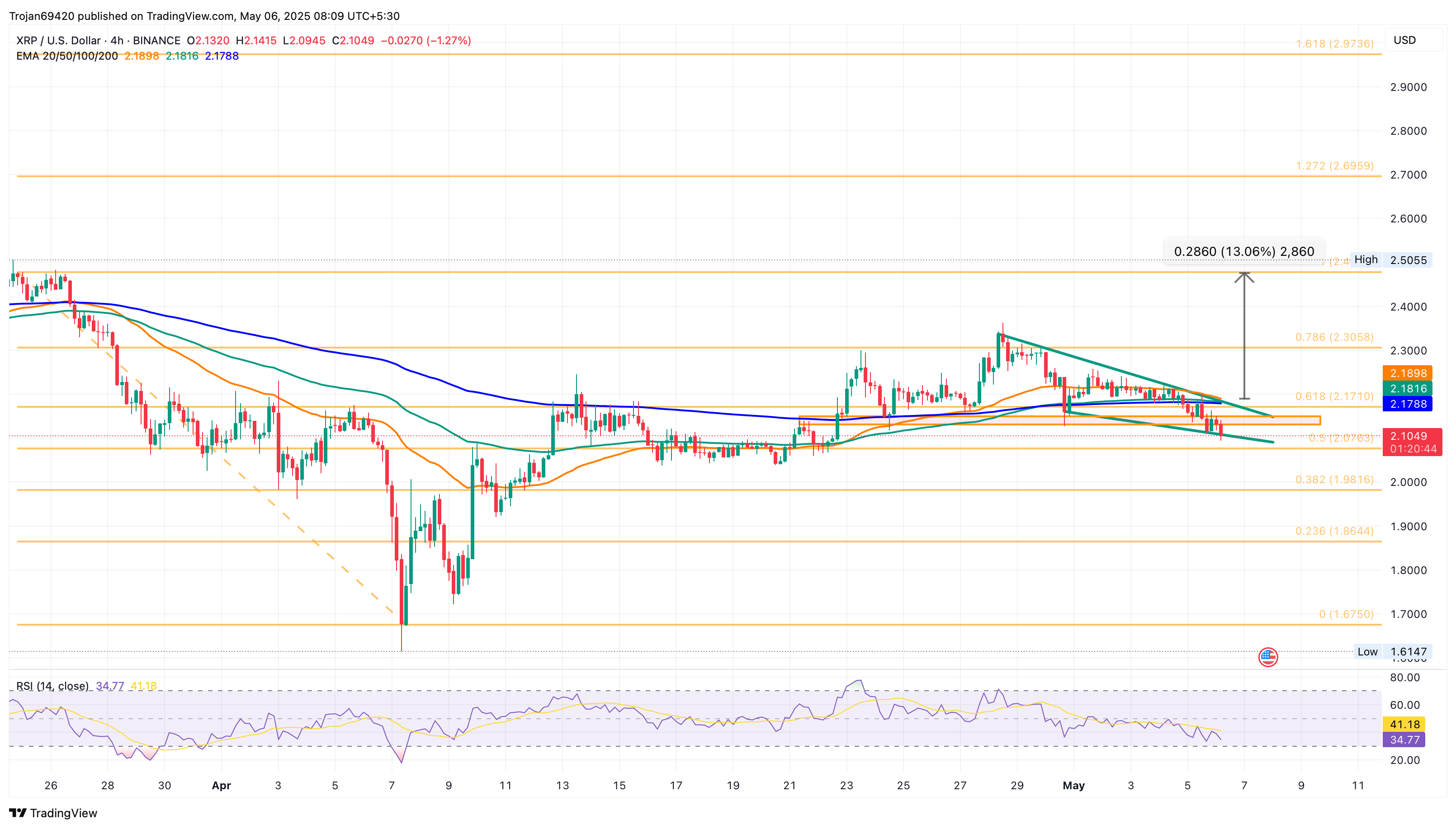
    Despite a volatile week, the XRP token stays stable at the wider cryptoma market at $ 2.13. The mood of the investors has significantly improved after the publication of the XRP market report Q1 2025 by Ripple, which emphasizes a number of strategic success. From institutional support to regulatory breakthroughs, XRP seems to be positioned for a bullish outbreak. Technical indicators, coupled with a strong macroeconomic outlook, indicate that the token could soon test the $ 3-resistance brand.

    When writing this article, XRP is traded at $ 2.09 and had fallen by 3.74% in the last 24 hours.

    Falling wedge pattern signals outbreak

    The technical analysis shows that a falling wedge pattern has formed between April 28 and May 6th. XRP recorded lower highs and lower lows during this period, with the trend lines merging at $ 2.14. Analysts see this constellation as interest bully, which usually leads to an outbreak when the down momentum subsides. A confirmed outbreak could drive XRP up to 10 % with a target of $ 2.36.

    Despite a decline of 10 % last week, XRP maintained support above the $ 2 threshold. According to market analysts, this stability strengthens the outbreak potential. The general market conditions will remain a key factor for whether XRP can reach the $ 3 brand in the coming weeks.

    Institutional movements strengthen market trust

    The Q1 2025 XRP Markets Report by Ripple outlines important developments that support long -term optimism. The report leads several positive measures in the US leadership, including a implementation regulation of Donald Trump, which supports crypto innovations. The appointment of Paul Atkins as SEC chairman and the cross-party dynamics for stablecoin legislation have further improved regulatory clarity.

    The institutional activities have increased. Franklin Templeton submitted an S-1 application for an XRP ETF, while Volatility Shares suggested three other XRP-based ETFs. The Brazilian CVM approved a special XRP ETF, and the CME Group introduced XRP futures, which further anchored the institutional legitimacy of XRP.

    Despite weekly drains of $ 37.7 million, XRP system products have recorded $ 214 million in tribes this year. This means that XRP only lacks $ 1 million to exceed global Ethereum fund inflows, which underlines the increasing demand from investors.

    The on-chain indicators reflect a cooling phase in the first quarter, whereby the creation of wallets and the transaction volume decreased by 30-40 %. The activity of the decentralized stock exchange (Dex) also decreased by 16 % in the quarterly comparison. The USD-based stable coin from Ripple, Rlusd, has proven to be a growth catalyst. RLUSD’s market capitalization exceeded $ 90 million, while the cumulative Dex volume was over $ 300 million.

    The report also confirms the takeover of Hidden Road, a large Prime broker, with Ripple worth $ 1.25 billion. This step is seen as a strategic attempt to position RLUSD as a stable coin for companies with real benefits. With its plans to enable cross-margining between traditional and digital asset markets, Ripple wants to combine the institutional financial world with the blockchain infrastructure.