
Tag: Orbital weapons

  • Living Nostradamus Issues Chilling Prediction on Future of Global Order

    Living Nostradamus Issues Chilling Prediction on Future of Global Order

    Living Nostradamus Warns Global Power Will Be Decided in Earth’s Orbit

    Brazilian mystic Athos Salomé, known as the “Living Nostradamus” for reportedly predicting events including Queen Elizabeth II’s death and the Covid-19 pandemic, has issued a new warning: the next global hegemony will be determined not on land, but in space.

    Orbit Becomes Strategic Territory

    Salomé recently told LADbible that Earth’s orbit is poised to become the planet’s next strategic territory. While tech billionaires Elon Musk and Jeff Bezos advance plans to launch tens of thousands of satellites, and startups explore concepts like orbital mirrors for constant daylight, Salomé frames the issue around military dominance rather than commercial ambition.

    “The next global hegemony will be determined not by what’s on Earth’s land, but whether an orbital power dominates,”

    According to Salomé, private companies are already developing asteroid-mining projects while superpower militaries pour billions into autonomous satellites and classified orbital technologies. He predicts space-stationed weapons will become standard in the coming years, raising concerns about accelerated militarization and the potential onset of Kessler Syndrome — a cascade of orbital debris collisions that could render low Earth orbit unusable.

    Quantum Computing Threatens Digital Security Architecture

    Beyond space militarization, Salomé warns that advancements in quantum computing represent a turning point comparable to the discovery of electricity. Quantum computers leverage quantum physics to solve complex problems in minutes that would take conventional computers millions of years, according to IBM.

    While quantum computing research remains ongoing and public availability is distant, Salomé argues these machines will soon break the mathematical encryption underpinning modern banking systems, passwords, diplomatic communications, and military networks.

    “The entire world will have to rebuild its digital security architecture. Governments are already quietly moving toward what the experts refer to as ‘post-quantum cryptography’.”

    Converging Sci-Fi Scenarios

    The convergence of orbital weapons platforms and encryption-shattering supercomputers reads like science fiction, yet both developments are actively funded and researched by state actors and private enterprises. Salomé’s predictions highlight the dual-use nature of emerging technologies: satellite constellations enable global connectivity while providing military surveillance capabilities; quantum breakthroughs promise scientific advances while threatening the cryptographic foundations of digital trust.

    As nations and corporations race to establish orbital infrastructure and quantum supremacy, the strategic landscape Salomé describes moves from speculation toward operational reality.
  • US Military Confirms Deployment of Weapons in Space

    US Military Confirms Deployment of Weapons in Space

    US Acknowledges Deployment of Space Weapons for First Time

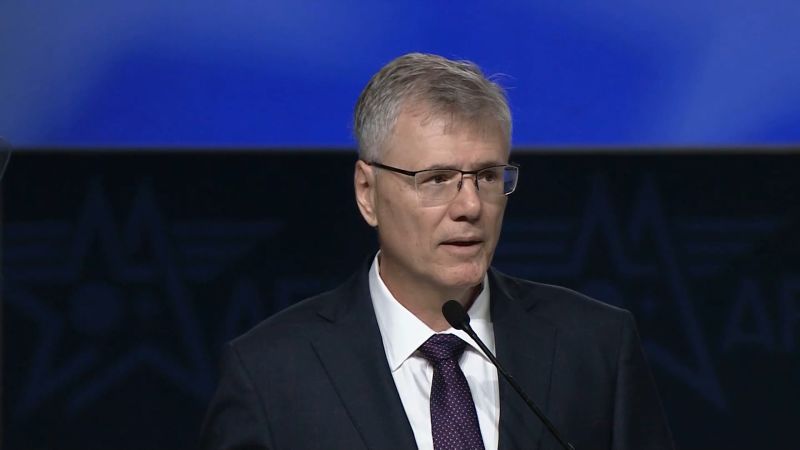
    The United States has deployed weapons in space and will use them to defend American forces, Air Force Secretary Troy Meink announced Monday. The statement marks the first public acknowledgment of such capabilities in orbit and serves as a deliberate signal to potential adversaries.

    Meink’s Announcement at Air, Space and Cyber Conference

    “Today we continue to ensure we remain ready to meet the challenges of evolving threats wherever they exist,” Meink told the Air, Space and Cyber Conference, an annual gathering hosted by the Air & Space Forces Association in National Harbor, Maryland. “This is why the United States now has on-orbit space control weapons capable of defending the joint force against hostile adversary action.”

    Meink did not provide specifics on the weapons and, when asked to expand, refused to offer additional details. It remains unknown when the weapons were placed into orbit.

    Context: Space Force and Global Competition

    President Donald Trump established the US Space Force in 2019 as part of the Air Force, touting it as a historic step toward bolstering US defense capabilities amid an advancing arms race. China and Russia have challenged America’s space dominance, according to US military assessments.

    “China develops and operates space and counterspace capabilities as part of a military modernization strategy,” the US Space Force says on its website, while “Russia views space as a warfighting domain and believes space supremacy will be a decisive factor in future conflicts.”

    Russian and Chinese Space Capabilities

    US military officials have repeatedly warned that both countries are testing new offensive space capabilities. Examples cited include Russian satellite constellation training missions that Washington says could demonstrate “attack and defend tactics” for future combat, and China’s development of a nuclear-capable partial-orbit hypersonic missile.

    As CNN reported in 2024, US intelligence suggests Russia has also made efforts to develop a space-based nuclear weapon that would use a massive energy wave, known as an electromagnetic pulse, to potentially knock out a large swath of commercial and government satellites – a claim Moscow has denied.

    Potential Impacts of Space-Based Weapons

    Such a weapon could have broad, devastating impacts. For example, it could upend satellites the world relies on to predict the weather and respond to disasters, or even potentially affect global navigation systems used for everything from banking and cargo shipping to hailing a ride share and ambulance dispatch.

    “It is critically important that we maintain our dominance not only in the air but in space, and so we’ve had to take steps to make sure that when we’re threatened, we can take care of that,” Meink said Monday.

    CNN has reached out to the Space Force for comment.

    Legal Framework and Treaty Considerations

    While the 1967 Outer Space Treaty bans nuclear weapons or weapons of mass destruction in orbit, it does not prohibit the use of conventional weapons in space or the use of ground-based weapons against assets in space – leaving room for interpretation.

    Trump’s Golden Dome Initiative and Future Plans

    Last December, Trump signed an executive order calling US superiority in space “a measure of national vision and willpower,” with an emphasis on developing next-generation missile defense technologies and ensuring its abilities to counter threats, including “any placement of nuclear weapons in space.”

    The executive order was a step toward Trump’s proposed “Golden Dome” missile defense system, an ambitious multibillion-dollar plan inspired by Israel’s Iron Dome that officials say would allow the US to intercept missiles from anywhere in the world.

    The US has remained vague on its plans for developing the missile shield, which Trump said he hopes to be completed by 2028. As CNN earlier reported, the Pentagon has scheduled its first major test for just before the 2028 election, according to two sources familiar with the matter.

    Speaking Monday, Meink also said a US space-based interceptor program had moved “from initial contract to flight-ready hardware in less than one year,” without revealing further details.