Tag: Optimism

  • Layer-2 and DeFi Tokens Lead Broad Crypto Advance as Post-Fed Hike Nerves Fade

    Layer-2 and DeFi Tokens Lead Broad Crypto Advance as Post-Fed Hike Nerves Fade

    Key Highlights

    • DeFi and Layer-2 tokens led a broad crypto market rally Friday, with the DeFi Select Index surging 16% in 24 hours as risk-on sentiment returned following the Fed rate decision.
    • Bitcoin reclaimed $78,000 while Uniswap (UNI) futures open interest neared a record high, signaling strong institutional conviction in major DeFi protocols.
    • Implied volatility dropped to May lows and options skew turned short-term bullish for BTC and ETH, suggesting traders expect near-term market calm after key macro events cleared.

    DeFi and Layer-2 Tokens Spearhead Post-Fed Risk-On Rotation

    Cryptocurrency markets extended their post-Federal Reserve rally into Friday, with a pronounced sector rotation shifting leadership from privacy and haven assets toward decentralized finance (DeFi) and Layer-2 scaling tokens. The DeFi Select Index (DFX) accelerated fastest among major benchmarks, surging 8.3% since midnight UTC and 16% over the trailing 24-hour period, reflecting a broad-based return to risk-on positioning across digital asset markets.

    Bitcoin $BTC rose above $78,000 during the European morning session, adding 2.1% since midnight UTC and 1.9% over the past 24 hours to trade at $78,192.86. Despite the advance, the largest cryptocurrency remains approximately 5% below its September 4 monthly high of $82,284 after two weeks of range-bound price action. The CoinDesk 100 index showed near-universal gains, with all but two constituents trading higher on the day.

    Macroeconomic Backdrop Fuels Risk Appetite

    The rally unfolded against a more conducive macroeconomic backdrop. The 10-year U.S. Treasury yield slipped back below the psychologically significant 5% threshold, while Brent crude eased under $103 per barrel after touching $109 earlier in the week. This combination relieved some of the inflation pressure that had followed the latest rate increase. Traditional risk assets mirrored the optimism, with S&P 500 and Nasdaq 100 futures rising 0.3% and 0.6% respectively, while gold and silver added 1.1% and 2.8%.

    Derivatives Data Reveals Structural Capital Inflows

    Futures Open Interest Expands as Volume Dips

    The crypto futures market is signaling a revival in positional trading rather than speculative churn. Cumulative open interest (OI) expanded nearly 5% to $141.2 billion, contrasting with a 3% decline in daily trading volume to $95 billion. The taker buy-sell volume remains balanced, suggesting capital is entering the market structurally rather than through aggressive momentum chasing.

    Bitcoin Positioning Builds Gradually

    Bitcoin futures open interest ticked up to 680,000 BTC from 670,000 BTC since midnight UTC, a modest increase accompanying the price advance. This combination typically represents a build-up of long, or bullish, positions. However, the increase remains slight, and the OI tally sits well below the peak of 800,000 BTC recorded early this year, indicating overall positioning remains light by historical standards.

    Binance Trader Ratios Show Institutional Conviction

    Binance’s top trader long-short accounts ratio pulled back to 1.52 from Wednesday’s high near 2.0, while the long-short positions ratio remains elevated at 2.36. This divergence means fewer individual large holders, or “whales,” are leaning long, but those who are have significantly increased their bet sizes, pointing to strong institutional conviction rather than retail-driven speculation.

    Uniswap Futures Open Interest Nears Record

    Among altcoins, open interest in futures tied to Uniswap’s $UNI surged to 86.61 million tokens, flirting with an all-time high and up from 76.89 million tokens yesterday. This expansion highlights substantial capital inflows moving in tandem with a 30% explosion in the token’s spot price. The renewed appetite for major DeFi altcoins stems from mounting market optimism surrounding friendly, coordinated crypto regulations from the SEC and CFTC.

    Volume Delta and Volatility Metrics Confirm Bullish Tilt

    The bullish mood is reflected in the 24-hour OI-adjusted cumulative volume delta, which is positive for most major tokens excluding GRAM, SHIB, HBAR, and BNB. A positive reading indicates bulls are being more aggressive by executing market orders rather than passive limit orders. With major events including the Clarity Act vote and the Federal Reserve and Bank of Japan interest-rate meetings now past, Bitcoin’s annualized 30-day implied volatility index (BVIV) dropped to 36%, a level that has acted as a floor since May, pointing to expectations for near-term market calm.

    Options Skew Turns Short-Term Bullish

    In options listed on Deribit, Bitcoin’s one-week put-call skew has turned positive, indicating relative richness of calls over puts. However, one- and two-month skews still show a slight put bias. Ethereum’s one-week skew also shows bullishness. The 24-hour volume rankings present a mixed picture, with both BTC calls and puts featuring among the most actively traded contracts.

    Token Spotlight: UNI Leads DeFi Surge, Layer-2 Tokens Match Strength

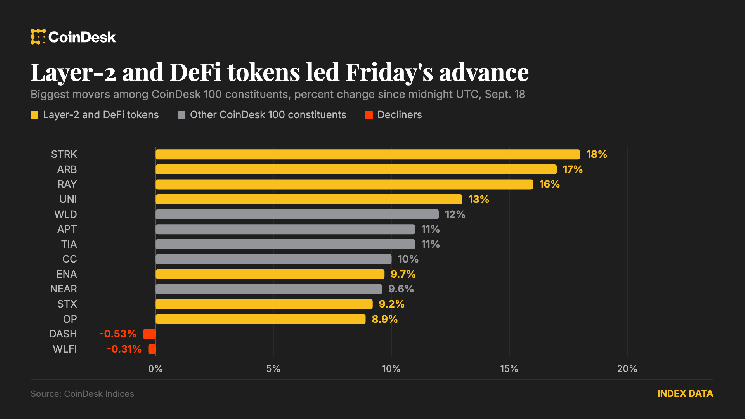
    The DeFi Select Index’s advance rested largely on Uniswap ($UNI), which gained 13% since midnight UTC and 25% over the past 24 hours. Ethena (ENA) added 9.6% and liquid-staking token Lido DAO ($LDO) rose 6.6%. Layer-2 tokens matched DeFi’s strength, led by Starknet ($STRK) at 18% on the day and 21% over 24 hours, with Arbitrum ($ARB) up 17% and 25%, Stacks ($STX) up 9.2%, and Optimism ($OP) up 8.9%. STRK reached its highest level since June 19, while ARB at 20.9 cents hasn’t traded this high since January.

    Solana ($SOL) added 4.5% to $106.14, though the sharper move occurred within its ecosystem where Solana-based DEX token Raydium ($RAY) rose 16% to $1.71 while liquid-staking token Jito ($JTO) lagged at 1.6%. This split points to DEX volume driving the bid rather than a blanket rally for the chain. Thursday’s leader, Zcash ($ZEC), traded at $1,490.10 for a gain of 1.6% on the day against 7.6% over 24 hours, meaning almost all of its advance occurred Thursday. Rival privacy token Dash ($DASH) was one of only two CoinDesk 100 constituents in the red, losing 0.53%, alongside World Liberty Financial ($WLFI), which fell 0.31%. CoinMarketCap’s “Altcoin Season” index rose to 44/100 from Tuesday’s low of 32/100, confirming speculation as the overarching theme Friday.

    Why This Matters

    The sector rotation from privacy coins to DeFi and Layer-2 tokens signals a meaningful shift in market narrative. For months, regulatory uncertainty had pressured DeFi protocols, but the prospect of coordinated SEC and CFTC frameworks has reignited institutional interest in governance tokens like UNI and scaling solutions like ARB, OP, and STRK. The derivatives data reinforces this: rising open interest alongside declining volume suggests conviction-driven positioning rather than speculative flipping. Meanwhile, implied volatility compressing to multi-month lows and short-term options skew turning bullish indicate the options market is pricing in a period of stability after a dense macro calendar. For traders, the Altcoin Season index climbing from 32 to 44 confirms broadening participation beyond Bitcoin, though it remains well below levels seen during full altcoin rotations. The next test will be whether this derivatives-led bid translates into sustained spot accumulation or fades as macro data dependencies return.

    Frequently Asked Questions

    Why are DeFi and Layer-2 tokens outperforming Bitcoin and privacy coins?

    Market optimism around potential coordinated crypto regulations from the SEC and CFTC has renewed institutional appetite for major DeFi protocols like Uniswap and scaling solutions like Arbitrum, Optimism, and Starknet. The DeFi Select Index surged 16% in 24 hours while privacy leaders like Zcash and Dash stalled or declined.

    What does the rise in futures open interest with falling volume indicate?

    The 5% expansion in cumulative open interest to $141.2 billion alongside a 3% drop in daily volume to $95 billion suggests structural capital inflows and positional trading rather than short-term momentum chasing. Balanced taker buy-sell volume further supports this interpretation.

    How should traders interpret the current options skew and volatility readings?

    Bitcoin’s 30-day implied volatility (BVIV) dropping to 36%—a floor since May—signals expectations for near-term calm after key macro events. One-week put-call skew turning positive for both BTC and ETH shows short-term bullish bias, though longer-dated skews retain a slight put bias, indicating hedging for medium-term downside risk remains.

  • Optimism Approves Superchain Upgrade Paving Way for Interoperability Launch

    Optimism Approves Superchain Upgrade Paving Way for Interoperability Launch

    Key Highlights

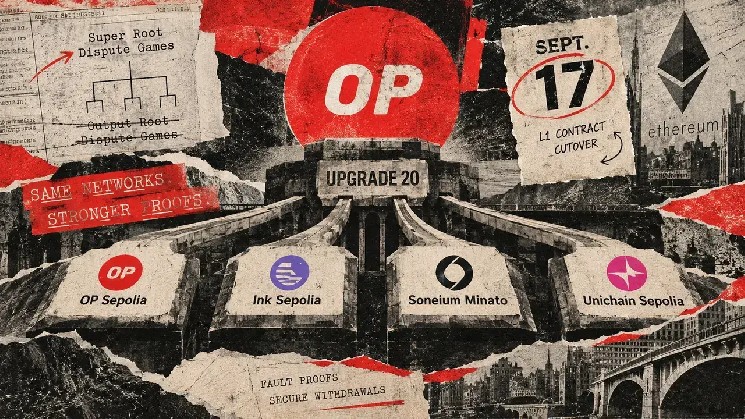
    • Optimism governance approved Upgrade 20 on Sept. 16, initiating a transition from Output Root Dispute Games to Super Root Dispute Games across OP Sepolia, Ink Sepolia, Soneium Minato, and Unichain Sepolia testnets.
    • The upgrade introduces timestamp-based dispute proofs—replacing L2 block numbers—to establish the common time reference required for future Superchain cross-chain interoperability.
    • Mainnet execution is targeted for Sept. 24 contingent on a healthy seven-day testnet soak; ordinary users need no action, but node operators and withdrawal integrators must update infrastructure before the cutover.

    Optimism Advances Superchain Architecture With Upgrade 20 Fault-Proof Overhaul

    Optimism’s governance cycle concluded voting on September 16, greenlighting Upgrade 20 and setting in motion a foundational shift in how the OP Stack validates state before withdrawals are finalized to Ethereum. The approval places four major testnets—OP Sepolia, Ink Sepolia, Soneium Minato, and Unichain Sepolia—on track for a coordinated contract upgrade on September 17, with OP Mainnet and other participating chains slated for September 24 provided the new dispute system completes a clean seven-day soak period.

    From Output Roots to Super Roots: A Structural Pivot

    The core of Upgrade 20 replaces the existing Output Root Dispute Game architecture with Super Root Dispute Games. Under the legacy model, a challenger anchors a claim to a specific L2 block number. Super Root games instead use a timestamp as the common reference point, creating the temporal alignment that a future multi-chain dispute system will require. Optimism has characterized the upgrade as a prerequisite for Superchain interoperability because Super Roots can eventually represent multiple chains at the same timestamp.

    Critically, Upgrade 20 does not yet activate cross-chain interoperability. Each chain’s dispute infrastructure remains separate, and each new game still contains the Output Root of a single chain. By migrating the dispute-system architecture now, Optimism aims to avoid modifying that security layer again when cross-chain interoperability moves to production.

    Bundled Contract Improvements and Operational Safeguards

    The release also packages changes to Optimism’s contracts manager and SystemConfig, including safeguards around upgrade sequencing and cleanup of legacy configuration functions. These additions address issues identified during Upgrade 19, reinforcing the reliability of the upgrade pipeline itself.

    Infrastructure Migration: What Operators and Developers Must Do

    The transition imposes concrete requirements on chain operators and integration developers. Permissioned chains will move to dispute game type 5, while permissionless fault-proof deployments will use game type 9. Before the L1 contract cutover, operators must ensure op-challenger and op-dispute-mon support Super Roots, while op-proposer must switch to the new RPC and game type when upgraded contracts are executed. Existing Output Root configurations must remain available long enough for in-flight games to conclude.

    Bridge and withdrawal integrations that inspect dispute games directly can no longer assume a game’s root claim is a single-chain Output Root. Applications must recognize the new game types and retrieve the appropriate chain-specific root from the Super Root structure. Developers using viem/op-stack for withdrawal proving need version 2.51.0 or later and must pass the initiating transaction’s L2 timestamp through the proving flow.

    For end users, the migration is seamless: previously submitted withdrawal proofs remain valid, and the OptimismPortal contract continues to accept both dispute-game formats. OP nodes that simply follow the chain do not require a new activation configuration, as the transition does not entail an L2 hardfork.

    Why This Matters: Laying the Groundwork for a Multi-Chain Future

    Upgrade 20 represents a deliberate architectural decoupling: Optimism is modernizing the dispute layer today to prevent a second disruptive migration when Superchain interoperability launches. The shift to timestamp-based proofs is the linchpin—without a shared time reference, coordinating disputes across multiple OP Stack chains would be impractical. By executing this change now, while each chain’s dispute game remains single-chain, the collective reduces the surface area of risk for the eventual multi-chain activation.

    The seven-day testnet soak serves as a critical stress test for the new game types, challenger tooling, and proposer workflows. A clean run would validate that the Super Root architecture can sustain mainnet-grade security and liveness, clearing the path for the September 24 mainnet cutover. The broader ecosystem—including rollup operators, bridge providers, and wallet integrators—will be watching the testnet period closely, as any regression in fault-proof liveness or withdrawal finality could delay the mainnet deployment and, by extension, the timeline for Superchain interoperability.

    Frequently Asked Questions

    Do ordinary users or token holders need to take any action for Upgrade 20?
    No. Previously submitted withdrawal proofs remain valid, and the OptimismPortal continues to accept both the legacy Output Root and new Super Root dispute-game formats. No user-side steps are required.
    What is the difference between game type 5 and game type 9 in the new system?
    Permissioned chains (those with allowlisted challengers) move to game type 5, while permissionless fault-proof deployments use game type 9. Both operate under the Super Root timestamp-based architecture.
    When will Superchain cross-chain interoperability actually go live?
    Interoperability remains a later step. Upgrade 20 only prepares the dispute infrastructure; each chain’s game still contains a single chain’s Output Root. The timeline for activating cross-chain dispute games has not been announced and will depend on the stability of this migration and subsequent governance decisions.
  • Aave V4 Deposits Surge to $806M on 30% Weekly Gain

    Aave V4 Deposits Surge to $806M on 30% Weekly Gain

    Aave V4 Deposits Surge 30% in a Week to Record $806 Million

    Aave’s Version 4 protocol has reached a new all-time high in user deposits, hitting $806 million according to the platform’s live onchain dashboard. The figure represents a 30% increase over the past seven days and extends a steep growth trajectory that began in mid‑August.

    Rapid August Milestones

    Separate protocol announcements tracked the ascent: V4 deposits crossed $500 million on August 19, breached $600 million two days later, and surpassed $800 million six days after that. A further update noted that Ethereum‑based V4 deposits alone exceeded $500 million on August 25. EtherFi Cash has emerged as the second‑largest market within the V4 ecosystem.

    Borrowing Activity Grows Alongside Deposits

    The dashboard shows $216 million in active loans across V4. In the EtherFi Cash market specifically, Aave measured $62 million of active loans where weETH collateral backs WETH borrowing at 92% utilization.

    Deployment Breakdown by Network and Market

    V4 is currently deployed on Ethereum, Optimism, and Avalanche. The largest market by deposits is Ethereum Core at $378 million, followed by EtherFi Cash on Optimism at $257 million. Ethereum Global Dollar holds $75 million, Ethereum Prime $63 million, while Avalanche Core and Ethereum Plus account for $18 million and $15 million respectively.

    Asset Composition of Deposits

    The deposit mix is led by weETH at $97 million and USDG at $90 million. WETH and USDC each represent $81 million, followed by liquidETH ($77 million), liquidUSD ($58 million), and WBTC ($54 million).

    V3 Still Dominates Total Liquidity

    Despite V4’s rapid growth, Aave’s V3 protocol retains a far larger deposit base. The equivalent V3 dashboard shows $31 billion in user deposits, with Ethereum Core alone holding $25 billion.

    Architectural Shift: Hub‑and‑Spoke vs. Market‑per‑Pool

    The two versions organize liquidity differently. According to Aave’s documentation, V4 replaces V3’s market‑per‑pool design with a hub‑and‑spoke system. Hubs consolidate liquidity and accounting, while spokes apply separate borrowing rules and risk limits to particular markets.

    EtherFi Cash Targets $500 Million Lending Capacity

    On August 27, TokenLogic reported that the EtherFi Cash market had been live for two weeks and was progressing toward a $500 million lending‑capacity target.