Tag: OpenZeppelin

  • S&P Global Agrees to Acquire Smart Contract Security Firm OpenZeppelin

    S&P Global Agrees to Acquire Smart Contract Security Firm OpenZeppelin

    Key Highlights

    • S&P Global has entered a definitive agreement to acquire OpenZeppelin, a leading smart contract security and auditing firm widely used across Ethereum and DeFi ecosystems.
    • Financial terms of the acquisition were not disclosed, and the transaction remains subject to customary closing conditions.
    • The deal signals a strategic convergence of traditional financial risk analytics and blockchain infrastructure security as tokenized assets move into mainstream finance.

    S&P Global Expands Digital Asset Capabilities Through OpenZeppelin Acquisition

    S&P Global, one of the world’s largest providers of credit ratings, market data, and financial analytics, has announced a definitive agreement to acquire OpenZeppelin, the blockchain security firm best known for its smart contract libraries, auditing services, and development tools that underpin a significant portion of the Ethereum and decentralized finance (DeFi) landscape. The announcement, made via an S&P Global press release dated September 17, 2026, marks a pivotal moment in the integration of crypto-native security expertise into traditional financial risk infrastructure. While financial terms were not disclosed, the strategic rationale underscores a fundamental shift: as financial products increasingly migrate onto blockchain rails, code-level vulnerabilities are being reclassified as systemic financial risks.

    Blockchain Risk Enters the Traditional Risk Framework

    Historically, S&P Global’s business has centered on helping investors and institutions assess creditworthiness, market dynamics, and financial exposure through conventional instruments. However, the proliferation of tokenized bonds, stablecoins, and institutional-grade blockchain networks has introduced a new variable into the risk equation: smart contract integrity. A tokenized security may mirror a familiar financial product in economic terms, but its ownership, transfer, and settlement logic now depend on immutable code deployed on public or permissioned ledgers. Vulnerabilities in that code—whether reentrancy bugs, access control flaws, or upgradeability risks—can result in direct financial loss, regulatory scrutiny, and reputational damage. By bringing OpenZeppelin’s deep technical bench in-house, S&P Global gains a specialized layer of expertise to evaluate the software infrastructure that increasingly sits beneath financial products themselves.

    OpenZeppelin’s Evolution from DeFi Guardian to Institutional Infrastructure

    Founded in 2015, OpenZeppelin established itself as a cornerstone of smart contract security, providing reusable, battle-tested libraries—most notably the ERC-20 and ERC-721 implementations—that became de facto standards across Ethereum. Its audit practice has reviewed code for major protocols including Coinbase, Uniswap, and the Ethereum Foundation. Five years ago, smart contract audits were primarily a concern for DeFi projects seeking to avoid exploits. Today, the same technical primitives secure tokenized treasuries, central bank digital currency pilots, and regulated security token platforms. This expansion of use cases has pushed smart contract security into a vastly larger addressable market, one that now includes banks, asset managers, and market infrastructure providers—precisely the clientele S&P Global serves.

    Why This Matters

    The acquisition reflects a broader maturation of crypto infrastructure from a niche concern to a systemic component of global finance. As regulators in the U.S., EU, and Asia advance frameworks for tokenized assets and blockchain-based settlement, the demand for standardized, institutionally credible security assurances will grow. S&P Global’s move positions it to potentially develop new rating methodologies or risk scores that incorporate smart contract audit quality, formal verification coverage, and ongoing monitoring—analogous to how it evaluates credit risk today. For OpenZeppelin, the deal provides distribution into the core of traditional finance, accelerating adoption of its security tooling beyond native crypto teams. The transaction, which has not yet closed, remains subject to regulatory approvals and customary conditions. If completed, it will represent one of the most significant crossovers between a legacy financial data giant and a native blockchain security firm to date.

    Frequently Asked Questions

    What is OpenZeppelin and why is it significant?

    OpenZeppelin is a leading blockchain security company known for developing widely adopted open-source smart contract libraries (such as ERC-20 and ERC-721 standards) and providing professional audit services for major Ethereum and DeFi projects. Its code secures billions in digital asset value across the ecosystem.

    Why is S&P Global acquiring a crypto security firm?

    As financial instruments move onto blockchain infrastructure, smart contract vulnerabilities become direct financial risks. S&P Global aims to integrate OpenZeppelin’s technical expertise to evaluate and rate the code-layer security of tokenized assets, stablecoins, and institutional blockchain networks—extending its traditional risk analytics into the digital asset domain.

    Has the deal closed?

    No. The acquisition is subject to customary closing conditions, including regulatory approvals. Financial terms were not disclosed in the September 17, 2026 announcement from S&P Global.
  • S&P Global Quietly Prepares for Round-the-Clock Markets, From Kaiko to OpenZeppelin

    S&P Global Quietly Prepares for Round-the-Clock Markets, From Kaiko to OpenZeppelin

    Key Highlights

    • S&P Global agreed to acquire smart contract security firm OpenZeppelin, expanding its digital asset business into the technology layer underpinning tokenized finance.
    • OpenZeppelin will operate as a separate business unit under CEO Demian Brener, reporting to S&P Global Ratings President Yann Le Pallec; financial terms were not disclosed.
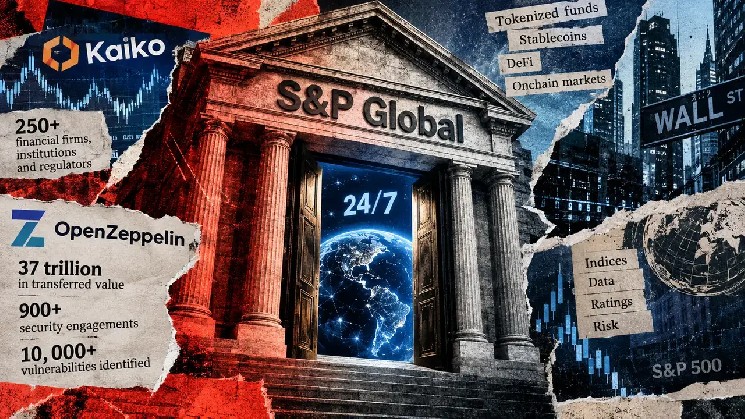
    • The acquisition gives S&P direct exposure to the security infrastructure behind more than $37 trillion in transferred value, over 900 security engagements, and 10,000+ identified vulnerabilities.

    S&P Global Acquires OpenZeppelin to Secure Tokenized Finance Infrastructure

    Financial data and ratings giant S&P Global announced on September 17 an agreement to acquire OpenZeppelin, a leading smart contract security firm whose open-source libraries and audit services underpin a vast swath of the blockchain ecosystem. The move marks a significant deepening of S&P’s push into digital assets, adding a technical risk layer to its traditional financial risk toolkit as institutional capital increasingly migrates to blockchain networks.

    Under the terms of the agreement, OpenZeppelin will continue operating under its own name as a distinct business unit. Chief Executive Demian Brener will remain in charge and report to S&P Global Ratings President Yann Le Pallec. Financial details of the transaction were not disclosed, and the deal remains subject to customary closing conditions.

    Strategic Rationale: Addressing the On-Chain Technology-Risk Layer

    The acquisition targets a specific gap in institutional risk management. As financial products—from stablecoins and tokenized funds to decentralized finance applications—move onto blockchains, institutions face a new category of risk: the software that issues, transfers, and manages those assets. S&P stated that OpenZeppelin will expand capabilities in what it described as the “on-chain technology-risk layer,” including security assessments and benchmarks for digital assets.

    This adds a technical dimension to S&P’s existing financial-risk business. Tokenized funds and stablecoins remain exposed to traditional risks around issuers, collateral, and liquidity, but their operation also depends on smart contracts, permissions, and blockchain infrastructure that introduce technical vulnerabilities. Le Pallec articulated the strategy directly:

    “Our digital assets strategy centers on bringing trusted data, benchmarks and transparent risk assessment to markets as they move onchain.”

    OpenZeppelin’s Model Preserved: Open Source and Developer Trust

    OpenZeppelin has built its reputation on two pillars: its widely used Contracts library, a standard across blockchain applications, and its security teams that review smart contracts and systems before deployment. The company emphasized that its libraries will remain free, open source, and publicly maintained after the acquisition, including future versions. Its audit, engineering, and security work will also continue under the existing team.

    This preservation of the developer model is critical to OpenZeppelin’s adoption. Brener noted that the combination could help OpenZeppelin reach more financial institutions as banks, asset managers, and issuers increase their use of blockchain infrastructure. For S&P, the acquisition provides access to OpenZeppelin’s technical expertise and developer relationships, while OpenZeppelin gains S&P’s institutional relationships, research resources, and distribution channels. S&P said the acquisition is not expected to materially affect its financial results, emphasizing near-term expansion of capabilities rather than a large new revenue stream.

    Why This Matters: Building Infrastructure for 24/7 Markets

    The OpenZeppelin deal is the latest in a series of strategic moves by S&P Global to build infrastructure for markets that increasingly operate around the clock. Three days prior, S&P led a strategic investment in crypto-data provider Kaiko, extending its Series B funding to $110 million alongside participants including DRW, Susquehanna, Royal Bank of Canada, Nasdaq, and BNP Paribas. Kaiko supplies market data and infrastructure to over 250 financial firms, institutions, and regulators, connecting to more than 150 exchanges.

    S&P and Kaiko have already collaborated to bring traditional benchmarks on-chain. In March, they embedded the iBoxx US Treasuries Index into blockchain infrastructure, and earlier this month they combined their digital-asset benchmark businesses into the S&P Kaiko Digital Asset Indices. S&P Dow Jones Indices also helped develop the S&P Digital Markets 50 Index, which Dinari subsequently tokenized using Chainlink for verifiable on-chain pricing.

    Beyond benchmarks, S&P has developed stablecoin stability assessments, issued a credit rating for DeFi protocol Sky, and licensed the S&P 500 for tokenized products. The OpenZeppelin acquisition adds the smart-contract security piece to a stack that now includes: Kaiko for crypto-native pricing and market data, S&P for benchmarks and financial-risk analysis, and OpenZeppelin for smart-contract expertise governing how assets move between investors and applications.

    As trading expands outside traditional exchange hours, always-on markets require continuous prices, collateral valuations, benchmarks, and risk controls. Tokenized assets add software and smart contract risks alongside conventional financial ones. For S&P, this creates an opportunity to extend services it already sells to banks and asset managers into a market where the infrastructure itself is becoming part of the risk assessment. If more securities and funds migrate onto blockchains, institutions may increasingly need a single provider to understand both the asset they hold and the technology that determines how it moves.

    Frequently Asked Questions

    What does OpenZeppelin do, and why is it significant?

    OpenZeppelin is a smart contract security firm whose open-source Contracts library is a widely used standard across blockchain applications. The company has completed over 900 security engagements, identified more than 10,000 vulnerabilities before production, and its infrastructure has supported over $37 trillion in transferred value. It provides both the code libraries developers build on and the audit services that verify contract safety before deployment.

    Will OpenZeppelin’s open-source libraries remain free after the acquisition?

    Yes. OpenZeppelin explicitly stated that its libraries will remain free, open source, and publicly maintained after the acquisition, including future versions. Its audit, engineering, and security work will also continue under the existing team, preserving the developer model that drove its adoption.

    How does this fit into S&P Global’s broader digital asset strategy?

    The acquisition is part of a coordinated buildout that includes a strategic investment in crypto-data provider Kaiko, the launch of on-chain benchmarks like the iBoxx US Treasuries Index and S&P Kaiko Digital Asset Indices, stablecoin stability assessments, a credit rating for DeFi protocol Sky, and licensing the S&P 500 for tokenized products. Together, these pieces give S&P capabilities across market data, benchmarks, financial risk analysis, and now smart-contract technical risk for 24/7 blockchain markets.

  • S&P Global Acquires OpenZeppelin to Expand Tokenized Finance Risk Capabilities

    S&P Global Acquires OpenZeppelin to Expand Tokenized Finance Risk Capabilities

    S&P Global has acquired OpenZeppelin, a leading blockchain security firm, marking a significant expansion of the financial intelligence provider’s digital asset capabilities. The acquisition brings OpenZeppelin’s extensive smart contract auditing expertise under the S&P Global umbrella, extending the company’s reach from entity-level ratings to code-level security assessments.

    OpenZeppelin’s Security Track Record

    Founded in 2015, OpenZeppelin has established itself as a cornerstone of onchain security. The firm provides comprehensive security assessments and secure development services, alongside an open-source smart contract library that underpins many of the largest stablecoins and tokenized funds in the market. According to S&P Global, OpenZeppelin has conducted more than 900 security engagements, identifying over 10,000 vulnerabilities before code reached production environments.

    Leadership Continuity

    Co-founder and CEO Demian Brener will continue to lead the business as its own unit under the OpenZeppelin name, reporting to Le Pallec. This structure preserves the firm’s operational independence while integrating its specialized capabilities into S&P Global’s broader digital asset strategy.

    Strategic Digital Asset Expansion

    The acquisition represents the latest move in S&P Global’s concerted push into digital asset coverage, which has been building for more than a year. The company has published stablecoin stability assessments and issued the first credit rating of a DeFi protocol, Sky. OpenZeppelin’s addition extends this work from rating the entity to rating the underlying code it runs on—a critical layer of infrastructure security.

    Recent Digital Asset Investments

    The deal follows a series of strategic digital asset initiatives by the roughly $120 billion company. On Monday, S&P Global led a strategic investment that extended crypto data firm Kaiko’s Series B funding to $110 million, joined by BNP Paribas, Nasdaq Ventures, Coinbase Ventures, and Royal Bank of Canada. Earlier in September, S&P Dow Jones Indices and Kaiko launched a co-branded digital asset index suite. In March, the two firms tokenized the iBoxx U.S. Treasuries Index.

    Financial Impact

    The transaction is subject to closing conditions and is not expected to have a material impact on S&P Global’s financial results.