Tag: NEAR Protocol

  • Bitget Hack Splits the Cross-Chain Market Into Two Products

    Bitget Hack Splits the Cross-Chain Market Into Two Products

    Key Highlights

    • $NEAR intercepted and is holding $503,000 linked to the Bitget breach.
    • The incident highlights a growing divide over whether cross-chain infrastructure should screen suspected stolen funds.
    • No public release authority or remedy for wrongly flagged users has been identified.

    $NEAR’s Bitget screening decision challenges crypto’s permissionless model

    Shevchenko positioned the blocked $503,000 against $NEAR’s broader business activity. The network routinely processes more than $100 million in daily volume, making the intercepted funds a negligible fraction of its activity. The screening therefore did not materially disrupt the service’s flow.

    Cross-chain infrastructure has traditionally been viewed as structurally incapable of stopping stolen assets because there is often no operator to contact and no account that can be frozen. The Bitget-related transfers demonstrate that the limitation can instead be a matter of policy. A service that takes custody during a swap, even temporarily, can screen funds at that point. Whether it does so is a business decision rather than an unavoidable technical limitation.

    Permissionless infrastructure, but with boundaries

    $NEAR presents itself as permissionless, open and uncensorable. However, a service capable of freezing funds during a swap is operating in a way many users would describe as permissioned. Vini Barbosa, a technical writer building at Ramp Labs, argued on X that permissionlessness should remain neutral. He also warned that a rail willing to restrict suspected unlawful users could restrict people moving money under repressive governments.

    NEAR cofounder Illia Polosukhin responded with a narrower definition: permissionless means that no one needs permission to own assets, transfer them or deploy contracts. Shevchenko’s description acknowledges the tension between those positions. The service will remain “permissionless infrastructure, but with boundaries.”

    Institutional users, which are now a major target for infrastructure providers, generally favor rails that include screening controls. THORChain publicly defended the opposite approach. “A halt is not a selective freeze of specific funds or an individual swap,” the protocol wrote on X. “THORChain is permissionless and doesn’t censor by design.”

    THORChain also questioned what responsibility Bitcoin, Ethereum and BNB Chain should bear when stolen funds move across their networks. It pointed out that the addresses involved in the theft of $10.7 million from its own vaults in May were never blacklisted. The same position applied after the $1.5 billion Bybit theft last year.

    Crypto industry divided over who should control stolen funds

    Supporters of decentralization backed the decision, but prominent industry figures also criticized it. Bitget CEO Gracy Chen, whose request THORChain declined, wrote that decentralization “is a design principle, not a shield for facilitating known stolen funds.”

    OKX founder Star Xu challenged the comparison with Bitcoin from another angle. THORChain’s validators jointly control the assets held in its vaults, he argued, making the network an intermediary rather than a base layer. Xu also noted that the same node operators halted THORChain for 39 days in May when its own vaults were threatened.

    Stablecoin issuers represent a separate control layer. Circle and Tether froze approximately $320,000 in USDC and USDT connected to the Bitget breach. Although that amount is small compared with the total loss, it demonstrates why issuer-level freezing remains the most reliable circuit breaker in crypto: it acts directly on the asset rather than only at the application level.

    Who controls the frozen $503,000?

    $NEAR is holding the intercepted $503,000 while a legal and recovery process is pursued. The network has also waived the recovery bounty offered by Bitget. Formal requests are handled through a Kodex law-enforcement portal, which is the channel Bitget or investigators would use to claim the funds.

    Shevchenko’s report does not identify who has authority to approve a release, nor does it describe a process through which a wrongly flagged user could recover funds. The screening system operates using estimates with a stated error margin of 10%.

    A screening system that stops a legitimate transfer without publishing release authority or a remedy effectively holds someone’s money on suspicion. Securities and payments industries developed defined procedures for this situation because retaining funds without a clear process creates liability in almost every jurisdiction. Crypto’s screening infrastructure has reached a similar point, but without an equivalent framework.

    Why This Matters

    The dispute over the frozen $503,000 will test whether cross-chain services can impose screening rules while maintaining a credible permissionless identity. It also raises practical questions for institutional users, decentralized protocols and asset issuers about who should intervene when stolen funds move across networks.

    The outcome could establish whether fund releases are governed by transparent rules that users can examine or by discretionary decisions made by infrastructure operators. It will also show whether crypto’s emerging compliance controls are accompanied by due-process mechanisms for users whose transfers are wrongly identified.

    Frequently Asked Questions

    Why did $NEAR freeze the $503,000?

    $NEAR intercepted the funds in connection with the Bitget breach and is holding them pending a legal and recovery process. The source does not specify the final authority responsible for releasing the money.

    What is the debate over permissionless infrastructure?

    One side argues that permissionless networks should not censor or selectively halt transactions. The other argues that services handling assets during swaps can and should screen suspected stolen funds, particularly for institutional users.

    Can a wrongly flagged user recover the frozen funds?

    The source does not describe a published remedy or release process for wrongly flagged users. Formal requests are routed through a Kodex law-enforcement portal used by Bitget or investigators to claim the funds.


  • NEAR Intents Launches Unified Liquidity Solution for DeFi

    NEAR Intents Launches Unified Liquidity Solution for DeFi

    Key Highlights

    • NEAR Protocol launches NEAR Intents to create a unified liquidity layer for cross-chain DeFi operations.
    • ZCash users gain access to Cash App and PayPal transactions through NEAR Intents integration.
    • Traders monitor NEAR’s ecosystem growth as cross-chain volume rises across the cryptocurrency market.

    NEAR Protocol Unveils NEAR Intents to Unify Cross-Chain Liquidity

    NEAR Protocol has officially introduced NEAR Intents, a new architectural concept designed to function as a unified liquidity layer across blockchain networks. The announcement, published via the official NEAR Protocol Twitter account, signals a strategic push to streamline decentralized finance (DeFi) interactions by reducing fragmentation between previously isolated ecosystems. As cross-chain transaction volumes climb industry-wide, the initiative positions NEAR as a foundational infrastructure provider for next-generation liquidity routing.

    ZCash Integration Expands Real-World Payment Utility

    A practical demonstration of the technology’s reach is already live: ZCash users can now transact through mainstream financial applications including Cash App and PayPal, enabled by NEAR Intents integration. This development bridges privacy-focused cryptocurrency holdings with widely adopted consumer payment rails, broadening the scope of DeFi usability beyond native crypto interfaces. The integration underscores NEAR Protocol’s long-standing focus on facilitating seamless transactions and interoperability between disparate blockchain networks.

    Market Context: Mixed Signals Amid Growing Cross-Chain Momentum

    The broader cryptocurrency market is currently displaying mixed momentum across altcoins, yet cross-chain activity continues to accelerate. NEAR Intents arrives at a pivotal moment when liquidity solutions are becoming a critical component of the DeFi stack. Regulatory clarity around decentralized finance remains an evolving landscape that influences how projects like NEAR Protocol develop technologies and expand market reach. By targeting the interoperability layer directly, NEAR aims to capture value from the increasing demand for frictionless asset movement across chains.

    Why This Matters

    Unified liquidity layers represent a structural shift in DeFi architecture, moving away from fragmented, chain-specific liquidity pools toward aggregated, intent-based settlement. NEAR Intents could reduce slippage, lower transaction costs, and simplify user experience by abstracting away the complexity of bridging and routing. For developers, the framework may lower barriers to building cross-chain applications. For users, it brings crypto closer to the seamless payment experiences found in traditional finance. The ZCash-to-Cash App/PayPal pathway illustrates how such infrastructure can unlock real-world utility for privacy coins and other niche assets.

    Frequently Asked Questions

    What is NEAR Intents?

    NEAR Intents is a concept introduced by NEAR Protocol to create a unified liquidity layer that enables cross-chain transactions and DeFi interactions across multiple blockchain networks.

    How does the ZCash integration work with Cash App and PayPal?

    Through NEAR Intents integration, ZCash users can now transact via popular platforms like Cash App and PayPal, bridging privacy-focused cryptocurrency with mainstream payment applications.

    Why are traders watching NEAR Protocol’s developments closely?

    Traders are monitoring the impact of NEAR Intents on cross-chain liquidity, as successful implementation could drive increased engagement and liquidity within NEAR’s ecosystem amid rising cross-chain volumes.

  • Crypto Market Weekly Winners and Losers: ARB, NEAR, STABLE, PI

    Crypto Market Weekly Winners and Losers: ARB, NEAR, STABLE, PI

    Key Highlights

    • Bitcoin reclaimed the $80,000 level as crypto markets shifted from risk-off to a strong rebound, with altcoins outperforming major assets late in the week.
    • AI platform token Akedo (AKE) led weekly gainers with a 400% surge, while Arbitrum (ARB) and NEAR Protocol posted 60% and 55% gains respectively.
    • Stable (STABLE), Pi Network (PI), and Rain (RAIN) headed the losers list, with STABLE breaking below critical $0.025 support and PI facing potential deeper capitulation below $0.05.

    Market Rebounds as Risk Appetite Returns

    Cryptocurrency markets experienced sharp volatility this week before staging a decisive recovery, with Bitcoin [BTC] reclaiming the psychologically significant $80,000 threshold. Ethereum [ETH] and Solana [SOL] joined the rally as short covering and renewed risk appetite propelled the broader market higher. The weekly trajectory moved from an initial risk-off posture to a strong rebound, with momentum rotating aggressively toward higher-beta altcoins during the latter half of the period. Several tokens posted triple-digit percentage gains, underscoring a pronounced appetite for speculative momentum plays.

    Weekly Winners: AI Tokens and Layer-2s Lead

    Akedo (AKE) Surges 400% in Price Discovery Mode

    AI platform token Akedo [$AKE] emerged as the week’s standout performer, posting a massive 400% weekly gain. The rally extends two prior weeks of increases—77% and 7% respectively—while the Relative Strength Index (RSI) remained extremely overextended throughout. This pattern suggests sustained bullish momentum driven by fear-of-missing-out (FOMO) dynamics keeping investors engaged despite short-term selling pressure. On the daily chart, three consecutive green candles signal fresh buying interest and building investor conviction. The token has entered price discovery territory around the $0.08 level, with the $0.10 psychological barrier now the next key area to watch. However, the extremely overextended RSI warrants caution, as a near-term pullback remains a distinct possibility.

    Arbitrum (ARB) Reclaims Early-Q1 Range Amid Profit-Taking Risk

    Ethereum Layer-2 network Arbitrum [$ARB] secured the second spot with a 60% weekly advance, returning to its early-Q1 price range above the $0.20 resistance—a level not breached since the January cycle. While the RSI is stretched but not fully overbought, the fact that short-term bears are already in profit creates a significant profit-taking risk. Historical precedent underscores this concern: last week, ARB declined 30% after a 125% weekly gain. The $0.20 level now serves as critical support; as long as price holds above it, the bullish trend remains intact, but a rejection could trigger another sharp correction.

    NEAR Protocol (NEAR) Tests Q1 Highs Above $3

    NEAR Protocol [$NEAR] rounded out the top three with a 55% weekly increase, reclaiming multi-month highs and crossing the critical $3 level. Its weekly chart structure mirrors ARB’s, positioning it for a re-test of Q1 levels. However, selling pressure has already emerged on the daily chart, pushing price down more than 6% as short-term holders take profits and late long positions are closed. While the RSI remains stretched rather than overbought, a failure to recover alongside renewed price decline could see NEAR retreat below $3, though a full Q1-style correction appears premature at this stage.

    Speculative Altcoins Post Extreme Gains

    Beyond the major DeFi assets, speculative altcoins dominated the leaderboard. BLORB [BLORB] led with a staggering 5,615% gain, followed by Harmony [ONE] at 536% and Bedrock [BR] at 337%, highlighting the extreme risk appetite concentrated in low-liquidity names.

    Weekly Losers: Support Breaks and Bearish Structures

    Stable (STABLE) Breaks Critical $0.025 Support

    USDT-native Layer-1 blockchain Stable [$STABLE] posted the largest weekly decline at 16%, with bearish momentum showing no signs of exhaustion. The drop has brought price near early-Q1 lows and, crucially, below the $0.025 support level. This breakdown places more investors in loss territory, potentially forcing additional capitulation selling. The RSI continues heading lower without approaching oversold territory, suggesting bears retain sufficient momentum to target the next significant level at $0.02. A weekly close below current levels would confirm the loss of another critical support structure.

    Pi Network (PI) Faces Oversold Bounce or Deeper Capitulation

    Pi Network [PI] declined 11.5% for the week, ranking as the second-largest loser. A potential bullish divergence exists: the RSI has entered extremely oversold territory while price holds above $0.05. However, the correction follows two weeks of failed upside attempts above $0.10, indicating insufficient buying power to overcome that threshold. If the bearish structure prevails, PI could break below $0.05 to form a third lower low, enhancing the downside structure and potentially triggering a deeper capitulation phase—a high-risk scenario for holders.

    Rain (RAIN) Extends Correction Amid Persistent Bearish Momentum

    Crypto payments platform Rain [$RAIN] posted a 2% weekly decline, marking its second consecutive weekly correction after a 29% drop the prior week. The RSI sits in neutral territory, suggesting selling pressure remains unexhausted. Price is flirting with the $0.02 level, which now represents critical short-term support. A bearish break below this threshold would likely initiate a fresh correction phase.

    Memecoins and Niche Tokens Suffer Severe Drawdowns

    The broader losers list featured extreme downside volatility. Hunter Biden’s Laptop [LAPTOP] plummeted 65%, Lisk [LISK] shed 50%, and AI Companions [AIC] declined 46% as momentum cooled rapidly across speculative names.

    Why This Matters

    This week’s price action illustrates a classic crypto market rotation: as Bitcoin stabilizes and reclaims key levels, speculative capital flows aggressively into higher-beta altcoins, producing extreme percentage gains in AI-themed tokens, Layer-2s, and micro-cap names. The divergence between fundamentally backed projects like Arbitrum and NEAR—which are reclaiming multi-month technical structures—and purely speculative assets posting 5,000%+ gains highlights the dual-track nature of current market participation. For traders, the key technical levels identified ($0.20 for ARB, $3 for NEAR, $0.025/$0.02 for STABLE, $0.05 for PI) will dictate near-term directional bias. The prevalence of overextended RSIs across top gainers signals elevated short-term reversal risk, while deeply oversold conditions in losers like PI present potential mean-reversion opportunities—provided support holds. Market participants should monitor whether the altcoin momentum broadens or contracts into a narrower leadership group, as this will signal the sustainability of the current risk-on phase.

    Frequently Asked Questions

    Which tokens were the biggest weekly gainers and losers?

    Top gainers: Akedo (AKE) +400%, Arbitrum (ARB) +60%, NEAR Protocol (NEAR) +55%. Notable speculative winners included BLORB (+5,615%), Harmony/ONE (+536%), and Bedrock/BR (+337%). Top losers: Stable (STABLE) -16%, Pi Network (PI) -11.5%, Rain (RAIN) -2%. Severe declines also hit Hunter Biden’s Laptop/LAPTOP (-65%), Lisk/LISK (-50%), and AI Companions/AIC (-46%).

    What are the critical technical levels to watch next week?

    For gainers: AKE faces resistance at $0.10; ARB must hold $0.20 support to maintain bullish structure; NEAR needs to defend $3. For losers: STABLE risks further decline toward $0.02 after breaking $0.025; PI could see deeper capitulation below $0.05; RAIN faces a critical test at the $0.02 level.

    What drove the market’s shift from risk-off to rebound?

    The recovery was fueled by short covering and renewed risk appetite, with Bitcoin reclaiming $80,000 acting as the primary catalyst. Momentum subsequently rotated into higher-beta altcoins, particularly AI-themed tokens and Layer-2 scaling solutions, while major assets like Ethereum and Solana also rallied in sympathy.

  • NEAR Hits New ‘All-Time High’ in TVL, But What About Its Price?

    NEAR Hits New ‘All-Time High’ in TVL, But What About Its Price?

    Key Highlights

    • NEAR Protocol surges over 10% in 48 hours, breaking the $3.2–$3.4 supply zone to print a new local swing high at $3.9 while trading above all key Exponential Moving Averages.
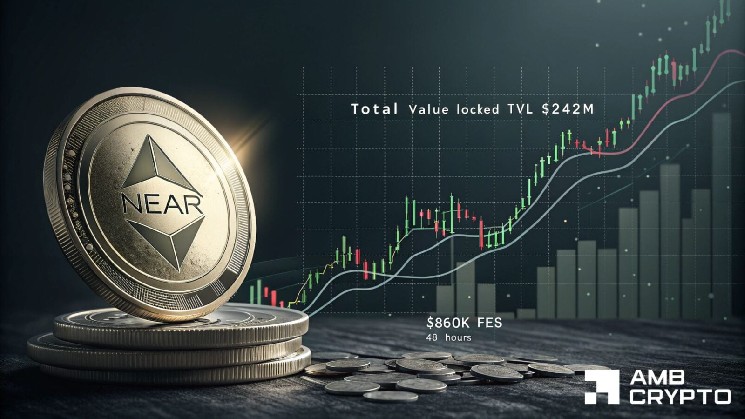
    • Network fundamentals hit record strength: Total Value Locked (TVL) reaches an all-time high of $242 million and protocol fees climb to $860,000 over the same period, per DefiLlama data.
    • NEAR satisfies all criteria for its anticipated milestone airdrop as of September 19, with TVL having crossed $70 million and price clearing $3.3, adding a fundamental catalyst to the technical breakout.

    NEAR Protocol Leads Crypto Market Rebound with Double-Digit Gains

    NEAR emerged as one of the cryptocurrency market’s biggest beneficiaries over the last 48 hours as the wider sector flashed green. The token recorded gains exceeding 10%, propelled by improving network activity that provided fundamental backing for the rally. This explosive bullish push cleared NEAR’s supply zone between $3.2 and $3.4 and printed a new local swing high at $3.9. With the token now trading above all key Exponential Moving Averages, market participants are assessing whether network bulls can sustain the momentum.

    On-Chain Fundamentals Underpin Price Surge

    Latest on-chain metrics reveal that fundamentals for NEAR Protocol have been robust over time. To be specific, the blockchain’s Total Value Locked set another record high of $242 million while network fees soared over the last 48 hours. This hike may be evidence that more capital is pouring into NEAR’s ecosystem. Additionally, NEAR protocol’s fees hit the $860,000-mark over the same period. Cumulatively, the hike in capital inflows into the network and fee generation may be a sign of growing activity across the ecosystem, according to data sourced from DefiLlama.

    Airdrop Milestone Adds Catalyst to Bullish Narrative

    Still, it is worth noting that 19th September marks the first day since NEAR ticked all the boxes for the anticipated milestone airdrop. The token’s TVL crossed the $70 million-mark two days ago while yesterday’s rally pushed the token’s price above $3.3. This convergence of technical breakout, record on-chain activity, and airdrop eligibility creates a multi-layered bullish case that distinguishes NEAR from peers relying solely on speculative momentum.

    Technical Outlook: Bulls Face Profit-Taking Test

    NEAR’s ability to maintain the prevailing momentum will depend on whether buyers continue to support the token after its 10% daily hike. A sustained rally alongside further growth in TVL and network fees would keep the bullish structure intact and could bring higher price levels into focus. Conversely, a rise in profit-taking could force NEAR to consolidate and retest nearby support. As it stands, the network’s long-term on-chain sentiments point to a potential bullish continuation. However, a short-term correction from the anticipated profit-taking cannot be ignored completely.

    Why This Matters

    The NEAR Protocol rally exemplifies a growing market trend where price action is increasingly tied to verifiable on-chain fundamentals rather than pure speculation. The simultaneous achievement of an all-time high in TVL ($242 million), a surge in protocol revenue ($860,000 in 48 hours), and the satisfaction of airdrop criteria signals genuine ecosystem adoption. For investors and developers, this suggests NEAR’s sharded proof-of-stake architecture is attracting meaningful capital and usage—critical for long-term viability in the competitive Layer-1 landscape. The upcoming days will test whether the protocol can convert speculative inflows into sticky liquidity, a key determinant of whether the $3.9 high becomes a launchpad or a local top.

    Frequently Asked Questions

    What triggered NEAR’s recent price surge above $3.9?
    The surge was driven by a combination of broad crypto market recovery, NEAR clearing a key $3.2–$3.4 supply zone, and strong on-chain fundamentals including record TVL of $242 million and $860,000 in protocol fees over 48 hours.
    Has NEAR qualified for its anticipated milestone airdrop?
    Yes, as of September 19, NEAR met all criteria for the milestone airdrop after TVL crossed $70 million and the token price surpassed $3.3.
    What are the key levels to watch for NEAR’s next move?
    Immediate resistance lies at the $3.9 local high, while support zones to watch on any pullback include the cleared supply area at $3.2–$3.4 and key Exponential Moving Averages now acting as dynamic support.
  • NEAR Protocol Marks 5 Years of 100% Uptime

    NEAR Protocol Marks 5 Years of 100% Uptime

    Key Highlights

    • NEAR Protocol achieved over 1 million transactions per second (TPS) in verified benchmarks while maintaining 100% uptime across five years of operation.
    • Dynamic resharding and post-quantum signing are now live, marking significant scalability and security upgrades for the layer-1 blockchain.
    • Technological milestones position NEAR as an infrastructure leader, potentially driving developer adoption and ecosystem growth amid mixed market signals.

    NEAR Protocol Sets New Performance Benchmarks With Million-TPS Throughput

    NEAR Protocol has announced a suite of infrastructure milestones that collectively underscore its positioning as a high-throughput, enterprise-grade layer-1 blockchain. The network recorded over 1 million transactions per second in verified benchmarking environments, a figure that places it among the highest-performing public blockchains by raw capacity. Equally notable, the protocol has sustained 100% uptime since its mainnet launch five years ago, a reliability metric that distinguishes it in an industry where network outages have affected several major competitors. The announcements were shared via the project’s official channels, accompanied by a link to the formal disclosure for community verification.

    Dynamic Resharding and Post-Quantum Cryptography Go Live

    Beyond raw throughput, NEAR has activated two architectural upgrades designed to future-proof the network. Dynamic resharding — a mechanism that allows the blockchain to adjust its shard count in real time based on demand — is now operational, enabling elastic scalability without requiring hard forks or manual governance interventions. Simultaneously, the network has implemented post-quantum signing, integrating cryptographic primitives resistant to quantum-computing attacks. These features reflect a deliberate strategy to address both present-day scalability bottlenecks and long-term cryptographic risk, catering to developers building applications that require predictable performance and forward-compatible security.

    Market Context: Technical Strength Amid Trading Lull

    Despite the technical fanfare, on-chain and exchange data show NEAR’s trading volume currently unavailable, suggesting a temporary lull in speculative activity. Analysts note that such disconnects between fundamental upgrades and short-term market attention are common in crypto cycles, particularly when macro conditions suppress risk appetite. However, the protocol’s role as a foundational layer for decentralized applications — emphasizing usability, low finality latency, and now quantum-resistant tooling — may attract builder mindshare over time. Projects seeking reliable infrastructure for high-frequency use cases, such as gaming, payments, or real-world asset tokenization, could increasingly evaluate NEAR’s stack as a viable alternative to more congested or less upgradeable networks.

    Why This Matters

    The convergence of million-TPS benchmarking, five-year uptime, live dynamic resharding, and post-quantum cryptography represents a rare full-stack maturity milestone in the layer-1 landscape. Most blockchains optimize for one or two of these dimensions; NEAR’s simultaneous progress across throughput, reliability, adaptive scaling, and cryptographic agility signals a platform engineered for production-grade workloads rather than speculative narratives. As the industry shifts toward modular architectures and application-specific chains, base layers that offer predictable performance and upgradeable security primitives are likely to capture disproportionate developer mindshare. NEAR’s roadmap — now demonstrably executing on these vectors — positions it to benefit from the next wave of institutional and enterprise blockchain adoption, where infrastructure robustness is a procurement requirement, not a marketing claim.

    Frequently Asked Questions

    What does NEAR Protocol’s 1 million TPS benchmark mean for real-world usage?

    The 1 million TPS figure was achieved in a verified benchmarking environment and represents theoretical peak capacity under optimized conditions. Actual application throughput will depend on smart contract complexity, network topology, and user behavior, but the headroom suggests NEAR can support high-frequency use cases — such as on-chain order books, real-time gaming, or micropayment streams — without congestion-induced fee spikes.

    How does dynamic resharding differ from static sharding used by other blockchains?

    Static sharding fixes the number of shards at launch or requires a hard fork to change, limiting flexibility. NEAR’s dynamic resharding allows the protocol to split or merge shards automatically in response to load, maintaining optimal resource utilization without governance delays or network disruptions. This elasticity is critical for handling unpredictable demand surges from viral applications or seasonal traffic patterns.

    Why implement post-quantum signing now when quantum computers remain experimental?

    Cryptographic migrations take years to standardize, deploy, and achieve ecosystem-wide adoption. By integrating post-quantum primitives today — specifically lattice-based signatures resistant to Shor’s algorithm — NEAR ensures that accounts and contracts created now remain secure against future quantum advances. This proactive approach aligns with NIST’s post-quantum cryptography standardization timeline and reduces the risk of a disruptive, emergency migration later.

  • NEAR Price Rallies 24% After AI Utility Expands Across 43 Models – Will the Rally Last?

    NEAR Price Rallies 24% After AI Utility Expands Across 43 Models – Will the Rally Last?

    Key Highlights

    • $NEAR token surges 24.52% as confidential TVL tops $70 million, triggering the first milestone snapshot allocating 333,333 tokens locked until the three-day volume-weighted average price sustains above $3.33.
    • Spot volume jumps 131.81% to $1.63 billion with CryptoQuant data showing Big Whale Orders and a Taker Buy Dominant 90-day CVD, confirming aggressive buyer control during the rally.
    • Technical breakout targets the $4 region after clearing $2.820 resistance and reaching $3.461, with a higher-timeframe Fair Value Gap spanning $3.65–$4.20 and ADX at 55.63 signaling strong trend momentum.

    Confidential Infrastructure Milestone Fuels $NEAR Rally

    The Near Protocol native token $NEAR has emerged as the top-performing artificial intelligence crypto asset, posting a 24.52% gain as trading activity expanded across both spot and derivatives markets. The advance coincides with a significant milestone for the network’s confidential infrastructure: total value locked (TVL) in confidential applications recently surpassed $70 million, triggering the first snapshot under the Confidential Intents incentive program.

    According to program parameters, the snapshot allocated 333,333 milestone tokens. These tokens remain locked until $NEAR’s three-day volume-weighted average price (VWAP) reaches and sustains at least $3.33. While the token’s spot price climbed above that threshold during the recent expansion, eligibility for unlocking requires the three-day VWAP to hold at or above $3.33, adding a time-weighted condition to the incentive structure.

    Ecosystem Utility Expands Across AI and Cross-Chain Execution

    Beyond the incentive mechanics, the protocol’s Confidential Intents framework now supports private execution across more than 30 connected blockchains. The system has also integrated Intents with autonomous-agent infrastructure to facilitate asset transfers and cross-chain payments. On the AI front, $NEAR’s utility deepened through staking-based computing credits that currently cover 43 AI models, broadening the token’s fundamental demand drivers beyond speculative trading.

    Spot market participation surged in tandem, with volume increasing 131.81% to $1.63 billion. This spike suggests broad-based market engagement underpinning the price appreciation rather than thin-liquidity movement.

    Whale Orders and Aggressive Spot Buying Confirm Demand

    Large market participants strengthened the demand picture as price accelerated. CryptoQuant’s Spot Average Order Size metric registered Big Whale Orders, indicating a prevalence of larger transaction sizes. Simultaneously, the 90-day Spot Taker Cumulative Volume Delta (CVD) remained Taker Buy Dominant, signaling that aggressive buyers controlled executed spot activity throughout the rally.

    Analysts note that whale-sized orders alone do not conclusively prove accumulation; however, the Taker Buy Dominant reading provides stronger evidence that active demand accompanied those trades. The combination of elevated order sizes and aggressive buyer execution gives $NEAR’s move firmer spot-market structural support.

    Derivatives Leverage Amplifies Identifiable Demand

    By contrast, the derivatives market expanded sharply as traders increased leveraged exposure. Open Interest rose 39.54% to $924.66 million, while derivatives volume surged 101.79% to $1.85 billion. This expansion could support trend continuation while buyers defend the breakout, though elevated leverage also increases liquidation risk should $NEAR reverse sharply.

    Crucially, spot buying and Big Whale Orders accompanied this derivatives expansion, indicating that leverage amplified identifiable spot demand rather than carrying the rally in isolation.

    Technical Structure Points Toward $4 Fair Value Gap

    During its uptrend, $NEAR broke decisively above the $2.820 level, overcoming a resistance zone that had previously rejected further advance. Price subsequently reached $3.461, bringing a higher-timeframe Fair Value Gap (FVG) into immediate focus. The imbalance stretches approximately between $3.65 and $4.20, placing the psychologically significant $4.00 level inside the target region.

    Directional strength intensified substantially during the breakout, with the Average Directional Index (ADX) reaching 55.6278. The Positive Directional Indicator (+DI) at 50.3812 overwhelmingly exceeds the Negative Directional Indicator (-DI) at 4.1701, confirming dominant bullish momentum. Additionally, the Parabolic SAR indicator at $2.297 remains well below the prevailing market price, reinforcing the development of a constructive technical structure.

    If bulls maintain control above the $2.820 breakout zone, $NEAR could extend deeper into the FVG. Alternatively, rejection from the imbalance would likely send price back toward the breakout area before another recovery attempt.

    Why This Matters

    The convergence of fundamental milestone achievement, expanding confidential and AI utility, and robust spot-market demand structures distinguishes this rally from purely speculative rotations. The Confidential Intents milestone demonstrates tangible adoption of Near’s privacy-preserving cross-chain infrastructure, while the staking-based AI compute credits create a recurring utility loop for token holders. Technically, the clean break of multi-month resistance at $2.820 and the measured move toward the $3.65–$4.20 FVG provide a clear roadmap for trend followers. However, the 39.5% surge in open interest warrants monitoring: a sharp correction could trigger cascading liquidations, testing the durability of the spot bid. The three-day VWAP condition for milestone token unlocks also introduces a near-term price anchor at $3.33 that may act as a magnet or support zone in the coming sessions.

    Frequently Asked Questions

    What triggers the unlock of the 333,333 milestone tokens allocated to the Confidential Intents program?
    The tokens remain locked until $NEAR’s three-day volume-weighted average price (VWAP) sustains at or above $3.33. A spot price print above $3.33 is insufficient; the three-day average must hold the level.
    How large is the current confidential TVL on Near, and how many blockchains does Confidential Intents connect?
    Confidential TVL recently surpassed $70 million, and Confidential Intents supports private execution across more than 30 connected blockchains.
    What do the CryptoQuant Spot Taker CVD and Big Whale Orders indicate about current market dynamics?
    The 90-day Spot Taker CVD reading of “Taker Buy Dominant” shows aggressive buyers are driving spot execution, while Big Whale Orders signal elevated average transaction sizes. Together, they suggest strong, active demand from large participants rather than passive accumulation.
  • Top Crypto Price Predictions: Near Protocol, Venice Token, Hyperliquid

    Top Crypto Price Predictions: Near Protocol, Venice Token, Hyperliquid

    Key Highlights

    • The global cryptocurrency market valuation reached $2.76 trillion amid a broad-based rally that persisted despite interest rate hikes from the Federal Reserve and the Bank of Japan.
    • Near Protocol (NEAR) surged to $3.7830, breaking above a key $3.08 cup-and-handle resistance, though an RSI of 85 signals overbought conditions and a potential retest of support.
    • Hyperliquid (HYPE) climbed toward a $100 target after clearing its prior all-time high of $89.38, fueled by political tailwinds and a perpetual DEX volume exceeding $240 billion in 30 days.

    Broad Market Resilience Defies Central Bank Tightening

    The cryptocurrency market demonstrated notable strength in the latest session, with the aggregate market capitalization holding at $2.76 trillion and the majority of tokens trading in positive territory. This advance occurred despite a backdrop of monetary tightening, as both the Federal Reserve and the Bank of Japan (BoJ) implemented interest rate hikes, while crude oil prices remained elevated—factors that have historically pressured risk assets. The decoupling suggests growing conviction among market participants in the structural narratives driving specific Layer-1 ecosystems and decentralized finance primitives.

    Near Protocol Leads Layer-1 Outperformance Amid AI Narrative

    Near Protocol ($NEAR) has emerged as a standout performer among major Layer-1 networks, significantly outpacing Bitcoin, Ethereum, and XRP in year-to-date returns. The token rallied to a high of $3.7830, a remarkable climb from its year-to-date low of $0.8490. Technically, NEAR cleared the $3.08 resistance level, which represented the upper boundary of a cup-and-handle formation—a pattern widely regarded in technical analysis as a bullish continuation signal. The asset now trades above all major moving averages and the Supertrend indicator, while the Average Directional Index (ADX) continues to rise, confirming strengthening trend momentum.

    However, caution is warranted. The Relative Strength Index (RSI) has elevated to 85, placing the token deep in overbought territory. This creates a heightened probability of a near-term pullback to retest the $3.08 breakout level as new support—a classic break-and-retest pattern—before the uptrend potentially resumes. The project’s diversified positioning, spanning a Layer-1 blockchain, a privacy-focused trading platform, and an AI agent marketplace, continues to underpin fundamental demand.

    Venice Token Extends Gains on AI Utility and Deflationary Mechanics

    Venice Token ($VVV), the native asset of the Venice AI platform, traded at $27.25, approaching its all-time high of $29.30. The platform differentiates itself by aggregating access to leading AI models from providers including Anthropic, OpenAI, and Grok, with users paying in fiat currency. A portion of platform fees is allocated to a systematic buy-and-burn mechanism, introducing deflationary pressure; the protocol burned over $702,000 worth of VVV last month and an additional $673,000 in the current month. Price action has confirmed a break-and-retest above the $21.48 cup-and-handle resistance, with the token holding above all key moving averages. The technical path of least resistance points upward, with analysts targeting the $35 level as the next significant objective.

    Hyperliquid Surges on Political Tailwinds and DEX Dominance

    Hyperliquid ($HYPE) has experienced a powerful upward trajectory catalyzed by two significant external developments. Former President Donald Trump signaled support for the protocol’s entry into the United States market, while the Securities and Exchange Commission (SEC) indicated backing for the tokenization of traditional stocks—both developments validating Hyperliquid’s core value proposition. Fundamentally, the platform’s perpetual decentralized exchange (DEX) has cemented its market leadership, processing over $240 billion in volume over the past 30 days, a figure that substantially exceeds rivals such as Aster and Lighter.

    From a technical perspective, HYPE has completed a textbook break-and-retest pattern, finding support at $76—its June 16 high—before breaking decisively above the prior all-time high resistance at $89.38. With the breakout confirmed and the asset trading in price discovery mode, the next major psychological and technical target sits at $100.

    Why This Matters

    The divergent technical setups across these three assets illustrate the maturing differentiation within the crypto market. NEAR’s strength reflects the market’s appetite for integrated AI-blockchain infrastructure, Venice demonstrates the viability of real-yield, utility-driven tokenomics in the AI sector, and Hyperliquid’s ascent highlights the convergence of regulatory clarity, political advocacy, and superior product-market fit in decentralized derivatives. Collectively, their resilience amid Federal Reserve and BoJ tightening suggests that protocol-specific fundamentals are increasingly superseding macroeconomic beta as the primary driver of capital allocation. Traders should monitor the $3.08 level on NEAR for confirmation of the break-and-retest, VVV’s approach to price discovery above $29.30, and HYPE’s volume sustainability as it approaches the $100 milestone.

    Frequently Asked Questions

    What is driving the current rally in the cryptocurrency market despite rate hikes?
    The market’s resilience stems from strong protocol-specific fundamentals—such as AI integration, deflationary tokenomics, and record DEX volumes—overriding traditional macroeconomic headwinds from the Federal Reserve and Bank of Japan rate decisions.
    Is Near Protocol (NEAR) overbought at current levels?
    Yes, the Relative Strength Index (RSI) reading of 85 indicates significantly overbought conditions, increasing the likelihood of a corrective pullback to retest the $3.08 breakout level before any further upside continuation.
    What makes Hyperliquid (HYPE) unique compared to other decentralized exchanges?
    Hyperliquid operates a high-performance perpetual DEX that processed over $240 billion in 30-day volume, surpassing peers like Aster and Lighter, while benefiting from explicit political support for U.S. market entry and SEC openness to asset tokenization.
  • NEAR Surges 21% on Launch of Historic Confidential Perps Powered by Hyperliquid

    NEAR Surges 21% on Launch of Historic Confidential Perps Powered by Hyperliquid

    Key Highlights

    • Near Protocol launches the industry’s first “Confidential by Default” perpetuals trading, masking all position details including asset types, sizes, entry times, and trading direction.
    • The feature runs on Near’s multi-chain Confidential Intents pipeline, which recently surpassed $70 million in total value locked (TVL), with Hyperliquid serving as the chief execution and liquidity layer.
    • NEAR token surges 21.36% to $3.21 while HYPE gains 10.82% to $86.72 following the announcement and Kraken parent Payward’s plans to bring Hyperliquid to the US market.

    Near Protocol Pioneers Confidential Perpetuals Trading on Blockchain

    Near Protocol has unveiled what it describes as the decentralized finance industry’s first “Confidential by Default” perpetuals trading environment, a development that directly addresses a fundamental tension in blockchain architecture: the conflict between radical transparency and competitive trading execution. The new feature, accessible via near.com, completely obscures all perpetual position data—including asset types, position sizes, entry timestamps, and directional bias—from public view.

    While transparency remains a foundational principle of blockchain technology, Near’s development team argues that complete visibility creates structural disadvantages for significant market participants. The protocol identifies three specific vulnerabilities inherent in fully transparent order books: front-running by on-chain bots that detect pending orders and execute ahead of them, strategy copying that allows competitors to mirror profitable approaches, and forced liquidations where malicious actors target public liquidation prices to push traders out of positions.

    Technical Architecture and Strategic Partnerships

    The confidential perpetuals infrastructure operates on Near’s multi-chain Confidential Intents pipeline, which recently achieved a $70 million total value locked milestone. The system combines high-speed execution with selective disclosure capabilities designed to satisfy regulatory compliance requirements. Integration with Circle’s USDC stablecoin enables inter-agentic payments, while Hyperliquid functions as the primary execution and liquidity layer, providing access to over 50 perpetual markets with leverage up to 40x.

    This architecture effectively merges the privacy characteristics traditionally associated with centralized exchanges—where order books and position data remain opaque—with blockchain’s core value propositions of speed, decentralization, and non-custodial asset control.

    Why This Matters: The Evolving Privacy Landscape in DeFi

    Near’s launch reflects accelerating industry demand for private transaction capabilities that maintain regulatory compliance. The competitive landscape now includes Ethereum-based confidential DeFi yield vaults, optional privacy wrappers from platforms such as Zama and Fhenix, and Cardano’s Midnight chain which offers what its developers term “rational privacy.” Each approach represents a different philosophical and technical solution to the privacy-transparency spectrum.

    However, Near’s confidential perpetuals trading remains restricted in the United States and Canada due to regulatory considerations, highlighting the ongoing tension between privacy-preserving financial infrastructure and jurisdictional compliance requirements. The geographic limitation underscores that technical innovation in this space continues to outpace regulatory clarity.

    Market Response and Price Action

    Following the announcement, NEAR token appreciated 21.36% intraday to trade at $3.21, according to CoinMarketCap data. The move coincides with broader sector rotation toward artificial intelligence-linked crypto assets. Technical analysis suggests that if NEAR maintains support above $3.00, the token could retest the $3.33 incentive threshold, while a break below $2.80 might trigger a decline toward the $2.57 Fibonacci support level.

    Simultaneously, HYPE token—native to the Hyperliquid ecosystem—gained 10.82% to reach $86.72 after Kraken’s parent company Payward announced plans to introduce Hyperliquid to the United States market, potentially expanding the protocol’s regulatory footprint and user base.

    Frequently Asked Questions

    What makes Near’s perpetuals trading “Confidential by Default”?

    All perpetual position data—including asset types, position sizes, entry times, and trading direction—is automatically masked from public view without requiring users to opt into privacy features.

    Which partners power the execution and liquidity for Near’s confidential perpetuals?

    Hyperliquid serves as the chief execution and liquidity layer, providing access to over 50 perpetual markets with up to 40x leverage, while USDC integration enables stablecoin settlements.

    Is Near’s confidential perpetuals trading available to users in the United States?

    No, the service remains restricted in the US and Canada due to regulatory reasons, despite the underlying technical infrastructure being operational globally.

  • QuantusNetwork Launches $QTC on NEAR Protocol

    QuantusNetwork Launches $QTC on NEAR Protocol

    Key Highlights

    • QuantusNetwork has launched $QTC, a post-quantum secure asset, on the NEAR Protocol, marking a significant advancement in quantum-resistant blockchain infrastructure.
    • The $QTC token introduces cross-chain functionality with built-in confidentiality features from inception, addressing emerging threats from quantum computing to traditional cryptographic standards.
    • NEAR Protocol’s scalability and developer-friendly architecture were cited as key factors in its selection as the launch platform for this security-focused asset.

    QuantusNetwork Deploys Quantum-Secure Asset on NEAR Protocol

    QuantusNetwork has officially launched $QTC, a post-quantum asset designed to withstand cryptographic threats posed by advancing quantum computing capabilities, on the NEAR Protocol blockchain. The announcement, disseminated via an official tweet from NEAR Protocol, positions the deployment as a milestone in the evolution of blockchain security architecture. By introducing a quantum-secure, cross-chain asset with confidentiality guarantees from day one, QuantusNetwork aims to preempt vulnerabilities that could compromise existing cryptographic standards as quantum computing technology matures.

    Strategic Platform Selection Underscores Security Focus

    The choice of NEAR Protocol as the launch venue reflects a deliberate alignment with a network recognized for its high throughput, low transaction costs, and developer-centric tooling. NEAR’s sharded proof-of-stake consensus mechanism provides the scalability required for complex cryptographic operations inherent in post-quantum cryptography, while its growing ecosystem of decentralized applications offers immediate utility pathways for $QTC integration. The protocol’s public endorsement of the launch signals institutional-grade confidence in both the asset’s technical design and QuantusNetwork’s security methodology.

    Market Context: Security as a Differentiator Amid Volatility

    The launch arrives during a period of mixed momentum across the broader cryptocurrency market, where divergent price action has underscored the importance of fundamental differentiators. As quantum computing research accelerates globally—with nation-states and major technology firms achieving periodic breakthroughs—the theoretical timeline for cryptographically relevant quantum attacks has compressed. QuantusNetwork’s proactive deployment of $QTC responds directly to this shifting threat model, targeting institutional allocators and security-conscious developers who view quantum resistance as a prerequisite for long-term asset viability rather than a speculative feature.

    Social Signal and Ecosystem Implications

    Early social media engagement surrounding the announcement indicates heightened awareness of post-quantum preparedness within the crypto community. The discourse extends beyond $QTC’s immediate utility, framing the launch as a potential catalyst for broader adoption of quantum-resistant standards across Layer 1 and Layer 2 networks. Observers note that successful integration and sustained demand for $QTC within the NEAR ecosystem could establish a template for security-first asset design, influencing roadmap priorities for projects currently reliant on elliptic curve cryptography vulnerable to Shor’s algorithm.

    Why This Matters

    The deployment of $QTC represents more than a single asset launch; it signals a maturation in how blockchain infrastructure addresses existential cryptographic risks. While quantum computers capable of breaking RSA or ECC encryption remain years from practical realization, the “harvest now, decrypt later” threat model—where adversaries store encrypted traffic for future decryption—creates urgency for forward-secure systems. NEAR Protocol’s role as the launch platform reinforces its positioning as a hub for cryptographic innovation, potentially attracting additional security-focused projects. For market participants, $QTC’s performance will serve as an early indicator of institutional appetite for quantum-native assets and may accelerate standardization efforts across the industry.

    Frequently Asked Questions

    What makes $QTC different from other tokens on NEAR Protocol?

    $QTC is designed as a post-quantum secure asset employing cryptographic primitives resistant to attacks by quantum computers, with cross-chain functionality and confidentiality features implemented from launch—distinguishing it from assets relying on classical elliptic curve cryptography.

    Why was NEAR Protocol chosen for this launch?

    NEAR Protocol’s sharded architecture provides the scalability needed for computationally intensive post-quantum operations, while its developer-friendly environment and established ecosystem facilitate rapid integration and adoption of advanced cryptographic assets.

    How does this launch affect the broader blockchain security landscape?

    The introduction of a production-ready quantum-secure asset on a major Layer 1 network sets a precedent for proactive cryptographic migration, potentially accelerating industry-wide adoption of post-quantum standards before quantum threats become practical.

  • NEAR Protocol Highlights Need for Data Privacy

    NEAR Protocol Highlights Need for Data Privacy

    NEAR Protocol took to social media to assert that any system holding identities is a potential exposure point. The project emphasized that confidentiality should be a baseline expectation, particularly for financial and AI systems. The statement reflects mounting concerns about data privacy across the cryptocurrency sector.

    Community Response Signals Growing Privacy Focus

    The protocol’s recent post gained significant traction, accumulating 334 likes and 48 retweets. The engagement underscores how data protection has become a central conversation as the broader crypto market navigates mixed signals. Safeguarding sensitive user information in financial infrastructure and artificial intelligence applications is rapidly shifting from a feature to a fundamental user requirement.

    Market Context and Protocol Alignment

    Current market dynamics present a complex backdrop for this privacy advocacy. While digital asset markets show divergent trends, the call for stronger data protections may shape how blockchain projects architect their protocols to meet evolving expectations. NEAR Protocol, a blockchain platform built for high-performance decentralized applications, has positioned confidentiality as core to its mission of enhancing trust and security in the evolving Web3 landscape.

    Industry Implications for Developers and Traders

    Market participants are monitoring how NEAR’s stance on confidentiality translates into platform enhancements and user adoption. As privacy concerns intensify, protocols that prioritize data protection may gain competitive advantage through increased trust. This dynamic could catalyze a broader industry reassessment of data handling standards across the blockchain ecosystem.

    This article does not constitute financial advice.