Tag: Middle East tensions

  • Bond Volatility Surges While Bitcoin and Wall Street Remain Calm

    Bond Volatility Surges While Bitcoin and Wall Street Remain Calm

    Key Highlights

    • The U.S. 10-year Treasury yield briefly touched 5.2% on Thursday before settling at 5.163%, driven by Middle East conflict pushing oil and diesel prices higher and complicating the global inflation outlook.
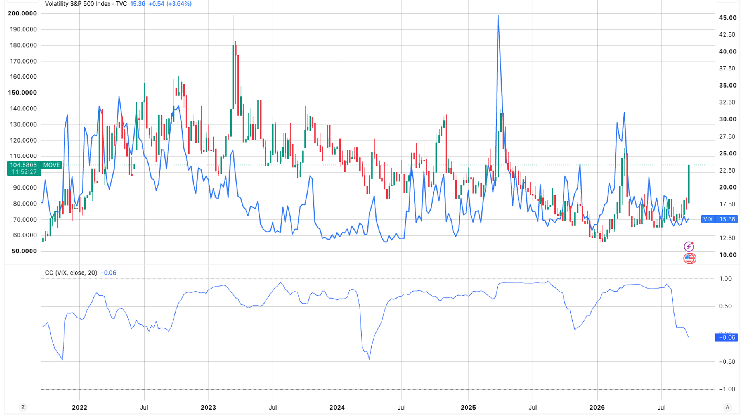
    • The ICE BofA MOVE Index ($MOVE) shows bond traders are paying significantly more for interest-rate volatility protection despite the S&P 500 rising roughly 21% since March when $MOVE was last at similar levels.
    • The 20-day correlation between the VIX and $MOVE turned negative (-0.06) for the first time since April 2024, while the BVIV-$MOVE correlation sits at -0.37, indicating a historic divergence between equity and bond volatility expectations as Bitcoin’s implied volatility hovers near yearly lows.

    Global Bond Yields Surge Amid Middle East Tensions

    A broad-based climb in government bond yields is rippling through global markets this week, with the benchmark U.S. 10-year Treasury yield briefly piercing the 5.2% threshold on Thursday before retreating slightly to 5.163%. The selloff in fixed income comes as the widening conflict in the Middle East drives crude oil and diesel prices higher, injecting fresh uncertainty into the inflation outlook and prompting traders to reassess how much further major central banks may need to tighten monetary policy. The move underscores the fragile nature of the disinflation narrative that had previously anchored market expectations for rate cuts.

    MOVE Index Signals Rising Rate Volatility Premium

    The ICE BofA MOVE Index, a widely watched gauge of expected volatility in U.S. Treasury markets, has climbed to levels last seen in March. However, the equity market backdrop has shifted dramatically: the S&P 500 stood near 6,350 when $MOVE previously traded at this level, but the index has since surged to 7,704, a gain of approximately 21%. This divergence highlights a critical shift—bond traders are now paying a considerably higher premium for protection against interest-rate swings even as equity markets rally, suggesting fixed-income participants see risks that stock investors are currently disregarding.

    Correlation Breakdown Between Asset Class Volatility

    The structural relationship between equity and bond volatility measures is showing signs of fracture. Over a 20-day rolling window, the correlation between the Cboe Volatility Index (VIX) and the MOVE Index has slipped to -0.06, turning negative for the first time since April 2024, though the reading remains statistically close to zero. The correlation between the Cboe Bitcoin Volatility Index (BVIV) and $MOVE is more distinctly negative at -0.37, marking one of its lowest readings in years. This decoupling occurs as bond volatility rises while Bitcoin’s expected volatility remains anchored near its yearly low, a dynamic that challenges traditional cross-asset hedging assumptions.

    Bitcoin’s Detachment from Yield Narrative

    Adding to the complexity, recent analysis from CoinDesk indicates that rising yields alone have demonstrated little consistent relationship with Bitcoin’s returns. The cryptocurrency’s implied volatility, as measured by BVIV, has failed to respond to the spike in rate volatility, remaining near annual lows. This suggests that Bitcoin is currently trading on idiosyncratic drivers—such as ETF flow dynamics and regulatory developments—rather than macroeconomic interest-rate sensitivity, further isolating the digital asset from traditional fixed-income turbulence.

    Why This Matters

    The simultaneous rise in bond yields and volatility premiums, coupled with a breakdown in cross-asset correlations, signals a potential regime shift for multi-asset portfolios. For institutional investors, the negative VIX-MOVE correlation undermines the traditional negative equity-bond correlation that has underpinned 60/40 portfolio construction for decades. The fact that Bitcoin volatility remains suppressed while rate volatility spikes suggests the asset is not currently functioning as a macro hedge against inflation or rate uncertainty. Market participants should monitor whether the $MOVE index sustains these elevated levels, as persistent bond volatility could force a repricing of risk assets broadly, including equities and digital assets, particularly if the Federal Reserve signals a higher-for-longer rate stance in response to energy-driven inflation pressures.

    Frequently Asked Questions

    What is the MOVE Index and why is it important?

    The ICE BofA MOVE Index ($MOVE) measures the implied volatility of U.S. Treasury securities across the 2-, 5-, 10-, and 30-year maturities. It serves as the bond market’s equivalent of the VIX, reflecting how much traders are paying to hedge against interest-rate swings. A rising $MOVE indicates growing uncertainty about the path of monetary policy and inflation.

    Why has the correlation between VIX and MOVE turned negative?

    The 20-day correlation between the VIX (equity volatility) and MOVE (bond volatility) fell to -0.06, its first negative reading since April 2024. This suggests equity traders are complacent—pricing in a soft landing and continued rally—while bond traders are hedging aggressively against sticky inflation and higher-for-longer rates, creating a rare divergence in risk perception across asset classes.

    Is Bitcoin acting as a hedge against rising yields?

    According to CoinDesk’s analysis, rising yields alone have shown little consistent relationship with Bitcoin’s returns. Currently, Bitcoin’s implied volatility (BVIV) is near yearly lows while bond volatility ($MOVE) spikes, and the BVIV-MOVE correlation sits at -0.37. This indicates Bitcoin is not currently functioning as a macro hedge against interest-rate volatility.
  • Bitcoin Rejected at $82K: 3 Reasons Behind Sunday Pullback

    Bitcoin Rejected at $82K: 3 Reasons Behind Sunday Pullback

    Key Highlights

    • Bitcoin rallied from $75,000 to nearly $82,000 last week before stalling at resistance amid escalating Middle East tensions.
    • The U.S. State Department warned of rapid escalation between Saudi Arabia and Iran-backed Houthis, prompting travel advisories and reported high-alert status for Iranian forces.
    • Technical indicator TD Sequential flipped to a sell signal at $81,500, suggesting short-term momentum is overextended, according to analyst Ali Martinez.

    Bitcoin’s Recovery Rally Hits Geopolitical and Technical Headwinds

    Bitcoin staged a sharp recovery last week, climbing from a low of $75,000 to within striking distance of $82,000 — its highest level since early March. The rally unfolded despite a confluence of macroeconomic pressures, including fallout from the CLARITY Act legislative setback and a hawkish Federal Reserve outlook that had previously weighed on risk assets. Buyers stepped in aggressively on Friday and Saturday, erasing the post-Senate vote decline in a matter of sessions. However, the upward momentum stalled just shy of the $82,000 mark as fresh geopolitical risks emerged from the Middle East, introducing a new layer of uncertainty for global markets.

    U.S. Warns of Rapid Escalation in Saudi-Houthi Conflict

    Reports over the weekend indicated a significant deterioration in regional security. The U.S. State Department issued a statement confirming that Iranian-supported Houthis have engaged in hostilities against Saudi Arabia, including targeting civilian airports. “Iranian-supported Houthis have engaged in hostilities against Saudi Arabia, including civilian airports. This military conflict has the potential to escalate rapidly,” said the US State Department. The statement also warned Americans to “seriously reconsider travel to and through the region.” Saudi authorities reported intercepting and destroying a ballistic missile fired at Riyadh on Saturday evening, with no casualties reported. Meanwhile, BBC sources noted that energy infrastructure along the Red Sea coast was also targeted.

    Adding to the tension, the X account Daily Iran News, which commands over 500,000 followers, claimed that Iran had issued “Code 100” — its highest alert level — for all armed forces, encompassing the Islamic Revolutionary Guard Corps (IRGC), the regular Army, and security forces. In response to the deteriorating situation, former President Donald Trump reportedly cut short his weekend at Camp David to return to the White House, while Israeli Prime Minister Benjamin Netanyahu also departed the U.S. earlier than planned.

    TD Sequential Flashes Sell Signal as Momentum Stretches

    On the technical front, the rally’s exhaustion coincides with a key indicator turning bearish. Analyst Ali Martinez observed that the TD Sequential, which had flashed a buy signal when Bitcoin touched $75,000, flipped to a sell signal on Saturday evening just as the price tapped $81,500. “That suggests short-term momentum may be getting stretched, and I’m watching closely for signs that it’s time to lock in some profits,” he added. The confluence of a technical sell trigger and heightened geopolitical risk has created a dual barrier for Bitcoin’s next leg higher, with traders now monitoring whether the asset can consolidate above $80,000 or faces a pullback toward the $78,000–$79,000 support zone.

    Why This Matters

    The intersection of geopolitical instability and technical resistance underscores Bitcoin’s evolving role as a macro-sensitive asset. While often framed as a hedge against monetary debasement, Bitcoin remains acutely responsive to global risk sentiment — particularly when energy markets and major power dynamics are involved. The Saudi-Houthi escalation threatens to disrupt oil flows through the Red Sea, potentially reigniting inflation fears and complicating the Federal Reserve’s policy path. For crypto markets, the TD Sequential sell signal adds a layer of technical discipline to the narrative-driven volatility, reminding participants that rapid, news-fueled rallies often require consolidation before sustainable trend continuation. The coming days will test whether Bitcoin can decouple from traditional risk-off impulses or remains tethered to the broader geopolitical cycle.

    Frequently Asked Questions

    What caused Bitcoin’s rally to stall near $82,000?

    The rally stalled due to a combination of escalating Middle East hostilities between Saudi Arabia and Iran-backed Houthis, which triggered risk-off sentiment, and a technical sell signal from the TD Sequential indicator at $81,500, suggesting short-term momentum was overextended.

    What is the significance of the U.S. State Department’s warning?

    The State Department confirmed active hostilities involving Iranian-backed Houthis targeting Saudi civilian infrastructure and warned the conflict could escalate rapidly, advising Americans to seriously reconsider travel to the region — signaling heightened concern over a broader regional war.

    What does the TD Sequential sell signal imply for Bitcoin’s next move?

    According to analyst Ali Martinez, the sell signal indicates short-term momentum is stretched, increasing the probability of a consolidation or pullback. He noted he is watching for signs to lock in profits, implying a cautious near-term outlook unless price action invalidates the signal.

  • U.S. Diesel Prices Hit Record High as Bitcoin, Gold Struggle

    U.S. Diesel Prices Hit Record High as Bitcoin, Gold Struggle

    Diesel Prices Surge Amid Middle East Tensions and Tight Refining Capacity

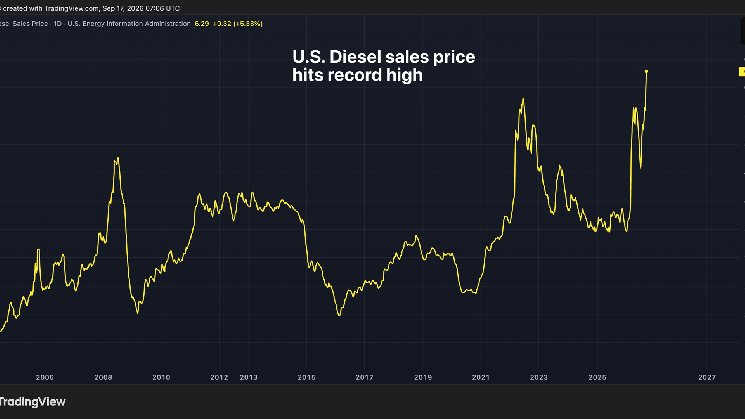
    Diesel prices are climbing sharply, driven primarily by escalating geopolitical tensions in the Middle East. The ongoing conflict involving the U.S., Israel, and Iran has disrupted crude oil flows and inflated risk premiums on refined products. Constrained refinery capacity worldwide, combined with robust demand from freight and industrial sectors, has amplified the price move, transforming a regional supply shock into a global price spike.

    Federal Reserve Policy Adds Pressure

    The Federal Reserve’s Wednesday rate hike underscores how policymakers remain biased toward using interest rate increases to combat inflation stemming from oil-supply shocks—a strategy some observers characterize as a mistake. Record diesel prices now present a significant headwind for gold, bitcoin, and technology stocks.

    Like gold, bitcoin is widely viewed as a store of value and a sovereign hedge. However, historically, higher borrowing costs have weighed on the cryptocurrency’s market value, as evidenced during the 2022 Fed tightening cycle.

    Rate Hike Details and Forward Guidance

    On Thursday, the Fed raised rates by 25 basis points, lifting the benchmark borrowing cost to the 3.75%-4% range. Goldman Sachs and Morgan Stanley both anticipate an additional 25 basis point hike in October.

    Global Central Banks Follow Suit

    Other major central banks are also tightening monetary policy. The European Central Bank recently increased rates, and the Bank of Japan (BOJ) is expected to do the same on Friday.