Tag: Middle East conflict

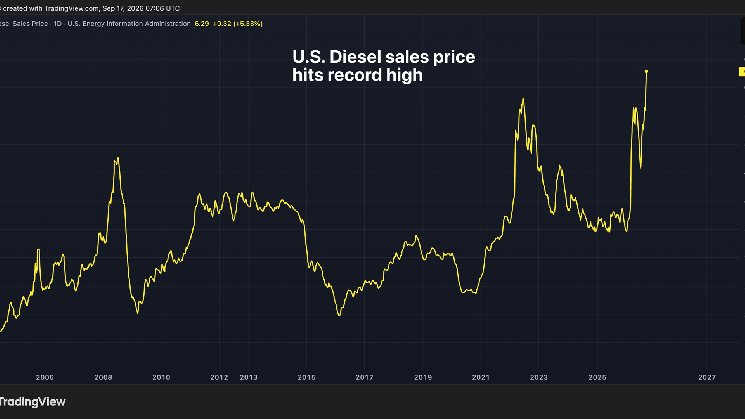
  • U.S. Diesel Prices Hit Record High as Bitcoin and Gold Struggle

    U.S. Diesel Prices Hit Record High as Bitcoin and Gold Struggle

    Diesel prices are surging globally, driven primarily by escalating geopolitical tensions in the Middle East. The ongoing conflict involving the U.S., Israel, and Iran has disrupted crude oil flows and injected significant risk premiums into refined product markets. Compounding the supply-side pressure, tight refinery capacity and robust demand from both freight and industrial sectors have amplified the price move, transforming a regional supply shock into a worldwide spike at the pump.

    Federal Reserve Policy Under Scrutiny Amid Supply-Driven Inflation

    The Federal Reserve’s decision on Wednesday to raise its benchmark borrowing cost by 25 basis points to the 3.75%–4% range has drawn criticism from market observers. Critics argue the hike demonstrates a policy bias toward using interest rate increases to combat inflation rooted in oil-supply shocks—a strategy some view as a fundamental mistake. Higher borrowing costs historically act as a headwind for non-yielding assets, and the current environment is no exception.

    Record Diesel Prices Create Headwinds for Gold, Bitcoin, and Tech Stocks

    Record-high diesel prices are pressuring traditional safe-haven assets and growth equities alike. Both gold and bitcoin are widely viewed as stores of value and hedges against sovereign risk. However, historical precedent shows that rising interest rates weigh heavily on cryptocurrency valuations, a dynamic clearly illustrated during the Fed’s aggressive tightening cycle in 2022. Technology stocks, sensitive to discount rates and economic growth forecasts, face similar downward pressure.

    Global Central Banks Extend Tightening Cycle

    The shift toward restrictive monetary policy is not isolated to the United States. The European Central Bank has recently implemented its own rate increase, and the Bank of Japan (BOJ) is widely expected to follow suit with a hike on Friday. Major Wall Street institutions, including Goldman Sachs and Morgan Stanley, anticipate the Fed will deliver an additional 25 basis point increase at its October meeting, signaling that the global tightening cycle remains firmly in place.


  • Oil Prices Dip Yet Stay on Track to Close Week Above $100

    Oil Prices Dip Yet Stay on Track to Close Week Above $100

    Oil prices pulled back on Friday but remained on track for a weekly gain of nearly 9% after surging above $100 a barrel for the first time in months. Brent crude futures, the global benchmark, fell 2.4% to trade at $105.03 a barrel, while U.S. West Texas Intermediate (WTI) slipped 2.75% to $99.66 per barrel. On Thursday, Brent peaked near $108 a barrel and WTI topped $104.

    Diplomatic Signals Trigger Pullback

    The decline followed reports from Iranian state media that Tehran will meet with Gulf states in Oman to discuss the Strait of Hormuz, signaling diplomatic engagement despite a week of sharp escalation. Brent futures were on course for a weekly gain of 9%, set to close the week above the critical $100 mark for the first time since mid-May. WTI’s week-to-date gain stood at 8.9%. Friday’s drop snapped five consecutive days of gains for Brent and an eight-day winning streak for WTI.

    Markets Brace for Protracted Conflict

    Traders are pricing in a prolonged Iran conflict, reacting to escalating tensions in the Middle East and a Wall Street Journal report that top White House advisors discussed with President Donald Trump the possibility that the conflict could extend beyond his current term. Trump has said the conflict will end after the U.S. midterm elections in November, adding that oil and gas prices will also fall after the critical vote.

    Geopolitical Fears Dominate Trading

    “Once again, it is geopolitical fears driving everything,” Deutsche Bank’s Jim Reid said in a Friday morning note. “In terms of the latest Middle East headlines, yesterday saw growing concerns over the safety of Red Sea shipping, and the potential knock-on effects for Saudi oil exports, as Houthi rebels captured Yemen’s port city of Mokha, which is located close to the Bab el-Mandeb Strait on the southern end of the Red Sea. The mood also wasn’t helped by news that Saudi Arabia’s oil output has fallen to its lowest since 1990.”

    Analyst Weighs Structural vs. Transitory Supply Deficit

    Tamas Varga, an analyst at PVM Oil Associates, told CNBC that the key question for investors is whether the current supply deficit is structural or transitory. “While further spikes cannot be ruled out and re-visiting the April peak of $126 remains a possibility as global and regional oil inventories keep drawing down, it must be noted that [the] higher oil prices climb, the more demand will be obliterated,” he said. “The difference between the current crisis and… the one experienced in 1990, during the first Gulf War, is that today oil is more elastic than 35 years ago.”

    Renewables Accelerate Demand Shift

    Varga said renewable energy is “more than capable” of replacing “certain parts of the barrel,” especially in electricity generation. “It appears only a question of time that the gap between global oil supply and demand will narrow, either by supply increasing in case of a truce or demand decreases, due to the widespread use of alternative energy sources,” he added. “In the interim, further oil price strength is very much possible, but it would be surprising to see it lasting beyond 2026.”

  • Stock Market Today: Live Updates on Market Moves

    Stock Market Today: Live Updates on Market Moves

    Traders worked the floor of the New York Stock Exchange on Aug. 25, 2026, as U.S. equities slid Thursday after domestic oil prices surged past $100 a barrel. The selloff reflected mounting anxiety that a prolonged conflict in the Middle East would fuel higher inflation and keep interest rates elevated for longer.

    Major Indexes Finish Lower

    The Dow Jones Industrial Average fell 195 points, or 0.4%. The S&P 500 declined 0.6%, while the Nasdaq Composite dropped 0.9%. The three major averages extended a losing streak to three sessions.

    Oil Prices Jump on Geopolitical Tensions

    Crude prices continued to weigh on market sentiment as the war between the U.S. and Iran entered its seventh month. U.S. West Texas Intermediate futures for October delivery climbed above $100 per barrel, while the international benchmark Brent crude for November spiked above $105 a barrel.

    Treasury Yields Hit Multi-Month Highs

    The rally in energy pushed the benchmark 10-year Treasury yield above 4.9%, its highest level since November 2023. Rising yields pressured rate-sensitive growth sectors, particularly high-beta semiconductor stocks that have led the bull market.

    Chip Stocks Lead Sector Declines

    Intel shares fell 3%, and Micron Technology declined 2%, as investors worried that higher borrowing costs and energy expenses could slow economic growth and dampen demand for semiconductors.

    Wholesale Inflation Data Fails to Soothe Nerves

    A relatively tame producer price index report did little to calm fears. The PPI rose a seasonally adjusted 0.4% in August, matching the Dow Jones consensus. On an annual basis, wholesale inflation stood at 5.4%, well above the Federal Reserve’s 2% target.

    The data arrives ahead of Friday’s closely watched consumer price index. Both gauges feed into the Fed’s preferred inflation metric, the personal consumption expenditures price index, which will not be released until after the central bank’s rate decision on Sept. 16.

    Analyst Perspective: PPI Inconclusive, Oil and Yields Raise Stakes

    “The PPI release itself was inconclusive, in that doesn’t really help to settle the question of ‘hike or no hike’ from the Fed next week, but WTI oil prices surging back above $100 and Treasury yields hitting new highs is certainly raising the stakes for investors ahead of tomorrow’s crucial CPI report,” wrote Stephen Coltman, head of macro at 21shares.

    Fed Hike Probability Climbs to 74%

    Fed funds futures were last pricing in a 74% likelihood of a quarter-point rate increase following next week’s policy meeting, according to the CME FedWatch Tool.

    Treasury Buyback Announcement Adds to Pressure

    The market’s three-day slide accelerated after the Treasury Department said it would buy back up to $6 billion in longer-term debt — triple the usual amount. Less than a month earlier, the Treasury had announced it would more than double the size of its $2 billion government debt repurchase operations.

    — CNBC’s Jeff Cox and Spencer Kimball contributed to this report.