Tag: MicroStrategy

  • Strategy Pays $100M Premium to Repurchase Bitcoin It Previously Sold

    Strategy Pays $100M Premium to Repurchase Bitcoin It Previously Sold

    Key Highlights

    • Strategy (formerly MicroStrategy) incurred a $100.2 million opportunity cost after selling 6,948 BTC at an average of $62,150 in summer 2024 and repurchasing 5,553 BTC at an average of $80,207 this autumn.
    • The company’s founder Michael Saylor and CEO Phong Le stated the sales were executed for “messaging purposes” to “inoculate the market” rather than due to cash needs, despite SEC filings citing dividend funding.
    • Strategy still holds 1,363 fewer BTC than its June peak of 847,363, and replacing the remaining coins at current prices would require approximately $100 million more.

    Summer Sale, Autumn Rebuy: A Costly Roundtrip

    Strategy, the corporate bitcoin treasury pioneer founded by Michael Saylor, has spent recent weeks reacquiring 5,553 of the 6,948 bitcoin it liquidated between May and August 2024. The roundtrip trade has proven expensive: the company sold at an average price of $62,150 per coin, generating $345.1 million in proceeds, only to repurchase at an average of $80,207 — a 29% premium that cost shareholders $445.4 million for the same 5,553 coins. The realized opportunity cost of being out of the market during bitcoin’s summer-to-autumn rally exceeds $100.2 million.

    The first repurchase tranche arrived during the week ending August 30, when Strategy acquired 4,603 BTC at $80,318 each for $369.7 million, funded by newly issued stock that diluted common shareholders. A follow-up purchase of 950 BTC at $79,670 apiece was executed last week using cash instead of equity. Despite these outlays, the company’s holdings stand at 846,000 BTC — still 1,363 coins short of the 847,363 it held as recently as June 21. Reacquiring the remaining shortfall would demand roughly another $100 million at prevailing market prices.

    Sales Driven by Narrative, Not Necessity

    According to Saylor and CEO Phong Le, the motivation for the initial sales was not liquidity pressure but strategic messaging. On a May 5 call with analysts, Saylor stated the company would sell bitcoin “just to inoculate the market” and send a signal to news publications that it had done so. He later told Fortune, “the skeptics and the short-sellers don’t recognize that we’re just selling a $BTC derivative, and we have the option to sell the $BTC.” Both executives appeared on numerous television interviews and podcasts to frame the sales as deliberate communication rather than financial distress.

    However, official SEC filings for the sales cited dividend funding as the use of proceeds — despite the company holding sufficient cash to cover those dividends without liquidating bitcoin. The discrepancy between public statements and regulatory disclosures has drawn scrutiny from analysts and shareholders alike.

    Leadership Remains Unapologetic

    Neither Saylor nor Le has expressed regret over the sequence of trades. On the day of Strategy’s fourth sale of the year, Le posted, “This is the Digital Credit Capital Framework at work.” He subsequently told Bloomberg that it was “the right trade at the time to sell $BTC.” Le added, “It’s a two-way strategy. There will be times when it makes sense to sell bitcoin.” The comments underscore a philosophical shift toward active portfolio management — buying and selling based on capital market conditions — rather than the perpetual accumulation strategy the company previously championed.

    Why This Matters

    Strategy’s bitcoin treasury operations have long served as a bellwether for corporate digital asset adoption. The summer 2024 sell-and-rebuy episode marks the first significant deviation from the company’s “never sell” narrative, testing investor confidence in a model that previously relied on unwavering conviction. The $100 million-plus opportunity cost quantifies the financial penalty of market-timing decisions in a volatile asset class. Furthermore, the divergence between management’s public rationale (“messaging”) and SEC filing rationale (dividend funding) raises governance questions about transparency. With 1,363 BTC still un-replaced and bitcoin trading near multi-month highs, the company faces a choice: deploy additional capital at elevated prices or accept a permanently reduced bitcoin position — either outcome carrying implications for shareholders who viewed Strategy as a pure-play bitcoin proxy.

    Frequently Asked Questions

    How much bitcoin does Strategy currently hold compared to its June 2024 peak?
    Strategy holds 846,000 BTC as of the latest disclosure, down from 847,363 BTC on June 21, 2024 — a shortfall of 1,363 coins.
    What was the stated reason for the summer 2024 bitcoin sales?
    Michael Saylor and CEO Phong Le publicly stated the sales were for “messaging purposes” to “inoculate the market” and demonstrate the company’s ability to sell bitcoin as a derivative-like instrument. SEC filings, however, listed dividend funding as the use of proceeds.
    Has Strategy completed its repurchase program?
    No. The company has repurchased 5,553 of the 6,948 BTC sold. Replacing the remaining 1,363 BTC at current market prices would require approximately $100 million in additional capital.
  • ‘The orange tie stays’: Michael Saylor responds to venture capitalist’s bitcoin obituary

    ‘The orange tie stays’: Michael Saylor responds to venture capitalist’s bitcoin obituary

    Key Highlights

    • Jason Calacanis declares Bitcoin “boring” as it returns to $80,000, criticizing its transaction utility, user experience, and cultural relevance.
    • Michael Saylor counters that Bitcoin has become a $1.6 trillion “Digital Capital” asset focused on generational wealth preservation.
    • The exchange highlights a fundamental divide between critics seeking utility and adoption metrics versus proponents viewing Bitcoin as a long-term store of value.

    Calacanis Declares Bitcoin’s Cultural Moment Has Passed

    As bitcoin reclaimed the $80,000 level on Friday, veteran investor Jason Calacanis took to social media to deliver a scathing assessment of the cryptocurrency’s current trajectory. “The dead cat continues to bounce,” wrote Calacanis, invoking a market term for a temporary recovery in a declining asset. He proceeded to dismantle the case for bitcoin across multiple dimensions, questioning its fundamental utility seventeen years after its inception.

    Utility, Experience, and the “Dinner Party” Test

    Calacanis argued that bitcoin fails as both a transactional medium and a platform for smart contracts, while presenting an “intimidating user experience” that alienates mainstream users. He contended the asset no longer captures the public imagination, applying a cultural litmus test: “If it comes up at the dinner party, it’s followed by a hearty ‘remember that!’” The investor suggested the narrative has shifted from wealth creation to stability expectations. “Folks expect bitcoin to be stable and that it’s no longer a way to get rich quick,” he continued. “It’s boring … Advocates went from pirates to suits in orange ties, awkwardly sharing cringe memes — just like the cool kids do!” His conclusion was definitive: “If Bitcoin were going to reach mass adoption and an important use case, it does better than anyone else, it would have by now.”

    Saylor Reframing: Digital Capital and Generational Wealth

    Michael Saylor, founder of MicroStrategy and bitcoin’s most prominent corporate advocate, issued a point-by-point rebuttal framing the asset in civilizational rather than consumer terms. “You’ve watched Bitcoin grow since 2011,” Saylor responded. “It’s now a $1.6 trillion success and the world’s most valuable digital asset.” He rejected the premise that transactional velocity or dinner-party relevance defines success. “Digital Capital is the killer app,” Saylor continued. “Preserving wealth across generations is a bigger ambition than entertaining a dinner party.” He closed with a symbolic declaration of continuity: “The orange tie stays.”

    Why This Matters

    The Calacanis-Saylor exchange crystallizes the central debate surrounding bitcoin in 2025: whether its value proposition lies in medium-of-exchange utility and mass consumer adoption — the original cypherpunk vision — or in settlement-layer “Digital Capital” serving as a sovereign-grade store of value. Calacanis represents the skeptic’s benchmark: seventeen years without Venmo-level usability or mainstream cultural currency suggests product-market fit failure. Saylor represents the institutional thesis: a $1.6 trillion market cap, nation-state accumulation strategies, and corporate treasury adoption prove the “digital gold” use case has already won. The “orange tie” motif — originally a bitcoin community signal — now functions as a Rorschach test: to critics, a symbol of cringe corporate co-option; to believers, a marker of institutional maturation. With bitcoin oscillating around $80,000, the next inflection point may depend less on technical upgrades and more on whether sovereign and corporate balance-sheet allocation continues to outpace retail onboarding.

    Frequently Asked Questions

    What triggered the Calacanis-Saylor exchange?

    Bitcoin’s return to the $80,000 price level on Friday prompted Jason Calacanis to post a critical thread questioning bitcoin’s utility, user experience, and cultural relevance after 17 years. Michael Saylor responded directly, reframing bitcoin as “Digital Capital” for generational wealth preservation.

    What is Michael Saylor’s “Digital Capital” thesis?

    Saylor argues bitcoin’s primary value proposition is not payments or smart contracts but serving as a sovereign-grade, digitally native store of value — “Digital Capital” — capable of preserving wealth across generations, a purpose he considers more significant than consumer adoption or dinner-party relevance.

    What does “the orange tie stays” signify?

    The orange tie has been a symbol worn by bitcoin advocates, including Saylor, representing conviction in the asset. Calacanis mocked it as “suits in orange ties, awkwardly sharing cringe memes.” Saylor’s closing line — “The orange tie stays” — signals institutional conviction remains unchanged despite criticism.

  • Strategy Copycat Satsuma Crashes 99%, Liquidates Treasury

    Strategy Copycat Satsuma Crashes 99%, Liquidates Treasury

    Satsuma Technology Collapses 99% After Bitcoin Treasury Strategy Fails

    British bitcoin treasury company Satsuma Technology has crashed 99% from its 2025 peak, liquidated its entire bitcoin holdings, and suspended trading as it faces delisting proceedings. The firm, which raised £168.9 million ($227.6 million) from noteholders during the height of the 2025 bitcoin treasury boom, sold all 669 of its remaining BTC and is now under High Court of Justice procedures to distribute £30.7 million ($41.4 million) to shareholders by the end of September.

    On Monday, the company attempted to postpone its own delisting while searching for a new trading venue. As recently as June 24, 2025, Satsuma was valued at over £120 million ($162 million).

    Regulatory Constraints Prevent Bitcoin Returns to Investors

    Chief Bitcoin Strategist Mark Moss explained in an interview that UK regulations prevent returning bitcoin directly to investors. According to Moss:

    “We can’t give the investors back their $BTC. We have to give them the dollar amount of the bitcoin when they accepted it.”

    From Gaming to AI to Bitcoin: A Series of Pivots

    Incorporated in March 2021 as Streaks Gaming, the company pivoted to artificial intelligence as StreaksAI before embracing cryptocurrency as Tao Alpha. Its final rebrand to Satsuma Technology channeled the “sats” denomination of bitcoin.

    The bitcoin treasury model was seemingly encouraged by Strategy (formerly MicroStrategy) founder Michael Saylor, who reportedly said:

    “There’s room for 400 million companies to buy $BTC.”

    Unfortunately, the bitcoin treasury bubble burst in early summer 2025, and the performance of most copycat stocks has been overwhelmingly negative since their initial purchases.

    Sequans Also Dumps Bitcoin Treasury After Less Than a Year

    Satsuma isn’t alone. Fellow bitcoin treasury company Sequans has also liquidated its bitcoin holdings after less than a year, underscoring the broader collapse of the corporate bitcoin treasury trend.

    “The Next MSTR” That Wasn’t

    Moss, appointed as chief Bitcoin strategist, was tasked with raising non-dilutive capital and generating yield from the company’s self-described “treasury” — now fully liquidated. Upon his appointment, Moss proclaimed:

    “Satsuma $SATS.L is entering the UK markets with a better model: Balance sheets backed by pristine collateral ($BTC), not empty promises.”

    He also promoted the stock to his followers. Money initially followed the hype. In July 2025, Satsuma closed a £163.6 million ($220 million) convertible note round led by ParaFi Capital. Pantera Capital, Digital Currency Group, and Kraken also contributed capital and subscribed. Some investors paid in bitcoin; the company accepted 1,097 BTC in lieu of £96.9 million ($130.6 million) in cash.

    The first rupture came in December when Satsuma sold 579 of its 1,199 coins for about £40 million ($54 million). The proceeds were earmarked to repay £78 million ($105 million) of notes maturing at year-end.

    Fleeing Executives and the End of the Strategy

    The boardroom soon began to empty. CFO Andrew Smith quit on February 18 after shareholders requisitioned a general meeting about his performance, while CEO Henry Elder resigned on March 6 after seven months on the job.

    Backers also turned away. By April, Bloomberg reported that Pantera was among investors pushing Satsuma to dump its remaining bitcoin. Pantera’s DAT Opportunity Fund held 6.7% equity at the time, and the company’s market value had fallen below the value of its coins.

    Satsuma admitted an embarrassingly high average purchase price of £84,026 ($113,000) per BTC.

    Directors initially dug in. Four of the six board members wanted the strategy to continue. As recently as July, the company insisted:

    “For the avoidance of doubt, the board’s recommendation is that shareholders VOTE AGAINST the resolutions to return capital and to delist.”

    Shareholders ignored that advice, voting more than 90% in favor of a wind-down on July 20, 2026.

    Between July 24 and 31, Satsuma netted £31.9 million ($43 million) for its last 669.49 BTC. The average sale price was £47,667 ($64,272) per coin — 43% below what it paid.

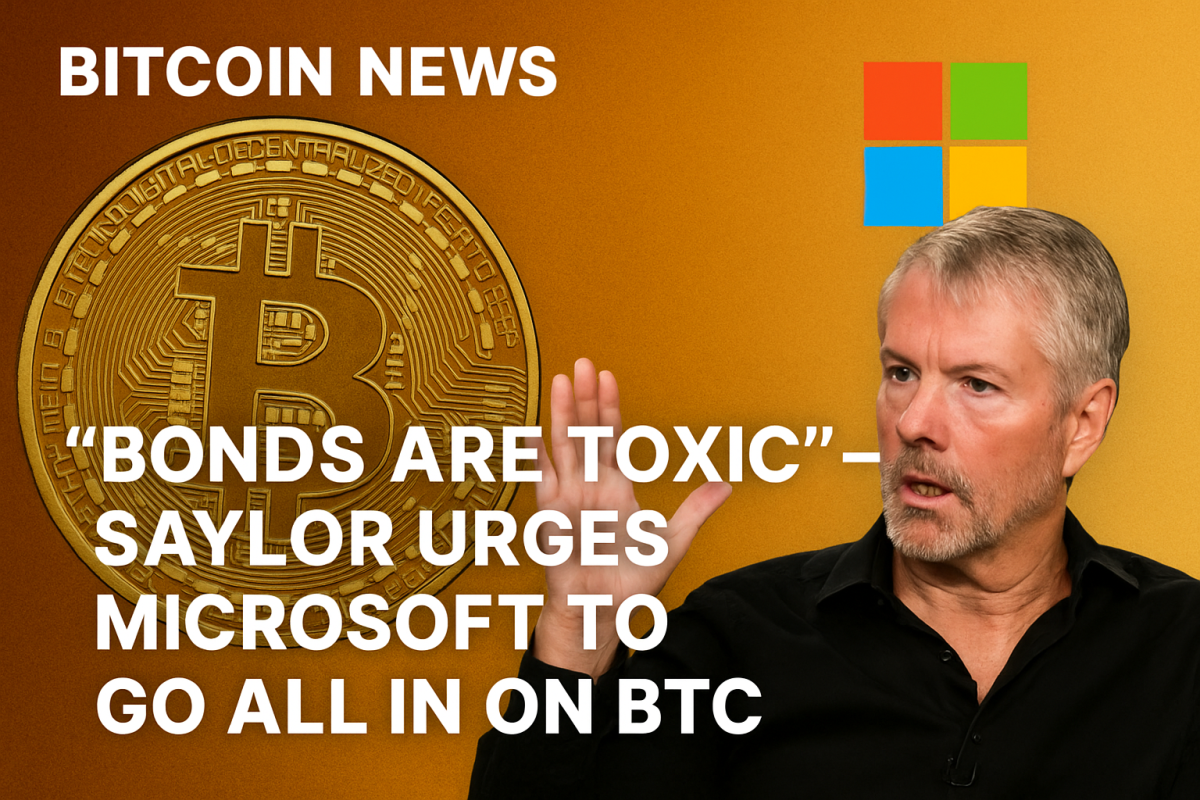
  • Bitcoin-News: Michael Saylor pushes Microsoft into a Bitcoin engagement-“bonds are toxic”

    Bitcoin-News: Michael Saylor pushes Microsoft into a Bitcoin engagement-“bonds are toxic”


    • Michael Saylor urgently advises Microsoft to rethink his financial strategy and an investment of $ 75 billion in Bitcoin.
    • He claims that only 4 % of the listed companies are really capable of creating real market value, and Bitcoin is therefore the best value.

    On the Meet „Bitcoin for the Corporations 2025“Michael Saylor criticized Microsoft’s financial strategy and urged the tech giant to Bitcoin worth $ 75 billion.

    In his opinion, traditional financial methods such as stock returns and keeping bonds are gradually losing their influence. Saylor called the increasing costs for inflation, taxes and regulation as the main factors that the traditional assets weaken, which he now describes as “toxic”

    Saylor cited the data that describes the situation that only a small group of stock corporations, about 4 %, the “Magnificent 7”, contribute to the market value of the sector, while most companies generate the same profit.

    In addition, he warned the companies that stake in outdated models that they will be the last in competition, and he spoke positively about Bitcoin as the best long -term investment to maintain assets.

    In addition, he mentioned that some financial decisions that Microsoft has made in the past did not like him and therefore advised the company to change, including some risky steps.

    Bitcoin as the best investment

    Saylor explained to the audience step by step The differences between Bitcoin and other assets such as gold, real estate and stock returns from companies.

    He claimed that conventional investments are devalued by inflation while Bitcoin Because of its incelasticity, decentralization, unchangeability and ability to survive in the long termthe only currency in the worldthe future of financial system and the has become digital gold.

    When describing the historical returns, he named Bitcoin as an example of constant outperformance not only compared to the S&P 500, but even to the well-known tech giants.

    In addition, Saylor showed the Role of the AI in the economy and pointed out that die most New startups will not survive the competition, which has become even stronger despite the hype. He also warned that conventional companies that use AI without the protection that Bitcoin offers could be faced with increasing complexity and regulatory problems.

    Is made a comparison to his company Microstrategy and as it developed from a “zombie company”, as he called it, into a global market leader in Bitcoin participations.

    In this phase he stated that the company had to make a difficult decision: Either with the to continue familiar but declining strategies or Change the course quickly towards innovation. In his opinion, the decision for Bitcoin has not only saved the companyrather also developed new financial potential.

    Capital escape in digital assets accelerates

    One of the segments that Saylor explained was how the assets of companies through Inflation and taxesis consumed. He made a comparison between Real estate (whose value can disappear due to the property tax and the maintenance costs) and gold (which is a challenge in storage and transport) with Bitcoin, which he described as invisible, immortal and free of physical restrictions.

    He pointed out that the flow of capital more and more in the direction of digital assets and found that Bitcoin was the best way to do money so protect that even the most traditional investment hazards are not recognized.

    Saylor came to the conclusion that those companies that get involved early on this step will have the upper hand in the coming decade.