Tag: MiCA regulation

  • Hester Peirce Departs SEC: What Her Exit Means for Crypto Custody in Germany

    Hester Peirce Departs SEC: What Her Exit Means for Crypto Custody in Germany

    Key Highlights

    • SEC Commissioner Hester Peirce, known as “Crypto Mom,” departs October 2, 2026, leaving a two-member commission (Chair Paul Atkins and Mark Uyeda) with no nominee yet named for the vacant seat.
    • For investors in Germany, European law—specifically MiCA and the AMLR—governs crypto access, custody, and taxation; SEC staffing changes do not alter rights or obligations under EU regulation.
    • From July 10, 2027, EU-regulated providers must delist anonymity-enhanced assets such as Monero and Zcash under AMLR Article 79, though self-custody remains legal; holders should prepare withdrawal or sale strategies now.

    Peirce Departs SEC; Commission Reduced to Two Members

    U.S. Securities and Exchange Commission Commissioner Hester Peirce announced her resignation on September 25, 2026, with a final working day of October 2, 2026. In a farewell letter published on the platform X, she thanked the President for the opportunity to hold the office and said she expected the agency to continue striking a balance between regulation and individual freedom of choice. Peirce has served on the commission since January 2018; her second five-year term expired in June 2025, but she remained in office under a holdover provision that permits a commissioner to serve until a successor is confirmed. Since February 2025 she led the SEC’s Crypto Task Force, the working group shaping U.S. digital-asset classification. Following her departure, she will join the law faculty at Regent University in Virginia in November.

    Peirce earned the industry nickname Crypto Mom for repeatedly voting against enforcement actions targeting crypto projects and for defending the right to self-custody. Her exit leaves the commission with two members: Chair Paul Atkins and Commissioner Mark Uyeda. SEC rules of procedure allow two members to form a quorum when the commission is understaffed, so operations continue. However, the White House has not yet nominated a candidate for the vacant seat, and Senate confirmation typically takes six to twelve months, meaning the third seat could remain empty well into 2027. A two-member bench makes contested rulemakings more vulnerable to legal challenge, as opponents can more easily argue the absence of a robust majority. The Crypto Task Force is expected to continue its work, though without the commissioner who built it; whether the agency maintains its current stance on custody, token classification, and exemptions will only become clear in forthcoming decisions.

    European Rulebook Governs German Investors, Not SEC Staffing

    For anyone buying crypto in Germany through an exchange or broker, the applicable framework is European, not American. The Markets in Crypto-Assets Regulation (MiCA) became fully applicable across the European Union on July 1, 2026, ending all transition periods. Every provider serving EU clients must now hold authorisation as a crypto-asset service provider (CASP). The European Securities and Markets Authority (ESMA) publicly called on unlicensed providers in June 2026 to wind down their EU operations in an orderly manner.

    This creates a clear allocation of responsibility: complaints about a platform authorised in Germany go to BaFin; claims over loss of client funds fall under MiCA and German law; SEC decisions do not interrupt that chain. Investors verifying whether their platform operates within the EU perimeter should consult the public registers of competent authorities rather than follow personnel news from Washington. A provider absent from the register may not serve EU clients, and no European supervisor stands behind it in a dispute.

    AMLR Article 79: Anonymity-Enhanced Assets Face July 2027 Deadline

    What Article 79 Prohibits Providers From Doing

    The concrete rule change for European investors is already published in the Official Journal and is unrelated to the SEC. Regulation (EU) 2024/1624, adopted May 31, 2024, applies from July 10, 2027. Its Article 79 prohibits credit institutions, financial institutions, and crypto-asset service providers from maintaining anonymous accounts. Expressly covered are accounts for crypto-assets that permit the anonymisation of transactions, as well as dealing in coins whose purpose is to obscure payment flows. In practice, regulated trading venues in the EU will have to remove assets such as Monero (XMR) and Zcash (ZEC) from their offerings by that deadline.

    Why Your Own Wallet Is Not Covered

    The regulation addresses obliged entities—banks, financial institutions, and service providers. It does not forbid private individuals from holding such coins in a wallet of their own or sending them directly to another wallet. Self-custody means you hold the private keys yourself and no service provider keeps them for you. What changes in 2027 is the on- and off-ramp: deposits, withdrawals, and exchanges run through providers, and those are precisely the parties that are bound. Anyone holding assets from this group therefore has a time frame and two routes: move into self-custody while withdrawals are still open, or sell within the regulated offering. Both require preparation.

    US Spot ETFs vs. European ETPs: Access Routes for German Investors

    This is where U.S. regulation becomes tangible for German retail investors, and in a direction often misunderstood. Spot crypto ETFs authorised in the United States are generally not tradable for retail investors in Germany through German brokers because they lack the European investor information documents required under the Prospectus Regulation and MiFID II. The European route runs through exchange-traded products (ETPs) or exchange-traded notes (ETNs)—securities that track the price of a crypto-asset and are in many cases physically backed. For tax purposes these products are not the same as owning coins directly. How a crypto ETP is treated depends on its structure; the one-year holding period from income tax law applies to crypto-assets held directly. That classification should be settled before purchase, not at tax-return time.

    Holding Period and Records: Moving to Self-Custody Is Not a Disposal

    A transfer from an exchange to your own wallet is not a disposal. Under common practice the original acquisition date is preserved, so the one-year holding period under Section 23 of the German Income Tax Act (EStG) continues to run and does not restart. A profit realised within one year of acquisition is taxable; after one year it remains tax-free. Since 2024, an exemption limit of €1,000 per calendar year applies to gains within the period, and the limit falls away entirely once exceeded.

    Documentation is critical. Since January 1, 2026, crypto-asset service providers have been reporting transaction and personal data to tax authorities; the first transmission for the 2026 tax year occurs in 2027. The tax office will see movements whose tax classification you must justify. Document acquisition dates and transfers without gaps so that, in case of doubt, you argue with paperwork rather than memory.

    Hardware Wallet and Seed Phrase: Three Checks Before the Move

    Self-custody shifts risk: no service provider can freeze your coins, and nobody but you can recover them. A seed phrase is the sequence of words from which all private keys of a wallet can be restored; whoever has it has the coins. The move into your own custody is a transfer between your wallets and not a sale. Three steps belong before the first large transfer:

    1. Backup the word sequence on paper or metal—never as a photo, a cloud note, or in a browser-linked password manager.
    2. Test with a small amount: send a nominal sum, restore the wallet from the backup on a second device, send the amount back. Only then move the full balance.
    3. Verify what your device displays before approving any transaction; a signature whose content you cannot read is a blank cheque.

    A device is no substitute for care. The most common losses stem not from broken encryption but from lost backups and from approvals the owner granted themselves.

    Market Snapshot (September 26, 2026, 21:48 UTC)

    At the time of analysis, Bitcoin traded at $84,146 (CoinGecko), up 0.39% on the day and 3.31% over seven days. Zcash stood at $1,675.92 (+9.31% daily), and Monero at $555.71 (+0.57% daily). On the upside, the $87,000 level marks where the early-week rally failed before price fell back below $84,000 according to September 26 reports. On the downside, the area around $84,000 marks the zone that has only just given way. Both are reference points from price history, not forecasts. Price targets cited in analyses belong to the person or house voicing them, not to the market. For the regulatory questions at hand, the price situation is secondary: the July 2027 deadline is fixed regardless, and holding periods run on calendar days, not prices.

    Why This Matters

    The departure of a single U.S. regulator—however prominent—does not rewrite the legal framework governing crypto investors in Germany. The European Union has established a comprehensive, binding regime through MiCA and the Anti-Money Laundering Regulation (AMLR) that determines which assets may be offered, which providers may operate, and how client assets are protected. The July 10, 2027 AMLR deadline for anonymity-enhanced assets is a hard regulatory milestone that will reshape the product range on every EU-licensed venue, irrespective of SEC leadership. Meanwhile, U.S. spot ETFs remain structurally inaccessible to EU retail investors, directing demand toward physically backed ETPs with distinct tax treatment. For German investors, the actionable priorities are clear: verify provider authorisation via BaFin or home-state registers, prepare for the delisting of Monero and Zcash by moving to self-custody or selling before July 2027, and maintain rigorous acquisition records ahead of the first automated tax-data transmission in 2027.

    Frequently Asked Questions

    Does Hester Peirce’s resignation change what crypto I can buy or hold in Germany?

    No. Your rights and obligations are set by European and German law—MiCA, the AMLR, and the German Income Tax Act—not by the staffing of the U.S. SEC. The assets available on EU-licensed platforms, the rules for self-custody, and the tax treatment of gains are unaffected by SEC personnel changes.

    Will I still be able to hold Monero (XMR) and Zcash (ZEC) after July 10, 2027?

    Yes, in self-custody. AMLR Article 79 prohibits EU-regulated providers (exchanges, custodians, brokers) from offering or facilitating transactions in anonymity-enhanced assets. It does not prohibit private individuals from holding, sending, or receiving those assets in their own wallets. However, after July 10, 2027, you will not be able to deposit or withdraw them through any EU-licensed service provider.

    Does moving crypto from an exchange to my own hardware wallet reset the one-year tax-free holding period?

    No. Under prevailing German tax practice, a transfer to self-custody is not a disposal. The original acquisition date is preserved, so the one-year holding period under §23 EStG continues uninterrupted. Ensure you document the transfer and retain records of the original purchase to substantiate the holding period if questioned by tax authorities.

  • EU faces September 30 deadline to decide future of DeFi loans

    EU faces September 30 deadline to decide future of DeFi loans

    Key Highlights

    • The European Banking Authority has asked the European Commission to examine new MiCA rules for crypto firms that connect customers to DeFi lending protocols, recommending a cost-benefit analysis of potential duties for intermediated borrowing and lending.
    • The EBA identified two possible regulatory changes: adding intermediated crypto borrowing and lending to MiCA’s list of CASP services, and setting requirements for CASPs facilitating access to DeFi lending through interfaces or products.
    • The Commission’s targeted consultation closes on September 30, 2024, and may accompany its report with a legislative proposal if warranted, though no new rules are currently enacted.

    EBA Urges Commission Review of MiCA Rules for DeFi Access Points

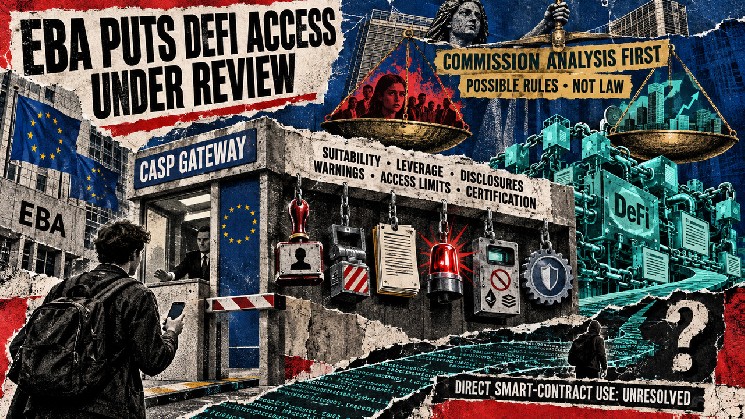
    The European Banking Authority (EBA) has formally requested that the European Commission examine potential new rules under the Markets in Crypto-Assets (MiCA) regulation targeting crypto-asset service providers (CASPs) that connect customers to decentralized finance (DeFi) lending protocols. In its September 24 response to the Commission’s consultation, the regulator called for a cost-benefit analysis of possible duties for intermediated borrowing and lending, specifically focusing on CASPs that give clients access to DeFi lending through interfaces or product offerings. The EBA emphasized that consumer risks—including incomplete information about fees, yields, collateral changes, leverage amplifying losses, and risks from commingling, outages, hacks, and poor recordkeeping—prompted its call to assess the issue.

    Mapping CASP Roles in DeFi Lending

    The EBA’s review maps potential CASP roles in DeFi lending while noting that direct smart-contract use remains unresolved. The authority identified two distinct regulatory pathways for the Commission’s consideration. The first would add intermediating crypto borrowing and lending to MiCA’s existing list of CASP services. The second would establish specific requirements for CASPs that facilitate access to DeFi lending protocols, whether through a user interface or a product providing exposure to DeFi yields. The Commission would need to weigh the scale of these activities, the extent of retail participation, and the materiality of risks before deciding whether to pursue legislation.

    Proposed Safeguards and Access Restrictions

    Among the six DeFi lending safeguards proposed for Commission analysis, the EBA suggested suitability tests to assess whether a customer should participate, leverage caps, and fuller disclosures to address borrowing risks. For DeFi access specifically, the regulator floated extra warnings that activity through a truly decentralized protocol may lack regulatory safeguards, as well as certification of lending protocols for resilience to cyberattacks. A separate option concerns tokens whose issuers lack required MiCA authorization: the EBA said CASPs could be prohibited from intermediating or facilitating borrowing and lending involving assets that meet MiCA’s definition of an asset-referenced or e-money token but have no authorized issuer.

    Why This Matters

    The EBA’s recommendations signal a potential regulatory boundary forming around the “front-end” access points to DeFi—wallets, apps, and structured products that bridge retail users to on-chain lending protocols like Aave. While the underlying protocols continue to execute loans autonomously via smart contracts, the firms controlling the user-facing layer could face new suitability checks, disclosure requirements, and leverage restrictions. The distinction between an interface providing protocol access, a service intermediating a loan, and a product offering DeFi exposure will be critical: any future measure must translate these categories into clear obligations for firms and customers. The Commission’s consultation closes on September 30, 2024, at 11:59 p.m. Central European Summer Time, and its subsequent report—potentially accompanied by a legislative proposal—will determine whether these proposals advance into binding law. Until then, the current MiCA framework remains unchanged for DeFi lending access.

    Frequently Asked Questions

    Does the EBA’s response create any new rules for DeFi lending today?

    No. The EBA’s response is a recommendation to the European Commission to examine potential legislation. It does not enact any new lending rules or change current MiCA requirements. The Commission must still conduct its analysis, weigh the scale and risks of intermediated DeFi access, and decide whether to pursue a legislative proposal.

    How would the proposed rules affect direct smart-contract interaction with DeFi protocols?

    The EBA’s review explicitly notes that direct smart-contract use remains unresolved. The proposals target CASPs that facilitate access through interfaces or products—not users interacting directly with protocol smart contracts. Future lawmakers would still need to define the scope of “facilitating access” and decide how to treat direct on-chain interaction.

    What specific consumer risks did the EBA cite to justify its recommendations?

    The EBA highlighted incomplete information about fees, yields, and collateral requirement changes; leverage amplifying losses; risks from commingling, outages, hacks, and poor recordkeeping; absence of creditworthiness checks; and possible over-indebtedness as the key consumer harms driving its call for regulatory examination.

  • ECB Plans to Buy Tokenized Bonds with Its Own Funds

    ECB Plans to Buy Tokenized Bonds with Its Own Funds

    Key Highlights

    • The European Central Bank (ECB) plans to allocate a small portion of its reserves to tokenized securities, establishing direct exposure to blockchain-based financial markets.
    • Transactions will settle via Pontes, a new Eurosystem platform that connects the ECB’s payment infrastructure to blockchain networks using central bank money.
    • ECB Executive Board member Piero Cipollone emphasized that Pontes brings “the stability and trust of central bank money to the European tokenized finance ecosystem.”

    ECB Takes Strategic Step Into Tokenized Securities

    The European Central Bank has announced plans to invest a modest share of its foreign reserves in tokenized securities, marking a significant institutional endorsement of blockchain-based financial infrastructure. The initiative positions the ECB as an active participant rather than a mere observer in the evolving digital asset landscape, allowing it to gain firsthand operational experience with the technology’s potential for wholesale financial markets.

    Pontes Platform Bridges Central Bank Money and Blockchain Markets

    Central to the strategy is Pontes, a newly launched Eurosystem platform designed to settle wholesale transactions in central bank money. The platform functions as a bridge between the ECB’s existing payment system and blockchain-based financial markets, enabling the secure transfer of tokenized assets against central bank liabilities. This architecture addresses a critical gap in the current digital asset ecosystem: the ability to settle tokenized securities with the same finality and risk profile as traditional central bank money settlements.

    “Pontes brings the stability and trust of central bank money to the European tokenized finance ecosystem,” said Piero Cipollone, member of the ECB’s executive board. “It will give an important advantage to help it scale.”

    Initial Investment Focus on Euro-Denominated Government Securities

    The ECB’s initial foray will concentrate exclusively on euro-denominated securities issued by euro-area governments, regional authorities, agencies, and European supranational institutions. This conservative scope reflects the central bank’s mandate to maintain financial stability while exploring innovation. By limiting purchases to high-quality public sector issuers, the ECB minimizes credit risk while testing the end-to-end workflow of tokenized bond acquisition, settlement, and ongoing portfolio management.

    Testing Technology Across Full Investment Lifecycle

    Beyond the initial purchase, the ECB intends to evaluate the technology across the complete investment lifecycle. This includes assessing how tokenized bonds perform in secondary market trading, corporate actions processing, coupon payments, and redemption events—all settled through the Pontes infrastructure. The exercise serves as a practical stress test for the Eurosystem’s readiness to integrate distributed ledger technology into core central banking operations without compromising monetary policy implementation or financial stability.

    Why This Matters

    The ECB’s move signals a broader strategic shift among major central banks toward operational engagement with tokenization. While many monetary authorities have conducted proofs-of-concept or pilot projects, the decision to commit actual reserves—however small—represents a tangible step toward mainstreaming blockchain-based settlement for wholesale finance. The Pontes platform specifically addresses the “settlement finality” challenge that has hindered institutional adoption of tokenized assets, offering a model where central bank money anchors the transaction. As the European Union advances its Markets in Crypto-Assets (MiCA) regulation and explores a digital euro, the ECB’s hands-on experience with tokenized government securities will likely inform future policy frameworks for digital asset markets and central bank digital currency interoperability.

    Frequently Asked Questions

    What is the Pontes platform?

    Pontes is a new Eurosystem platform that enables wholesale transactions in tokenized securities to settle in central bank money. It connects the ECB’s traditional payment infrastructure with blockchain-based financial markets, providing settlement finality equivalent to existing central bank systems.

    What types of tokenized securities will the ECB purchase?

    The ECB’s initial investments will focus exclusively on euro-denominated securities issued by euro-area governments, regional authorities, agencies, and European supranational institutions.

    Why is the ECB investing in tokenized securities now?

    The ECB aims to test the technology as an active investor—from purchase through settlement to portfolio management—gaining operational insight into blockchain-based markets while supporting the scaling of the European tokenized finance ecosystem with the stability of central bank money.

  • Binance’s MiCA Application Stalls as ECB President Pushes Digital Euro ‘fit for future’

    Binance’s MiCA Application Stalls as ECB President Pushes Digital Euro ‘fit for future’

    Key Highlights

    • ECB President Christine Lagarde personally intervened to halt Binance’s MiCA license approval in Greece, according to a Wall Street Journal report.
    • The intervention was reportedly motivated by concerns that Binance’s stablecoin operations could undermine the ECB’s Digital Euro project, slated for a 2027 pilot and 2029 launch.
    • Binance withdrew its Greek application in mid-June 2026 and plans to reapply in another jurisdiction, likely France, though the timeline remains uncertain pending ESMA’s assumption of sole regulatory authority in 2027.

    ECB Intervention Halts Binance MiCA License Process in Greece

    Binance’s bid to secure a Markets in Crypto-Assets (MiCA) license within the European Union has hit a significant political roadblock. According to a report by The Wall Street Journal, European Central Bank President Christine Lagarde directly intervened to stop the approval process underway with Greece’s regulator, the Hellenic Capital Market Commission (HCMC). The report alleges that Lagarde ordered Greek authorities to pause Binance’s application, citing a strategic imperative to protect the ECB’s flagship Digital Euro project. The central bank digital currency (CBDC) is currently scheduled for a test pilot beginning in mid-2027, with a full launch targeted for 2029.

    Stablecoin Competition and the Digital Euro Vision

    The WSJ report indicates that Lagarde’s opposition stems from a fear that crypto exchanges like Binance are accelerating the adoption of USD-denominated stablecoins, a dynamic the ECB believes could erode the future relevance and monetary sovereignty of the Digital Euro. The source claims Lagarde explicitly stated she “wants the Digital Euro to be fit for the future” and raised specific concerns regarding the proliferation of dollar-backed stablecoins. This suggests the regulatory friction is less about Binance’s specific compliance posture and more about a broader policy conflict between private sector stablecoin dominance and public sector CBDC rollout.

    Regulatory Timeline and the ESMA Factor

    The political pressure forced Binance to withdraw its initial HCMC application in mid-June 2026, shortly after MiCA’s transitional period concluded on July 1, 2026. While Binance’s 2023 guilty plea in the United States for money laundering and sanctions violations was noted as a contributing factor in the report, the primary driver for the blockade appears to be the ECB’s strategic timeline. Currently, MiCA licensing is managed by national competent authorities with coordination from the European Securities and Markets Authority (ESMA). However, from 2027 onward, ESMA will assume sole direct supervisory authority over crypto-asset service providers across the bloc. The WSJ report suggests there was a concerted push to delay Binance’s approval until this centralized ESMA oversight regime takes full effect.

    Industry Reaction: Concerns Over Regulatory Fairness

    The alleged intervention has drawn sharp criticism from Binance and independent observers. A Binance spokesperson condemned the reported actions, arguing that MiCA approval should not be “A process where applicants can be privately undermined through informal channels.” The exchange maintains it met all key regulatory requirements and has stated its intention to reapply for a license in another European jurisdiction, with France widely speculated as the next target. However, whether a new application can be processed and approved before ESMA assumes sole authority in 2027 remains an open question.

    Market analysts have echoed the exchange’s concerns, questioning whether the EU can apply its landmark crypto framework consistently and fairly if political directives from the central bank can override national regulatory assessments. Separately, Binance founder Changpeng Zhao (CZ) publicly questioned why traditional banks appear apprehensive toward crypto and blockchain technology, framing the episode as a defensive move by incumbent financial infrastructure.

    Why This Matters

    The standoff between the ECB and Binance highlights a fundamental tension at the heart of European digital asset regulation: the competition between private stablecoins and sovereign central bank digital currencies. MiCA was designed to create a harmonized rulebook providing legal certainty for crypto businesses operating in the EU. If the framework’s implementation can be suspended by executive political intervention to favor a pending CBDC, it undermines the credibility of the regulatory regime and creates significant precedent risk for other global firms seeking EU authorization. The transition to ESMA as the sole supervisor in 2027 adds a layer of uncertainty; firms must now calculate whether applying under the current national regime is viable, or if they should wait for the centralized supervisor, potentially facing a de facto moratorium driven by CBDC protectionism.

    Frequently Asked Questions

    Did Binance fail to meet MiCA’s technical requirements for the license?

    According to the Wall Street Journal report, the license hiccup was not because Binance failed to meet key MiCA requirements. The withdrawal was forced by political intervention from the ECB President, who reportedly ordered Greece to stop the approval process to protect the Digital Euro project from stablecoin competition.

    When will ESMA become the sole crypto regulator in the EU?

    ESMA is scheduled to assume sole direct supervisory authority over crypto-asset service providers across the European Union starting in 2027. Until then, licensing and enforcement remain the responsibility of national competent authorities like Greece’s HCMC, with ESMA acting in an oversight and coordination capacity.

    Where will Binance apply next for a MiCA license?

    Binance has stated it intends to reapply for a MiCA license in another European country. Market speculation and the WSJ report suggest France is the most likely jurisdiction for the next application, though the company has not officially confirmed the specific venue or a definitive timeline for submission.

  • Deutsche Bank Launches Bitcoin Custody Service as BTC Trades at $75,500

    Deutsche Bank Launches Bitcoin Custody Service as BTC Trades at $75,500

    Key Highlights

    • Deutsche Bank will launch institutional crypto custody for Bitcoin, Ether, and select stablecoins in Europe before year-end under the EU’s MiCA regime, pending a BaFin licence expected in October.
    • The bank will manage private keys in-house using hardware-based protection, multi-person approvals, and segregated warm and cold storage, targeting corporates, asset managers, hedge funds, and sovereign institutions.
    • Germany’s largest lender enters a competitive European custody landscape already served by Standard Chartered, BBVA, DZ Bank, and Landesbank Baden-Württemberg, but brings globally systemically important bank (G-SIB) scale and existing client relationships.

    Deutsche Bank Commits to Regulated Crypto Custody Under MiCA

    Germany’s largest bank confirmed Wednesday it will begin safeguarding bitcoin and ether for institutional clients in Europe before the end of 2025, marking the most significant entry yet by a globally systemically important bank into regulated digital-asset custody. The announcement, made a day after the U.S. Senate failed to advance the Clarity Act, underscores a divergent regulatory path: while U.S. market-structure legislation stalls, Deutsche Bank is moving forward under the European Union’s Markets in Crypto-Assets (MiCA) framework.

    Gerald Podobnik, co-head of Deutsche Bank’s corporate bank, framed the move as complementary rather than disruptive. “digital assets are not a replacement for the traditional financial system but an important complement to it,” Podobnik said in a statement. “We see them as new rails that can coexist with existing market infrastructures while benefiting from the trust, security and safeguards that regulated financial institutions provide.” He added, “Our aim is to offer clients a secure and regulated gateway to this evolving market.” A bank spokesperson told Cointelegraph the firm expects to receive its MiCA custody licence from Germany’s BaFin in October. Bitcoin traded at $75,547 Wednesday afternoon, little changed over 24 hours, according to CoinGecko.

    Asset Scope and Technical Architecture

    At launch, the service will cover “a selected range of digital assets, including Bitcoin and Ether, as well as selected stable coins or e-money tokens, including USDC and EURC, EURAU,” the bank said. Circle issues USDC and EURC. EURAU is the euro-denominated stablecoin of AllUnity, a joint venture between Galaxy, Flow Traders, and DWS—the asset manager majority-owned by Deutsche Bank—which received a BaFin e-money licence in July 2025. “Tokenized financial instruments are also included in the roadmap,” the release added.

    The first clients will be corporates, asset managers, hedge funds, custodians, brokers, and sovereign institutions served by the corporate and investment banks. Critically, Deutsche Bank will manage the wallets and private keys itself, with keys secured behind hardware-based protection, multi-person approvals, and separate warm and cold storage. For Ido Sofer, founder and chief executive of key-management firm Sodot, that in-house approach signals strategic intent. “When you hear a bank is launching their own custody solution and they’re hiring blockchain engineers and so on, that means that they’re saying, okay, I want to go all in. I want to have those in-house capabilities and I want this as a business line,” Sofer said on the On The Margin podcast in April. “It really shifted from this is an experiment to this is a growth vector in the business line.”

    Three-Year Build and Competitive Landscape

    Deutsche Bank applied to BaFin for a digital-asset custody licence in June 2023 and named Swiss technology provider Taurus as its partner that September. In July 2025, Bloomberg reported the bank was targeting a 2026 launch and had engaged Bitpanda’s technology unit alongside Taurus. Wednesday’s release names neither firm, stating only that the service “will use selected external technology and infrastructure providers for defined technical components.”

    The bank arrives late to its immediate neighbourhood. Landesbank Baden-Württemberg announced institutional custody with Bitpanda in 2024; DZ Bank’s meinKrypto platform received MiCA authorisation in December 2025; and Standard Chartered and BBVA already operate regulated custody in Europe, as CoinDesk noted. What Deutsche Bank brings is scale: it is one of the banks the Financial Stability Board classifies as globally systemically important, and its clients have been asking who should hold the keys since a wave of exchange hacks last summer.

    Why This Matters

    Deutsche Bank’s entry signals a maturation of institutional crypto infrastructure in Europe. By operating under MiCA—the world’s first comprehensive crypto-asset regulatory regime—the bank offers a regulated alternative to offshore or unlicensed custodians, addressing a primary barrier for pension funds, insurers, and sovereign wealth funds. The decision to retain private keys in-house, rather than outsourcing to a specialist like Fireblocks or Copper, reflects a business logic older than blockchain: a custodian that controls the keys controls the client relationship and the cross-sell opportunities that follow. As Sofer noted, “It’s gonna be hard for you to leave.”

    However, the release carries a blunt risk disclosure: “Digital assets involve material risks, including price volatility, fraud, cyber incidents and failures of market participants,” it says. “Crypto-assets are not covered by a deposit-guarantee scheme comparable to the protection applicable to eligible bank deposits.” That trade-off—regulated custodial controls without deposit insurance—is the core proposition. Michael Tanguma, co-founder and chief executive of bitcoin custody firm Onramp, argues the market has already accepted it. “Nobody would tell an individual to take all their gold out of the bank and park it underneath their mattress,” Tanguma said in an August interview. “It’s a misnomer and fallacy to say that self custody is the only way.”

    Podobnik left the door open on scope: “The service will be further developed in line with client demand, regulatory requirements and the bank’s risk appetite,” he said. The release adds that timing, geography, and the asset list “may change as a result of regulatory requirements, internal approvals, market developments or client demand.” Sofer’s read is that such hedging is standard boilerplate once a G-SIB commits. “When a bank does something, this is for like five, 10 years, right?” he said. “They don’t say, well, let’s do this for a couple of quarters and re-evaluate.”

    Frequently Asked Questions

    Which digital assets will Deutsche Bank custody at launch?

    The bank will hold Bitcoin, Ether, and select stablecoins or e-money tokens including USDC, EURC, and EURAU. Tokenized financial instruments are on the roadmap for future inclusion.

    How does Deutsche Bank’s custody model differ from specialist crypto custodians?

    Deutsche Bank will manage wallets and private keys entirely in-house using hardware-based protection, multi-person approvals, and segregated warm and cold storage, rather than relying on third-party key-management providers. The bank argues this integrates the trust and safeguards of a regulated G-SIB with new digital-asset rails.

    Are crypto assets held by Deutsche Bank covered by deposit insurance?

    No. The bank explicitly warns that crypto-assets are not covered by any deposit-guarantee scheme comparable to the protection applicable to eligible bank deposits. Clients assume material risks including price volatility, fraud, cyber incidents, and counterparty failures.

  • Deutsche Bank Bets Big on Digital Assets, Potentially Reshaping European Crypto

    Deutsche Bank Bets Big on Digital Assets, Potentially Reshaping European Crypto

    Deutsche Bank Prepares Digital Asset Custody Launch for European Institutions

    Deutsche Bank is advancing into digital assets with plans to offer custody services to institutional and corporate clients across Europe later this year. The bank will hold wallets and private keys, enabling clients to safeguard and transfer Bitcoin (BTC), Ether (ETH), USD Coin (USDC), EURC, and EURAU without building their own custody infrastructure.

    Banking Framework for Digital Asset Access

    The service aims to place digital assets within a regulated banking framework, incorporating key protections such as private key storage, wallet control, and transaction approval controls. This approach could provide European institutions an easier entry point into crypto markets through existing banking relationships. While the initial asset list remains limited, tokenized financial instruments are expected to follow at a later stage.

    Regulatory approval remains a prerequisite between the announcement and launch, making the approval process and subsequent adoption critical developments to monitor.

    Regulated Custody Demand Driven by Institutional Allocation Trends

    Institutional interest has shifted beyond simple investment exposure to focus on regulated access mechanisms. According to a 2026 Coinbase-EY survey of over 350 decision-makers, 73% plan to increase allocations to digital assets. Within that study, 81% preferred spot exposure through registered vehicles such as ETFs and ETPs.

    This preference creates strong demand for regulated custody providers. Although hundreds of European-based MiCA-authorized cryptocurrency companies currently operate, very few major banks function as custodians. Deutsche Bank can therefore bridge crypto custody with established banking relationships across Europe, targeting asset managers, hedge funds, brokers, corporations, and sovereign institutions.

    Stablecoins Could Transform Custody into Recurring Settlement Channel

    Stablecoins have the potential to evolve Deutsche Bank’s custody service from a static storage product into an active settlement rail. USDC currently maintains approximately $74 billion in circulation, according to DeFiLlama data, demonstrating deep existing demand.

    EURC provides institutions a euro-denominated alternative within the same custody framework. Together, these stablecoins could support treasury transfers, business payments, and cross-border settlements alongside basic asset storage. If repeated transfers materialize, the activity would generate transaction flows beyond passive custody.

    Tokenized Assets May Extend Financial Rail Functionality

    Future addition of tokenized assets could further expand the service’s utility. Purchases, redemptions, and transfers of tokenized instruments would create additional flow opportunities. Consequently, stablecoins and tokenization combined could position a custody service provider as an active financial rail for institutional clients.

  • CoinEx Exits After 9 Years as Crypto Trading Consolidates at Major Exchanges

    CoinEx Exits After 9 Years as Crypto Trading Consolidates at Major Exchanges

    CoinEx Shuts Down After Nine Years Citing Revenue Decline and Rising Compliance Costs

    Centralized crypto exchange CoinEx announced on September 15 that it will wind down operations in stages after nine years, citing shrinking revenue and escalating compliance costs that have made the business unviable. The shutdown marks another exit of a mid-tier platform from an increasingly concentrated market.

    Phased Shutdown Timeline

    CoinEx has laid out a structured closure plan:

    • Immediate: New user registrations have been halted.
    • Immediate: Futures markets moved to reduce-only mode.
    • Immediate: Margin trading, loans, Earn, and staking products are being phased out.
    • September 29: Spot trading ends.
    • December 22: Withdrawals close permanently.

    The exchange has urged customers to withdraw assets early to avoid congestion as the December deadline approaches, stating that customer assets remain fully backed.

    Founder Explains Decision

    Founder Haipo Yang stated that CoinEx failed to reach the top tier of industry exchanges, leaving the company burdened with security and compliance obligations that became increasingly difficult to justify against declining revenue.

    “Revenues can decline, responsibility does not,” Yang said in a statement. “Carrying unlimited risk for limited revenue is no longer a rational choice.”

    CoinEx also pointed to a prolonged contraction in crypto trading volume and liquidity, alongside rising regulatory requirements across major jurisdictions. In 2023, the exchange settled a case with New York Attorney General Letitia James, agreeing to withdraw from the U.S. market after being accused of operating without registering as a securities and commodities broker-dealer. The settlement required CoinEx to refund more than $1.1 million to 4,691 New York investors and pay over $600,000 in penalties.

    Wave of Mid-Tier Exchange Exits

    CoinEx is not alone. Its shutdown follows similar moves by other long-running platforms:

    • BitMEX, once a dominant derivatives venue, will terminate exchange services on September 23 after more than 11 years. Owner HDR Global Trading cited a strategic review of the company and broader crypto industry.
    • AscendEX ceased normal operations on July 1, citing the EU’s Markets in Crypto-Assets framework (MiCA) alongside financial and operational pressures. A planned recapitalization failed, and the company has been preparing for a possible formal insolvency process.

    While circumstances differ, these exits are removing established venues from a market where trading activity is recovering but concentrating among the largest operators.

    Trading Volume Rebounds but Concentration Deepens

    According to CoinMarketCap data tracking eleven major centralized exchanges, combined spot and derivatives volume reached $4.23 trillion in August, a 12.3% increase from July as crypto prices recovered.

    However, the rebound did little to loosen the grip of the top platforms. Binance, OKX, MEXC, Bybit, and Gate.io accounted for approximately 88% of all trading volume across the cohort. Binance alone captured a record 43.3% market share for a third consecutive month.

    August Volume Breakdown (Top 5 Exchanges)

    • Binance: ~$1.83 trillion
    • OKX: ~$681.3 billion
    • MEXC: ~$469.5 billion
    • Bybit: ~$410.3 billion
    • Gate.io: ~$314.7 billion

    CoinEx was not among the eleven exchanges in CoinMarketCap’s sample, so the figures do not directly measure its market share loss. They do, however, illustrate the environment Yang is leaving: trading revenue is recovering while a small group of platforms captures the overwhelming majority of activity.

    Structural Pressure on Smaller Exchanges

    This concentration creates a difficult equation for exchanges operating further down the rankings. Compliance staffing, licensing, transaction monitoring, custody systems, and cybersecurity remain substantial fixed obligations even when an exchange has a fraction of the volume available to Binance or OKX.

    Significant On-Chain Assets Remain

    Data from Nansen showed approximately $253.6 million across CoinEx-labeled wallets following the shutdown announcement:

    • Bitcoin (BTC): ~$134.4 million (over half the total)
    • USDT and ETH: Combined >$50 million
    • Deployed through Aave: ~$27.6 million

    The balances do not necessarily represent customer liabilities because labeled exchange wallets can include operational funds and other assets. Their size still shows how much capital remains within CoinEx’s on-chain footprint as users move funds elsewhere.

    Liquidity Redistribution Begins September 29

    Once CoinEx switches off spot markets on September 29, its remaining traders, market makers, and token projects will need alternative venues. This will push another pool of crypto liquidity into a market where five exchanges already control nearly 88% of the trading volume measured by CoinMarketCap.

  • Bitcoin Suisse Plans to Cut Up to Half Its Swiss Jobs as Work Shifts Abroad

    Bitcoin Suisse Plans to Cut Up to Half Its Swiss Jobs as Work Shifts Abroad

    Bitcoin Suisse Cuts 60 Jobs in Switzerland, Shifts Development Overseas

    Crypto financial services firm Bitcoin Suisse plans to eliminate up to 60 positions in Switzerland, reducing its domestic workforce by half, as the company moves software development and back-office operations to lower-cost international hubs. The Zug-based firm, which oversees more than $3 billion in digital assets under custody, employs roughly 200 people globally.

    Restructuring Driven by Cost Efficiency

    As part of the reorganization, Bitcoin Suisse is closing its IT development site in Copenhagen. The company already operates a technology hub in Bratislava, Slovakia, and intends to establish another in Vietnam. CEO and co-founder Andrej Majcen explained the rationale to Swiss outlet Finews, which first reported the restructuring:

    “In Bratislava and Vietnam, we can provide these services at significantly lower cost,”

    Majcen emphasized that the decision reflects the company’s international growth strategy and is unrelated to difficult crypto market conditions.

    Expansion Beyond Crypto Services

    Founded in 2013, Bitcoin Suisse offers crypto trading, custody, staking, and lending. According to Majcen, the firm now aims to broaden its scope into wealth and asset management services targeting high-net-worth individuals and institutional clients.

    To support that expansion, the company has begun securing regulatory licenses. Its Liechtenstein subsidiary received authorization in June under the European Union’s Markets in Crypto-Assets (MiCA) framework, enabling it to serve clients across selected European Economic Area markets.

  • UniCredit Weighs Tokenized Products and Crypto Services for Clients, Report Says

    UniCredit Weighs Tokenized Products and Crypto Services for Clients, Report Says

    UniCredit is exploring new digital-asset services, including custody and brokerage, as the Italian lender evaluates building infrastructure to support the sector, Bloomberg reported Friday, citing people familiar with the matter.

    Technology Provider Selection Underway

    The bank is currently selecting a technology provider that would enable it to hold digital assets and facilitate transactions, according to the sources. Potential services remain under discussion, and no final decision has been made.

    Scope of Digital-Asset Offerings

    UniCredit is considering a range of services, including tokenized investment products and fixed-income securities, stablecoin applications for clients, and cryptocurrency exposure. The plans reflect a broader push by European banks into digital assets as the European Union’s Markets in Crypto-Assets (MiCA) regulation provides greater clarity for financial institutions.

    Existing Digital-Asset Initiatives

    UniCredit has so far targeted professional investors and corporations. Earlier this year, the bank offered a structured product tied to BlackRock’s iShares Bitcoin Trust ETF. Late last year, it issued Italy’s first tokenized minibond on a public blockchain. Tokenization refers to issuing and transferring traditional assets using blockchain networks.

    Strategic Partnerships and Investments

    The bank also joined other European lenders in creating Qivalis to develop a euro-denominated stablecoin. This week, UniCredit announced it acquired a minority stake in VC Trade, a German lending markets platform, to expand its digital capital markets capabilities.