Tag: Memecoin

  • CASHCAT Falls 30%, Yet Key Support Level Historically Triggers Rallies

    CASHCAT Falls 30%, Yet Key Support Level Historically Triggers Rallies

    Key Highlights

    • CashCat ($CASHCAT) plummeted roughly 30% in 24 hours as broader cryptocurrency market capital shrinkage triggered a breach of structural horizontal resistance.
    • Price has fallen into the lower support of a rising bullish channel — a level that has historically catalyzed rebounds — while Money Flow Index (MFI) surges to 35.5, signaling capital inflow.
    • Funding Rate remains positive at 0.0078% with net long positioning and spot market net buying, suggesting the drop is sentiment-driven rather than a structural bearish shift.

    CashCat Tests Critical Channel Support After 30% Correction

    CashCat ($CASHCAT) surrendered significant ground over the past 24 hours, declining approximately 30% as a wave of capital contraction swept across the wider cryptocurrency market. According to chart analysis from TradingView, the sell-off accelerated after price broke below a structural horizontal resistance line, pushing the memecoin down to the lower boundary of a broader rising bullish channel. Despite the sharp pullback, the asset remains embedded within an overall bullish pattern defined by oscillation between established upper resistance and lower support levels.

    Historical Support Zone Draws Buying Interest

    The current support level now being tested has acted as a launchpad for rallies on multiple prior occasions. Technical analysts note that price arriving at this zone increases the probability of a rebound, provided the prevailing fractal structure holds. On-chain and derivative metrics reinforce this view: the Money Flow Index (MFI), which tracks capital inflow and market bias, has surged to roughly 35.5. The uptick suggests that as price reached channel support, buy orders were triggered, injecting fresh liquidity into the market even as the broader correction unfolded.

    Bearish Momentum Peaks, But Derivatives Signal Resilience

    Short-term momentum indicators still favor sellers. The Bull Bear Power metric — a gauge of which side controls the market — shows bears dominant, with the red histogram bar printing its deepest level since September 10. However, derivative market structure tells a more nuanced story. Data from CoinGlass reveals the Funding Rate has dipped only marginally, holding at a positive 0.0078%. This reading indicates the majority of open contracts remain long. Simultaneously, spot market netflow has registered net buying, underscoring that the recent price decline stems primarily from sentiment deterioration rather than a fundamental shift in market structure.

    Why This Matters

    CashCat’s price action illustrates a classic memecoin dynamic: violent sentiment-driven corrections within intact longer-term technical frameworks. The convergence of a historically reliable channel support, rising MFI, positive funding rates, and spot accumulation creates a high-probability setup for a relief bounce — provided Bitcoin and the broader risk complex stabilize. Traders and investors should monitor whether the Bull Bear Power histogram begins to contract from its current extreme, which would signal exhausting selling pressure. A reclaim of the breached horizontal resistance would further validate the bullish channel thesis, while a decisive close below channel support would invalidate the pattern and open the door to deeper losses.

    Frequently Asked Questions

    What caused CashCat’s 30% price drop in the last 24 hours?

    The decline was triggered by broad cryptocurrency market capital shrinkage and a breach of a structural horizontal resistance line, pushing price into the support level of a rising bullish channel.

    Does the current technical setup favor a rebound?

    Yes. Price is testing a channel support that has sparked rallies before, MFI is rising at 35.5 showing capital inflow, Funding Rate remains positive at 0.0078% with net long positioning, and spot netflow shows buying — all suggesting the drop is sentiment-driven, not structural.

    What would invalidate the bullish case for CashCat?

    A decisive daily close below the rising channel’s lower support trendline would break the bullish pattern and likely lead to further downside.

  • Visa Tightens Memecoin Card Rules After Digital-Media Classification

    Visa Tightens Memecoin Card Rules After Digital-Media Classification

    Key Highlights

    • Visa is directing payment processors to stop using merchant category code 5815 (digital media) for memecoin purchases and instead apply cryptocurrency-related classifications.
    • JPMorgan Chase flagged at least one Visa transaction for incorrect coding, and the New York Attorney General’s Office is reviewing the issue.
    • The reclassification does not prohibit card-based memecoin purchases but may affect how card rewards are applied to such transactions.

    Visa Cracks Down on Memecoin Transaction Coding

    Visa is moving to tighten how memecoin purchases are classified across its network after scrutiny revealed that some card transactions were being processed under a digital-media merchant category code typically reserved for goods such as movies and audiobooks. The change follows test purchases made through Robinhood Wallet and Fomo using Visa and Mastercard cards via Apple Pay and Google Pay, which were processed by Crossmint and received merchant category code 5815. That code covers digital goods, whereas cryptocurrency purchases traditionally fall under separate merchant codes that determine how card issuers handle transactions, including rewards eligibility and risk controls.

    Issuer and Regulatory Scrutiny Prompts Action

    The misclassification drew immediate pushback from major financial institutions and regulators. JPMorgan Chase challenged the coding of at least one Visa transaction, stating it carried the wrong merchant category code and confirming it had opened a case with Visa. Simultaneously, the New York Attorney General’s Office said it was reviewing the issue. In response, Visa has reportedly instructed payment processors, including Checkout.com, to cease using the digital-media category for memecoin purchases and has given them until next week to update their systems to reflect cryptocurrency-related classifications.

    SEC Guidance Does Not Govern Card Network Rules

    Crossmint had cited a 2025 U.S. Securities and Exchange Commission staff statement on memecoins in connection with the transactions. However, that guidance pertains to securities law classification and does not determine how card networks categorize transactions for processing, rewards, or compliance purposes. Visa’s directive addresses the payment-network layer specifically, ensuring that memecoin purchases are routed through the appropriate merchant codes used for other cryptocurrency transactions.

    Why This Matters

    The reclassification carries practical consequences for consumers and the broader crypto payments ecosystem. Merchant category codes influence whether a transaction qualifies for standard credit card rewards—such as cash back on digital media—or is excluded, as many issuers treat cryptocurrency purchases differently. By aligning memecoin coding with established cryptocurrency categories, Visa closes a loophole that could have allowed purchasers to earn rewards unintended for digital-asset acquisitions. The move also signals that card networks and issuers are actively monitoring the intersection of consumer payments and emerging token types, especially as wallets like Robinhood Wallet and apps like Fomo expand access to memecoins through familiar checkout rails like Apple Pay and Google Pay. Regulatory attention from the New York Attorney General underscores that compliance scrutiny extends beyond securities law into consumer-protection and payment-network integrity.

    Frequently Asked Questions

    Does Visa’s change ban buying memecoins with a credit or debit card?

    No. Visa’s directive does not prohibit card-based memecoin purchases. It requires that such transactions be classified under cryptocurrency-related merchant category codes rather than the digital-media code (5815).

    Will this affect credit card rewards on memecoin purchases?

    Potentially, yes. Many card issuers exclude cryptocurrency-coded transactions from standard rewards programs. Shifting memecoin purchases to crypto merchant codes may cause them to lose eligibility for cash back, points, or miles that might have applied under the digital-media classification.

    What role did the SEC’s 2025 memecoin statement play in this decision?

    The SEC staff statement addresses whether certain memecoins qualify as securities under federal law. It does not govern payment-network merchant category codes. Visa’s action is independent and focused on transaction processing classification, not securities regulation.

  • Standard Chartered Predicts Arbitrum’s ARB Could Surge 70x to $10, Citing Robinhood Chain Revenue

    Standard Chartered Predicts Arbitrum’s ARB Could Surge 70x to $10, Citing Robinhood Chain Revenue

    Arbitrum token holders currently have no direct claim on the revenue generated by Robinhood Chain, a risk factor highlighted by analyst Kendrick in a recent research note. According to a CoinDesk report earlier this month, Robinhood Chain directs 10% of its net protocol revenue into the Arbitrum ecosystem. That allocation splits 8% to the DAO treasury and 2% to a developer fund, with zero flow directly to $ARB token holders at this stage.

    Robinhood Chain Growth Driven by Memecoin Activity

    While Kendrick’s long-term thesis centers on traditional-finance users adopting tokenized assets, Robinhood Chain’s early traction has arrived from a different demographic. Memecoin launchpads and trading applications have supplied much of the network’s initial activity, even though the chain was architected primarily around tokenized stocks and other traditional asset classes.

    Revenue Metrics Show Rapid Scaling

    The financial data underscores the chain’s quick ramp. In July, Robinhood Chain paid approximately $360,000 in licensing fees, accounting for 35% of Arbitrum DAO income for the month. By September 1, the chain was generating $3.75 million in user fees and transmitting roughly $370,000 to Arbitrum over a 24-hour period.

    Tokenization Thesis and Price Targets

    Kendrick projects that $4 trillion of traditional assets will be tokenized by the end of 2028, with Arbitrum positioned to capture an expanding share of the underlying infrastructure. Based on that trajectory, he forecasts the following price targets for $ARB:

    • Year-end 2024: $0.50
    • 2027: $1.50
    • 2028: $3.50
    • 2029: $6.50
    • 2030: $10.00

    The forecast hinges on Arbitrum’s ability to convert its current memecoin-driven volume into sustainable infrastructure revenue as tokenized traditional assets come online.

  • Poloniex Sparks Memecoin Interest with Community Tweet

    Poloniex Sparks Memecoin Interest with Community Tweet

    Poloniex Tweet Sparks Memecoin Speculation Across Crypto Community

    Poloniex has ignited fresh speculation in the cryptocurrency market with a recent tweet hinting at a potential surge in memecoin activity. The post, which has attracted significant engagement across social platforms, has traders and analysts scrutinizing the memecoin sector for the next breakout opportunity.

    Market Context and Community Reaction

    The broader crypto market continues to send mixed signals, with momentum diverging across major assets. Against this backdrop, Poloniex’s commentary on a possible memecoin run has amplified discussions within trading circles. While the exchange did not name a specific token, the community’s enthusiastic response underscores how quickly sentiment can shift when a major platform signals interest in a niche sector.

    This latest signal follows Poloniex’s Mission: Moon campaign, a creative outreach effort built around popular meme culture that has already heightened community interaction. The exchange’s pattern of blending social engagement with market narratives has become a recognizable part of its brand strategy.

    Key Developments for Traders

    • Poloniex’s tweet highlights potential upcoming memecoin activity, triggering heightened trader interest.
    • The post has generated notable engagement, reflecting strong community responsiveness.
    • Speculation is widespread regarding which memecoins may benefit, fueling buzz across trading forums.
    • Increased trading volumes and volatility in the memecoin market are possible outcomes.
    • Poloniex continues to leverage creative campaigns to foster community interaction around emerging trends.

    Token Metrics and Market Sentiment

    Current market conditions reflect cautious optimism. Although Poloniex has not disclosed specific trading volume data, the surge in social media discourse suggests investors are actively evaluating potential memecoin positions. Historically, such conversations often precede measurable market movements, making this a notable moment for participants monitoring early-stage trends.

    As a cryptocurrency exchange offering a wide array of trading pairs — including numerous memecoins — Poloniex operates under relevant financial regulations that guide its operations and outreach. Its history of community-driven campaigns positions it as an influential voice in shaping short-term market narratives.

    Levels and Signals to Monitor

    Traders are closely tracking Poloniex’s subsequent updates and the evolving sentiment across memecoin communities. The excitement generated by the initial tweet could translate into increased trading activity as investors position for potential price swings. Ongoing discussions within the community will likely further refine trading strategies in the near term.

    The interplay between social media trends and trading behavior remains a critical factor to watch over the coming days, particularly for assets driven by narrative momentum rather than fundamental catalysts.

  • MemeToro’s Agent Develops Fair Launch Protocol to Improve Memecoin Investing on BNB Chain in 2026

    MemeToro’s Agent Develops Fair Launch Protocol to Improve Memecoin Investing on BNB Chain in 2026

    Why Fair Launches Matter on BNB Chain

    BNB Chain has emerged as a highly active environment for new token and memecoin launches. The network’s low transaction costs and high speed lower the barrier to entry for creators and traders alike, but these same characteristics can expose retail investors to opaque launch mechanics and hidden insider advantages.

    A fair-launch model addresses this by codifying the rules of a token launch before buyers participate. The objective is to eliminate scenarios where insiders receive undisclosed allocations or where launch parameters can be altered without community knowledge. MemeToro’s approach replaces verbal promises with programmed rules enforced by smart contracts. Its new architecture incorporates an escrow mechanism designed to hold launch funds strictly under predefined conditions.

    The project states its system aims for zero insider allocation. In practical terms, the goal is to prevent a hidden group of insiders from securing a preferential token allocation before public participants. For BNB Chain traders, this structure makes launch conditions significantly easier to audit and verify.

    How the MemeToro AI Agent Fits Into the Process

    The fair-launch protocol operates as a core component of MemeToro’s broader AI Memecoin Agent. The agent is engineered around the end-to-end lifecycle of memecoin creation and launch, combining automated software tooling with immutable blockchain-based rules.

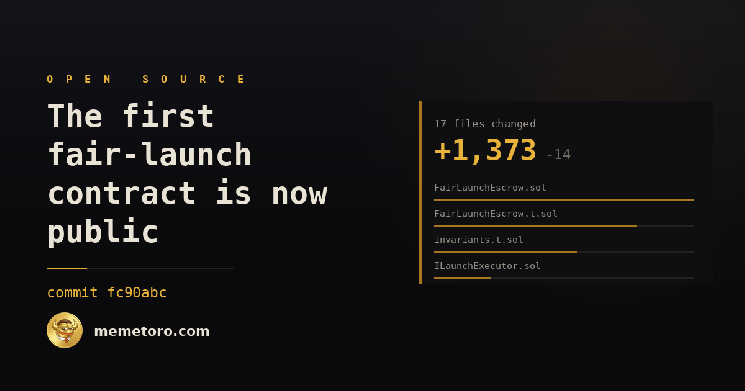
    The latest development update discloses 1,373 additional lines of open-source code. This work encompasses the fair-launch contract, the funding escrow module, and a comprehensive test suite. A critical architectural distinction is that the AI agent is not positioned as a substitute for blockchain-layer security. Rather, software automation handles operational aspects of the launch process while smart contracts enforce the defined ruleset.

    MemeToro says the new fair-launch contract has no owner, admin role, or upgrade path. This design choice is intended to remove the capacity for any single party to modify critical launch parameters post-deployment. However, the current implementation remains a development draft. It requires independent security review and mainnet deployment before traders should consider it production-ready infrastructure.

    How Programmatic Rules Could Improve Investor Trust

    Memecoin investing presents acute information asymmetry for newer traders. Launch decisions—token distribution, team allocations, liquidity handling—are frequently controlled opaquely by project teams. A buyer often cannot verify who holds tokens, whether allocations are mutable, or how funds are managed during the launch event.

    Programmatic rules encoded into smart contracts mitigate this opacity by making system behavior inspectable and verifiable. MemeToro’s model is built on five transparency pillars:

    • Public source code
    • Defined launch conditions
    • Funding escrow
    • No stated insider allocation
    • Automated enforcement

    This framework does not eliminate all risk. Smart contracts may contain vulnerabilities, and even well-designed systems remain subject to post-launch market dynamics. Consequently, the next development phase is critical: an independent audit must examine the production contract before users commit real capital.

    What the Latest Memecoin News Means for Traders

    The prevailing narrative in memecoin news is shifting from pure hype toward infrastructure development. MemeToro’s progress illustrates a targeted attempt to solve a specific structural problem: how to make new token launches more intelligible and trustworthy for retail participants.

    The 1,373-line code milestone provides tangible, measurable evidence of development velocity. Yet code volume alone is not a safety guarantee. Traders must continue to perform due diligence on contract addresses, liquidity depth, token distribution metrics, audit status, and prevailing market conditions before participating in any new memecoin launch.

    If MemeToro successfully transitions the fair-launch protocol from public repository to audited production infrastructure, it could establish itself as a significant primitive in the BNB Chain launch ecosystem. For now, its strongest signal is not a price projection, but the demonstrable effort to encode launch rules into visible, testable, and verifiable software.

    Frequently Asked Questions

    What is MemeToro’s fair-launch protocol?

    It is a planned system that uses smart-contract rules and escrow to make token launches more transparent.

    Why is BNB Chain important?

    BNB Chain supports fast, lower-cost token activity, making it a major environment for memecoin launches.

    Is the new protocol already fully live?

    The latest information describes the new fair-launch code as a development draft that still needs independent review and deployment.

    More Information on MemeToro ($MT) Presale

  • Solana Price Rises for First Time in 10 Months: What’s Next for SOL?

    Solana Price Rises for First Time in 10 Months: What’s Next for SOL?

    Solana (SOL) is showing renewed momentum across multiple key metrics, with August marking the network’s first positive monthly close in nearly a year. The shift coincides with record-breaking growth in real-world asset (RWA) tokenization and continued dominance in memecoin trading volume.

    Technical Breakthrough: First Green Monthly Candle in 10 Months

    After flashing red on the charts for almost a year, Solana finally finished a month in the green in August. The gains were powered by the monthly MACD, which moved close to a bullish crossover at press time. Additionally, SOL‘s monthly Relative Strength Index (RSI) broke a downtrend that had remained intact for nearly two years.

    While this technical improvement signals a potential trend change, analysts caution that SOL remains well below its previous all-time highs. A single green monthly candle does not confirm a full trend reversal, though it provides a foundation for bulls to build upon after months of sustained selling pressure.

    RWA Ecosystem Hits $4.35 Billion All-Time High

    Solana’s real-world asset ecosystem crossed $4.35 billion in total value locked, setting a new all-time high. The number of RWA holders on the network also climbed above 420,000, placing Solana among the market’s largest chains for tokenized assets despite competition from Ethereum (ETH) and other Layer 1 networks targeting the same institutional market.

    Memecoin Volume Dominance: 67% of Multichain DEX Activity

    On September 7, Solana captured approximately 67% of spot decentralized exchange (DEX) memecoin volume across tracked chains. This figure nearly triples Robinhood’s 23% share, while BNB Chain accounted for another 9%.

    Memecoin trading has historically been one of Solana’s strongest drivers of on-chain activity. Sustained dominance in this sector could continue to support transaction demand and liquidity across the broader ecosystem.

    Key Takeaways

    • August 2024: First positive monthly candle for SOL in 10 months.
    • RWA Milestone: $4.35 billion total value locked, 420,000+ holders.
    • Volume Leadership: 67% share of multichain memecoin DEX volume (Sept 7).