Tag: McLaren

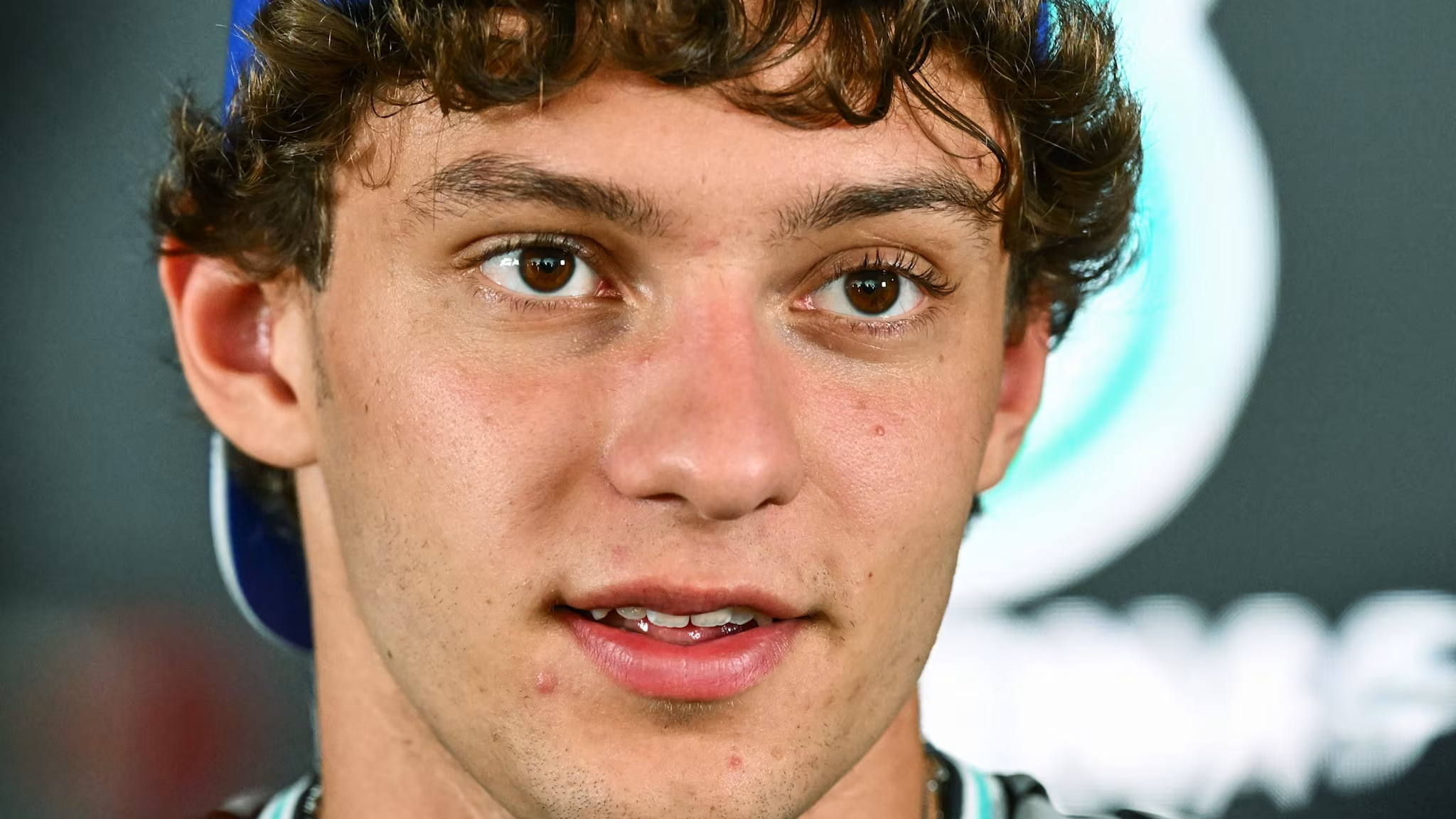
  • ‘Feel like it was a good recovery’ – Kimi Antonelli, Mercedes Reflect on Practice Ahead of 2026 Azerbaijan Grand Prix

    ‘Feel like it was a good recovery’ – Kimi Antonelli, Mercedes Reflect on Practice Ahead of 2026 Azerbaijan Grand Prix

    Key Highlights

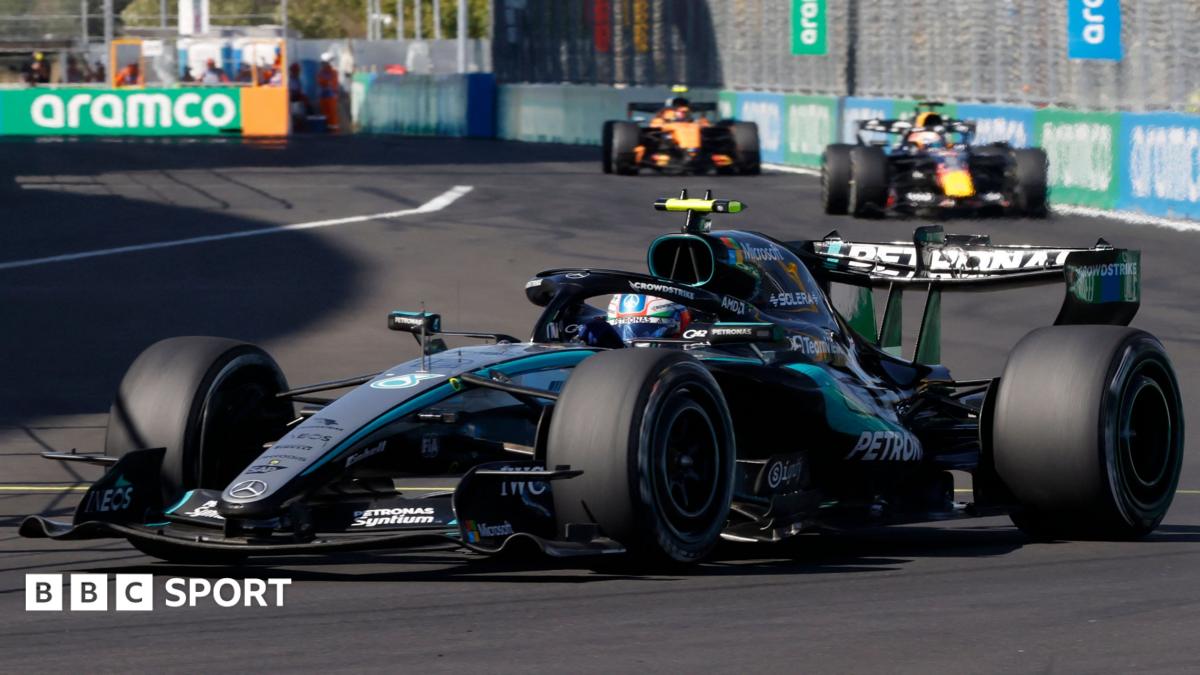
    • Kimi Antonelli describes his Azerbaijan Grand Prix practice as “a good recovery” despite a hydraulic failure in FP1 and a power unit change that cost him half of FP2.
    • The championship leader, holding an 81-point advantage after his Madrid win, still managed fifth in FP1 and second in FP2, while teammate George Russell topped both sessions.
    • Mercedes Deputy Team Principal Bradley Lord warns that rival updates from McLaren and Red Bull will close the performance gap, predicting a much tighter qualifying and race.

    Antonelli Overcomes Mechanical Setbacks to Stay in Contention

    Kimi Antonelli entered the Baku weekend with a commanding 81-point lead in the drivers’ standings following his victory in Madrid, but Thursday’s running presented an immediate test of resilience. The Mercedes driver suffered a hydraulic issue aboard his W15 approaching the midpoint of Free Practice 1, abruptly ending his participation in the one-hour session. The team was then forced to fit a new power unit due to fire damage, sidelining the Italian for the entire first half of FP2.

    Strong Pace Despite Limited Track Time

    Even with the severely curtailed programme, Antonelli posted competitive times, finishing fifth fastest in FP1 and second quickest in FP2. His teammate, George Russell, demonstrated the car’s underlying potential by topping both sessions, finishing more than half a second clear of Antonelli in the afternoon. Speaking after the day’s running, Antonelli remained upbeat about the team’s efforts to maximize the available laps.

    “We tried to do the max with what we had. Obviously lost quite a few laps in FP1 and then missing half of FP2 is never ideal, especially on a street circuit,” said Antonelli.

    “Overall I feel like it was a good recovery. I feel quite good in the car, obviously a few things to work on but looking forward to tomorrow.”

    Mercedes Braces for Tighter Competition as Rivals Introduce Upgrades

    While the FP2 timesheets painted a rosy picture for the Silver Arrows, Deputy Team Principal Bradley Lord struck a note of caution. He highlighted that major competitors have introduced significant development packages for the Azerbaijan round, which he expects will compress the field once qualifying and the Grand Prix commence.

    “We’ve seen competitors bring pretty big update packages if you look at McLaren, Red Bull as well. They’ll be absolutely in the mix, I don’t think the gaps at the top after FP2 were representative of the true gaps in performance,” he said.

    “I think everything will be much closer once we’re all running the same number of laps on the tyres.”

    “We hope to be in the mix, we should be in the mix on a low-drag circuit like this having performed really strongly at Monza but we’ll have our work cut out to get on pole.”

    Why This Matters

    The Azerbaijan Grand Prix represents a critical junction in the 2024 Formula 1 season. Baku’s unique street circuit layout—combining a low-drag straight with a twisty, castle section—places a premium on both raw power and mechanical grip, making it a strong indicator of each team’s development trajectory. For Antonelli, converting his championship lead into a clean weekend amid reliability gremlins would be a significant psychological blow to his rivals. For Mercedes, the weekend serves as a litmus test for their low-drag aerodynamic philosophy after a dominant showing at Monza. With McLaren and Red Bull deploying substantial upgrade packages, the competitive order established in Friday practice is widely expected to shuffle dramatically once engine modes are turned up and fuel loads are normalized for qualifying.

    Frequently Asked Questions

    What mechanical issues did Kimi Antonelli face during Friday practice in Baku?
    Antonelli suffered a hydraulic failure in FP1 that ended his session early. The team subsequently discovered fire damage requiring a full power unit change, causing him to miss the first half of FP2.
    How did Antonelli perform despite the limited running?
    Despite completing only half of the available practice laps, Antonelli finished fifth in FP1 and second in FP2, demonstrating strong underlying pace on the street circuit.
    Why does Mercedes expect the competition to be closer in qualifying and the race?
    Deputy Team Principal Bradley Lord noted that rivals McLaren and Red Bull have brought significant upgrade packages to Baku. He believes the FP2 gaps are not representative because teams were running different programmes, tyre strategies, and fuel loads, and that the field will compress once everyone runs comparable specifications in qualifying.
  • Revisiting One of F1’s Most Intriguing ‘What If?’ Moments

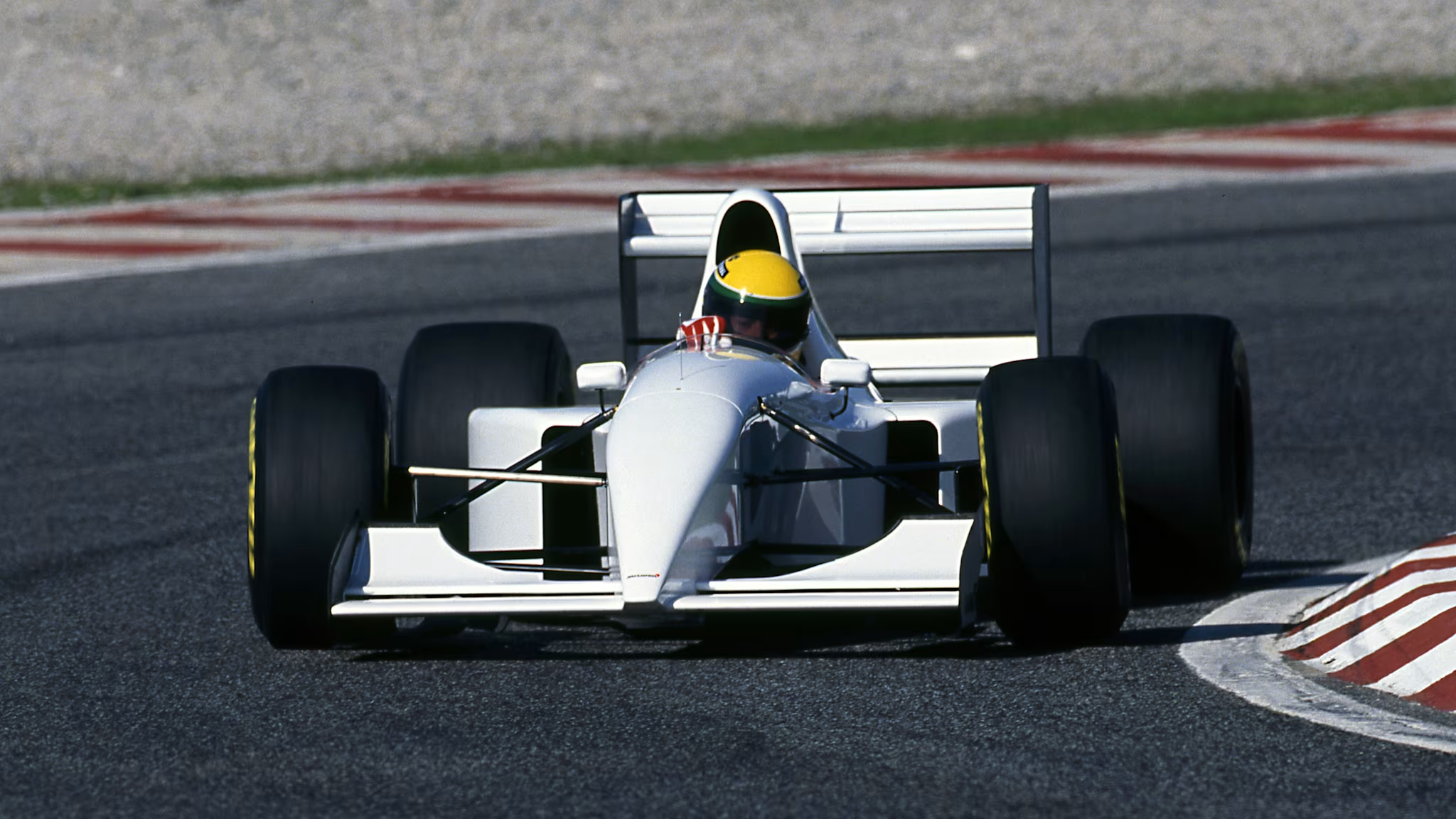
    Revisiting One of F1’s Most Intriguing ‘What If?’ Moments

    Key Highlights

    • McLaren dominated Formula 1 from 1988 to 1991, winning four consecutive Constructors’ and Drivers’ Championships with engine partner Honda.
    • The partnership ended abruptly when Honda withdrew from F1 at the close of the 1992 season due to financial pressures.
    • Honda’s departure triggered a period of instability and performance struggles for McLaren throughout the mid-1990s.

    The Golden Era: McLaren-Honda Dominance (1988–1991)

    During the late 1980s and early 1990s, McLaren authored one of the most dominant chapters in Formula 1 history. Between 1988 and 1991, the Woking-based squad secured four successive Constructors’ Championships and four straight Drivers’ Championships, a feat of consistency and excellence rarely matched in the sport. Central to this supremacy was the technical alliance with Japanese engine manufacturer Honda, whose power units—paired with McLaren chassis designed by the likes of Gordon Murray and later Neil Oatley—proved virtually unbeatable. Legendary drivers Ayrton Senna and Alain Prost, and later Gerhard Berger, piloted the MP4/4, MP4/5, MP4/5B, and MP4/6 to a combined 44 race victories over those four seasons, establishing a benchmark for engine-chassis integration.

    Sudden Shift: Honda’s Withdrawal at the End of 1992

    That period of stability and success turned into a spell of change and misfiring performance over the next few years. Amid growing financial pressures and a shifting corporate strategy, Honda made the decision to pull the plug on their Formula 1 operations at the end of the 1992 season. The announcement caught the paddock off guard; Honda had powered McLaren to the previous four titles and was still competitive, with Senna securing three wins in the 1992 campaign driving the MP4/7A. The Japanese manufacturer cited the need to redirect resources toward core automotive operations during a prolonged economic downturn in Japan, leaving McLaren without a works engine supply for the first time in nearly a decade.

    The Aftermath: Scrambling for Power and Competitiveness

    Honda’s exit forced McLaren into a frantic search for a new engine partner ahead of the 1993 season. The team eventually secured a customer supply of Ford HB V8 units, badged as Cosworth, which lacked the development support and raw power of the works Honda V10s and V12s. While Senna extracted remarkable results—including five victories—in the 1993 MP4/8, the writing was on the wall: McLaren had lost its factory backing and the deep integration that had defined its golden era. Subsequent partnerships with Peugeot (1994) and a return to Mercedes (1995 onward) would eventually restore winning ways, but the immediate aftermath of 1992 marked the end of McLaren’s most statistically dominant epoch and the beginning of a transitional wilderness.

    Why This Matters

    The dissolution of the McLaren-Honda alliance in 1992 serves as a pivotal case study in Formula 1’s reliance on manufacturer commitment. It illustrates how quickly a championship-winning structure can unravel when economic externalities—such as Japan’s “Lost Decade”—force OEMs to reprioritize spending. For McLaren, the loss triggered a multi-year rebuild that only concluded with the Mercedes works partnership, which delivered two more Drivers’ titles for Mika Häkkinen in 1998 and 1999. The episode also foreshadowed the volatile nature of engine supplier relationships that continues to shape the grid today, from Red Bull’s Renault and Honda cycles to Aston Martin’s forthcoming Honda return in 2026.

    Frequently Asked Questions

    How many championships did McLaren win with Honda between 1988 and 1991?

    McLaren won four consecutive Constructors’ Championships and four consecutive Drivers’ Championships during the 1988–1991 period with Honda power.

    Why did Honda leave Formula 1 at the end of 1992?

    Honda withdrew due to financial pressures and a need to redirect resources toward core automotive operations during a prolonged economic downturn in Japan.

    What engine did McLaren use after Honda left in 1992?

    For the 1993 season, McLaren used customer Ford HB V8 engines badged as Cosworth, before switching to Peugeot in 1994 and then beginning a long-term works partnership with Mercedes in 1995.

  • Nico Rosberg Proposes Major F1 VSC Rule Change After Lando Norris’ Spanish GP Setback

    Nico Rosberg Proposes Major F1 VSC Rule Change After Lando Norris’ Spanish GP Setback

    Key Highlights

    • 2016 Formula 1 World Champion Nico Rosberg has proposed closing the pitlane or drastically reducing the pitlane speed limit during Virtual Safety Car (VSC) periods to eliminate the unfair advantage gained by drivers who pit under VSC conditions.
    • The suggestion comes after the inaugural Spanish Grand Prix at the Madring circuit, where McLaren’s Lando Norris lost a likely victory after an ill-timed VSC deployed for Lance Stroll’s stranded Aston Martin allowed rivals to make cheaper pit stops.
    • Norris, who started from pole and built a lead over Mercedes’ Kimi Antonelli, had just passed the pit entry when the VSC was called, forcing him to stay out while Antonelli and Red Bull’s Max Verstappen pitted under neutralized conditions, ultimately finishing third behind race winner Antonelli and Verstappen.

    Rosberg Highlights Fundamental Flaw in VSC Pit Stop Delta

    Speaking on Sky Sports’ The F1 Show, 2016 Formula 1 World Champion Nico Rosberg dissected the strategic inequity exposed during the first-ever Spanish Grand Prix held at the Madring circuit. The race saw McLaren driver Lando Norris dominate the early stages from pole position, building a comfortable margin over Mercedes rookie Kimi Antonelli. However, the complexion of the Grand Prix shifted irrevocably when a Virtual Safety Car was deployed to retrieve Lance Stroll’s Aston Martin. Because Norris had just crossed the pit entry threshold, he was denied the opportunity to pit under the reduced time-loss delta that the VSC affords, while his primary rivals—including eventual race winner Antonelli and Red Bull Racing’s Max Verstappen—dived into the pits and emerged ahead.

    Former Champion Advocates for Structural Rule Changes

    Rosberg acknowledged the inherent lottery of neutralizations but argued the sport must explore regulatory fixes to preserve sporting fairness. “No, it’s just really unlucky,” Rosberg explained. “That’s the way it is. And it swings and roundabouts with the VSC and safety car deployments. You’re always going to have good luck or bad luck. It’s always horrible when that happens because he deserved to win, and it sucks that he lost it just because of a VSC.” He emphasized that while the VSC was introduced to avoid the spectacle-killing procession of a full Safety Car—“The problem is we hate seeing cars going round and round behind a safety car. It’s the most boring thing in the world of motorsport. And that’s why the VSC has been brought in so that we can reduce speed out there for minor dangers.”—the current rules create a perverse incentive where pitting under VSC yields a massive time gain relative to green-flag racing.

    Two Concrete Proposals to Neutralize the Pit Stop Advantage

    The German outlined two specific mechanisms to equalize the time loss of a pit stop regardless of track status. “Either the pitlane stays closed during a VSC, which then doesn’t give anybody the opportunity to take advantage during it or even why not something like: during a VSC, the pitlane speed limit gets reduced massively because it’s all about the time lost during a pitstop.” Rosberg explained the physics of the disparity: “The problem is during a VSC, the pitstop time lost is so much less because everybody on track is driving so slowly, so by going in the pits you lose a lot less race time, and that is the big problem, why then it becomes unfair.” His second proposal targets that delta directly: “But if you somehow find a way to make the pitstop time lost during a VSC as much time lost as when there’s no VSC, so you need to somehow slow people down who are going for the pitstop, that could be an idea. So then it’s all fair and equal for everybody.”

    Why This Matters

    The debate touches on a long-standing tension in Formula 1 between safety protocol integrity and competitive equity. The VSC was implemented precisely to minimize race neutralization time for minor incidents, yet its very efficiency—slowing cars on track without bunching the field—creates a “free” pit stop window that can overturn a driver’s legitimate on-track performance. The Madring race serves as a high-profile case study: Norris lost a near-certain win not through error or pace deficit, but through the geometric misfortune of track position relative to the pit entry at the moment of VSC deployment. As F1 evaluates its sporting regulations for future seasons, Rosberg’s proposals—closing the pitlane or mandating a drastically lower pitlane speed limit during VSC—represent practical, enforceable levers the FIA could pull to align the time cost of a pit stop with green-flag conditions, thereby removing the “lottery” element without reverting to full Safety Car deployments that degrade the spectacle.

    Frequently Asked Questions

    Why did Lando Norris lose the lead at the Spanish Grand Prix?

    A Virtual Safety Car was deployed to recover Lance Stroll’s Aston Martin just after Norris had passed the pit entry. This allowed rivals Kimi Antonelli and Max Verstappen to pit under VSC conditions—losing significantly less time relative to the field—while Norris was forced to stay out, dropping him to third by the finish.

    What specific rule changes did Nico Rosberg propose?

    Rosberg suggested two options: either keep the pitlane closed for the duration of a VSC, or drastically reduce the pitlane speed limit during a VSC so that the time lost during a pit stop equals the time lost under green-flag racing, neutralizing the unfair advantage.

    Was this the first Spanish Grand Prix at the Madring circuit?

    Yes, the race referenced was the inaugural Spanish Grand Prix held at the Madring circuit.

  • Lando Norris Spotted Driving Ferrari F40 in London Following 2025 Crash

    Lando Norris Spotted Driving Ferrari F40 in London Following 2025 Crash

    Key Highlights

    • Formula 1 champion Lando Norris has returned his rare Ferrari F40 to public roads in London following a January 2025 crash in Monaco that left the supercar damaged.
    • The F40, one of only 1,311 produced between 1987 and 1992, was being driven by a friend when it lost traction and struck guardrails while Norris was away.
    • Norris’s sighting comes after a third-place finish at the inaugural Spanish Grand Prix at Madring, while seven-time champion Lewis Hamilton has also recently acquired an F40.

    Norris’s Ferrari F40 Returns to London Streets After Monaco Crash Repair

    McLaren Formula 1 driver and 2025 world champion Lando Norris has been filmed driving his Ferrari F40 through London, marking the supercar’s first public appearance since a high-profile accident in Monaco earlier this year. The sighting follows Norris’s podium finish at the inaugural Spanish Grand Prix held at the new Madring circuit, where he secured third place. Footage circulating on social media shows the British driver behind the wheel of the iconic red supercar, confirming that extensive repairs have been completed since the January incident.

    Details of the January 2025 Monaco Accident

    The Ferrari F40 was involved in a crash on roads outside Monaco in January 2025 while Norris was traveling. According to reports, a friend was driving the vehicle when it lost traction exiting a left-hand corner and made contact with guardrails. The incident drew significant attention given the car’s rarity and historical significance. Norris addressed the situation shortly after it occurred, telling The Sun: “No [it is not back to normal]. It was when I was away. I wasn’t happy at all,” Norris told The Sun at the time. The 2025 champion took delivery of the F40 during the fourth quarter of 2024, adding it to a collection that already included multiple McLaren hypercars, a Porsche Carrera GT, and a Lamborghini Miura P400.

    Engineering Icon: The Ferrari F40 Legacy

    The crashed vehicle represents a significant piece of automotive history. Produced between 1987 and 1992, only 1,311 examples of the F40 were ever built. It holds the distinction of being the last road car personally overseen by Enzo Ferrari before his death in 1988, and it was the first street-legal production car to break the 200 mph barrier. The model’s twin-turbocharged V8 engine, lightweight composite construction, and raw driving dynamics have cemented its status as one of the most collectible supercars ever made, with values regularly exceeding several million dollars at auction.

    Fan Reaction and the Hamilton Connection

    Social media reaction to the London sighting was immediate and enthusiastic. On Instagram, one follower commented: “Good to see this car on the road again, after one of his friends crashed it some time ago,” while another praised: “Unbelievable taste in cars.” A third user drew a parallel to Norris’s Mercedes-powered rival, writing: “Are Lando and Lewis car sharing? Velcro on the back of the number plates?” The remark references Lewis Hamilton, the seven-time Formula 1 world champion who recently joined Scuderia Ferrari. Hamilton unveiled his own newly acquired Ferrari F40 ahead of the Italian Grand Prix at Monza, having previously sold his entire private car collection. The coincidence of both British F1 champions owning the same ultra-rare model has fueled discussion among motorsport and automotive enthusiasts alike.

    Why This Matters

    The return of Norris’s F40 to the road underscores the deep intersection between Formula 1 drivers and high-end automotive collecting. As brand ambassadors with substantial incomes and technical appreciation for engineering excellence, drivers like Norris and Hamilton serve as highly visible custodians of automotive heritage. The F40’s status as the final Enzo Ferrari–approved road car makes its preservation and active use particularly significant for marque historians and collectors. Furthermore, the Monaco crash and subsequent restoration highlight the specialized expertise required to repair carbon-fiber and Kevlar bodywork on a vehicle where original panels are irreplaceable. With both Norris and Hamilton now piloting F40s, the model’s cultural relevance within the F1 paddock has been reinforced, potentially influencing market values and collector interest in the coming years.

    Frequently Asked Questions

    When and where did Lando Norris’s Ferrari F40 crash?
    The crash occurred in January 2025 on public roads outside Monaco. A friend of Norris was driving when the car lost traction exiting a left-hand corner and struck guardrails. Norris was away at the time.
    How many Ferrari F40s were produced, and why is the model significant?
    Only 1,311 Ferrari F40s were built between 1987 and 1992. It was the last road car personally overseen by Enzo Ferrari and the first street-legal production car to exceed 200 mph, making it a landmark in automotive history.
    Does Lewis Hamilton also own a Ferrari F40?
    Yes. Seven-time Formula 1 champion Lewis Hamilton, who now drives for Scuderia Ferrari, recently acquired a Ferrari F40 after selling his previous car collection. He unveiled the purchase ahead of the Italian Grand Prix at Monza.
  • Andrea Stella: McLaren Must Help Oscar Piastri Stop “Thinking” About Driving ’26 F1 Car

    Andrea Stella: McLaren Must Help Oscar Piastri Stop “Thinking” About Driving ’26 F1 Car

    McLaren’s Stella: Piastri Still “Thinking and Driving” with 2026 F1 Machinery

    McLaren team principal Andrea Stella believes Oscar Piastri’s current performance deficit to teammate Lando Norris stems from the Australian driver still “thinking and driving” rather than operating instinctively with the 2026 Formula 1 regulations. The new technical framework has reduced aerodynamic output and introduced narrower tyres, significantly lowering overall grip levels and altering the driving demands compared to previous seasons.

    Piastri’s Strengths Clash with 2026 Car Characteristics

    Over the previous two seasons, Piastri established his strengths in carrying speed through high-speed corners and excelling in high-grip conditions. The 2026 rule changes have stripped away much of that grip, moving the MCL40 outside Piastri’s natural comfort zone. Combined with the charge-and-deploy nature of the new powertrains, this shift has contributed to a challenging campaign for the Melbourne-born driver.

    While Piastri and Norris were closely matched throughout 2025—aside from lower-grip events during the final flyaway races—Norris has held a clear advantage in the current season.

    Stella Targets Qualifying and Car-Driver Harmony

    Stella emphasized that improvement hinges on McLaren helping Piastri stop “thinking” on track, acknowledging that driving the MCL40 does not feel like a natural process for the 23-year-old.

    “I think with Oscar we need to qualify better, stay closer to the podium finish positions from the start,” Stella began. “In Monza he was P3 at the end of qualifying but somehow we managed to start P6 for the impeding. So there are several circumstances of which we need to take more control.
    “We need to execute better and then at the same time we need to get more in tune between Oscar and the MCL40 because still Oscar is driving and thinking. And when you drive and think, things get slowed down; slower as a driver in terms of deciding what to do and ultimately you are slower in terms of lap times.
    “So I think the agenda is very clear as to what we have to improve and I expect, like I always say, that we will get on top of that and we will see a stronger Oscar in the final part [of the year].”

    Front Wing Damage Compromises Piastri’s Race

    Piastri’s race was further complicated by front wing damage sustained in the opening corner after contact with George Russell’s Mercedes. The collision left a diveplane flapping against the endplate, costing measurable aerodynamic balance.

    “The front wing damage cost Oscar a few units of aero balance,” Stella added. “So definitely very measurable.
    “We were actually quite worried that this would have caused a lot of graining because the front end lost a lot of downforce. As a matter of fact, and thankfully, the hard tyres were hard and resistant enough not to open up the graining so Oscar could stay in the race.
    “When it comes to Oscar, I think the race was definitely compromised by not only the damage on the car but having lost further positions at the start. So I think even without the damage, it would have been a difficult race to get more out of the situation in which he found himself.”

    Despite the damage, the hard compound tyre proved durable enough to prevent graining, eliminating the need for a front wing change. Piastri managed a pass on Arvid Lindblad after his pit stop but ultimately finished seventh, trapped behind Franco Colapinto’s Alpine.

  • McLaren: Impossible Overtaking Cost Lando Norris Madring F1 Win

    McLaren: Impossible Overtaking Cost Lando Norris Madring F1 Win

    McLaren Formula 1 team principal Andrea Stella has identified the Madring circuit layout as the primary factor preventing Lando Norris from converting pole position into victory at the Spanish Grand Prix. Despite a dominant early pace, Norris fell victim to a poorly timed virtual safety car and, ultimately, a track design that offered virtually no overtaking opportunities.

    Virtual Safety Car Timing Undermines Norris Lead

    Norris started from pole at Madrid’s new street circuit and immediately built a six-second advantage over the opening 12 laps. That margin, however, became a liability when the virtual safety car (VSC) was deployed. Because Norris was too far ahead to pit without losing track position, he stayed out while rivals stopped.

    When Norris eventually pitted, a seven-second tire change dropped him 16 seconds behind Kimi Antonelli. Although the British driver slashed that deficit to challenge Antonelli and Max Verstappen for the lead by lap 48, he was unable to execute a pass.

    Stella: Slow Pit Stop Did Not Cost the Win

    Stella dismissed the idea that the sluggish stop altered the race outcome, emphasizing the circuit’s fundamental limitations.

    “Because probably Lando would have [come out] anyhow behind [George] Russell,” he pointed out. “And even if not, it would have not been possible to overtake Verstappen and Antonelli.

    “So, definitely, we take note that there’s a lot of work to do in our operation. And it’s not the first time that we have a slow stop. But in terms of the race itself, it didn’t make a difference.”

    The McLaren boss acknowledged the recurring operational issue but insisted the track layout rendered the pit-stop delay irrelevant to the final result.

    Madring Produces Fewest Overtakes of 2026 Season

    Data from Sunday’s race supports Stella’s assessment. The event featured just 10 overtaking moves—the lowest total of the 2026 campaign so far, even fewer than the 11 recorded at the traditionally processional Monaco Grand Prix. Four of those 10 passes involved backmarkers Valtteri Bottas or Lance Stroll being overtaken at the rear of the field.

    Turn 5 Geometry Blocks Overtaking Attempts

    The circuit’s primary passing zone, the heavy braking area at Turn 5, proved ineffective. The corner follows a curve that complicates braking precision, and its narrow width prevents two cars from entering side-by-side.

    “When it comes to overtaking, it’s a shame that it’s so difficult,” Stella added. “It just requires a large, large lap time difference to be able to overtake. I think what F1 will have to review is whether there are some modifications required at this circuit in order to introduce an overtaking possibility.

    “Because at the moment, the fact is that the straight may be long enough, but there’s absolutely no way that two cars can enter [Turn] 5 together. So it’s basically impossible an attempt of overtaking – which is a bit of a shame, because I think if overtaking was possible today, we would have [had] Lando regaining the lead, because the pace advantage was significant.”

    Circuit Modifications Under Consideration

    Stella’s remarks place the onus on Formula 1 and the circuit promoters to evaluate layout changes for future editions. With a straight that theoretically supports slipstreaming but a choke point that negates side-by-side racing, the Madring in its current configuration prioritizes track position over race craft—a dynamic that turned a potential Norris masterclass into a strategic dead end.

  • F1 Q&A: Madring’s Overtaking Problem, Virtual Safety Car Operation, and 2027 Rookie Prospects

    F1 Q&A: Madring’s Overtaking Problem, Virtual Safety Car Operation, and 2027 Rookie Prospects

    Key Highlights

    • Lando Norris lost a likely Spanish Grand Prix victory due to unique Virtual Safety Car timing that prevented only him from pitting, reigniting debate over minimum VSC duration rules.
    • McLaren team principal Andrea Stella expressed uncertainty over whether VSCs should last at least one full lap to equalize conditions or remain a “hands of the Gods” variable.
    • Haas appears the most likely entry point for 2026 rookies, with F2 champion Leonardo Fornaroli and Ferrari academy driver Rafael Camara leading candidates alongside Toyota protege Ryo Hirakawa.

    Norris Misfortune Reignites Virtual Safety Car Debate

    Lando Norris’ cruel twist of fate at the Spanish Grand Prix has thrust Formula 1’s Virtual Safety Car regulations back into the spotlight. The McLaren driver lost a commanding race lead—and near-certain victory—when a VSC deployment froze the field at the precise moment his track position made a pit stop impossible, while rivals behind him gained a free stop under neutralized conditions. Unlike previous strategic VSC gains, where teams deliberately gambled on a neutralisation, Norris’ predicament was purely circumstantial: he was the sole driver unable to access the pits during the brief window. The incident has been described as a “chance card in Monopoly” by observers, highlighting the arbitrary nature of the current system.

    Stella Questions Fairness, FIA Process Looms

    McLaren Team Principal Andrea Stella admitted the situation left him conflicted. “Offering a personal opinion, I’m puzzled myself as to what’s right,” Stella said. “Is it correct to give enough duration such that everyone will have been subject to the same track conditions? So, for instance, the virtual safety car lasts at least one full lap. Or you just keep it in the hands of the Gods, and sometimes you are lucky, sometimes you are not. I’m not sure.”

    Norris revealed after the race that the specific issue of VSC duration and pit-lane equity “has been spoken about many, many times” in driver briefings. Any regulatory change would follow a formal pathway: analysis by the Sporting Advisory Committee, then review by the F1 Commission comprising teams, commercial rights holder Formula 1, and governing body the FIA. However, sources indicate no immediate momentum exists for a rule alteration, as safety-car variability is widely accepted as an intrinsic, albeit unpredictable, competitive element.

    2026 Rookie Market: Haas the Epicenter of Opportunity

    With most 2026 driver line-ups settled or trending toward continuity, Haas emerges as the primary gateway for new talent. Esteban Ocon’s seat appears vulnerable, creating a rare opening. The leading contenders are Italy’s Leonardo Fornaroli, the reigning Formula 2 champion and a McLaren development driver, and Brazilian Rafael Camara, currently second in the F2 standings and a Ferrari Academy member. Both have tested for the American squad and reportedly impressed. Haas reserve driver Ryo Hirakawa, a long-time Toyota protege linked to the team’s technical partnership, remains in contention but is considered a less probable choice. The team is understood to prioritize a combination of pace and financial backing.

    Red Bull Junior Shuffle and Cadillac’s American Dilemma

    Elsewhere, Red Bull is evaluating a promotion for F2 championship leader Nikola Tsolov into the Racing Bulls squad. Such a move would necessitate dropping either Liam Lawson—who has performed solidly this season—or impressive rookie Arvid Lindblad, making the decision complex. At Cadillac, the plan to fast-track IndyCar race-winner Colton Herta has stalled; his difficult F2 campaign, yielding just a best finish of fifth and 19th in the standings, makes a 2026 graduation a significant risk. Fellow American Ugo Ugochukwu, who clinched the Formula 3 title in Madrid, is on Cadillac’s radar but is likely too inexperienced for an immediate F1 step. His stature—well over six feet, taller than current grid giants Esteban Ocon, Alex Albon, and George Russell—also presents unique cockpit integration challenges. The only other potential vacancy hinges on Fernando Alonso’s undecided future at Aston Martin.

    Why This Matters

    The Norris incident exposes a structural tension in F1’s sporting regulations: the balance between operational efficiency—the VSC’s original purpose of minimizing disruption for quickly cleared hazards—and competitive equity. The current rules, evolved through iterations including pit-lane closures, still allow a neutralisation to arbitrarily advantage or disadvantage a single driver based solely on micro-sector position at the moment of deployment. With the Sporting Advisory Committee and F1 Commission as the only formal mechanisms for change, any adjustment will be deliberate and political, requiring consensus among teams that may benefit from the status quo. Simultaneously, the 2026 rookie landscape reflects a broader trend of grid stability driven by multi-year contracts and academy consolidation, making Haas’s decision a bellwether for how teams weigh academy allegiance versus immediate performance and commercial value.

    Frequently Asked Questions

    Could the VSC rules be changed before the end of the 2025 season?

    It is highly unlikely. Any amendment requires analysis by the Sporting Advisory Committee and approval by the F1 Commission, a process that typically spans months. There is currently no indication that the FIA or Formula 1 management views this as an urgent safety or sporting integrity issue warranting an expedited change.

    Who is the favorite for the open Haas seat in 2026?

    There is no clear favorite. Leonardo Fornaroli (McLaren-backed F2 champion) and Rafael Camara (Ferrari-backed F2 runner-up) are the two primary candidates, both having tested successfully. Ryo Hirakawa (Toyota/HAAS reserve) is a dark horse. The final decision will likely weigh on-track performance, simulator work, and the commercial package each driver brings.

    Is Colton Herta’s F1 dream over?

    Not necessarily, but his path has narrowed significantly. A move to F1 in 2026 looks improbable given his current F2 form. Cadillac may opt to let him complete the F2 season to rebuild momentum for a potential 2027 entry, or explore alternative candidates like Ugo Ugochukwu, though the latter’s physical stature and inexperience present additional hurdles.

  • Lando Norris Completes First Full Test in McLaren’s Le Mans Hypercar

    Lando Norris Completes First Full Test in McLaren’s Le Mans Hypercar

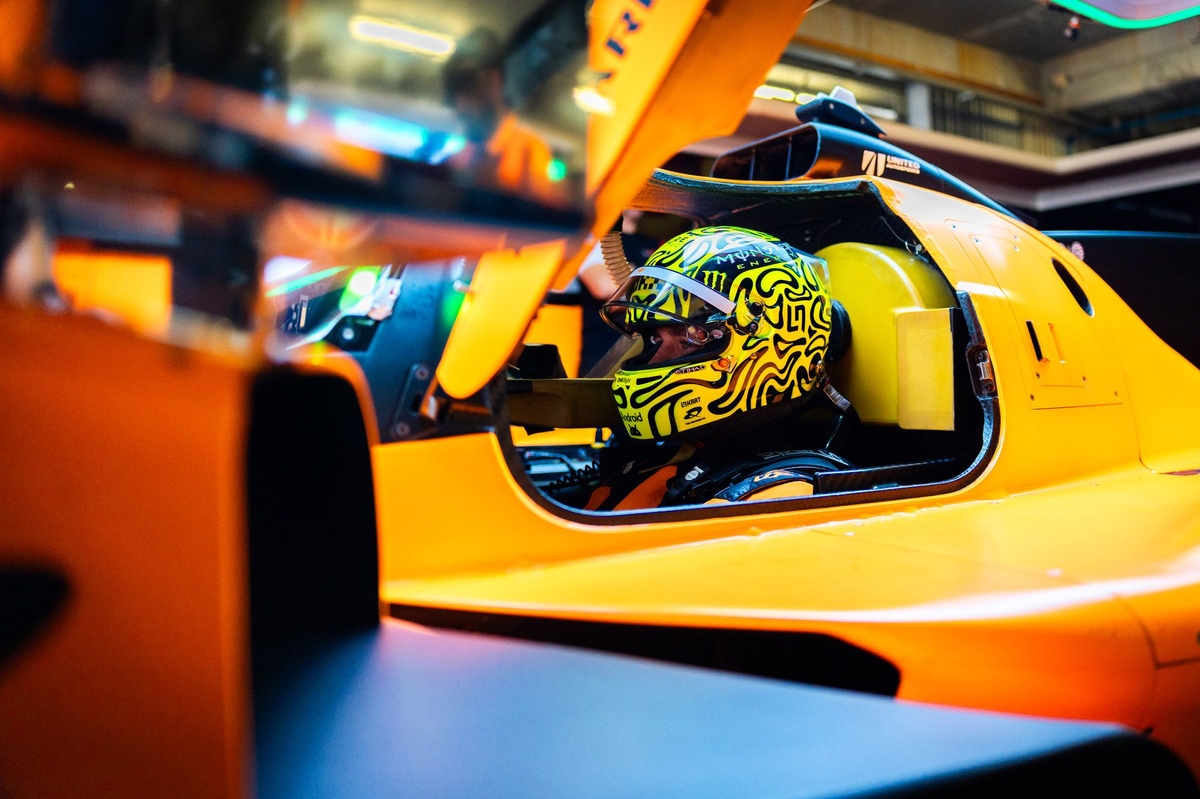
    Formula 1 world champion Lando Norris completed his first full test of the McLaren MCL-HY Le Mans Hypercar at the Algarve International Circuit in Portimão on Monday. The session came days after the Spanish Grand Prix at the new Madring circuit, where an ill-timed Virtual Safety Car denied Norris a potential victory. The British driver traveled across the border for a dedicated one-day program, completing 38 laps and covering 177 miles (285 kilometers) in the V6-powered prototype. McLaren confirmed the run included evaluation of several development items and leveraged Norris’s extensive Formula 1 experience for detailed feedback.

    Norris Completes First Full Test at Portimão

    Norris was supported by McLaren’s 2027 Hypercar drivers Mikkel Jensen and Laurens Vanthoor, who continued development work ahead of the British manufacturer’s World Endurance Championship debut next season. The test follows Norris’s initial taste of the MCL-HY during its public debut at the Goodwood Festival of Speed in July.

    Valuable Feedback from F1 Champion

    “First of all, a big thanks to the McLaren Hypercar Team for letting me drive the MCL-HY,” he said. “It was great for them to give me a chance to have a bit of fun and try something new, particularly during their busy preparations for next year.”

    “I think we also collected some valuable data, and I hope I was able to bring a different set of feelings, comments, and perspectives on things, which is useful for the team in this crucial testing period.”

    “It was cool for me personally to work with this team, and it was exciting to try new machinery too. I’ve not done a proper test in anything other than an F1 car for years now, so the fact I got to try something different, especially still as part of the McLaren family, was very special.”

    “It was a fun day in a quick car on a cool track, helping the team prepare for the start of WEC next year. A big thanks to everyone involved, I can’t wait to get back in the car in the future.”

    McLaren Hypercar Team Principal Comments

    “We are all racers at McLaren Racing, and competing in Formula 1, INDYCAR and the World Endurance Championship creates exciting cross-series opportunities,” he said.

    “Lando was keen to drive the MCL-HY beyond his Goodwood Hill run, so we invited him to join our private Portimão test. As we fully expected he adapted very quickly, integrated seamlessly and provided valuable feedback to support the car’s development.”

    “It was a pleasure to have him with the team, we wish him every success for the rest of the Formula 1 season, and we look forward to welcoming him back into the McLaren Hypercar Team soon.”

    Potential Le Mans 2027 Outing

    McLaren Racing CEO Zak Brown has previously expressed interest in fielding both Norris and Oscar Piastri in the WEC’s blue-riband event, the 24 Hours of Le Mans, though any such entry would likely require the team to run a third car. A Le Mans appearance would only be feasible if there are no clashes with Norris’s Formula 1 commitments next year. While the full 2027 WEC calendar was revealed three months ago — with Le Mans penciled in for the weekend of June 12–13 — Formula 1 has yet to publish its 2027 schedule amid ongoing geopolitical uncertainty in West Asia.

    Lando Norris, McLaren Photo by: McLaren
    Lando Norris, McLaren Photo by: McLaren
  • Guenther Steiner Criticizes Lando Norris’s Coca-Cola Spanish GP Moment as ‘unprofessional’

    Guenther Steiner Criticizes Lando Norris’s Coca-Cola Spanish GP Moment as ‘unprofessional’

    Guenther Steiner Criticizes Lando Norris Over Coca-Cola Cooldown Room Incident at Spanish Grand Prix

    Former Haas Formula 1 team principal Guenther Steiner has labeled Lando Norris’s decision to drink a Coca-Cola in the post-race cooldown room as unprofessional, following the Spanish Grand Prix in Madrid. The incident occurred after Norris finished third at the Madring circuit, sparking debate across the paddock and social media.

    Norris Defends Right to Choose His Drink

    With rival beverage company PepsiCo holding an official partnership with Formula 1, a series official reportedly asked the McLaren driver to put the Coca-Cola down. Norris firmly pushed back, stating:

    “I just did a race, so I’m allowed to drink what I would like. Thank you so much.”

    The exchange quickly went viral, with many fans praising Norris for standing his ground. However, Steiner offered a sharply different perspective during an appearance on The Red Flags Podcast.

    Steiner: “If You Are a Professional, You Don’t Do That”

    The former team chief argued that Norris should have adhered to the sport’s commercial protocols, regardless of personal preference.

    “If you are a professional, you don’t do that. End of story,” the former team chief said. “You know what you can do and what you cannot do. You’re well trained. He shouldn’t have done it. Is it a bad thing that he did it? Will somebody get hurt? No. But as a pro, you shouldn’t do it. But he has done it. And you know what? I couldn’t give a s***.”

    Commercial Reality Behind the Controversy

    When asked if the issue stemmed directly from PepsiCo’s F1 partnership, Steiner explained the categorical nature of sponsorship rights.

    “It’s all going by categories. They sell it and obviously if you don’t pay, you cannot have it. And he had a Coke. It was not the smartest thing to do.”

    Steiner added that the backlash ultimately benefited the non-sponsor brand.

    “But as I said, I don’t care because now, for Coca-Cola, it worked out pretty good. It was pretty good for [Coca-Cola]. If they wouldn’t have said anything, nobody would have even noticed, but because it was so bumped up now it’s a thing, and now Coca-Cola is laughing.”

    Race Context and Championship Standings

    Norris started the Spanish Grand Prix from pole position but dropped to third after an ill-timed virtual safety car period cost him the lead. He currently sits fourth in the 2025 drivers’ championship with 186 points, trailing leader Kimi Antonelli by 106 points.

    Lando Norris, McLaren. Photo by: Federico Basile
  • Why Formula 1 Should Avoid Knee-Jerk Rule Changes After Lando Norris’ Madrid Heartbreak

    Why Formula 1 Should Avoid Knee-Jerk Rule Changes After Lando Norris’ Madrid Heartbreak

    Lando Norris lost a potential Formula 1 victory at the Spanish Grand Prix through no fault of his own or his team’s, but due to the unfortunate timing of a virtual safety car (VSC) deployed on lap 14 following Lance Stroll’s retirement. The McLaren driver missed the pitlane entry by mere seconds before the VSC activation, making him the primary loser in a scenario where his main rivals—who lacked his outright pace—gained a “cheap” pit stop. The fastest driver on track ultimately settled for third place.

    Norris Questions Fairness of Current VSC Rules

    The outcome reignited debate regarding potential rule changes, with the VSC becoming the dominant talking point in Barcelona. Speaking in the post-race press conference, Norris expressed frustration over the lack of control he had over the situation.

    “There’s literally nothing I could do as a driver today to do a better job,” said Norris a few minutes after the finish in the press conference. “Pole, led the race, and to lose it for nothing in my control is, I don’t think, how a race should be won.

    “But I think people… I hope people agree, I think people would agree. But it is racing and it’s happened, so I can’t really complain about it. I can be upset about it, but I can’t really complain about it.”

    Proposed Solutions: Closing Pitlane or Mandatory VSC Duration

    In the aftermath, “easy solutions” often surface. Norris himself outlined two prominent ideas during the same press conference.

    “We have spoken about it in the past several times, about how it can be at least covered for one lap or everyone has the opportunity to do the pit stops, or you just block the pit entry and no one can box apart from if you have a puncture or something, you know.

    “So, I think there’s a few things you could do to make it more simple and more fair for everyone, but that’s a bigger discussion.”

    While both options—closing the pitlane under VSC or ensuring a full-lap VSC duration—would have neutralized the disadvantage for Norris in Spain, analysis suggests both create significant new problems.

    Why Closing the Pitlane Creates Safety Risks

    Closing the pitlane entry during a VSC would prevent the “cheap stop” scenario. Without refuelling, cars do not risk running dry during a safety period, making this seem logical. However, VSCs and safety cars are primarily deployed for on-track incidents involving damaged cars.

    Closing the pitlane while cars are circulating with damage—such as missing wheels or front wing failures—is illogical and unsafe. Allowing only damaged cars to pit introduces regulatory grey areas: defining what constitutes “damage” is complex. For instance, would the front wing damage sustained by Oscar Piastri in Madrid qualify? Furthermore, it could incentivize drivers to deliberately induce punctures to earn a pitstop right.

    “I think it’s something, as a group of drivers, I think we would all want,” he said, but also admitted that “there’s a lot more to it”.

    “You know, depending on if it’s raining and there’s a VSC and you’re on slicks, does it mean you can box or not? It’s a complicated subject.”

    Preventing drivers on slick tyres from switching to wets during a VSC deployed for safety would contradict the very purpose of the intervention. If a simple fix existed, it would likely have been implemented long ago.

    Why a Mandatory Full-Lap VSC Fails Strategically

    The alternative—guaranteeing the VSC lasts at least one full lap so every driver can pit—addresses the specific Madrid scenario where the VSC ended before Norris completed his lap. However, this creates strategic distortions in other common scenarios.

    Consider if Norris had pitted on lap 12 to cover an undercut from Kimi Antonelli (Mercedes). A subsequent VSC on lap 14 would put Norris at risk of losing track position to Antonelli. A mandatory full-lap VSC would guarantee Mercedes a “cheap” stop regardless of how quickly the track was cleared, artificially enforcing an “unfair” outcome. Critics would then likely demand race control act faster, ignoring that safety—not sporting equity—dictates deployment duration.

    Safety Remains the Sole Priority for Race Control

    The sporting outcome is not a factor for race control when deploying safety measures, nor should it be. Motor racing remains dangerous; safety is the only priority during incident management.

    “But I think as a collection of drivers, if we all talk about it, I think everyone wants the same thing, and that’s just fairness for everyone,” said Norris. “So yeah, of course I’m complaining about it today. I could benefit from it next week, next time out, and I could win because of it.

    “So yeah, I have to take it on the chin, but I just hope it doesn’t happen to anyone again because it’s just not how you should lose a race.”

    Accepting the Inherent Unpredictability of Sport

    While drivers are right to raise concerns, media headlines demanding immediate rule changes based on one event should not dictate regulatory overhauls. The Spanish GP highlighted a long-standing issue with VSC timing luck, but its persistence exists precisely because no simple solution withstands scrutiny across all scenarios.

    Those offering straightforward fixes typically fall into two categories: those who misunderstand the complexity of the problem, or politicians. Ultimately, the only realistic “solution” may be accepting that sport is not always fair—and that the VSC lottery, while frustrating, is an inherent variable in Formula 1.