
Tag: Matt Huang

  • Grayscale Zcash ETF Files for 3-for-1 Forward Share Split

    Grayscale Zcash ETF Files for 3-for-1 Forward Share Split

    Key Highlights

    • Grayscale’s Zcash ETF (ZCSH) will execute a 3-for-1 forward share split effective at the close of trading on September 28, according to an SEC filing.
    • The split aims to improve accessibility after the fund’s value surged approximately 2,800% over the past year, making the per-share price prohibitively high for some investors.
    • Zcash’s native token (ZEC) recently spiked to an effective all-time high of $1,521 following a disclosed investment by Paradigm co-founder Matt Huang, who called Zcash a “private complement to Bitcoin.”

    Grayscale Announces 3-for-1 Forward Split for Zcash ETF

    Grayscale Investments has filed with the U.S. Securities and Exchange Commission to implement a 3-for-1 forward share split for its Zcash Trust (ZCSH), a move designed to lower the per-share trading price and broaden investor access. According to the filing, the split will take effect at the close of trading on September 28. Shareholders of record will receive two additional shares for every one share held, resulting in a proportionate increase in the total number of shares outstanding while maintaining the same aggregate market value.

    Mechanics of the Split and Investor Impact

    The forward split operates as a standard corporate action that reduces the nominal price per share without altering the fund’s underlying net asset value. Grayscale illustrated the mechanics in a press release: “if you owned 10 shares valued at $300 each for a total $3,000 before the split, afterward you will own 30 shares valued at $100 each for an unchanged total of $3,000.” The firm explicitly stated the decision was driven by the trust’s dramatic appreciation, noting the token has increased in value by about 2,800% over the last year, rendering the price per unit “too high” for optimal market participation.

    ZEC Token Surges on Paradigm Investment Disclosure

    The structural announcement coincides with significant market momentum for Zcash’s native asset, ZEC. Cointelegraph reported on Thursday that ZEC rallied approximately 20% over a 24-hour period after Paradigm co-founder Matt Huang disclosed the crypto venture firm had made an unspecified purchase of the token. Huang characterized the asset as a “private complement to Bitcoin” and voiced support for the Zcash developer fund. He argued that sustained, long-term funding is critical as the industry confronts advancing threats from AI-driven cyber capabilities and the eventual advent of quantum computing.

    Market Reaction and Technical Milestones

    The confluence of the ETF split news and Huang’s endorsement catalyzed a sharp price discovery event. The Block reported that ZEC climbed as high as $1,521 early Friday, marking a new effective all-time high before retracing moderately. The rally occurs as the Zcash protocol prepares for its NU7 mainnet upgrade, currently targeting a November activation. That upgrade is expected to introduce 25-second block times, a significant throughput improvement intended to enhance the network’s utility for shielded transactions powered by zero-knowledge proofs.

    Why This Matters

    The Grayscale ZCSH split reflects a maturing dynamic in crypto-linked exchange-traded products: as underlying assets appreciate dramatically, fund sponsors must manage share prices to retain retail accessibility and trading liquidity. Simultaneously, the Paradigm investment signals renewed institutional conviction in privacy-preserving layer-one protocols, specifically those utilizing zero-knowledge cryptography. With the NU7 upgrade approaching, Zcash is attempting to reinforce its technical relevance—faster block times and sustained developer funding—at a time when regulatory scrutiny of privacy coins remains intense globally. The intersection of traditional finance wrapper mechanics (the ETF split) and core protocol evolution (NU7) highlights the dual-track development path for established crypto assets.

    Frequently Asked Questions

    When does the Grayscale Zcash ETF (ZCSH) share split take effect?

    The 3-for-1 forward split is effective at the close of trading on September 28. Shareholders will receive two additional shares for each share held at that time.

    Does the forward split change the total value of my investment in ZCSH?

    No. The split increases the number of shares outstanding proportionately while decreasing the price per share. The total market value of a shareholder’s position remains unchanged, as illustrated by Grayscale’s example of 10 shares at $300 becoming 30 shares at $100.

    What catalyzed the recent surge in Zcash (ZEC) price to $1,521?

    The price spike followed public disclosure that Paradigm co-founder Matt Huang purchased an unspecified amount of ZEC, calling it a “private complement to Bitcoin” and endorsing the protocol’s developer fund ahead of the planned NU7 network upgrade in November.

  • Bitcoin Bounces as Markets Brace for the Fed’s Next Move

    Bitcoin Bounces as Markets Brace for the Fed’s Next Move

    Key Highlights

    • The Federal Reserve raised its benchmark interest rate by 25 basis points to 3.75%–4% on a unanimous 12–0 vote, marking the first hike since July 2023.
    • Bitcoin held near $76,300, largely unmoved by the decision, while the broader crypto market capitalization stabilized around $2.63 trillion.
    • Zcash (ZEC) surged up to 23% to a multi-year high near $1,425 after Paradigm co-founder Matt Huang disclosed his firm’s stake, calling it “a private complement to Bitcoin.”

    Fed Delivers Expected Hike; Crypto Markets Absorb Move With Composure

    Bitcoin traded sideways near $76,300 on Thursday, showing remarkable resilience a day after the Federal Reserve executed its first interest rate increase since July 2023. The Federal Open Market Committee lifted the federal funds rate by 25 basis points to a target range of 3.75% to 4%, a decision backed by all 12 voting members. Heading into the announcement, CME’s FedWatch tool indicated traders had priced in a 93% probability of the move, which helped mute immediate volatility across digital asset markets.

    While traditional markets reacted more sharply—the Dow Jones Industrial Average fell roughly 1.2% and the S&P 500 declined 0.4% to 0.5% on Wednesday—cryptocurrency prices steadied by Thursday morning. The 10-year Treasury yield, which had breached 5% earlier in the week for the first time since 2007, retreated slightly, and equity futures turned positive. Oil prices also pulled back from highs above $100 a barrel driven by the Israel–Iran conflict. These developments eased the dual headwind of a stronger dollar and higher risk-free yields that typically pressure non-yielding assets like Bitcoin and gold.

    Zcash Breaks Out on Paradigm Endorsement and Privacy Narrative

    While major tokens traded in tight ranges, Zcash (ZEC) erupted as much as 23% to trade near $1,425, hitting a multi-year high. The catalyst came after Paradigm co-founder Matt Huang disclosed on X that his venture firm holds a position in ZEC and has invested in the Zcash Open Development Lab. Huang called Zcash “a private complement to Bitcoin” and argued its inflation-funded developer fund deserves continued backing as AI-driven cyber threats and quantum computing advance.

    The rally extends a powerful run for the privacy-focused cryptocurrency. ZEC has gained approximately 160% over the past month, vastly outperforming Bitcoin’s 18.2% climb in the same period, and is up nearly 3,000% over the trailing 365 days. In May, Multicoin Capital’s Tushar Jain revealed a position built since February, describing the token as “the cleanest way” to express a privacy thesis rooted in wealth-seizure fears. Those disclosures have helped make Zcash the standout performer among the top 10 cryptocurrencies by market capitalization this week.

    Broader Market Context: Liquidations, Legislative Setback, and Sentiment Shift

    Elsewhere in the top 50, gains were more modest. BNB traded near $724 (up 2%), Solana held just above $100 for a 3.3% increase, and XRP lagged at $1.29—up 2% on the day but still down more than 6% for the week. XRP’s weekly decline followed the failure of the crypto Clarity Act to secure a Senate cloture vote days earlier. The legislation would have legalized most crypto activity in the United States and provided more meaningful regulatory clarity for altcoins such as Solana and XRP than for Bitcoin, which is widely recognized to occupy a distinct regulatory category.

    Leveraged positions felt the pressure as prices ground higher into the rate decision. Roughly $373 million in crypto liquidations hit the market over 24 hours, with short positions accounting for the larger share. Sentiment indicators reflect the cooling enthusiasm: the Crypto Fear and Greed Index read 50, exactly in “neutral” territory, a significant drop from the “extreme greed” readings recorded just three weeks ago.

    Why This Matters

    The Fed’s latest hike signals that the central bank remains vigilant on inflation despite growing risks to economic growth. The median “dot plot” projection places the federal funds rate at 4.1% by the end of 2026, leaving room for one more quarter-point move this cycle. The next FOMC meeting is scheduled for October 27–28, and markets will closely parse incoming labor and inflation data for clues on whether that final hike materializes.

    For crypto, the relatively muted reaction suggests the rate path was well-telegraphed and that the market is increasingly focused on idiosyncratic catalysts—such as the privacy narrative driving Zcash—rather than macro surprises. The failure of the Clarity Act underscores that regulatory uncertainty remains a persistent overhang for altcoins, even as Bitcoin continues to decouple from traditional risk assets in the eyes of some investors. With the Fear and Greed Index resetting to neutral, the stage is set for the next directional move to be driven by either a macro shock or a breakthrough in protocol-level adoption.

    Frequently Asked Questions

    How did Bitcoin react to the Fed’s rate hike?

    Bitcoin briefly touched $76,499 after the announcement before settling near $76,300, roughly flat on the day. The muted response reflects the fact that traders had priced in a 93% probability of the 25-basis-point increase, per CME’s FedWatch tool.

    Why did Zcash (ZEC) surge while other cryptocurrencies were flat?

    Zcash jumped as much as 23% after Paradigm co-founder Matt Huang disclosed his firm’s stake and investment in the Zcash Open Development Lab. Huang called ZEC “a private complement to Bitcoin”, and the token has benefited from a growing privacy narrative amid concerns over AI-driven cyber threats and quantum computing.

    What is the Fed’s projected rate path and next meeting date?

    The Fed’s median projection sees the federal funds rate at 4.1% by the end of 2026, implying one more potential quarter-point hike. The next FOMC meeting is scheduled for October 27–28.

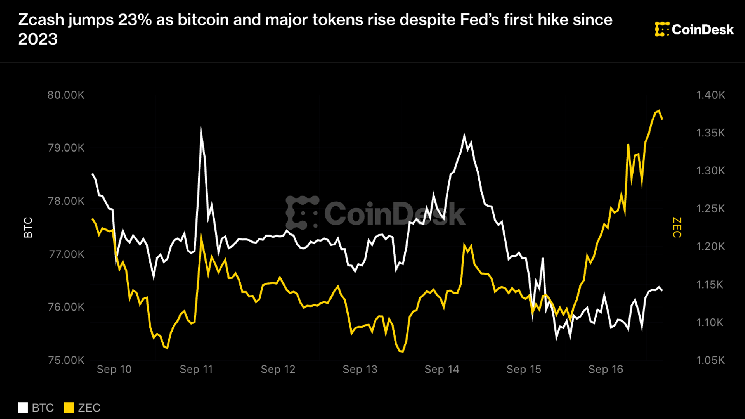
  • Zcash Surges 23% as Bitcoin, Major Tokens Rally Despite Fed’s First Rate Hike Since 2023

    Zcash Surges 23% as Bitcoin, Major Tokens Rally Despite Fed’s First Rate Hike Since 2023

    Privacy-focused cryptocurrency Zcash (ZEC) surged 23% over the past 24 hours, leading gains across major digital assets as Bitcoin and the broader crypto market rallied overnight into Asian trading hours Thursday. The move coincided with a recovery in U.S. stock futures following the Federal Reserve’s first interest-rate increase since 2023.

    Market Snapshot: ZEC Leads, Bitcoin Holds Near $76K

    At the time of writing, ZEC traded near $1,369, significantly outperforming the market. Bitcoin edged up less than 1% to approximately $76,258, while Solana (SOL) gained nearly 3% to just below $100. BNB and HYPE, the native token of the crypto trading platform Hyperliquid, each added more than 2%. Ether (ETH), XRP, and Dogecoin (DOGE) posted gains between 1% and 2%.

    Paradigm Co-Founder Highlights Zcash as Bitcoin Privacy Complement

    The sharp rally in ZEC followed public comments from Matt Huang, co-founder of prominent crypto investment firm Paradigm. In a post on X, Huang discussed Zcash’s role as a privacy layer for Bitcoin and disclosed that his firm holds a position in the token.

    “a private complement to Bitcoin.”

    Huang, whose firm owns ZEC, described the protocol as “a private complement to Bitcoin.” He expressed support for continued funding of Zcash’s core developers while advocating that governance votes by coin holders should be combined with other decision-making mechanisms for network upgrades.

    Zcash Governance and Monetary Policy in Focus

    Zcash enables users to transact without publicly revealing sender, recipient, or transaction amounts. Its community recently backed proposals aimed at accelerating payment speeds while maintaining the protocol’s scheduled reductions in new coin issuance—a disinflationary feature shared with Bitcoin’s halving cycle.

    The convergence of positive macro tailwinds, high-profile institutional endorsement, and ongoing protocol improvements appears to be driving renewed investor interest in privacy-preserving digital assets.