Key Highlights
- Martin McDonagh’s Wild Horse Nine reunites the filmmaker with Sam Rockwell for a third time and pairs him with John Malkovich as CIA operatives in pre-coup Chile, opening in theaters November 6 after a TIFF premiere.
- The film deliberately echoes McDonagh’s earlier In Bruges and the actors’ past roles—including Malkovich’s Burn After Reading CIA memoirist and Rockwell’s Confessions of a Dangerous Mind operative—creating a meta-commentary on repetition and history.
- Set days before the 1973 Chilean coup, the dark comedy uses Easter Island’s moai and wild horses as visual metaphors for imperial hubris, with cinematography by Ben Davis and supporting turns from Steve Buscemi, Parker Posey, and Tom Waits.
A Familiar Darkness in New Territory
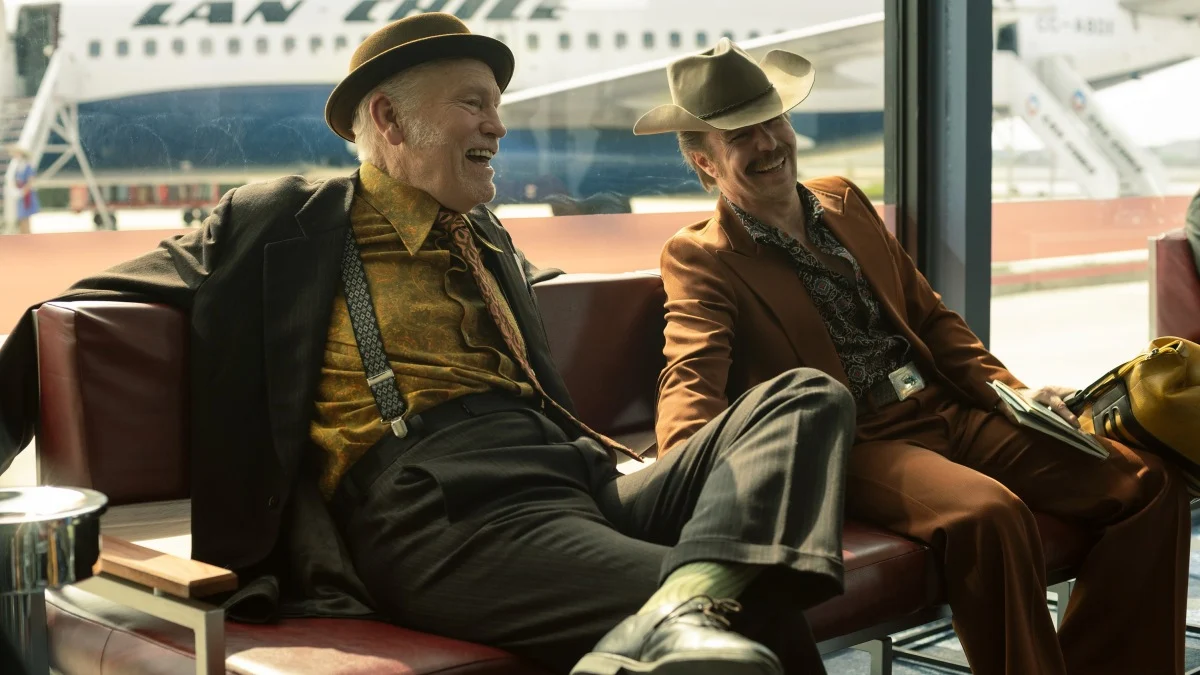
Martin McDonagh’s Wild Horse Nine arrives at the Toronto International Film Festival carrying the unmistakable DNA of its creator—the blisteringly macabre humor forged in The Pillowman, In Bruges, Seven Psychopaths, Three Billboards Outside Ebbing, Missouri, and The Banshees of Inisherin. As a comedy, it works fine. As a Martin McDonagh comedy, it feels deliberately redundant, and that redundancy may be precisely the point. The premise echoes In Bruges with surgical precision: two contract killers with an uneasy friendship, a picturesque vacation spot, and a deadly outcome looming. This time, the hitmen are CIA agents Chris (John Malkovich) and Lee (Sam Rockwell), dispatched to Santiago shortly before the 1973 Chilean coup d’état to destabilize the newly elected government before killing time on Easter Island, because Chris wants to see “the big heads.”
The Ugly American as Tragic Clown
Chris is unapologetically an Ugly American—loud, obnoxious, and breathtakingly cynical. When tourists urge him to call the island’s giant stone statues “moai,” the name the Indigenous people gave them, he scoffs. When two female college students express excitement over their women’s rights march, he breezily informs them their efforts will be for naught because of a U.S. operation that will topple their president. “Your country is gonna get fucked,” he tells them. The characterization mirrors the racist cop Rockwell played in Three Billboards, with one critical exception: Chris is no fool. His cynicism stems from knowing too much—so much that his chief (Steve Buscemi) is ready to silence him permanently. Both men know this trip is likely Chris’s last. Within their half-hearted tourism, Chris reflects on a lifetime of murders with not sadness but a shrugging resignation that Malkovich sculpts into a darkly funny portrayal. He becomes beguiled by wild horses roaming the lush landscape and attempts to flirt with one of the coeds he outraged earlier, his meanderings deepening the film through repetition rather than mere reiteration.
Echoes Across Filmographies
The repetition in Wild Horse Nine operates on multiple meta-textual levels. This marks Rockwell’s third McDonagh film following Seven Psychopaths and Three Billboards (he also starred in McDonagh’s 2010 Broadway play A Behanding in Spokane). More specifically, Rockwell previously played a swaggering, gallows-humored CIA operative in George Clooney’s Confessions of a Dangerous Mind. Malkovich, meanwhile, has not just played a CIA employee before—in both Wild Horse Nine and the Coen Brothers’ Burn After Reading, he portrays an agent looking to turn top-secret exploits into a memoir. Most joltingly, as Lee tries to protect Chris from an increasingly hostile world, cinephiles may recall Of Mice and Men, in which Malkovich played Lennie in the 1992 adaptation directed by and co-starring Gary Sinise. Buscemi’s furious CIA chief, Parker Posey as Lee’s glibly unfaithful wife, and Tom Waits snarling from Monument Valley’s depths all carry their own filmographic ghosts. Whether these resonances are intentional or the viewer’s own pattern-seeking, they reinforce the film’s thesis: history keeps repeating, for better or mostly worse.
Craft and Release
Ben Davis’s cinematography is gorgeous, framing these gruff conquerors in an untamed surroundings that mocks their mundane ambitions for control. Rockwell delivers greasy suavity in McDonagh’s signature caustic dialogue. Buscemi, Posey, and Waits pop with crackling outrage. Mariana di Girolamo and Ailín Salas bring fresh-faced exuberance that proves a terrific foil to Malkovich’s world-weariness. Malkovich himself is wickedly compelling as an infuriatingly blasé killer—his resignation expressed not through dull sullenness but an intoxicating levity, as if he can feel the fall coming and is all too happy to lift his wings. Wild Horse Nine urges audiences to look back on the filmographies of its makers just as Chris looks back on his life, understanding how history repeats while acknowledging there might still be something worthwhile in the present moment. The film opens in theaters on November 6.
Why This Matters
Wild Horse Nine represents a significant evolution in McDonagh’s filmography: his first period political thriller, his first Latin American setting, and his most explicit engagement with American imperial history. By casting actors whose previous roles explicitly echo their current ones, McDonagh transforms casting into commentary—suggesting that performers, like nations and spies, are trapped in cycles of repetition. The Chilean coup backdrop, still raw in collective memory, grounds the meta-textual play in real atrocity. The November 6 theatrical release positions it squarely in awards season conversation, where McDonagh’s previous work has excelled. For audiences, the film offers both accessible dark comedy and a dense intertextual puzzle rewarding multiple viewings.
Frequently Asked Questions
- When and where can I watch Wild Horse Nine?
- The film premiered at the Toronto International Film Festival and opens in theaters on November 6.
- How does Wild Horse Nine connect to Martin McDonagh’s previous films?
- The premise structurally echoes In Bruges (two killers, a vacation spot, impending death), while casting creates deliberate resonances: Rockwell’s third McDonagh collaboration, Malkovich echoing his Burn After Reading CIA memoirist, and Rockwell recalling his Confessions of a Dangerous Mind operative.
- What historical event frames the story?
- The film is set shortly before the September 11, 1973 Chilean coup d’état that overthrew democratically elected President Salvador Allende, with the CIA agents in Santiago to destabilize the government before a getaway to Easter Island.