Tag: Layer 1 blockchain

  • HBAR Price Surges 29%, Breaks Long-Term Resistance — $0.10 Target in Sight?

    HBAR Price Surges 29%, Breaks Long-Term Resistance — $0.10 Target in Sight?

    Key Highlights

    • Hedera’s HBAR token has surged nearly 29% from its recent low, reaching approximately $0.097 and breaking above the long-standing $0.086 resistance level.
    • The rally occurred on elevated trading volume, with the price clearing its 200-day moving average and shorter-term averages, signaling broad-based buyer participation.
    • The next critical hurdle is the psychological $0.10 level; a decisive daily close above could open the path toward the $0.109–$0.11 resistance zone seen in early June.

    HBAR Breaks Multi-Month Resistance on Strong Volume

    Hedera’s native token, HBAR, has staged a notable recovery, climbing almost 29% from its recent trough to trade near $0.097. The advance has propelled the altcoin above a persistent technical barrier at the $0.086 price level, a zone that had capped upside attempts for months. According to chart data sourced from TradingView, the token touched an intraday high of $0.099, bringing it within striking distance of the psychologically significant $0.10 threshold—a level HBAR has not managed to close above in several months.

    Volume Surge Confirms Buyer Conviction

    Adding technical weight to the move, daily trading volume expanded significantly compared to the preceding session and exceeded the average levels observed throughout August and early September. In technical analysis, a price advance accompanied by rising volume is typically interpreted as confirmation of genuine buyer interest, distinguishing a sustainable trend from a low-liquidity spike. The breakout has also repositioned HBAR above its 200-day moving average, which resides near the $0.086 mark. This long-term average previously acted as a ceiling for price action; reclaiming it suggests the current upswing may represent a structural shift rather than a fleeting bounce. Shorter-term moving averages now also sit below the current price, indicating bullish alignment across multiple timeframes.

    $0.10 Level Emerges as Pivot Point for Next Leg

    The immediate focus for market participants is whether HBAR can secure a convincing daily close above $0.10. The token stalled near $0.099 in the latest session, highlighting the resistance cluster at this round number. Should buyers overcome this hurdle, the early June supply zone between $0.109 and $0.11 becomes the next logical target—a region that previously triggered heavy selling pressure and may test resolve again. Conversely, failure to clear $0.10 could prompt a consolidation or pullback after the rapid ascent. The first line of defense on any rejection lies at $0.09, followed by the former breakout level at $0.086. A decisive break back below $0.086 would invalidate the bullish structure and raise the possibility that the recent rally overextended too quickly.

    Why This Matters

    Hedera’s price action reflects broader sentiment shifts in the layer-1 blockchain sector, where investors are reassessing valuations amid evolving macroeconomic conditions and network-specific developments. A sustained break above the 200-day moving average, confirmed by volume, is widely watched by algorithmic and discretionary traders alike as a signal of trend reversal. The $0.10 level holds outsized psychological importance; clearing it could attract momentum-driven flows and algorithmic buy programs, while failure may invite short-term profit-taking. Market participants will also monitor on-chain metrics—such as active addresses, transaction count, and staking participation—to gauge whether the price move is supported by fundamental network usage growth.

    Frequently Asked Questions

    What triggered HBAR’s recent 29% price increase?
    The rally appears driven by a technical breakout above the $0.086 resistance (200-day moving average) on significantly higher-than-average trading volume, indicating renewed buyer interest. No specific fundamental catalyst was cited in the source analysis.
    What are the key price levels to watch for HBAR next?
    The immediate resistance is $0.10. A daily close above this could target the $0.109–$0.11 zone. On the downside, $0.09 is the first support, followed by the critical $0.086 level; a break below $0.086 would negate the bullish breakout.
    Does the volume increase confirm the uptrend is sustainable?
    Rising volume during the advance is a positive technical signal suggesting broader participation. However, sustainability depends on whether buyers can defend the $0.086–$0.09 zone on any pullback and ultimately secure a close above $0.10.

  • Peter Brandt Predicts Ethereum Rally to $8,600 Amid Vitalik Buterin’s Quantum Focus

    Peter Brandt Predicts Ethereum Rally to $8,600 Amid Vitalik Buterin’s Quantum Focus

    Key Highlights

    • Veteran trader Peter Brandt forecasts Ethereum could reach $8,600 in the long term following a near-term breakout.
    • Ethereum co-founder Vitalik Buterin is prioritizing privacy enhancements, cybersecurity upgrades, and full quantum resistance for the Layer-1 blockchain.
    • The convergence of bullish technical analysis and foundational protocol upgrades signals a dual catalyst for Ethereum’s next growth phase.

    Brandt’s Technical Outlook Targets $8,600 Ethereum

    Veteran commodity trader Peter Brandt, widely followed for his classical charting expertise, has set a long-term price target of $8,600 for Ethereum (ETH). According to Brandt’s analysis, this ambitious level becomes attainable once ETH completes a near-term breakout from its current consolidation pattern. The projection draws on principles of classical charting and trend continuation, suggesting that a decisive move above key resistance could unlock a multi-year uptrend measured by logarithmic scaling. Brandt’s track record in identifying major trend inflections across asset classes lends weight to the forecast among technical analysts and macro-oriented crypto investors.

    Buterin’s Roadmap Prioritizes Quantum Resistance and Privacy

    Simultaneously, Ethereum co-founder Vitalik Buterin has outlined a strategic pivot for the protocol’s base layer, emphasizing three critical pillars: enhanced privacy, strengthened cybersecurity, and full quantum resistance. In recent communications, Buterin stressed that making the Layer-1 blockchain “fully quantum-resistant” is no longer a theoretical exercise but an urgent engineering priority as advances in quantum computing accelerate. The roadmap also doubles down on privacy-preserving frameworks for transactions and smart contracts, alongside hardened client diversity and formal verification to mitigate exploit surfaces. These initiatives aim to future-proof Ethereum’s settlement layer against both emerging cryptographic threats and evolving regulatory expectations around data protection.

    Converging Catalysts: Technical Breakout Meets Protocol Evolution

    The alignment of Brandt’s breakout thesis with Buterin’s architectural overhaul presents a rare confluence of technical and fundamental catalysts. Historically, Ethereum’s most sustained rallies have coincided with major protocol milestones—such as the Merge, Shanghai, and Dencun upgrades—that expanded utility and reduced supply-side pressure. The current focus on quantum-resistant cryptography, including potential adoption of lattice-based signatures and STARK-based validity proofs, could differentiate Ethereum as the first major blockchain to credibly neutralize quantum risk. Meanwhile, privacy enhancements such as stealth addresses and zero-knowledge proofs at the base layer may unlock institutional DeFi adoption that has been constrained by transparency requirements.

    Why This Matters

    Ethereum’s trajectory is increasingly defined by the intersection of market structure and protocol resilience. A breakout to new all-time highs, as Brandt anticipates, would reinforce ETH’s status as a sovereign-grade store of value and the primary collateral layer for on-chain finance. Buterin’s quantum-resistance mandate addresses an existential timeline: NIST’s post-quantum cryptography standards are being finalized, and any blockchain that fails to migrate risks obsolescence. Privacy upgrades, meanwhile, respond to growing demand from enterprises and regulated financial entities that require selective disclosure without sacrificing composability. Together, these developments position Ethereum to capture the next wave of institutional capital allocation into digital assets, provided the technical execution matches the roadmap’s ambition.

    Frequently Asked Questions

    What is Peter Brandt’s price target for Ethereum and what triggers it?
    Peter Brandt projects a long-term target of $8,600 for Ethereum, contingent on a near-term breakout from current price consolidation. His analysis relies on classical charting principles and logarithmic trend extrapolation.
    What are Vitalik Buterin’s current priorities for the Ethereum protocol?
    Vitalik Buterin is prioritizing three core areas: enhancing user privacy, strengthening cybersecurity across clients and smart contracts, and making the Ethereum Layer-1 blockchain fully quantum-resistant against emerging computing threats.
    How do quantum-resistant upgrades affect Ethereum’s long-term viability?
    Quantum-resistant cryptography ensures Ethereum’s settlement layer remains secure against future quantum computers capable of breaking current elliptic-curve signatures. Proactive migration preserves asset integrity, validator security, and trust in the network as a permanent infrastructure layer.
  • a16z-Backed Layer-1 Project Linera Shuts Down After Token Sale Falls Short

    a16z-Backed Layer-1 Project Linera Shuts Down After Token Sale Falls Short

    Key Highlights

    • Linera, an a16z-backed Layer-1 blockchain founded by former Meta researcher Mathieu Baudet, announced its shutdown on September 19 after a community token sale raised only 57% of its $1.5 million minimum target.
    • The project had previously secured approximately $12 million across two venture rounds—led by a16z Crypto and Borderless Capital—but emergency financing efforts failed to bridge the funding gap.
    • The team is winding down operations and will close its Discord server; user point balances remain recorded but carry no guarantee of future value, and the microchain-based protocol will not reach mainnet under the current team.

    Linera Shuts Down After Token Sale Misses Minimum Threshold

    Layer-1 blockchain project Linera has ceased operations, the team announced via Discord on September 19, citing insufficient funding as the sole reason for the shutdown. The decision comes despite the project having raised roughly $12 million in venture capital across two prior rounds and developing a novel “microchain” architecture designed for high-throughput parallel execution. Founded by former Meta researcher Mathieu Baudet, Linera had positioned its network of small, parallel chains—called microchains—as a scalable solution for handling large volumes of simultaneous on-chain activity.

    Community Round Falls 43% Short of $1.5 Million Minimum

    The immediate catalyst for the shutdown was the failure of Linera’s LNRA community token sale on the Sonar platform. The round attracted $848,271 in USDC from 617 participants—approximately 57% of the $1.5 million minimum required for the sale to close. Because the threshold was not met, the sale did not complete and every contribution was refunded to participants rather than locked into the project. The team characterized the result as nearly $900,000 in commitments, still well short of the capital needed to continue development toward a mainnet launch. Subsequent emergency financing efforts also failed to close the shortfall.

    Two Venture Rounds Totaling $12 Million Were Not Enough

    The shutdown is notable given Linera’s venture backing. A $6 million seed round announced in June 2022 was led by a16z Crypto, with participation from Cygni Capital, Kima Ventures, and Tribe Capital. A second $6 million round followed in August 2023, led by Borderless Capital and backed by Flow Traders, GSR, Matrixport, and Laser Digital. Despite this $12 million in institutional capital, the project exhausted its runway—a fate shared by other venture-funded crypto startups such as Kulipa, a stablecoin card issuer that shut down four months after raising a $6.2 million seed round.

    Why This Matters

    Linera’s closure underscores the persistent gap between venture funding and sustainable token economics in blockchain infrastructure. Even well-capitalized teams with novel technical architectures—Linera’s microchain design aimed to solve parallel execution bottlenecks—can fail when community fundraising falls short and follow-on capital dries up. The refund of all community contributions reflects a growing emphasis on investor protection in token sales, but it also leaves early supporters without token allocation or upside. For the broader ecosystem, the shutdown removes a technically distinct Layer-1 contender from the competitive landscape, while a16z Crypto’s recent $25 million seed investment in OpenReserve signals continued appetite for new infrastructure bets. Linera’s intellectual property and microchain research may yet influence future designs, but the protocol will not reach mainnet under its current team.

    Frequently Asked Questions

    Will Linera token holders or community sale participants receive any allocation?

    No. Because the community sale did not meet its $1.5 million minimum, all USDC contributions were refunded. No LNRA tokens were minted or distributed through the sale.

    What happens to user points earned during Linera’s testnet?

    User point balances remain on record, but the team explicitly stated there is no guarantee of future value. The Discord server will eventually be closed as part of the wind-down process.

    Is there any possibility Linera relaunches or its technology continues elsewhere?

    The team said it still hopes to finish the protocol and launch applications but offered no timeline. The microchain-based design will not reach mainnet under the current team, though the research could inform future projects.

  • NEAR Hits New ‘All-Time High’ in TVL, But What About Its Price?

    NEAR Hits New ‘All-Time High’ in TVL, But What About Its Price?

    Key Highlights

    • NEAR Protocol surges over 10% in 48 hours, breaking the $3.2–$3.4 supply zone to print a new local swing high at $3.9 while trading above all key Exponential Moving Averages.
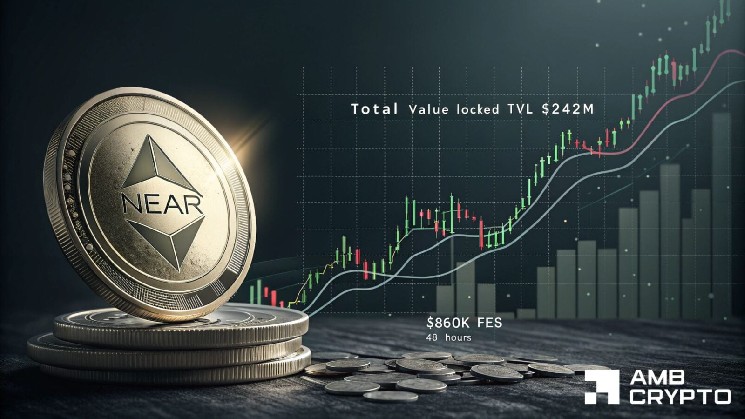
    • Network fundamentals hit record strength: Total Value Locked (TVL) reaches an all-time high of $242 million and protocol fees climb to $860,000 over the same period, per DefiLlama data.
    • NEAR satisfies all criteria for its anticipated milestone airdrop as of September 19, with TVL having crossed $70 million and price clearing $3.3, adding a fundamental catalyst to the technical breakout.

    NEAR Protocol Leads Crypto Market Rebound with Double-Digit Gains

    NEAR emerged as one of the cryptocurrency market’s biggest beneficiaries over the last 48 hours as the wider sector flashed green. The token recorded gains exceeding 10%, propelled by improving network activity that provided fundamental backing for the rally. This explosive bullish push cleared NEAR’s supply zone between $3.2 and $3.4 and printed a new local swing high at $3.9. With the token now trading above all key Exponential Moving Averages, market participants are assessing whether network bulls can sustain the momentum.

    On-Chain Fundamentals Underpin Price Surge

    Latest on-chain metrics reveal that fundamentals for NEAR Protocol have been robust over time. To be specific, the blockchain’s Total Value Locked set another record high of $242 million while network fees soared over the last 48 hours. This hike may be evidence that more capital is pouring into NEAR’s ecosystem. Additionally, NEAR protocol’s fees hit the $860,000-mark over the same period. Cumulatively, the hike in capital inflows into the network and fee generation may be a sign of growing activity across the ecosystem, according to data sourced from DefiLlama.

    Airdrop Milestone Adds Catalyst to Bullish Narrative

    Still, it is worth noting that 19th September marks the first day since NEAR ticked all the boxes for the anticipated milestone airdrop. The token’s TVL crossed the $70 million-mark two days ago while yesterday’s rally pushed the token’s price above $3.3. This convergence of technical breakout, record on-chain activity, and airdrop eligibility creates a multi-layered bullish case that distinguishes NEAR from peers relying solely on speculative momentum.

    Technical Outlook: Bulls Face Profit-Taking Test

    NEAR’s ability to maintain the prevailing momentum will depend on whether buyers continue to support the token after its 10% daily hike. A sustained rally alongside further growth in TVL and network fees would keep the bullish structure intact and could bring higher price levels into focus. Conversely, a rise in profit-taking could force NEAR to consolidate and retest nearby support. As it stands, the network’s long-term on-chain sentiments point to a potential bullish continuation. However, a short-term correction from the anticipated profit-taking cannot be ignored completely.

    Why This Matters

    The NEAR Protocol rally exemplifies a growing market trend where price action is increasingly tied to verifiable on-chain fundamentals rather than pure speculation. The simultaneous achievement of an all-time high in TVL ($242 million), a surge in protocol revenue ($860,000 in 48 hours), and the satisfaction of airdrop criteria signals genuine ecosystem adoption. For investors and developers, this suggests NEAR’s sharded proof-of-stake architecture is attracting meaningful capital and usage—critical for long-term viability in the competitive Layer-1 landscape. The upcoming days will test whether the protocol can convert speculative inflows into sticky liquidity, a key determinant of whether the $3.9 high becomes a launchpad or a local top.

    Frequently Asked Questions

    What triggered NEAR’s recent price surge above $3.9?
    The surge was driven by a combination of broad crypto market recovery, NEAR clearing a key $3.2–$3.4 supply zone, and strong on-chain fundamentals including record TVL of $242 million and $860,000 in protocol fees over 48 hours.
    Has NEAR qualified for its anticipated milestone airdrop?
    Yes, as of September 19, NEAR met all criteria for the milestone airdrop after TVL crossed $70 million and the token price surpassed $3.3.
    What are the key levels to watch for NEAR’s next move?
    Immediate resistance lies at the $3.9 local high, while support zones to watch on any pullback include the cleared supply area at $3.2–$3.4 and key Exponential Moving Averages now acting as dynamic support.
  • NEAR Protocol Marks 5 Years of 100% Uptime

    NEAR Protocol Marks 5 Years of 100% Uptime

    Key Highlights

    • NEAR Protocol achieved over 1 million transactions per second (TPS) in verified benchmarks while maintaining 100% uptime across five years of operation.
    • Dynamic resharding and post-quantum signing are now live, marking significant scalability and security upgrades for the layer-1 blockchain.
    • Technological milestones position NEAR as an infrastructure leader, potentially driving developer adoption and ecosystem growth amid mixed market signals.

    NEAR Protocol Sets New Performance Benchmarks With Million-TPS Throughput

    NEAR Protocol has announced a suite of infrastructure milestones that collectively underscore its positioning as a high-throughput, enterprise-grade layer-1 blockchain. The network recorded over 1 million transactions per second in verified benchmarking environments, a figure that places it among the highest-performing public blockchains by raw capacity. Equally notable, the protocol has sustained 100% uptime since its mainnet launch five years ago, a reliability metric that distinguishes it in an industry where network outages have affected several major competitors. The announcements were shared via the project’s official channels, accompanied by a link to the formal disclosure for community verification.

    Dynamic Resharding and Post-Quantum Cryptography Go Live

    Beyond raw throughput, NEAR has activated two architectural upgrades designed to future-proof the network. Dynamic resharding — a mechanism that allows the blockchain to adjust its shard count in real time based on demand — is now operational, enabling elastic scalability without requiring hard forks or manual governance interventions. Simultaneously, the network has implemented post-quantum signing, integrating cryptographic primitives resistant to quantum-computing attacks. These features reflect a deliberate strategy to address both present-day scalability bottlenecks and long-term cryptographic risk, catering to developers building applications that require predictable performance and forward-compatible security.

    Market Context: Technical Strength Amid Trading Lull

    Despite the technical fanfare, on-chain and exchange data show NEAR’s trading volume currently unavailable, suggesting a temporary lull in speculative activity. Analysts note that such disconnects between fundamental upgrades and short-term market attention are common in crypto cycles, particularly when macro conditions suppress risk appetite. However, the protocol’s role as a foundational layer for decentralized applications — emphasizing usability, low finality latency, and now quantum-resistant tooling — may attract builder mindshare over time. Projects seeking reliable infrastructure for high-frequency use cases, such as gaming, payments, or real-world asset tokenization, could increasingly evaluate NEAR’s stack as a viable alternative to more congested or less upgradeable networks.

    Why This Matters

    The convergence of million-TPS benchmarking, five-year uptime, live dynamic resharding, and post-quantum cryptography represents a rare full-stack maturity milestone in the layer-1 landscape. Most blockchains optimize for one or two of these dimensions; NEAR’s simultaneous progress across throughput, reliability, adaptive scaling, and cryptographic agility signals a platform engineered for production-grade workloads rather than speculative narratives. As the industry shifts toward modular architectures and application-specific chains, base layers that offer predictable performance and upgradeable security primitives are likely to capture disproportionate developer mindshare. NEAR’s roadmap — now demonstrably executing on these vectors — positions it to benefit from the next wave of institutional and enterprise blockchain adoption, where infrastructure robustness is a procurement requirement, not a marketing claim.

    Frequently Asked Questions

    What does NEAR Protocol’s 1 million TPS benchmark mean for real-world usage?

    The 1 million TPS figure was achieved in a verified benchmarking environment and represents theoretical peak capacity under optimized conditions. Actual application throughput will depend on smart contract complexity, network topology, and user behavior, but the headroom suggests NEAR can support high-frequency use cases — such as on-chain order books, real-time gaming, or micropayment streams — without congestion-induced fee spikes.

    How does dynamic resharding differ from static sharding used by other blockchains?

    Static sharding fixes the number of shards at launch or requires a hard fork to change, limiting flexibility. NEAR’s dynamic resharding allows the protocol to split or merge shards automatically in response to load, maintaining optimal resource utilization without governance delays or network disruptions. This elasticity is critical for handling unpredictable demand surges from viral applications or seasonal traffic patterns.

    Why implement post-quantum signing now when quantum computers remain experimental?

    Cryptographic migrations take years to standardize, deploy, and achieve ecosystem-wide adoption. By integrating post-quantum primitives today — specifically lattice-based signatures resistant to Shor’s algorithm — NEAR ensures that accounts and contracts created now remain secure against future quantum advances. This proactive approach aligns with NIST’s post-quantum cryptography standardization timeline and reduces the risk of a disruptive, emergency migration later.