Tag: La Monumental

  • What We Learned From Formula 1’s First Visit to the Madring

    What We Learned From Formula 1’s First Visit to the Madring

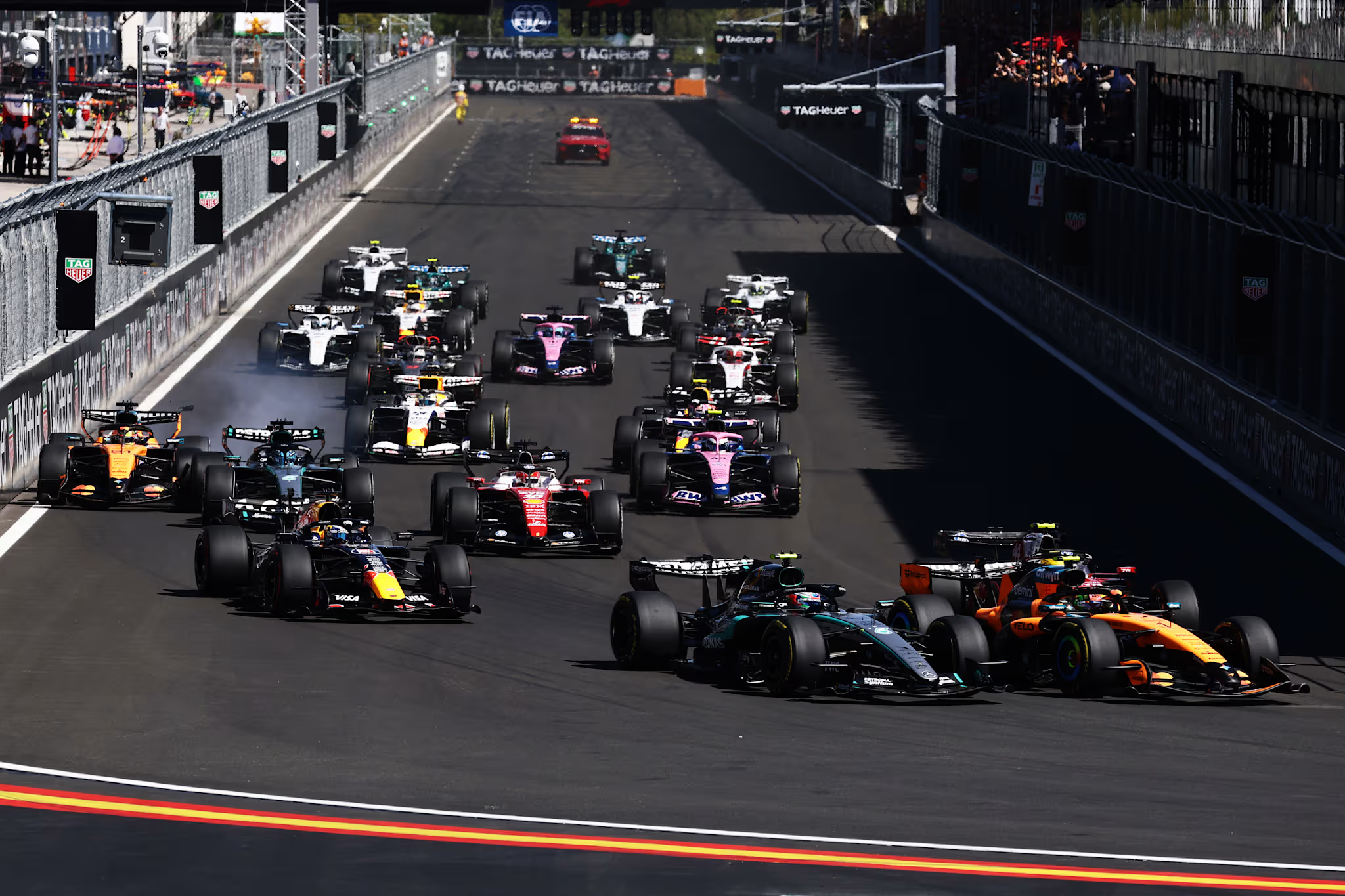
    The debut of a new circuit always injects a mix of adrenaline, curiosity, and trepidation into a Formula 1 weekend, and the Madring in Madrid delivered on every front. The inaugural Spanish Grand Prix at this venue offered immediate lessons on driver adaptation, tyre strategy, and the shifting dynamics of the 2026 title fight.

    How drivers tackled a fresh challenge

    While factors like weather swings and split‑second strategy calls always influence a race result, drivers usually rely on intimate knowledge of track layouts honed over years of simulator work and muscle memory. The Madring reset that familiarity. Despite extensive virtual preparation, the reality of a freshly laid surface, the proximity of the walls, and the electric atmosphere of the Spanish capital could only be absorbed once Free Practice 1 began on Friday afternoon.

    Home favourite Fernando Alonso described the layout as “very technical” and “attractive”, while several drivers drew parallels to Jeddah’s high‑speed, narrow character. Like its Saudi Arabian counterpart, the Madring showed its teeth early: Arvid Lindblad, Lewis Hamilton, and Ollie Bearman all ran into trouble during Free Practice. As the field found the initial limits, lap times tumbled dramatically — plummeting by more than two seconds between FP1 and Lando Norris’s stunning final qualifying effort.

    Tyre management proved decisive

    The ability to nurse tyres remains a cornerstone of race success, extending stint options and preserving grip for stability. At the Madring, that skill was tested severely. George Russell admitted after qualifying, “as the track has got faster, I’ve been struggling to get the most out of the tyres”, a deficit he believed cost him a shot at pole position and left him sixth on the grid.

    In the Grand Prix, Nico Hulkenberg secured just his third points finish of the season as Audi continued to close the gap to midfield rivals Racing Bulls and Alpine. The German highlighted that “managing the tyres and making sure you get to the end” made the difference on a day when the three teams showed “identical pace”. Lando Norris also excelled in tyre preservation — until a poorly timed Virtual Safety Car unravelled his race. He remained proud of his performance, stating: “The way I drive, the way I can look after the tyres and get lap time out of it, it’s giving me a lot of opportunities and I can do a better job than the others.”

    La Monumental lived up to its name

    Few corners punish Pirelli rubber as severely as La Monumental. This 550‑metre arena‑style section, flanked by up to 45,000 passionate fans and featuring a banking gradient of up to 24%, became a defining feature of the circuit. The variety of racing lines through the corner sparked heated moments, especially as it leads into a blind crest that demands immense courage to attack flat‑out.

    Another twist in the title fight

    It is rare to hear an F1 driver — among the most ruthless competitors in sport — concede that a rival deserved victory more than they did, yet that is exactly what unfolded in Madrid. Kimi Antonelli claimed his eighth win of the season, extending his Drivers’ Championship lead to a commanding 81 points. Despite the triumph, he remarked: “It’s good to win, but it doesn’t feel as good because I think Lando today deserved to win. But overall, you know, we’ll take it.”

    Antonelli’s assessment undersold his own drive: starting second, he overtook Norris during the pit stops and inherited the lead from Charles Leclerc after the Ferrari driver’s long opening stint ended with fewer than ten laps remaining. The 20‑year‑old then resisted pressure from both Norris and Max Verstappen to secure the most comfortable championship position of his career so far.

    The weekend also revealed a shift in mindset within the Mercedes camp. Team‑mate George Russell declared he is no longer “in the fight for the drivers’ title” after finishing fifth. Team principal Toto Wolff disagreed, stressing that anything can happen over the remaining rounds and that a “nice buffer” can evaporate quickly after a couple of crashes or retirements. With Norris on a scintillating run of form, Ferrari consistently close, and Russell operating with reduced pressure, the battle for the 2026 crown remains wide open.
  • Madring Circuit Guide: Everything You Need to Know

    Madring Circuit Guide: Everything You Need to Know

    Madrid’s Grand Prix History: From Jarama to the Madring Debut

    The 2026 Formula 1 season arrives at the Spanish Grand Prix this weekend, marking the highly anticipated debut of the Madring circuit. While this is the first time F1 has raced at the new Madrid venue, the Spanish capital boasts a rich history with the sport, having hosted the Spanish Grand Prix for the first time in 1968 at the Jarama circuit.

    Located approximately 30 kilometers north of the city center — significantly further out than the new Madring location — Jarama was introduced to the calendar in a shared rotation with Barcelona’s Montjuic Circuit. This arrangement was part of a concerted national effort to establish Spain as a fixture on the international motorsport stage.

    A tragic accident at Montjuic led to Madrid becoming the permanent host of the Spanish Grand Prix between 1976 and 1979, and once again in 1981. Those races produced victories for legends such as James Hunt and Mario Andretti. However, the event disappeared from the calendar for several years due to waning interest and challenging weather conditions. By the time the Spanish Grand Prix returned, Jerez and Barcelona had been selected as the preferred venues.

    Madring Circuit Layout: What Drivers Can Expect

    The short answer regarding the driving experience is that none of the competitors will know for certain until Free Practice 1 begins on Friday, September 11. However, the circuit layout and a useful test completed by Formula 3 provide valuable early indications.

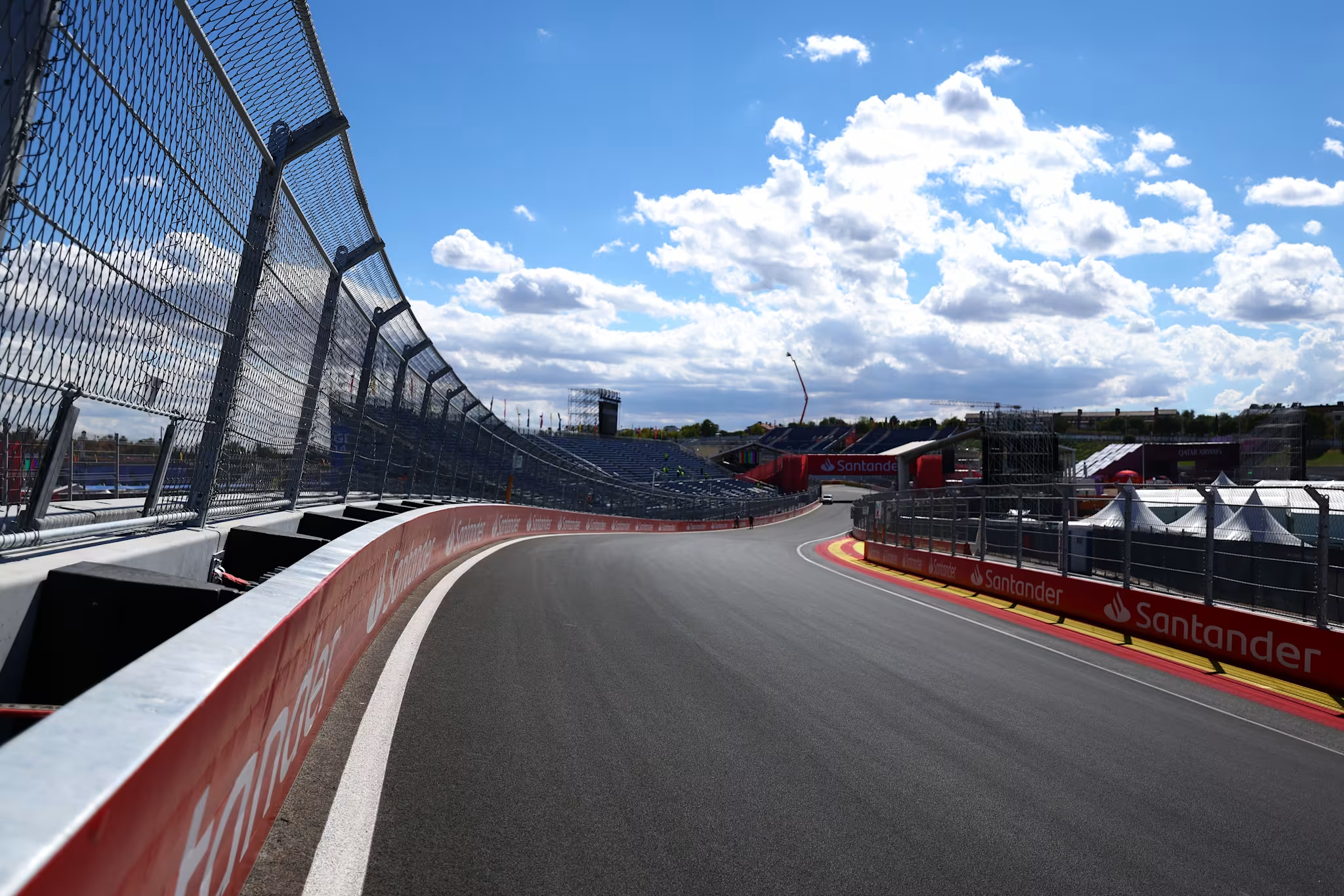
    The lap begins with a short run of roughly 200 meters down to Turn 1, before a right-hander launches drivers toward the third corner and onto the longest straight on the circuit. Speeds climb rapidly until a heavy braking zone arrives, accompanied by an elevation change and a blind apex at Turn 8.

    The street section concludes at this point, transitioning to the permanent track facility. A chicane sets up La Monumental — an ambitious and exhilarating banked curve featuring a 24% gradient. Thousands of spectators will line this section, where multiple racing lines are designed to encourage a variety of overtaking maneuvers.

    Another flat-out sequence of corners follows, but precision becomes paramount as the walls close in. The track then enters a twisty, technical complex culminating in a tight final corner that leads back onto the start/finish straight.

    Straight Mode Zones at the Madring

    As a reminder from the pre-season regulation summary, Straight Mode is a distinct aerodynamic configuration that allows cars to reduce drag, improving efficiency during high-speed acceleration.

    The rear wing opens a gap — similar to the former Drag Reduction System (DRS) — but now the front wing moves in synchronization. The uppermost front wing elements drop down simultaneously with the rear wing’s top element. This mode is deployed on every lap in dry conditions within designated areas, allowing the car to switch between two configurations: maximum downforce in corners and minimal drag on straights.

    At the Madring, there are two designated Straight Mode zones:

    • A run along the start/finish straight.
    • The section between Turns 3 and 4.

    Overtake Mode Detection and Activation Points

    Overtake Mode replaces DRS as a new power deployment strategy. It enables a driver to recover more electrical energy and access an additional electrical power profile, sustaining higher speeds for a longer duration.

    There is a single detection point per lap for this mode — typically positioned after the final corner leading onto a long straight. It becomes available on the following lap provided the driver remains within one second of the car ahead at that detection point.

    For the Madring, the Overtake Detection marker is situated just before the entry to Turn 22. The Overtake Activation line follows on the exit of that corner, heading onto the start/finish straight.

  • How to Stream the 2026 Spanish Grand Prix on F1 TV Premium

    How to Stream the 2026 Spanish Grand Prix on F1 TV Premium

    Formula 1 Debuts at Madring Circuit for 2026 Spanish Grand Prix: Complete Viewing Guide

    Formula 1 reaches Round 14 of the 2026 championship this weekend as the series makes its historic debut at the Madring circuit for the Spanish Grand Prix. Teams and drivers will tackle a brand-new layout featuring technical twisty sectors and a spectacular banked turn named La Monumental, creating an entirely unknown challenge for the paddock.

    How to Watch Every Session Live on F1 TV

    Comprehensive coverage of all track activity is available exclusively on F1 TV Pro. The service puts fans closer to the action with onboard cameras on all 22 cars, plus dedicated Pre-Race and Post-Race shows for every session.

    Supported Streaming Devices

    F1 TV Pro streams natively on all major platforms:

    • Apple TV
    • Chromecast (Generation 2 and newer)
    • Android TV
    • Google TV
    • Amazon Fire TV
    • Roku

    Major Changes for U.S. Viewers: Apple TV Partnership

    American fans will see a streamlined access model this season. Apple, now Formula 1’s Official U.S. Broadcaster, includes F1 TV free within its Apple TV subscription. The existing F1 TV broadcast team will front Apple TV’s English-language coverage, bringing their established expertise to a wider domestic audience.

    F1 TV Premium: The Ultimate Viewing Experience

    For viewers seeking maximum immersion, F1 TV Premium delivers:

    • 4K Ultra HD/HDR streaming on up to six simultaneous devices
    • Personalized Multiview with 26 selectable feeds on supported devices
    • Live coverage of every Grand Prix, Sprint, Qualifying, and practice session
    • Full access to F2, F3, F1 Academy, and Porsche Supercup races

    Exclusive On-Demand Programming

    Beyond live sessions, the platform features deep-dive series including Tech Talk Retro, exploring iconic car designs from Formula 1 history, and F1 Icons, chronicling the careers of legendary drivers.

    Expanded Payment Options and Availability

    Global access improves with additional payment methods, including American Express. F1 TV Pro and Premium remain available in selected territories only. For regional broadcaster details, subscription information, and the complete Spanish Grand Prix schedule, visit the official F1 TV website.