Tag: Kraken

  • Breaking: Official Statement on Altcoin Triggers Volatility Spike

    Breaking: Official Statement on Altcoin Triggers Volatility Spike

    Pump.fun, the Solana-based platform known for streamlined token creation and memecoin trading, appears to be broadening its scope. On-chain data reveals the emergence of new trading pairs linked to traditional equities, signaling a potential pivot toward tokenized stock exposure.

    Stock-Linked Pairs Surface on Pump.fun

    Blockchain analytics indicate that currency pairs referencing stock prices have begun appearing on the Pump.fun interface. The platform has not yet issued a comprehensive official statement clarifying the nature of these assets. It remains uncertain whether the listings represent directly tokenized shares or synthetic derivatives that track equity price movements on-chain.

    Sector Momentum Builds Around Tokenized Equities

    The development coincides with accelerating interest in tokenized share products across the digital asset industry. Robinhood has rolled out tokenized stock offerings for European users, while xStocks, a venture linked to Kraken, is expanding in the same vertical. Additionally, the London Stock Exchange Group (LSEG) recently announced plans to develop blockchain-based representations of UK shares in partnership with Payward, the parent company of Kraken.

    PUMP Token Reacts with Heightened Volatility

    Following the appearance of the equity-linked pairs and the broader wave of tokenized stock announcements, the native PUMP token experienced a notable increase in trading volatility. Market participants are closely monitoring whether the integration represents a permanent product expansion or a limited test deployment.

  • Hyperliquid and Kraken Parent Explore Regulated U.S. Futures Launch

    Hyperliquid and Kraken Parent Explore Regulated U.S. Futures Launch

    Hyperliquid Labs and Payward, the parent company of Kraken, are in advanced discussions to offer selected Hyperliquid-linked perpetual futures to U.S. traders through Bitnomial, a derivatives exchange regulated by the Commodity Futures Trading Commission (CFTC).

    Hyperliquid may reach U.S. traders through Bitnomial

    Bloomberg reported on Aug. 31 that Hyperliquid Labs and Payward are considering a structure that would list selected crypto perpetual futures on Bitnomial, the U.S. derivatives exchange owned by Kraken’s parent company.

    Under the proposed arrangement, eligible U.S. customers would trade the contracts through Bitnomial instead of connecting directly to Hyperliquid’s decentralized platform. The companies have not disclosed which assets would be included, how many contracts could be listed, or whether $HYPE would be among the underlying tokens.

    According to Bloomberg, Payward has already presented the Commodity Futures Trading Commission with an outline of the arrangement. Regulatory clearance is still required, and the companies have not announced a launch date or commercial terms.

    Bitnomial would provide the U.S. trading venue, customer access, and compliance infrastructure. Hyperliquid technology would support the assets or markets linked to the selected products, separating the regulated contracts from the permissionless platform used by the protocol’s existing customers.

    U.S. users remain unable to access Hyperliquid directly. An August filing cited in earlier coverage of the protocol said the platform continued to restrict U.S. users. It also said Hyperliquid Strategies was not aware at the time of any pending CFTC approval process for the network.

    The discussions do not represent approval for Hyperliquid itself to operate as a U.S. exchange. Instead, Bloomberg’s reported structure would place any American trading activity within Bitnomial’s regulated system and limit access to contracts selected for that venue.

    Payward controls a complete U.S. derivatives platform

    Payward completed its acquisition of Chicago-based Bitnomial on May 1. The transaction had initially been valued at up to $550 million in cash and stock, although the final price was not disclosed.

    The acquisition gave Payward control of a designated contract market, a derivatives clearing organization, and a futures commission merchant. Together, the three CFTC-regulated entities allow Bitnomial to provide exchange trading, clearing, and brokerage services within one corporate group.

    As crypto.news previously reported, Bitnomial spent more than a decade securing the licenses required to operate that structure. Payward said when the acquisition was announced that Bitnomial would retain its regulatory framework and continue serving third-party clients after joining the company.

    The infrastructure has already supported Kraken’s U.S. expansion. In June, Kraken introduced perpetual futures for eligible American clients through Bitnomial, placing the contracts alongside spot, margin, and traditional futures products on Kraken Pro.

    Kraken said customers could use a single collateral pool across perpetual futures and other derivatives positions. John Palmer, Kraken’s global head of derivatives, said the arrangement reduced the need for traders to split capital and positions across separate platforms.

    Perpetual futures differ from dated futures because they have no fixed expiration date. Recurring funding payments between long and short traders help keep the contract price close to the value of its reference asset.

    The format is common on offshore exchanges and decentralized platforms, but federal derivatives rules have historically limited U.S. access. Bitnomial’s involvement could give American traders access through a supervised exchange without opening Hyperliquid’s full range of onchain markets to U.S. customers.

    CFTC review will shape the final structure

    The CFTC would be the primary federal regulator for the proposed crypto derivatives because Bitnomial operates under the Commodity Exchange Act. Depending on the final structure and the assets referenced, regulators would need to determine how the contracts should be classified and whether the listing process satisfies applicable exchange requirements.

    Groups linked to Hyperliquid are already engaging U.S. regulators on related issues. In an Aug. 24 comment letter, the Hyperliquid Policy Center asked the Securities and Exchange Commission and the CFTC to recognize qualifying cash-settled equity perpetuals as security futures.

    The group argued that regulators should first examine how a derivative is structured and traded before using its underlying asset to divide oversight. Under its proposal, futures-like perpetual contracts tied to individual stocks would fall under the security futures framework jointly administered by the SEC and CFTC.

    According to the policy center, HIP-3 markets using Hyperliquid infrastructure processed more than $480 billion in cumulative notional volume during their first 10 months. The markets use central limit order books and continuous margin, while funding payments help align perpetual contract prices with their reference assets.

    The proposed Payward arrangement concerns selected crypto contracts, not unrestricted access to HIP-3 or the broader Hyperliquid platform. Bloomberg did not report that the SEC is involved in the discussions, and neither Payward nor Hyperliquid has published a list of the proposed contracts.

    U.S. regulators would also expect the regulated venue and its intermediaries to apply customer identification, anti-money laundering, and sanctions controls. Those requirements differ from the permissionless access model used by decentralized trading protocols.

    $HYPE extends its August rally

    $HYPE traded at about $84.50 when checked, up roughly 3% over 24 hours after recovering from an earlier decline. The token had gained more than 60% since the start of August, although available reports did not establish that expectations of U.S. access were responsible for the entire monthly advance.

    Hyperliquid processes more than $4 billion in daily trading volume, according to figures cited in the original report. Any Bitnomial offering would cover only a selected portion of Hyperliquid-linked markets. The companies have not disclosed whether revenue from the U.S. contracts would flow to the protocol or affect $HYPE’s existing token-buyback system.

  • Ripple Overtakes Kraken as Top Holding in NYSE-Traded C1 Fund Portfolio

    Ripple Overtakes Kraken as Top Holding in NYSE-Traded C1 Fund Portfolio

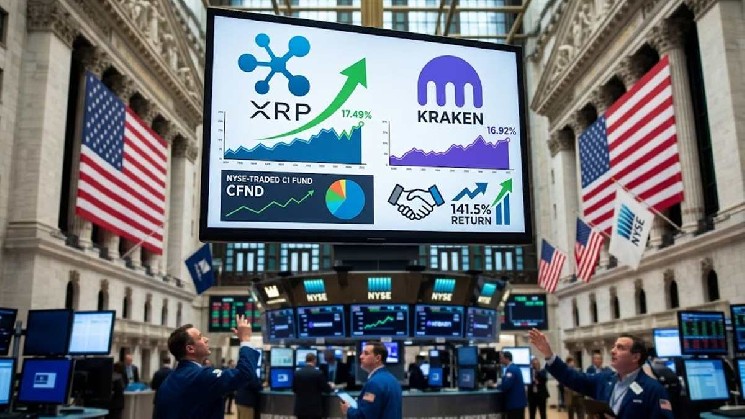
    Ripple Labs has become the largest holding in C1 Fund’s portfolio, accounting for 17.49% of net assets and moving ahead of Payward Inc., the parent company of Kraken, at 16.92%.

    C1 Fund had invested $41.3 million across 11 private digital-asset companies as of June 30, 2026, according to the fund’s second-quarter update. The fund trades on the New York Stock Exchange under the ticker CFND and focuses on secondary-market investments in late-stage private companies involved in digital-asset infrastructure and related services.

    Ripple Becomes C1 Fund’s Top Holding

    Ripple’s increased portfolio weighting was partly driven by a company share buyback. C1 Fund said the partial buyback generated a 141.5% return on the portion of its Ripple investment included in the transaction over approximately four months.

    The result reflects the return from the buyback rather than simply indicating that C1 Fund purchased additional Ripple shares during the quarter.

    Interest in private-market exposure to Ripple is also growing among traditional investment firms. Kinetics Internet Portfolio reported holding 1,875 Class A Ripple shares valued at approximately $246,319 as of June 30. The position represented about 0.1% of the fund’s $248.3 million in net assets and was classified as a Level 3 asset because Ripple remains a privately held company.

    Ripple equity and $XRP are separate investments. Ripple shares represent an ownership interest in the private company, while $XRP is a separate digital asset. Institutional participation in both markets nevertheless reflects broader acceptance of crypto-related financial products.

    Institutional Investors Increase $XRP ETF Exposure

    Institutional demand is also expanding through $XRP exchange-traded products. Goldman Sachs disclosed approximately $86.5 million invested across five spot $XRP ETFs as of June 30, after reporting no exposure to $XRP ETFs at the end of the previous quarter.

    The holdings included products from Bitwise, Franklin Templeton, Canary Capital, 21Shares and Grayscale.

    The wider digital-asset sector is also moving closer to the public markets. BitGo completed its initial public offering in January, while Kraken and Blockchain.com have confidentially filed IPO registration statements with the U.S. Securities and Exchange Commission, according to C1 Fund’s update.

  • KuCoin Can Block Your Crypto Transactions Even If You Never Sent Funds to 17 Sanctioned Platforms

    KuCoin Can Block Your Crypto Transactions Even If You Never Sent Funds to 17 Sanctioned Platforms

    KuCoin Expands Sanctions Screening to Indirect Crypto Transfers Across 17 Platforms

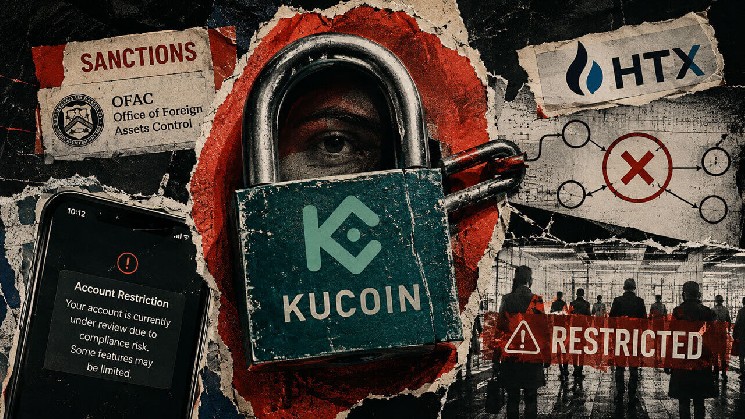
    KuCoin has broadened its sanctions compliance framework to cover indirect cryptocurrency transfers involving 17 platforms, including the Justin Sun-linked $HTX. The policy, outlined in an August 27 compliance notice, means users may face transaction holds or rejections even when they do not interact directly with a listed entity.

    Platforms Covered by the New Restrictions

    The affected platforms include:

    • Shelbit
    • Aban Tether
    • A7 Nigeria
    • A7 Africa
    • PilotFinance
    • Rapira
    • Aifory Pro
    • ABCeX
    • WhiteBird
    • NoOnecrypto
    • Tradex
    • Monease
    • BitPapa
    • Exnode
    • Exnode Pay
    • EXMO
    • $HTX (Huobi Global SA)

    How Indirect Screening Works

    Under the updated policy, KuCoin may screen the source of funds, originating and destination addresses, and intermediary service providers for connections to the listed entities. Transactions attempted to these platforms may undergo enhanced review or trigger temporary wallet and account restrictions. Repeated or serious violations could ultimately lead to suspension or withdrawal of KuCoin services for the user.

    The controls broadly align with recent U.S. and European sanctions actions, but their reach extends beyond direct counterparties. KuCoin has not disclosed how many transaction hops it traces or what level of on-chain attribution is sufficient to establish an indirect connection.

    $HTX Faces Growing Isolation From Major Exchange Rails

    $HTX is the most consequential name on KuCoin’s list by scale and is already facing similar restrictions elsewhere. Binance stopped processing transactions involving $HTX and 10 other platforms from August 23 as part of its own sanctions-compliance measures. This narrows the routes through which $HTX-linked funds can move across major exchanges even as $HTX itself remains operational.

    Corporate Identity Dispute

    $HTX continues to dispute the sanctions-related allegations and the corporate identity behind the designation. The EU regulation names “$HTX (Huobi Global SA)”, a label also used by KuCoin. However, $HTX said in May that Huobi Global S.A. is distinct from the online $HTX exchange.

    Meanwhile, the Justin Sun-linked exchange said it is pursuing legal and compliance discussions with authorities in the UK and EU as some users report funds being frozen on third-party platforms, including Kraken. $HTX said it has submitted materials relating to 17 Kraken user freeze cases to the courts and is working to reduce disruptions affecting customers.

    Operational Updates From $HTX

    Molly, $HTX’s head of markets, said the exchange processed more than 100,000 deposit and withdrawal transactions over two days without identifying new cases of indiscriminate freezes. She also said $HTX recently upgraded its wallet infrastructure and introduced a withdrawal-address rotation mechanism. The exchange described the changes as a security measure intended to reduce disruption from third-party risk controls and on-chain labeling.

    Implications for Users and Transaction Provenance

    For users, the practical effect is increasingly clear. Funds linked to $HTX or another listed provider can face restrictions before they reach KuCoin, depending on the transaction path and the intermediaries involved. That pushes sanctions enforcement beyond direct counterparties and deeper into transaction provenance, with exchanges increasingly assessing where funds originated, where they are headed, and which services they touched along the way.