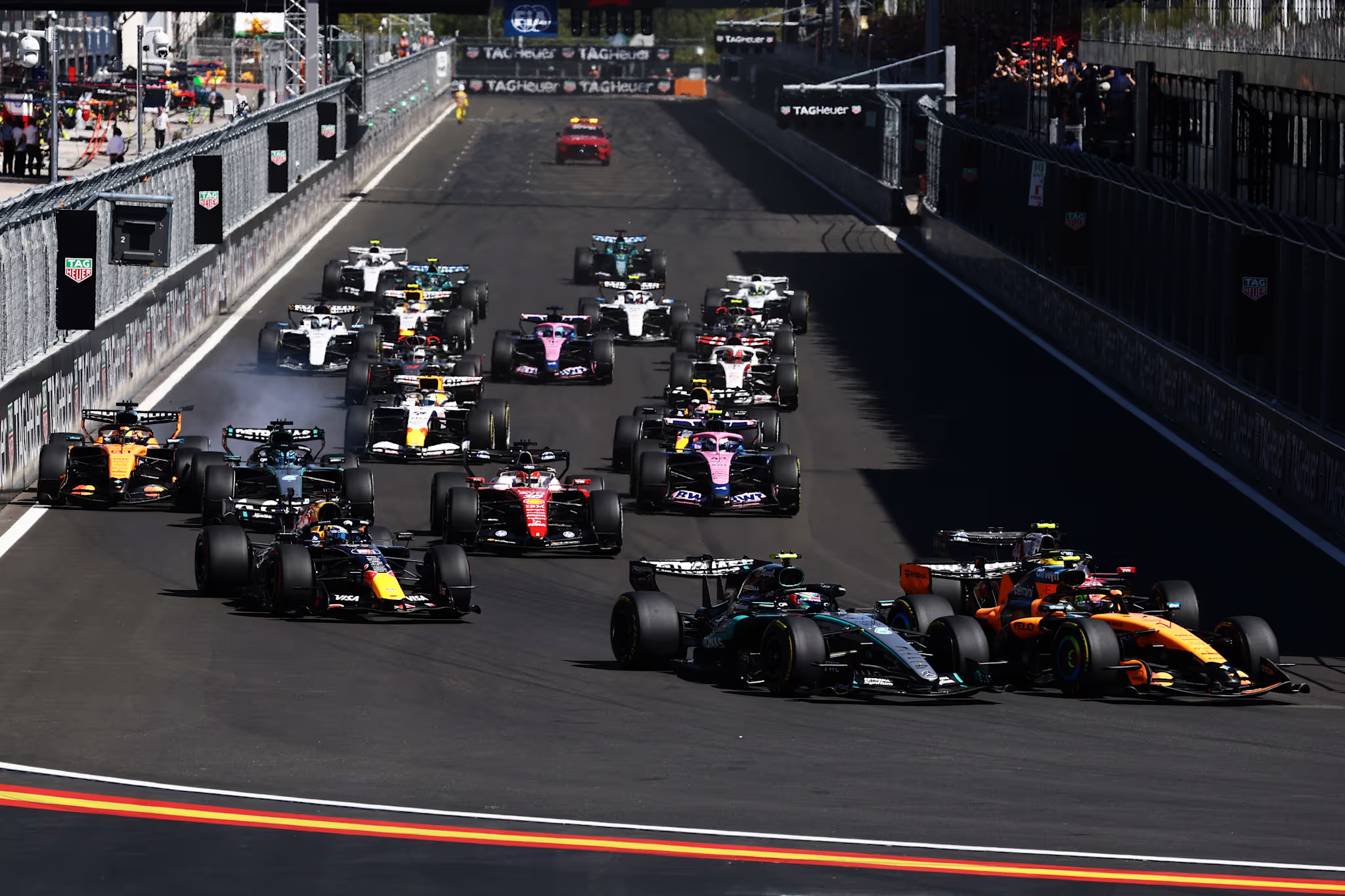
Tag: Kimi Antonelli

  • How to Stream the 2026 Azerbaijan Grand Prix on F1 TV Premium

    How to Stream the 2026 Azerbaijan Grand Prix on F1 TV Premium

    Key Highlights

    • Kimi Antonelli leads the 2026 Formula 1 Drivers’ Championship by 81 points heading into the Azerbaijan Grand Prix at the Baku City Circuit.
    • Apple becomes Formula 1’s new Official U.S. Broadcaster, with F1 TV included free within Apple TV subscriptions and the F1 TV broadcast team fronting English-language coverage.
    • F1 TV Premium offers 4K Ultra HD/HDR streaming on up to six devices with a 26-feed Multiview feature, plus access to F2, F3, F1 Academy, and Porsche Supercup sessions.

    Azerbaijan Grand Prix Sets Stage for Championship Showdown in Baku

    The 2026 Formula 1 season arrives at the Baku City Circuit this weekend for the Azerbaijan Grand Prix, with championship leader Kimi Antonelli looking to extend his commanding advantage on the streets of Baku. The Mercedes driver enters the round with an 81-point lead at the top of the drivers’ standings following his victory at the Spanish Grand Prix in Madrid, positioning him as the clear favorite to add another triumph to his growing tally.

    Lando Norris, the reigning World Champion, arrives in Azerbaijan seeking redemption after a cruel twist of fate in Spain. The McLaren driver missed out on a potential race win when his pit stop coincided with the conclusion of a Virtual Safety Car phase, costing him critical track position. Norris will be keen to bounce back on a circuit that has historically produced unpredictable racing and dramatic momentum shifts.

    F1 TV Expands Access with Apple Partnership in United States

    Formula 1’s streaming platform is undergoing a significant transformation in the United States. Apple has been named Formula 1’s new Official U.S. Broadcaster, with F1 TV now included for free within Apple TV subscriptions. This strategic partnership streamlines access for American fans while enhancing the overall viewing experience. The established F1 TV broadcast team will primarily front Apple TV’s English-language coverage, bringing their expertise and insight to a substantially wider U.S. audience.

    For viewers seeking the premium experience, F1 TV Premium delivers races in 4K Ultra HD/HDR across up to six simultaneous devices. A personalized Multiview feature—available on select devices—offers 26 different feeds to choose from, allowing fans to curate their own race perspective. The platform also provides comprehensive coverage of every Formula 1 Grand Prix, Sprint, Qualifying, and practice session, alongside live streams of F2, F3, F1 Academy, and Porsche Supercup events.

    Enhanced Content Library and Global Payment Options

    Beyond live race coverage, F1 TV continues to expand its on-demand library with in-depth programming. Tech Talk Retro examines iconic car designs from Formula 1’s history, while F1 Icons chronicles the careers of legendary drivers from past eras. The service has also broadened its payment infrastructure, now accepting American Express among other methods to facilitate easier global access for subscribers.

    F1 TV Pro and Premium remain available in selected locations only. Fans can check regional broadcaster details and session times for the Azerbaijan Grand Prix through official Formula 1 channels.

    Why This Matters

    The Azerbaijan Grand Prix represents a critical inflection point in the 2026 championship. With an 81-point cushion, Antonelli holds a near-insurmountable lead with more than half the season remaining, though Baku’s history of safety cars and high-attrition races means no lead is truly secure. Simultaneously, Formula 1’s U.S. media rights shift to Apple signals the sport’s accelerating push into mainstream American streaming ecosystems, potentially reshaping how millions of new fans discover and consume F1 content. The integration of F1 TV into Apple’s subscription bundle removes a significant friction point for casual viewers, while the Premium tier’s 26-feed Multiview caters to the hardcore enthusiast demographic that drives sustained engagement.

    Frequently Asked Questions

    How can I watch the Azerbaijan Grand Prix in the United States?

    In the U.S., the Azerbaijan Grand Prix will be available on Apple TV, which now includes F1 TV free with an Apple TV subscription. The F1 TV broadcast team will front the English-language coverage on Apple’s platform.

    What is the difference between F1 TV Pro and F1 TV Premium?

    F1 TV Pro provides live coverage of every session with exclusive features like onboard cameras for all 22 cars and Pre-Race/Post-Race shows. F1 TV Premium adds 4K Ultra HD/HDR streaming on up to six devices, a 26-feed Multiview feature on select devices, and access to F2, F3, F1 Academy, and Porsche Supercup sessions.

    Is F1 TV available worldwide?

    F1 TV Pro and Premium are available in selected locations only. Fans should check the official Formula 1 website for details of broadcasters in their specific area.
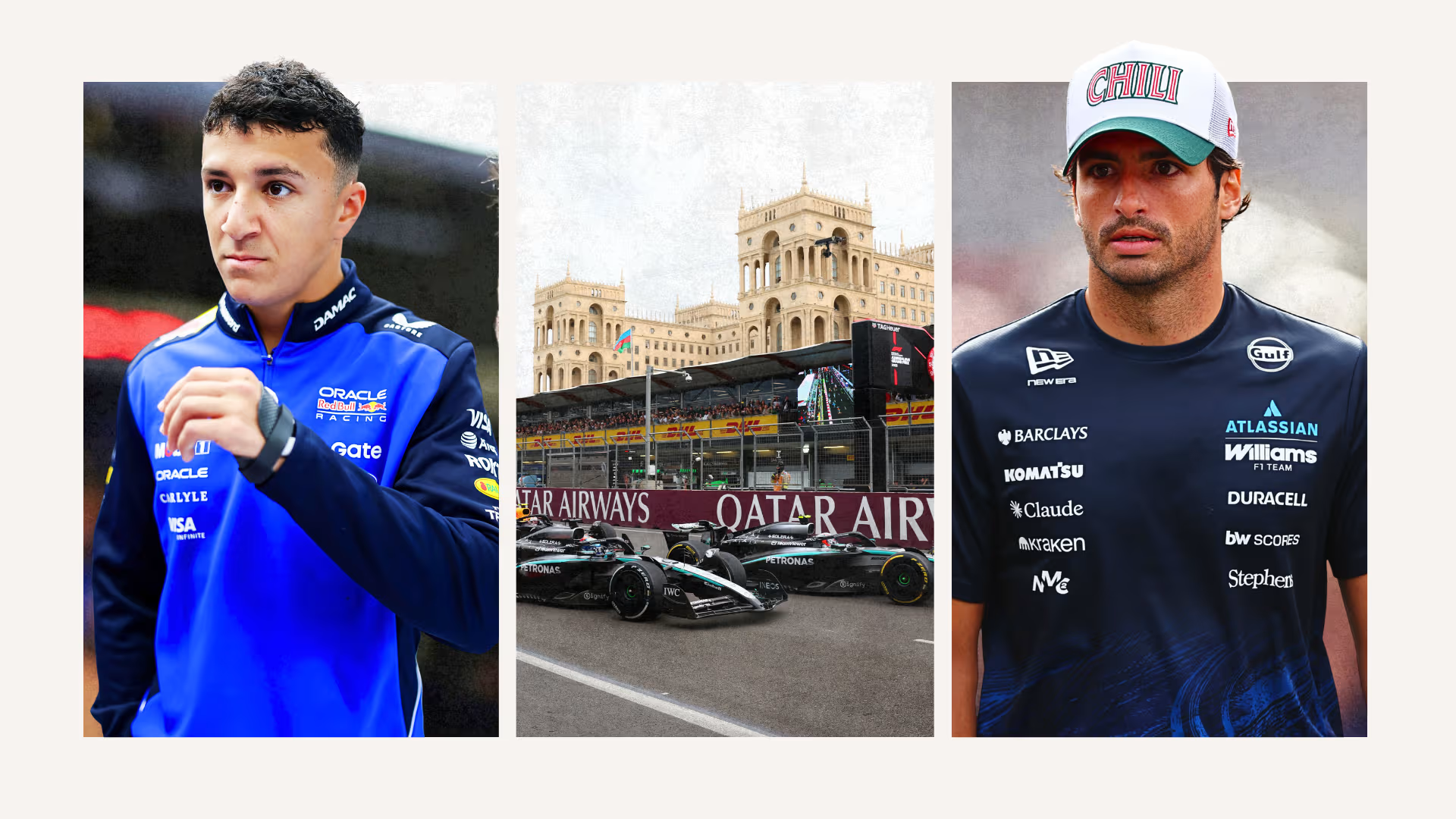
  • Race Week: 5 Storylines to Watch Ahead of the 2026 Azerbaijan Grand Prix

    Race Week: 5 Storylines to Watch Ahead of the 2026 Azerbaijan Grand Prix

    Key Highlights

    • The 2026 Formula 1 season enters a decisive phase with the first of three consecutive triple-headers beginning at the Azerbaijan Grand Prix in Baku, where Kimi Antonelli leads the Drivers’ Championship for Mercedes.
    • Isack Hadjar may return to the Red Bull seat after missing three rounds with a wrist injury, though the team insists they will not rush his recovery ahead of a grueling three-race stretch.
    • Williams debut a long-planned upgrade package in Baku aiming to climb from ninth in the Constructors’ standings, while Formula 2 hosts a pivotal double-header with the title fight finely balanced among four drivers.

    Triple-Header Gauntlet Begins in Baku as Championship Momentum Builds

    The 2026 Formula 1 season shifts into its most demanding phase this weekend as the Azerbaijan Grand Prix launches the first of three consecutive triple-headers. With nine races compressed into eleven weeks, the schedule offers little margin for error and amplifies the significance of every development — on track and off. Kimi Antonelli arrives at the Baku City Circuit leading the Drivers’ Championship after winning the previous two rounds, giving Mercedes a psychological edge even as the team acknowledges its early-season performance advantage has eroded. The Italian rookie’s consistency has made him the benchmark, but the unique demands of Baku’s street layout — where barrier-kissing precision meets a 2.2-kilometre straight that invites late-braking overtakes — could reshuffle the competitive order.

    Hadjar Recovery Monitored Closely as Red Bull Prioritize Long-Term Health

    Isack Hadjar has not raced for Red Bull since sustaining a wrist injury during the summer shutdown, forcing him to miss the Zandvoort, Monza, and Madrid rounds. Liam Lawson has deputised at the senior team, with Yuki Tsunoda moving up to VCARB in a chain reaction that has reshaped Red Bull’s driver deployments. A two-week gap since Madrid has increased optimism regarding Hadjar’s potential return in Azerbaijan, but the team has been unequivocal: he will only resume driving once medical clearance confirms full recovery. Given that Baku begins a triple-header — followed by races in Singapore and Austin — any premature return risks aggravating the injury during a stretch with minimal recovery windows. Team officials have indicated an update is expected in the coming days, making Hadjar’s status one of the most closely watched storylines heading into the weekend.

    Williams Unveil Critical Upgrade Package Amid Constructors’ Battle

    Williams arrive in Baku with a substantial upgrade package telegraphed months in advance, a rare instance of a team publicly committing to a development timeline. The Grove-based squad sits ninth in the Constructors’ Championship, six points behind Audi and ten adrift of seventh-placed Haas. The 2026 season was internally targeted as a return to midfield competitiveness, but results have fallen short of expectations. Technical Director Pat Fry’s development group has focused the Baku package on aerodynamic efficiency and mechanical grip — areas where the FW48 has struggled relative to rivals. Beyond immediate points gains, the upgrade serves as a validation of Williams’ development trajectory; a clear step forward would confirm the team’s engineering direction is sound ahead of the 2027 regulation cycle.

    Mercedes Manage Upgrade Cadence While Defending Championship Lead

    Mercedes have been transparent about their constrained upgrade cadence this season, a consequence of prioritising the launch specification that dominated the opening rounds. While that early advantage has diminished, the team remains firmly in the championship hunt — Antonelli’s back-to-back victories underscore the W15’s underlying potential. Mercedes confirmed last week that new components will debut at the following round in Malaysia, meaning Baku represents another weekend where the Silver Arrows must extract maximum performance from their current package. McLaren, Ferrari, and Red Bull have all introduced updates more frequently, applying relentless development pressure. How Mercedes manage this defensive phase — balancing resource allocation between current and future cars — will be a defining strategic narrative of the triple-header period.

    Driver Market Stagnates Despite Impending Contract Deadlines

    While the on-track calendar accelerates, the 2027 driver market has scarcely moved since the Zandvoort announcements, which included Max Verstappen’s contract extension and the retention of both Williams drivers. Haas remain the most conspicuous open seat, having evaluated Ryo Hirakawa, Rafael Camara, Leonardo Fornaroli, and Jack Doohan across a month of testing. No decision is imminent. Fernando Alonso’s future continues to dominate paddock speculation; the double World Champion is widely expected to remain with Aston Martin, yet his home race in Madrid passed without an announcement. Racing Bulls also represent a potential flashpoint, though their current line-up appears stable. The lack of movement is unusual for this stage of the season and suggests teams are awaiting clarity on 2027 power unit regulations or key driver decisions before committing.

    Saturday Race and Revised Schedule Mark Baku’s Tenth Anniversary

    This year marks a decade since Formula 1’s first visit to Azerbaijan in 2016, and the milestone edition arrives with a scheduling anomaly: the Grand Prix will be contested on Saturday, 26 September, rather than the traditional Sunday. The shift avoids a clash with Azerbaijan’s Remembrance Day on 27 September, compressing the entire weekend by 24 hours. Media obligations move to Wednesday, practice to Thursday, qualifying to Friday, and the race to Saturday. The format change compresses preparation time for teams and broadcasters alike, while the circuit itself remains unchanged — a 6.003-kilometre street layout that combines a hyper-technical castle section with the longest flat-out section on the calendar. Overtaking into Turn 1 is frequent, and races have historically been decided in the final metres of the final lap. The Saturday slot adds novelty to an already unpredictable venue.

    Formula 2 Title Fight Reaches Crescendo with Double-Header Format

    Support category action amplifies the weekend’s stakes as Formula 2 adopts a double-header format mirroring Formula 3’s season finale at the Madring. Two qualifying sessions on Thursday set the grids for a Friday morning Sprint Race and a Friday afternoon Feature Race preceding Formula 1 qualifying. A second Feature Race on Saturday leads into the Grand Prix. The championship battle is exceptionally tight: Red Bull junior Nikola Tsolov leads Ferrari academy driver Rafael Camara by just seven points. Alpine-backed Gabriele Mini sits 24 points behind Tsolov — within a single race victory — while team-mate Alex Dunne remains a mathematical contender at 38 points adrift. Baku’s history of chaotic, safety-car-influenced races makes it a potential title decider; the double-header format doubles the scoring opportunities and the risk.

    Why This Matters

    The Azerbaijan Grand Prix sits at a rare convergence of sporting, technical, and commercial inflection points. For the Drivers’ Championship, the triple-header sequence will test consistency and resilience over a compressed timeframe where a single mechanical failure or driving error carries disproportionate weight. Antonelli’s lead is slender in real terms; the circuits to come — Baku, Singapore, Austin — demand vastly different car characteristics, favouring no single team philosophy. For constructors, Williams’ upgrade represents a litmus test for midfield ambition: success could trigger a development arms race among Audi, Haas, and Alpine, while failure may force a strategic pivot toward 2027. The driver market’s inertia is equally significant; with fewer than ten races remaining, teams without confirmed 2027 line-ups risk losing preferred candidates to rival series or academy promotions. Finally, the Saturday race format — while a one-off — offers Formula 1 data on condensed weekend structures, a concept under study for future calendar compression. Baku, then, is not merely the next race; it is a stress test for the sport’s competitive, technical, and operational frameworks.

    Frequently Asked Questions

    Why is the Azerbaijan Grand Prix taking place on a Saturday?
    The race has been moved forward by 24 hours to avoid a clash with Azerbaijan’s Remembrance Day on 27 September. The entire weekend schedule shifts accordingly: media day on Wednesday, practice Thursday, qualifying Friday, and the Grand Prix on Saturday.
    Will Isack Hadjar race for Red Bull in Baku?
    Hadjar has missed the last three rounds with a wrist injury. A two-week break since Madrid increases the likelihood of his return, but Red Bull have stated he will only drive once fully cleared medically. An update is expected before the weekend.
    How close is the Formula 2 championship battle heading into Baku?
    Nikola Tsolov leads Rafael Camara by seven points. Gabriele Mini is 24 points behind the leader, and Alex Dunne trails by 38 points. With a double-header format offering two Feature Races, the title fight could swing dramatically this weekend.
  • Formula 1 2026 Azerbaijan Grand Prix: Start Time and How to Watch

    Formula 1 2026 Azerbaijan Grand Prix: Start Time and How to Watch

    Key Highlights

    • Formula 1 heads to the Baku City Circuit for the 2026 Azerbaijan Grand Prix, with the race scheduled for Saturday, September 26 at 15:00 local time.
    • Kimi Antonelli holds a commanding 81-point lead in the drivers’ championship after his Madrid victory, while Lando Norris seeks redemption after missing a potential win from pole position.
    • Formula 2 continues its 2026 campaign in Baku for Round 12 with championship leader Nikola Tsolov in action across a packed support-race schedule beginning Thursday, September 24.

    Formula 1 Arrives in Baku for Critical Championship Weekend

    The Formula 1 circus touches down in Azerbaijan this week for the ninth running of the Azerbaijan Grand Prix at the Baku City Circuit, marking the venue’s 10th Formula 1 outing since its debut as the European Grand Prix in 2016. The street circuit, renowned for its dramatic blend of high-speed straights and tight, twisty sections winding through the city’s historic old town and medieval walls, sets the stage for a pivotal weekend in the 2026 championship battle.

    Championship Dynamics: Antonelli Extends Lead, Norris Hunts Redemption

    Kimi Antonelli arrives in Baku with a formidable 81-point advantage at the top of the drivers’ standings following his victory at the previous round in Madrid. That race delivered a significant twist: polesitter Lando Norris, driving for McLaren, failed to convert his grid position into a win, handing Antonelli a crucial psychological and numerical edge. The McLaren driver will be desperate to bounce back on a circuit that has historically produced unpredictable outcomes, while Antonelli aims to continue his commanding run of form and tighten his grip on the title.

    Baku’s Unique Challenge and Historical Winners

    The Baku City Circuit’s distinctive layout—looping around the Caspian Sea waterfront and through the narrow streets of the old town—has consistently tested driver precision and car reliability. Over the years, only two drivers have managed multiple victories at this venue: Sergio Perez and Max Verstappen, both of whom have stood on the top step of the podium twice. Their success underscores the circuit’s demand for a blend of outright speed, tire management, and race craft, qualities that will be essential again this weekend.

    Session Schedule and Global Broadcast Details

    The weekend kicks off unusually early with Free Practice 1 on Thursday, September 24 at 12:30 local time, followed by Free Practice 2 at 16:00. Friday, September 25 sees Free Practice 3 at 12:30 and Qualifying at 16:00, setting the grid for the Grand Prix itself on Saturday, September 26 at 15:00 local time. Comprehensive global start times for all sessions are available via the official Formula 1 race hub.

    Fans can watch every session live on F1 TV Pro (available in selected territories), which offers ad-free coverage, onboard cameras from all 22 cars, and pre- and post-race shows in six languages. The service streams via Apple TV, Chromecast (Gen 2+), Android TV, Google TV, Amazon Fire TV, and Roku. For an enhanced experience, F1 TV Premium provides 4K Ultra HD/HDR streaming on up to six devices simultaneously, plus a personalized Multiview feature with 26 selectable feeds on compatible devices. The platform also includes live coverage of F2, F3, F1 ACADEMY, and Porsche Supercup sessions. Live timing remains accessible on F1.com and the official F1 app throughout the weekend.

    Weather Outlook and Formula 2 Support Action

    Current forecasts indicate mild and dry conditions for the Azerbaijan Grand Prix weekend, though the circuit’s proximity to the Caspian Sea often brings gusty winds that have caught out drivers in previous years. Teams will need to monitor aerodynamic balance closely, particularly during qualifying and the race.

    While Formula 3 concluded its season in Spain, the 2026 Formula 2 championship moves to Baku for Round 12. Championship leader Nikola Tsolov heads the field into a packed schedule: Qualifying, Practice, and Qualifying 2 all take place on Thursday, September 24. The Sprint Race runs Friday, September 25 at 08:15 local time, followed by Feature Race 1 at 14:15. Feature Race 2 is set for Saturday, September 26 at 11:00, providing a full day of junior single-seater action ahead of the Formula 1 Grand Prix.

    Why This Matters

    The Azerbaijan Grand Prix represents a critical juncture in the 2026 Formula 1 season. With Kimi Antonelli holding an 81-point championship lead, the pressure mounts on rivals—particularly Lando Norris and McLaren—to close the gap before the calendar enters its latter stages. Baku’s history of safety cars, red flags, and strategic variability offers a prime opportunity for a momentum shift. Additionally, the circuit’s status as a street venue with limited run-off areas amplifies the importance of qualifying performance and race-day execution. For Formula 2, Baku hosts a triple-header weekend that could decisively shape the title fight, with Nikola Tsolov aiming to extend his advantage under the unique pressure of two feature races in two days. The event also marks the continued evolution of F1’s broadcast strategy, with F1 TV Premium’s 4K Multiview offering a glimpse into the future of personalized motorsport consumption.

    Frequently Asked Questions

    When does the 2026 Azerbaijan Grand Prix race start?
    The Grand Prix starts on Saturday, September 26 at 15:00 local time at the Baku City Circuit. Global start times vary by time zone and are listed on the official Formula 1 race hub.
    How can I watch the Azerbaijan Grand Prix live?
    Live coverage is available on F1 TV Pro (ad-free, with onboards and multi-language commentary) and F1 TV Premium (4K UHD/HDR, Multiview, up to six devices). Both services stream via major smart TV platforms. Live timing is also free on F1.com and the F1 app.
    Who are the most successful drivers at the Baku City Circuit?
    Sergio Perez and Max Verstappen are the only drivers to have won multiple times in Baku, each with two victories. The circuit has produced a variety of winners since its 2016 debut as the European Grand Prix.
  • Mercedes Targets Pole Drought End with Malaysia F1 Upgrades

    Mercedes Targets Pole Drought End with Malaysia F1 Upgrades

    Key Highlights

    • Mercedes confirms its next major Formula 1 upgrade package will debut at the Malaysian Grand Prix on 2–4 October, targeting a return to pole-contending form.
    • Despite a commanding 145-point championship lead over Ferrari, the Silver Arrows have not claimed pole position since Kimi Antonelli topped qualifying at Spa in July.
    • Trackside engineering director Andrew Shovlin expects a “decent step” from the Malaysian updates but cautions the competitive gap to McLaren and Ferrari is now just one or two tenths.

    Mercedes Targets Malaysian Upgrade to Arrest Qualifying Slide

    Mercedes has confirmed that its next significant Formula 1 development package will arrive at the Malaysian Grand Prix on 2–4 October, marking the Asian venue’s return to the calendar in place of Bahrain. The German manufacturer enters the event with a substantial 145-point advantage over Ferrari in the 2026 Constructors’ Championship, a lead built despite the team’s last major upgrade being introduced at the Montreal round in May. Since then, Mercedes has relied on minor, circuit-specific updates while rivals Ferrari and McLaren have pursued more aggressive development programmes.

    That strategic conservatism has coincided with a shift in competitive momentum. After winning the opening six grands prix of the season, Mercedes has secured only four victories in the subsequent eight rounds, with McLaren and Ferrari each claiming two wins. More critically for a team historically defined by Saturday dominance, the Silver Arrows have not started from pole position since Kimi Antonelli set the pace at Spa-Francorchamps in July—a drought spanning four consecutive race weekends.

    Shovlin Details Baku Strategy and Upgrade Timeline

    Speaking on the Nu Silver Arrows Radio Show podcast, trackside engineering director Andrew Shovlin outlined the team’s immediate approach. With the Azerbaijan Grand Prix preceding Malaysia, Shovlin acknowledged limited new components for the Baku street circuit, emphasising its unique demands.

    “We haven’t got much new coming to Baku, but actually that’s a circuit that’s more about drag than downforce. So the car was good in Monza, hopefully it will work well in Baku. But, you need a car that can have a good straight line speed.”

    “There’s other things, though, you need in Baku, like the sort of street circuit nature, almost that Monaco-esque being able to deal with the low speed, keeping all the wheels on the ground.”

    Looking beyond the Caspian Sea venue, Shovlin confirmed the developmental focus shifts eastward.

    “And then the updates, well, they’re going to come Malaysia onwards and hopefully we’ll make a decent step. I don’t think we’re going to be out front by miles, but hopefully we’ll be back into a position where we can really go into qualifying, knowing that we’re fighting for pole.”

    Championship Lead Masks Growing Qualifying Deficit

    The disconnect between Mercedes’ race-day potency and its qualifying form is stark. Antonelli has converted the W15’s race pace into back-to-back victories at Monza and Madrid, yet the team finds itself on a pole-position drought that contrasts sharply with the opening phase of the campaign. In the three most recent rounds without a Mercedes pole, McLaren’s Lando Norris has topped the timesheets each time—a reversal from the first ten rounds where the Silver Arrows swept every pole position.

    Shovlin articulated the fine margins now defining the championship’s front row.

    “Early in the season, we tended to go thinking, we have a car that if we do a really good job, it should be on pole. We should be fighting for a race win. Whereas now the margin between finishing first and finishing sixth is one or two tenths and it’s difficult to predict because Monza is a unique track.”

    “It needs a car that’s quite slippy with low drag and then new circuit like Madring couldn’t be more different. But we just focus on getting the most out of the car and if we win, awesome.”

    Why This Matters

    The Malaysian Grand Prix represents a pivotal inflection point in the 2026 season. While Mercedes’ championship buffer provides insulation, the convergence of performance among the top three teams—now separated by mere hundredths of a second in qualifying—threatens to erode the operational advantages that come with starting at the front. For team principal Toto Wolff and technical director James Allison, the Malaysian upgrade must deliver not merely incremental lap time but a restoration of the qualifying predictability that underpinned the team’s early-season dominance. With McLaren and Ferrari showing no signs of slowing their development trajectories, the Sepang event will test whether Mercedes’ conservative mid-season strategy was a calculated masterstroke or a window of opportunity ceded to rivals.

    Frequently Asked Questions

    When will Mercedes’ next major upgrade arrive?
    The next significant development package is scheduled for the Malaysian Grand Prix on 2–4 October 2026.
    Why has Mercedes not taken pole since July?
    The competitive gap to McLaren and Ferrari has narrowed to one or two tenths of a second, making qualifying outcomes highly sensitive to circuit characteristics. Lando Norris has claimed pole in three of the last four rounds for McLaren.
    What is Mercedes’ current championship position?
    Mercedes leads the 2026 Constructors’ Championship by 145 points over second-placed Ferrari, despite winning only four of the last eight races.
  • Kimi Antonelli’s Luxury Problem Sparks Concern for Toto Wolff and Mercedes

    Kimi Antonelli’s Luxury Problem Sparks Concern for Toto Wolff and Mercedes

    Key Highlights

    • Kimi Antonelli secured a strong result at the Madring circuit in Madrid despite repeated track-limit warnings from race engineer Pete Bonnington and a late-race brush with the wall at Turn 7.
    • Mercedes team principal Toto Wolff described the 20-year-old Italian as “an inch too cool,” joking with father Marco Antonelli about his son’s aggressive driving while acknowledging it may be the source of his speed.
    • Both Wolff and Antonelli insist the rookie is not thinking about the championship, emphasizing a compartmentalized approach and a strong support network to manage pressure through the remainder of the 2025 season.

    Antonelli’s Flat-Out Approach Tests Mercedes’ Patience in Madrid

    The Madring circuit in Madrid provided the latest showcase of Kimi Antonelli’s uncompromising driving style, a trait that continues to deliver results while simultaneously testing the nerves of the Mercedes pit wall. Race engineer Pete Bonnington assumed the role of a stern schoolteacher throughout the Grand Prix, relentlessly reminding the 20-year-old Italian to respect track limits on a layout where overtaking proved virtually impossible. Having gained an early advantage from a well-timed virtual safety car period, Antonelli’s primary task was to bring the car home cleanly ahead of Max Verstappen and Lando Norris, who were resigned to following the Mercedes to the finish line.

    Radio Drama: From “Weird Steering” to a Wall Strike

    The race weekend nearly took a dramatic turn earlier in the event when Antonelli delivered what sounded like a prank call over the team radio. Antonelli: “Check the car!” Bonnington responded calmly, “Which corner?” only for the driver to clarify, “No I didn’t touch any wall, but the steering feels weird…” The tension escalated with five laps remaining. Despite facing little genuine pressure from behind, Antonelli tagged one of the concrete walls lining the challenging circuit. “I touched the wall on the entry to Turn 7,” Antonelli yelled. The incident underscored a pattern of flirting dangerously with track boundaries, much to the dismay of his father Marco and team boss Toto Wolff.

    Wolff: “He’s Causing Us Grey Hair” But Speed Justifies the Risk

    Speaking after the race, Wolff offered a candid, often humorous assessment of his young charge’s methodology. Revealing a post-race conversation with Marco Antonelli, the Mercedes chief stated: “I just discussed it with his father and we were joking: ‘What an idiot!’. No, that’s just Kimi. The white lines, we had to drum it into his head that he shouldn’t go over the white lines. Even in Monza, he still went over the white lines and [risked] the car. And the same with track limits. At a certain stage, I said to him: ‘Don’t you see out of the car? Do we need to sit you that high up so that you have [avoid] those track limit things? We had a laugh about it. And today, six laps to the end or whatever it was, he says: ‘Check the car, I just brushed the wall.’ What?! He’s causing us grey hair. But maybe he’s like this and maybe that’s what’s making him so quick.”

    Wolff doubled down on the characterization, adding: “He had to hit the wall again because he wants to go fast. Sometimes for me, he’s an inch too cool.” The team principal suggested this flat-out approach is a trait Mercedes will have to live with, at least until it eventually goes wrong. Yet, when pressed on whether the pressure of a maiden world championship challenge might alter the rookie’s mindset, Wolff was adamant it would not.

    Compartmentalization and the “Black Swan” Philosophy

    Addressing the championship implications for the youngest driver ever in such a position, Wolff insisted: “I promise you he’s not thinking about it. The way this kid is able to compartmentalise and be the young kid and then get into the car and be the mature racing driver… If Kimi says to himself: ‘I’m not thinking about the championship’, then he’s not thinking about the championship. We are also trying, the parents and myself, the team is saying: ‘You know, this is not finished.’ There are black swan events. They can come and you’re losing something out of your hands when you didn’t think it was possible to lose. So, he’s not going to think about it. We’re too grown up and mature for this. We think about worst-case scenarios. He doesn’t think about it.”

    Building on the lessons of a troubled debut year in 2025, Antonelli feels equipped to handle the season’s remaining challenges, whether the finale arrives in Abu Dhabi or at an impromptu home race in Imola near his native Bologna. He credits his support system for keeping him grounded. “I’m lucky to have really good people around me. I have an incredible team that supports me, a great family. Especially my dad is the one who keeps me on the ground. Especially when he sees that I might lose a little bit the way, he doesn’t [hesitate] to tell me off or to just tell me to come back to the ground. On my side, as I said many times, I just try to do my best every race, trying to really drive as fast as I can whenever I go in the car. And then we’ll see where we end up at the end of the year. But definitely I don’t want to overcomplicate things or just drive worrying about championship or results. Just driving, doing my best.”

    Why This Matters: The Antonelli Paradox

    Kimi Antonelli’s 2025 campaign represents a fascinating case study in modern Formula 1 driver management. Mercedes has invested heavily in the Italian teenager as a cornerstone of their post-Lewis Hamilton era, and his raw pace is undeniable. However, the Madrid weekend crystallized the central tension of his rookie season: the razor-thin line between “maximum attack” and “costly mistake.” The Madring circuit’s unforgiving walls and strict track limits acted as a pressure cooker, exposing the operational friction between a driver whose instinct is to push beyond the limit and an engineering team desperate for reliability. Wolff’s public joking—referencing “grey hair” and calling his own driver an “idiot” affectionately—signals a management strategy of acceptance rather than suppression. The team has calculated that neutering Antonelli’s aggression might dull the very weapon that makes him quick. The broader championship picture remains volatile; with Verstappen and Norris still in contention, Mercedes cannot afford a “black swan” event caused by an avoidable error. The coming rounds will test whether this high-wire act can be sustained until the checkered flag in Abu Dhabi.

    Frequently Asked Questions

    What happened during Kimi Antonelli’s radio exchange with Pete Bonnington in Madrid?

    Early in the race, Antonelli reported a steering issue saying, “Check the car!” When Bonnington asked which corner, Antonelli clarified he hadn’t hit a wall but the steering felt weird. Later, with five laps to go, Antonelli struck the wall at Turn 7 entry, reporting, “I touched the wall on the entry to Turn 7.”

    How did Toto Wolff characterize Antonelli’s driving style after the race?

    Wolff described Antonelli as “an inch too cool” and revealed he and Marco Antonelli joked, “What an idiot!” regarding the track limits violations. Wolff acknowledged the aggression causes “grey hair” but suggested it might be the source of Antonelli’s speed, stating Mercedes will have to live with the approach until it goes wrong.

    Is Kimi Antonelli thinking about the 2025 World Championship?

    Both Wolff and Antonelli insist he is not. Wolff emphasized Antonelli’s ability to compartmentalize and stated the team and parents constantly remind him “this is not finished,” focusing on “black swan events” and worst-case scenarios. Antonelli said he simply tries to drive as fast as possible every race without overcomplicating things or worrying about the championship.

  • Kimi Antonelli and Mercedes Make Their Own Luck in Madrid

    Kimi Antonelli and Mercedes Make Their Own Luck in Madrid

    How Kimi Antonelli and Mercedes Mastered the VSC to Win the Spanish Grand Prix

    Kimi Antonelli’s victory at the Formula 1 Spanish Grand Prix appeared to hinge on a stroke of luck when a Virtual Safety Car (VSC) was triggered by Lance Stroll’s retirement. However, a deeper look at the telemetry and team radio reveals a calculated masterclass in racecraft and strategy from the Mercedes rookie and his pitwall.

    The VSC Moment That Changed the Race

    The neutralisation period arrived at the precise moment to flip the script on a race that Lando Norris seemed destined to win. Norris had already passed the pitlane entry when the VSC was deployed, eliminating his chance to stop. Antonelli, conversely, managed to dive into the pits at the last second. He emerged with the “virtual” lead, slotting in just behind Charles Leclerc, who had yet to make his stop.

    While the timing was fortunate, it was not accidental. Mercedes had anticipated the neutralisation, and Antonelli manipulated his pace to buy the team the critical seconds required to execute the stop.

    Telemetry Reveals Deliberate Pace Management

    Data analysis highlights exactly how Antonelli created his own opportunity. The moment yellow flags flew for Stroll’s stranded Aston Martin at Turn 20, race engineer Peter Bonnington alerted the Italian. Antonelli immediately backed off—significantly more than required by the regulations.

    Comparing Lap 13 vs. Lap 14

    • Turn 19: Antonelli entered 29 km/h slower than on the previous lap.
    • Turn 20 Braking Zone: He arrived 24 km/h slower, lifting off the throttle much earlier.

    This deliberate deceleration cost him several tenths against Norris and Max Verstappen on track, but it gifted his strategists the time window needed to confirm the VSC and call him in.

    Antonelli vs. Verstappen Under Identical Conditions

    The contrast is stark when comparing Antonelli’s telemetry to Verstappen, who was running six seconds behind under the same yellow flags before the VSC was officially deployed:

    • Verstappen was 15 km/h faster through Turn 19.
    • Verstappen reached the Turn 20 braking point 18 km/h quicker, lifting later.

    Antonelli was not merely adhering to the yellow flag delta; he was actively managing the gap to the pit entry to ensure he would be in position if—and when—the race was neutralised.

    Driver and Pitwall in Perfect Sync

    Antonelli confirmed the pre-emptive nature of his actions after the race, crediting the early warning from his engineer.

    “In my case, the timing was perfect: Bono warned me in the final sector that a virtual safety car might come out, so I lifted off,” Antonelli said after the race. “I slowed down a bit on purpose to see if I could catch the VSC right before the pit entry, and it worked out great.”

    The Mercedes pitwall had already flagged a high probability of a VSC based on real-time analysis of Stroll’s incident. This foresight allowed the strategy group to initiate the communication chain before Race Control made the official call.

    Three-Second Decision Making

    Team principal Toto Wolff praised the speed of the internal process, estimating the entire chain—from strategy identification to driver execution—took roughly three seconds.

    “The chain of command, the process was great,” Wolff said. “The strategy group had it on their mind, obviously, and then someone said, ‘That’s not going to clear quickly with the Aston Martin in the wall’. And then it was strategy to Bono, Bono double-checked, Bono to Kimi, and that was all. We’re talking about three seconds.”

    Racecraft Beyond the Years

    It remains impossible to quantify exactly how many tenths Antonelli’s deliberate lifting contributed to the successful stop versus the VSC timing itself. However, the episode serves as a compelling case study in the 18-year-old’s ability to read a race dynamically. By anticipating the neutralisation and adjusting his speed proactively, he handed his team the margin required to execute a race-winning strategy.

  • Sebastian Vettel: “I’d be very happy” for Kimi Antonelli to become F1’s youngest champion

    Sebastian Vettel: “I’d be very happy” for Kimi Antonelli to become F1’s youngest champion

    Vettel Backs Antonelli to Shatter Youngest Champion Record

    Sebastian Vettel has declared he will be “very happy” if Kimi Antonelli eclipses his long-standing record as Formula 1’s youngest world champion. The four-time title winner set the benchmark in 2010 at 23 years, four months and 11 days, trimming five-and-a-half months off Lewis Hamilton’s 2008 mark.

    Antonelli Poised to Rewrite History

    Antonelli, still only 20, is increasingly favored to claim the 2025 crown. His victory at the Spanish Grand Prix extended his championship lead over Mercedes teammate George Russell to a commanding 81 points, putting the Italian on course to become the sport’s youngest-ever title holder.

    Speaking in Monza, Vettel offered unreserved support for the youngster:

    “I’d be very happy for him. He had an incredible year. There’s the old phrase that records are there to be broken. He still has a lot of years ahead of him to do so.

    “I love the sport, so as a spectator it’s very exciting. I’d wish for the others to come back and be more in the mix. I’m independent and happy for [him] because I know how much work there is behind it to achieve it, and whoever will win will deserve it as well.”

    Records Already Falling

    Antonelli has already claimed several milestones once held by Vettel. The Italian secured his maiden pole position and first hat-trick (pole, win, fastest lap) at 19 years old this season; Vettel achieved those feats at 21 in 2008 and 2009 respectively.

    Antonelli’s growing collection of youth records also includes youngest fastest-lap scorer, race leader, championship leader and grand-chelem achiever — marks previously held by Hamilton and Max Verstappen. Verstappen retains the records for youngest driver, points scorer, podium finisher and race winner in F1 history.

    Mutual Respect Between Generations

    The Mercedes driver expressed gratitude for his predecessor’s encouragement:

    “It’s great. Seb is incredible. He’s a friend of mine, always sends some messages after every race weekend or even before some of them.

    “It’s great to see so much support from him and so much appreciation as well. Definitely, I’m very happy to get his messages, and for sure they make a little difference in going into the weekend or even after.”

    F1’s Top 10 Youngest World Champions

    Year Driver Team Age
    2010 Sebastian Vettel Red Bull 23y, 4m, 11d
    2008 Lewis Hamilton McLaren 23y, 9m, 26d
    2005 Fernando Alonso Renault 24y, 1m, 27d
    2021 Max Verstappen Red Bull 24y, 2m, 12d
    2011 Sebastian Vettel Red Bull 24y, 3m, 6d
    2022 Max Verstappen Red Bull 25y, 9d
    2006 Fernando Alonso Renault 25y, 2m, 23d
    2012 Sebastian Vettel Red Bull 25y, 4m, 22d
    1972 Emerson Fittipaldi Lotus 25y, 8m, 29d
    1994 Michael Schumacher Benetton 25y, 10m, 10d

    Additional reporting by Ronald Vording and Filip Cleeren

  • Mercedes Explains Why George Russell Pitted Under VSC at Madring

    Mercedes Explains Why George Russell Pitted Under VSC at Madring

    Key Highlights

    • Mercedes deputy team principal Bradley Lord revealed George Russell’s alternate strategy was forced by the poorly timed virtual safety car on lap 14, which ruined the team’s planned one-stop on hard tyres.
    • Russell switched to mediums under the VSC to attempt an undercut on Charles Leclerc, then returned to hards on lap 28, finishing just 0.7 seconds behind the Ferrari in fifth place.
    • The result leaves Russell 81 points adrift of Mercedes teammate and championship leader Kimi Antonelli, with the Briton admitting a title challenge now feels “exceptionally unlikely.”

    VSC Timing Derails Mercedes’ Original One-Stop Plan for Russell

    Mercedes deputy team principal Bradley Lord has detailed the strategic dilemma that forced George Russell into a two-stop strategy during Formula 1’s Spanish Grand Prix, explaining that the virtual safety car deployment on lap 14 arrived at the “worst possible time” for the British driver. Russell started sixth on the hard compound tyre with a clear intention to run long and execute a one-stop race, mirroring the approach of Charles Leclerc ahead of him in the Ferrari. However, the neutralisation period—triggered while Russell was the second car on hards behind Leclerc—eliminated any realistic chance of overtaking or undercutting on similar-aged rubber.

    Why Mercedes Chose to ‘Box Opposite to Leclerc’

    Faced with the prospect of Russell simply circulating behind the Ferrari to the finish, Mercedes opted for a reactive ‘box opposite to Leclerc’ call under the VSC. “The opportunity to undercut was very, very limited, and the opportunity to overtake was almost non-existent for cars on similar age tyres,” Lord explained. The team fitted medium tyres knowing they would not last the remaining 43 laps, planning a 20-lap stint before switching back to the more durable hard compound for the final phase. This divergent strategy was a calculated gamble to create a performance differential in a race where track position appeared unassailable.

    Russell’s Pace Forces Ferrari’s Hand and Nearly Yields a Podium

    The tactical switch sparked an impressive performance from Russell. His pace on the medium tyre was sufficient to pressure Leclerc into an earlier pit stop than Ferrari likely desired, a move that simultaneously handed clean air to race leader and Mercedes teammate Kimi Antonelli. Russell rejoined on fresh hards for the closing laps and hounded Leclerc relentlessly, crossing the line a mere 0.7 seconds adrift of the Ferrari in fifth place. Lord noted Russell “unleashed some really impressive performance” and that the hard tyre proved “quite fragile” on the Ferrari in the final stint.

    Why This Matters

    The Spanish Grand Prix outcome underscores the critical importance of safety car timing in modern Formula 1 strategy, particularly at circuits like Madrid where overtaking is at a premium. For Mercedes, the race delivered a bittersweet narrative: a dominant victory for championship leader Kimi Antonelli, facilitated by the same VSC that compromised Russell’s race. The 81-point gap now separating the teammates highlights how quickly a title fight can pivot on a single strategic variable. With Russell openly conceding his championship hopes are “exceptionally unlikely,” the focus within the team will inevitably shift toward consolidating Antonelli’s lead while extracting maximum constructors’ points from both cars in the remaining rounds.

    Frequently Asked Questions

    Why did George Russell pit under the Virtual Safety Car when he started on hard tyres?

    The VSC deployed on lap 14 at the worst possible moment for Russell’s planned one-stop strategy. As the second car on hards behind Charles Leclerc, staying out would have condemned him to following the Ferrari to the finish with almost zero overtaking opportunity. Mercedes chose to ‘box opposite to Leclerc,’ fitting mediums to create a strategic differential.

    How did Russell’s alternate strategy affect the race outcome?

    Russell’s medium-tyre stint forced Leclerc into an earlier pit stop than Ferrari planned, which gave Kimi Antonelli clean air at the front. Russell then switched back to hards on lap 28 and closed to within 0.7 seconds of Leclerc by the finish, setting the fastest lap of the race in the process.

    What is George Russell’s current championship deficit to Kimi Antonelli?

    Following the Spanish Grand Prix, Russell trails Mercedes teammate and championship leader Kimi Antonelli by 81 points. Russell has described his chances of fighting for the title as “exceptionally unlikely.”

  • Nico Rosberg Stunned by Kimi Antonelli’s “Unbelievable” Maturity Amid 2026 F1 Title Fight

    Nico Rosberg Stunned by Kimi Antonelli’s “Unbelievable” Maturity Amid 2026 F1 Title Fight

    Rosberg Astonished by Antonelli’s Maturity as Mercedes Rookie Extends 2026 Title Lead

    2016 Formula 1 World Champion Nico Rosberg says he has been left astonished by Kimi Antonelli’s composure during the 2026 season, after the Mercedes rookie secured his eighth victory of the year at the inaugural Spanish Grand Prix held at the Madring circuit.

    The win extends Antonelli’s commanding lead atop the Drivers’ Championship to 81 points over teammate George Russell, who sits second in the standings. The Italian entered the season as a title contender alongside the experienced Russell but has rapidly established himself as the class of the field.

    Rosberg Draws Parallels to 2016 Title Pressure

    Speaking to Sky Sports F1 after the Madrid race, Rosberg compared Antonelli’s current mindset to the intense psychological burden he carried during his own championship-winning campaign.

    “We are all human. He’s not superhuman,” Rosberg said. “I was absolutely terrified that it was hard to drive properly. The nearer I got to the end of the season, it was impossible for me to win races or get pole because my brain capacity had so much fear of losing my dream with a stupid mistake or with something which can easily happen.

    “At some point he will have to feel that a little bit. But it’s unbelievable so far how solid and mature he is. Even Toto can’t believe it.”

    Rosberg’s reference to fear paralyzing performance late in a title fight underscores the rarity of Antonelli’s consistency. Despite being only 20 years old, the Italian became the youngest driver ever to lead the championship following back-to-back wins at the Chinese and Japanese Grands Prix, and has only strengthened his grip since.

    Wolff: Antonelli is “Cool as a Cucumber”

    Mercedes Team Principal Toto Wolff echoed Rosberg’s amazement, describing his young driver’s demeanor as almost preternaturally calm.

    “I think he’s cool – sometimes an inch too cool! When he brushes the wall five laps from the end and comes on the radio ‘check the car’, you’re like ‘really, again, white lines, walls’ but maybe that’s how he keeps himself in the zone,” Wolff said.

    “Almost his youth helps him a lot because he’s 20. He could stay in this sport for 20 years with so many opportunities. He’s so above all of our expectations and his own. He’s just going with the flow.

    “I think there is also a genetic factor. You are born cool as a cucumber or you’re not. You can see this in junior formula or karting – taking pressure easier.

    “He’s taken this to another level. We are talking about Formula 1. You see junior drivers crumbling in Formula 2.

    “He’s just doing his thing. We told him ‘this is a race where we need to bring it home, need to score points whether it’s P2 or P5, we don’t care, just drive it home’. He does that and goes fast.”

    Wolff’s assessment highlights a maturity that defies the typical rookie trajectory. While many questioned when the pressure would finally affect the young Italian, Antonelli continues to deliver race-winning speed alongside the discipline of a veteran.

    Championship Momentum Builds for Mercedes Phenom

    With eight victories already secured and a substantial points cushion over a proven race-winner in Russell, Antonelli’s maiden title appears increasingly inevitable. The Madrid weekend served as further evidence that the Mercedes driver possesses not only raw pace but the psychological resilience required to close out a championship—a trait that even a former champion like Rosberg finds remarkable.

  • What We Learned From Formula 1’s First Visit to the Madring

    What We Learned From Formula 1’s First Visit to the Madring

    The debut of a new circuit always injects a mix of adrenaline, curiosity, and trepidation into a Formula 1 weekend, and the Madring in Madrid delivered on every front. The inaugural Spanish Grand Prix at this venue offered immediate lessons on driver adaptation, tyre strategy, and the shifting dynamics of the 2026 title fight.

    How drivers tackled a fresh challenge

    While factors like weather swings and split‑second strategy calls always influence a race result, drivers usually rely on intimate knowledge of track layouts honed over years of simulator work and muscle memory. The Madring reset that familiarity. Despite extensive virtual preparation, the reality of a freshly laid surface, the proximity of the walls, and the electric atmosphere of the Spanish capital could only be absorbed once Free Practice 1 began on Friday afternoon.

    Home favourite Fernando Alonso described the layout as “very technical” and “attractive”, while several drivers drew parallels to Jeddah’s high‑speed, narrow character. Like its Saudi Arabian counterpart, the Madring showed its teeth early: Arvid Lindblad, Lewis Hamilton, and Ollie Bearman all ran into trouble during Free Practice. As the field found the initial limits, lap times tumbled dramatically — plummeting by more than two seconds between FP1 and Lando Norris’s stunning final qualifying effort.

    Tyre management proved decisive

    The ability to nurse tyres remains a cornerstone of race success, extending stint options and preserving grip for stability. At the Madring, that skill was tested severely. George Russell admitted after qualifying, “as the track has got faster, I’ve been struggling to get the most out of the tyres”, a deficit he believed cost him a shot at pole position and left him sixth on the grid.

    In the Grand Prix, Nico Hulkenberg secured just his third points finish of the season as Audi continued to close the gap to midfield rivals Racing Bulls and Alpine. The German highlighted that “managing the tyres and making sure you get to the end” made the difference on a day when the three teams showed “identical pace”. Lando Norris also excelled in tyre preservation — until a poorly timed Virtual Safety Car unravelled his race. He remained proud of his performance, stating: “The way I drive, the way I can look after the tyres and get lap time out of it, it’s giving me a lot of opportunities and I can do a better job than the others.”

    La Monumental lived up to its name

    Few corners punish Pirelli rubber as severely as La Monumental. This 550‑metre arena‑style section, flanked by up to 45,000 passionate fans and featuring a banking gradient of up to 24%, became a defining feature of the circuit. The variety of racing lines through the corner sparked heated moments, especially as it leads into a blind crest that demands immense courage to attack flat‑out.

    Another twist in the title fight

    It is rare to hear an F1 driver — among the most ruthless competitors in sport — concede that a rival deserved victory more than they did, yet that is exactly what unfolded in Madrid. Kimi Antonelli claimed his eighth win of the season, extending his Drivers’ Championship lead to a commanding 81 points. Despite the triumph, he remarked: “It’s good to win, but it doesn’t feel as good because I think Lando today deserved to win. But overall, you know, we’ll take it.”

    Antonelli’s assessment undersold his own drive: starting second, he overtook Norris during the pit stops and inherited the lead from Charles Leclerc after the Ferrari driver’s long opening stint ended with fewer than ten laps remaining. The 20‑year‑old then resisted pressure from both Norris and Max Verstappen to secure the most comfortable championship position of his career so far.

    The weekend also revealed a shift in mindset within the Mercedes camp. Team‑mate George Russell declared he is no longer “in the fight for the drivers’ title” after finishing fifth. Team principal Toto Wolff disagreed, stressing that anything can happen over the remaining rounds and that a “nice buffer” can evaporate quickly after a couple of crashes or retirements. With Norris on a scintillating run of form, Ferrari consistently close, and Russell operating with reduced pressure, the battle for the 2026 crown remains wide open.