
Tag: Kaiko

  • Binance Deal Boosts Circle in Stablecoin Race With Tether, Analysts Say

    Binance Deal Boosts Circle in Stablecoin Race With Tether, Analysts Say

    Key Highlights

    • Binance processed $5 million to $10 billion in daily USDC spot trading volume throughout 2026, capturing 10-20 times more activity than most other exchanges which typically stay below $500 million daily.
    • USDC’s market capitalization reaches approximately $74 billion, remaining the second-largest dollar stablecoin behind Tether’s USDT at roughly $140 billion.
    • Circle is expanding beyond issuance with its Circle Payments Network and a $400 million acquisition of Singapore-based Tazapay to build payment infrastructure across emerging markets.

    Binance Drives USDC Trading Dominance in 2026

    Binance has cemented its position as the primary venue for USDC spot trading throughout 2026, consistently capturing the largest share of daily volume according to data from market research firm Kaiko. The exchange processed between $5 million and $10 billion in USDC spot trading activity each day, a figure that dwarfs the competition. Most other trading venues typically remain below $500 million in daily USDC volume, making Binance’s throughput roughly 10 to 20 times greater than its nearest rivals.

    “Throughout 2026, Binance has consistently captured the largest share of $USDC spot trading activity, processing $5 million-$10 billion in daily volume, roughly 10-20 times more than most other trading venues, which typically stay below $0.5 billion,” said Anastasia Melachrinos, head of research at Kaiko.

    Exchange Landscape Remains Static as Binance Expands

    Kaiko’s analysis indicates that other major exchanges have largely maintained their previous USDC trading ranges, suggesting that Binance itself has been the primary driver of the volume increase. The concentration of activity on a single platform underscores the exchange’s outsized influence on stablecoin liquidity and market structure. As Binance continues to push USDC adoption in emerging markets, researchers expect this dominance to intensify further.

    “As Binance accelerates $USDC’s reach in emerging markets, that dominance is likely to grow even further,” Melachrinos said.

    Circle Counters Tether with Infrastructure Play

    The trading dynamics unfold against a backdrop of intensifying competition between the two leading dollar-pegged stablecoins. USDC currently holds a market capitalization of about $74 billion, positioning it as the second-largest U.S. dollar stablecoin behind Tether’s USDT, which commands roughly $140 billion. Industry observers see a clear mutual incentive for both Binance and Circle, USDC’s issuer, to expand the stablecoin’s footprint through the exchange’s global user base and infrastructure.

    “There is a clear incentive on both sides to grow $USDC through Binance’s user base and infrastructure,” said Martins Benkitis, co-founder and CEO of Gravity Team.

    Circle has been actively building beyond its core issuance business. The company’s Circle Payments Network aims to connect financial institutions for stablecoin-based payments, while its recently announced $400 million acquisition of Singapore-based Tazapay would add local banking relationships and payment rails across emerging markets. This strategy arrives as the stablecoin competitive landscape broadens beyond the traditional Circle-Tether duopoly, with major banks and payment companies including Visa, Mastercard, and Stripe pushing further into stablecoin payments and infrastructure.

    Why This Matters

    The concentration of USDC trading volume on Binance highlights the evolving market structure of stablecoin liquidity, where a single centralized exchange acts as the primary price discovery venue for a major digital asset. For Circle, the partnership with Binance and the Tazapay acquisition represent a strategic pivot toward becoming a payments infrastructure company, not just a stablecoin issuer. This shift coincides with increasing regulatory clarity in major jurisdictions and the entry of traditional financial giants like Visa and Stripe, signaling a maturation of the stablecoin sector from speculative trading instruments to settlement layers for global commerce. The coming months will test whether Circle’s infrastructure investments can translate USDC’s trading dominance into broader adoption for cross-border payments and institutional settlement.

    Frequently Asked Questions

    How much USDC trading volume does Binance handle compared to other exchanges?
    Binance processes $5 million to $10 billion in daily USDC spot trading volume, which is roughly 10-20 times more than most other trading venues that typically stay below $500 million daily, according to Kaiko research.
    What is Circle’s strategy beyond stablecoin issuance?
    Circle is building the Circle Payments Network to connect financial institutions for stablecoin payments and has announced a $400 million acquisition of Singapore-based Tazapay to gain local banking relationships and payment rails across emerging markets.
    How does USDC’s market cap compare to USDT?
    USDC has a market capitalization of about $74 billion, making it the second-largest U.S. dollar stablecoin behind Tether’s USDT at roughly $140 billion.
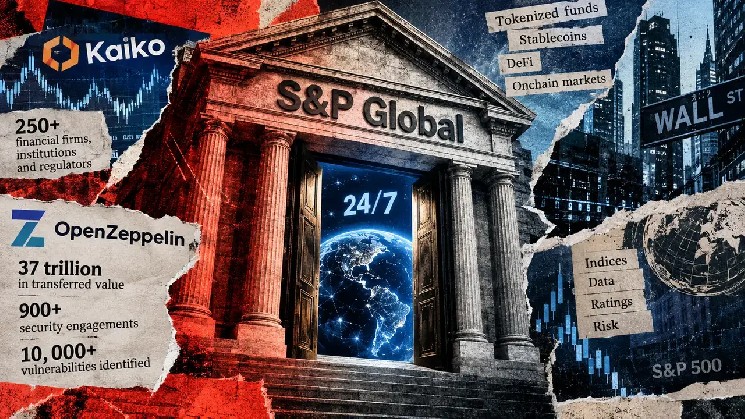
  • S&P Global Quietly Prepares for Round-the-Clock Markets, From Kaiko to OpenZeppelin

    S&P Global Quietly Prepares for Round-the-Clock Markets, From Kaiko to OpenZeppelin

    Key Highlights

    • S&P Global agreed to acquire smart contract security firm OpenZeppelin, expanding its digital asset business into the technology layer underpinning tokenized finance.
    • OpenZeppelin will operate as a separate business unit under CEO Demian Brener, reporting to S&P Global Ratings President Yann Le Pallec; financial terms were not disclosed.
    • The acquisition gives S&P direct exposure to the security infrastructure behind more than $37 trillion in transferred value, over 900 security engagements, and 10,000+ identified vulnerabilities.

    S&P Global Acquires OpenZeppelin to Secure Tokenized Finance Infrastructure

    Financial data and ratings giant S&P Global announced on September 17 an agreement to acquire OpenZeppelin, a leading smart contract security firm whose open-source libraries and audit services underpin a vast swath of the blockchain ecosystem. The move marks a significant deepening of S&P’s push into digital assets, adding a technical risk layer to its traditional financial risk toolkit as institutional capital increasingly migrates to blockchain networks.

    Under the terms of the agreement, OpenZeppelin will continue operating under its own name as a distinct business unit. Chief Executive Demian Brener will remain in charge and report to S&P Global Ratings President Yann Le Pallec. Financial details of the transaction were not disclosed, and the deal remains subject to customary closing conditions.

    Strategic Rationale: Addressing the On-Chain Technology-Risk Layer

    The acquisition targets a specific gap in institutional risk management. As financial products—from stablecoins and tokenized funds to decentralized finance applications—move onto blockchains, institutions face a new category of risk: the software that issues, transfers, and manages those assets. S&P stated that OpenZeppelin will expand capabilities in what it described as the “on-chain technology-risk layer,” including security assessments and benchmarks for digital assets.

    This adds a technical dimension to S&P’s existing financial-risk business. Tokenized funds and stablecoins remain exposed to traditional risks around issuers, collateral, and liquidity, but their operation also depends on smart contracts, permissions, and blockchain infrastructure that introduce technical vulnerabilities. Le Pallec articulated the strategy directly:

    “Our digital assets strategy centers on bringing trusted data, benchmarks and transparent risk assessment to markets as they move onchain.”

    OpenZeppelin’s Model Preserved: Open Source and Developer Trust

    OpenZeppelin has built its reputation on two pillars: its widely used Contracts library, a standard across blockchain applications, and its security teams that review smart contracts and systems before deployment. The company emphasized that its libraries will remain free, open source, and publicly maintained after the acquisition, including future versions. Its audit, engineering, and security work will also continue under the existing team.

    This preservation of the developer model is critical to OpenZeppelin’s adoption. Brener noted that the combination could help OpenZeppelin reach more financial institutions as banks, asset managers, and issuers increase their use of blockchain infrastructure. For S&P, the acquisition provides access to OpenZeppelin’s technical expertise and developer relationships, while OpenZeppelin gains S&P’s institutional relationships, research resources, and distribution channels. S&P said the acquisition is not expected to materially affect its financial results, emphasizing near-term expansion of capabilities rather than a large new revenue stream.

    Why This Matters: Building Infrastructure for 24/7 Markets

    The OpenZeppelin deal is the latest in a series of strategic moves by S&P Global to build infrastructure for markets that increasingly operate around the clock. Three days prior, S&P led a strategic investment in crypto-data provider Kaiko, extending its Series B funding to $110 million alongside participants including DRW, Susquehanna, Royal Bank of Canada, Nasdaq, and BNP Paribas. Kaiko supplies market data and infrastructure to over 250 financial firms, institutions, and regulators, connecting to more than 150 exchanges.

    S&P and Kaiko have already collaborated to bring traditional benchmarks on-chain. In March, they embedded the iBoxx US Treasuries Index into blockchain infrastructure, and earlier this month they combined their digital-asset benchmark businesses into the S&P Kaiko Digital Asset Indices. S&P Dow Jones Indices also helped develop the S&P Digital Markets 50 Index, which Dinari subsequently tokenized using Chainlink for verifiable on-chain pricing.

    Beyond benchmarks, S&P has developed stablecoin stability assessments, issued a credit rating for DeFi protocol Sky, and licensed the S&P 500 for tokenized products. The OpenZeppelin acquisition adds the smart-contract security piece to a stack that now includes: Kaiko for crypto-native pricing and market data, S&P for benchmarks and financial-risk analysis, and OpenZeppelin for smart-contract expertise governing how assets move between investors and applications.

    As trading expands outside traditional exchange hours, always-on markets require continuous prices, collateral valuations, benchmarks, and risk controls. Tokenized assets add software and smart contract risks alongside conventional financial ones. For S&P, this creates an opportunity to extend services it already sells to banks and asset managers into a market where the infrastructure itself is becoming part of the risk assessment. If more securities and funds migrate onto blockchains, institutions may increasingly need a single provider to understand both the asset they hold and the technology that determines how it moves.

    Frequently Asked Questions

    What does OpenZeppelin do, and why is it significant?

    OpenZeppelin is a smart contract security firm whose open-source Contracts library is a widely used standard across blockchain applications. The company has completed over 900 security engagements, identified more than 10,000 vulnerabilities before production, and its infrastructure has supported over $37 trillion in transferred value. It provides both the code libraries developers build on and the audit services that verify contract safety before deployment.

    Will OpenZeppelin’s open-source libraries remain free after the acquisition?

    Yes. OpenZeppelin explicitly stated that its libraries will remain free, open source, and publicly maintained after the acquisition, including future versions. Its audit, engineering, and security work will also continue under the existing team, preserving the developer model that drove its adoption.

    How does this fit into S&P Global’s broader digital asset strategy?

    The acquisition is part of a coordinated buildout that includes a strategic investment in crypto-data provider Kaiko, the launch of on-chain benchmarks like the iBoxx US Treasuries Index and S&P Kaiko Digital Asset Indices, stablecoin stability assessments, a credit rating for DeFi protocol Sky, and licensing the S&P 500 for tokenized products. Together, these pieces give S&P capabilities across market data, benchmarks, financial risk analysis, and now smart-contract technical risk for 24/7 blockchain markets.

  • Kaiko Extends Series B Funding to $110 Million with S&P Global, BNP Paribas

    Kaiko Extends Series B Funding to $110 Million with S&P Global, BNP Paribas

    Crypto data provider Kaiko has extended its Series B funding round to $110 million following a strategic investment led by S&P Global, marking another milestone in the convergence of digital asset infrastructure and traditional finance.

    Funding Round Details and Key Investors

    Kaiko originally announced its Series B in May 2022, raising $53 million and tripling its valuation, which remains undisclosed. A year earlier, the firm closed a $24 million Series A led by Anthemis and Underscore VC. The latest extension brings total Series B capital to $110 million.

    The round includes participation from a consortium of major financial institutions and crypto-native firms:

    • S&P Global (lead investor)
    • BNP Paribas
    • Coinbase Ventures
    • Nasdaq
    • Royal Bank of Canada
    • Stellar

    Strategic Focus: 24/7 Market Infrastructure

    The fresh capital will be deployed to expand Kaiko’s data infrastructure to support the growth of 24/7 digital markets, the company announced Monday. Founded in France in 2014, Kaiko serves more than 150 exchanges and blockchain protocols and plans to strengthen its core data business while expanding its product offering.

    “Digital asset markets operate 24/7, and the infrastructure supporting them must do the same,” Kaiko said, adding that the funding demonstrates that institutions running today’s capital markets are investing in the data infrastructure required to operate tokenized markets.

    Institutional Convergence Signal

    The investor roster—spanning traditional financial giants like S&P Global, BNP Paribas, Nasdaq, and Royal Bank of Canada alongside crypto-native backers—underscores the accelerating institutional adoption of digital asset market infrastructure. Kaiko’s data products are positioned to bridge the gap between legacy capital markets and the always-on nature of blockchain-based trading.

    The blockchain analytics firm did not immediately respond to a CoinDesk request for further information.