Tag: Jackson Hole

  • Cardano Hits 10,166% Liquidation Imbalance as ADA Price Tests $0.20 Support

    Cardano Hits 10,166% Liquidation Imbalance as ADA Price Tests $0.20 Support

    Cardano’s ADA token is facing a critical test at the $0.20 price level amid a sharp imbalance in leveraged liquidations.

    Cardano recorded $1.17 million in liquidations over the past 24 hours, according to Coinglass. Long positions accounted for $1.16 million of the total, while short positions represented $11,410.

    The imbalance between long and short liquidations reached 10,166%, showing that leveraged long traders bore the overwhelming majority of losses. The concentration of liquidations on one side of the derivatives market could contribute to increased volatility if ADA breaks decisively out of its current range.

    ADA is down 3.66% over the past 24 hours at $0.20 as the broader crypto market weakened over the weekend following Fed Chair Kevin Warsh’s hawkish remarks at the Jackson Hole event. According to CME FedWatch, the probability of a September rate hike rose to 42% from 35% a day earlier.

    Warsh’s speech had been closely watched because the Jackson Hole event has often provided an opportunity for Federal Reserve leaders to prepare markets for significant policy changes.

    Cardano has extended its decline from last Saturday’s high of $0.259 and is now down 9.27% on a weekly basis. ADA fell from a high of $0.218 yesterday, catching bullish traders off guard, as reflected in the predominance of long liquidations.

    ADA is currently attempting to hold support at $0.20. Traders will be watching the outcome of that effort closely in the coming sessions.

    Cardano Dijkstra Development Gains Momentum

    According to Intersect, development work for the Dijkstra era is progressing across node development, protocol parameters, supporting infrastructure and node diversity. Upcoming node releases are expected to enable early testing of Dijkstra functionality.

    Node 11.1 is currently in pre-release, while Node 11.2 is expected within the next two to three weeks and will include the Plutus V4 ledger interface. The update is expected to provide greater visibility into Dijkstra and support early testing of its capabilities. However, it should not be considered the hard-fork-ready release.

    The feature-complete 11.3 release is expected in the months ahead. The overall Dijkstra delivery timeline continues to be assessed in relation to the node release schedule.

    In the meantime, stake pool operators can continue participating in Leios development on the Musashi testnet, with a rewards program announced earlier this month.

  • Fed Chair Kevin Warsh Triggers $488 Million Crypto Liquidation Cascade as Rate Hike Expectations Rise

    Fed Chair Kevin Warsh Triggers $488 Million Crypto Liquidation Cascade as Rate Hike Expectations Rise

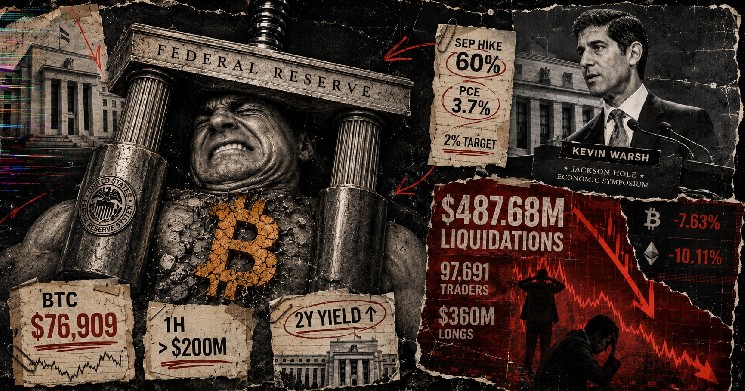
    Bitcoin fell below $77,000 on Friday after Fed Chair Kevin Warsh revived concerns that interest rates could move higher at Jackson Hole.

    Data from CryptoSlate showed Bitcoin, the largest cryptocurrency by market capitalization, dropping as low as $76,909 before recovering to $77,712 at press time. The cryptocurrency remained down about 4% over the previous 24 hours.

    The decline intensified a broader crypto deleveraging event that wiped out nearly $488 million from derivatives traders as markets sharply repriced expectations for Federal Reserve policy.

    Warsh revives rate-hike fears

    Traders raised the probability of a September rate increase to about 60%, up from roughly 35% before Warsh’s remarks. Short-term Treasury yields also climbed, while the US dollar strengthened.

    Warsh gave investors several reasons to reassess expectations that the Federal Reserve was preparing to ease monetary policy. He argued that inflation remained too high despite improved price data during the summer.

    The Fed’s preferred personal consumption expenditures price index was running at 3.7% over the past year and at a 4.1% annualized pace over the past six months. Both readings remain well above the central bank’s 2% target.

    Recent inflation reports had not convinced Warsh that the underlying trend had changed. He said:

    “We must be confident that underlying inflation is moving to our objective, clearly and at sufficient speed. Otherwise, we have work to do.”

    Warsh also questioned whether current borrowing conditions were restraining demand sufficiently. Credit markets showed limited signs of policy restraint, while corporate bond spreads remained historically narrow and bank lending standards relatively easy.

    He added:

    “I would be hard pressed to describe broad financial conditions as restrictive.”

    The combination delivered a hawkish signal to financial markets. Warsh described labor conditions as consistent with full employment, pointed to healthy consumer spending and strong business investment, and said the Fed’s “predominant focus right now should be on prices.”

    For crypto traders, the implication was immediate. A resilient economy gives the Fed more room to keep monetary policy tight, while persistent inflation increases the risk that its next move could be another rate increase rather than the easier financial conditions that risk assets had been anticipating.

    The two-year Treasury yield rose to a one-month high after the remarks as investors increased their bets on another rate increase.

    Leveraged crypto traders suffer nearly $488 million in liquidations

    The shift in rate expectations hit a crypto market that had entered Friday with substantial leveraged exposure following Bitcoin’s recent rally above $80,000.

    CoinGlass recorded $487.68 million in liquidations across the cryptocurrency market during the previous 24 hours, affecting 97,691 traders. More than $200 million in positions were closed within one hour of Warsh’s speech.

    Bitcoin and Ethereum led crypto liquidations as 24-hour losses reached $487.81 million across 97,772 traders. Source: CoinGlass

    Long positions accounted for more than $360 million of the losses, indicating that traders positioned for further gains absorbed most of the reversal. Bitcoin positions generated about $141 million of the liquidations.

    The largest individual liquidation was an $11.66 million ETH-USDT position on Binance.

    Warsh’s speech also affected the gold market. Reports said gold and silver lost more than $700 billion in combined market value following the remarks.

    Higher interest-rate expectations create several simultaneous headwinds for cryptocurrency markets. Rising Treasury yields increase the returns available from dollar-denominated assets, while a stronger dollar typically tightens financial conditions for speculative investments.

    Expectations for more restrictive monetary policy can also reduce the liquidity that helped drive Bitcoin’s recent advance.

    Friday’s reaction showed how quickly that relationship can reassert itself. Bitcoin had been trading near $80,000 before Warsh’s speech became the dominant macroeconomic catalyst. Contemporaneous reports showed the cryptocurrency falling more than 3% as rate-hike expectations increased.

    Less Fed guidance could increase crypto rate volatility

    Warsh offered little certainty about the Federal Reserve’s next move.

    The chairman has moved away from the forward guidance used heavily by his predecessors, arguing that telegraphing policy paths can distort markets and limit the central bank’s flexibility when economic conditions change.

    He also rejected the idea of giving investors a mechanical reaction function that would dictate how interest rates should respond to individual economic reports.

    This approach could make upcoming inflation and employment data more important for Bitcoin and other risk assets. Traders will have fewer signals from the Fed about how policymakers intend to respond to new economic information.

    Apollo Global Management Chief Economist Torsten Slok has argued that this type of policy regime could push more interest-rate moves outside Federal Reserve meeting days. Investors would continuously reprice economic data instead of waiting for policymakers to validate existing expectations.

    Slok noted that since the Fed began raising rates in 2022, much of the increase in longer-term Treasury yields has occurred outside Federal Open Market Committee meetings. Inflation reports, employment data, Treasury issuance and the term premium became larger drivers of the bond market.

    Warsh reinforced that philosophy on Friday, saying markets should form their own expectations rather than look primarily to the Fed for their “next trade.”

    For Bitcoin, Friday offered an early example of what that environment could look like.

    Warsh stopped short of committing to a September rate increase, leaving incoming data to determine whether the Fed follows through. However, his insistence that inflation remains too high, financial conditions are not particularly restrictive and interest rates remain the central bank’s main policy tool was enough to revive fears of tighter monetary policy.

  • Bitcoin’s 22% Rally Needs Real Demand to Outlast Treasury Liquidity Boost

    Bitcoin’s 22% Rally Needs Real Demand to Outlast Treasury Liquidity Boost

    Bitcoin’s recent breakout appears to have been triggered by a shift in U.S. Treasury-market liquidity, but analysts say the rally’s staying power hinges on whether exchange-traded fund inflows and spot demand can replace the initial macroeconomic boost.

    Treasury Buybacks Spark 22% Surge and Short Squeeze

    Bitcoin surged roughly 22% during its breakout week as long-term Treasury yields fell and the dollar weakened following the U.S. Treasury’s decision to expand buybacks of longer-dated government debt. The move also triggered a major short squeeze, while demand for U.S. spot Bitcoin exchange-traded funds accelerated.

    The Treasury announced on Aug. 19 that it would at least double the maximum size of liquidity-support buybacks for 10-to-20-year and 20-to-30-year nominal Treasuries, raising them from $2 billion to at least $4 billion per operation. The larger operations are scheduled to begin Sept. 9 and continue through the current refunding quarter.

    Macro Forces Drove First Stage of Rally, Analysts Say

    Fabian Dori, chief investment officer at FINMA-regulated digital asset bank Sygnum, told crypto.news that Bitcoin’s behavior alongside other markets suggests the first stage of the rally had a strong macro component.

    “The clearest tell is the combination of cross-asset behavior and crypto-market plumbing.”

    Dori said the Treasury’s announcement temporarily pushed long-term yields lower while weakening the dollar and lifting both gold and Bitcoin. In his view, those moves were consistent with investors seeking hard assets amid renewed concerns about currency debasement rather than a rally driven exclusively by crypto-specific demand.

    Martin Lee, Market Insights Lead at DWF Labs, pointed to a similar divergence across markets. AI and technology assets remained under pressure while gold and Bitcoin ETFs attracted capital as debasement concerns returned, he told crypto.news.

    As crypto.news reported earlier, U.S. spot Bitcoin ETFs received about $1.92 billion during the breakout week, their largest weekly inflow in 10 months. At the same time, the price surge forced traders positioned for further weakness out of the market. Lee said a record $2.7 billion in crypto short positions were liquidated as Bitcoin cleared its previous trading range, meaning part of the apparent spot demand reflected traders buying Bitcoin to cover bearish positions.

    Derivatives Data Points to Mixed Drivers

    Derivatives data provides another clue about the nature of the breakout. Dori noted that Bitcoin-denominated open interest fell during the rally while funding rates remained contained. Bitcoin futures open interest recently declined to roughly 587,584 BTC, its lowest level in nearly five months, from around 645,760 BTC on Aug. 14.

    Rather than showing traders aggressively piling into leveraged long positions, Dori said the combination points toward forced short covering playing an important role. Still, he does not view the entire rally as a macro trade.

    “So the right interpretation is probably mixed.”

    Dori said the first impulse saw Bitcoin behave more like gold, as lower long-term yields, a weaker dollar, and debasement concerns drove demand. A second, crypto-specific impulse came from ETF inflows alongside regulatory developments in Washington, including the SEC’s Regulation Crypto proposal and renewed White House pressure for progress on the CLARITY Act.

    ETF Flows Sustain Momentum as Bond-Market Impact Fades

    ETF flows provide some evidence that demand has continued beyond the initial Treasury shock. U.S. spot Bitcoin ETFs recorded eight consecutive sessions of inflows through Wednesday, attracting about $2.8 billion over the streak.

    The continued inflows matter because the initial reaction in the bond market has already weakened. BNY Markets said the decline in the term premium following the Treasury announcement had largely retraced, with long-term yields returning close to levels seen before the Aug. 19 announcement.

    Bitcoin has therefore reached a point where crypto-specific buying may need to carry more of the rally if the original rate impulse continues to fade.

    Sept. 9 Buyback Launch Is Next Liquidity Test

    The larger Treasury buybacks do not begin until Sept. 9, raising the question of how much of their expected impact markets have already priced in. Dori said markets normally react when such policies are announced rather than waiting for the operations themselves to begin. More important than the immediate size of the purchases, in his view, was the signal that the Treasury is willing to intervene when longer-term borrowing costs become excessively high.

    Whether that support lasts will depend on what happens after the announcement’s effect fades. Dori said rising long-end yields would suggest that the buybacks are failing to provide the expected support, while a rebuilding of the Treasury General Account could withdraw liquidity. Rapid increases in funding rates and open interest would also indicate that leverage, rather than underlying demand, had begun driving Bitcoin higher. Weakening ETF flows or tighter dollar funding conditions would remove another source of marginal demand.

    Lee similarly argued that anticipation alone cannot sustain the rally indefinitely.

    “A rally on anticipation is only as durable as the flow that follows it.”

    He identified ETF flows, futures basis and funding, and Bitcoin’s previous trading range as three key indicators to watch before Sept. 9. A week of negative ETF creations while Bitcoin holds near current levels could indicate that the anticipation trade is unwinding, Lee said. He added that the three-month futures basis moved back above the 10-year Treasury yield during the rally; a reversal below that level would suggest the cash-and-carry bid had failed to persist. The more bearish combination would be Bitcoin closing back inside its pre-breakout range while ETF flows turn negative, which Lee said would indicate that leverage drove much of the move without a durable structural bid emerging.

    Liquidity Analysis Extends Beyond Fed Policy Rate

    Both analysts also argue that investors looking only at the Federal Reserve’s policy rate may miss important forces influencing crypto prices. Dori said Treasury cash management, particularly changes in the Treasury General Account and the mix of issuance and buybacks, has recently become an important marginal driver of liquidity. The term premium then transmits changes at the long end of the Treasury curve into risk assets.

    Other channels include bank balance-sheet capacity, private credit creation, stablecoin growth and global dollar funding conditions, while the Federal Reserve’s balance sheet remains important over a longer horizon. Lee similarly ranks dollar funding conditions and real yields ahead of the policy rate for short-term crypto market behavior, followed by the term premium. Treasury cash balances and reserve dynamics influence the liquidity underneath those markets, while issuance matters partly through its effect on longer-term yields.

    For Lee, Bitcoin’s reaction to the Treasury buyback announcement showed how quickly a change at the long end of the yield curve can affect crypto even without a change in the Fed’s policy-rate outlook.

    Warsh’s Jackson Hole Speech in Focus

    The liquidity debate now shifts toward Federal Reserve Chair Kevin Warsh’s first Jackson Hole keynote on Friday. The latest inflation data gives the Fed a complicated backdrop. The Bureau of Economic Analysis reported that headline Personal Consumption Expenditures inflation rose 0.2% in July and 3.7% from a year earlier. Core PCE increased 0.2% for the month and 3.3% annually. Real consumer spending was nearly unchanged during July, while the personal saving rate stood at 3%.

    Dori said Warsh could affect short-term rate expectations by explaining how the Fed views current inflation pressures, including those connected with oil markets. Treasury is attempting to influence the longer end of the curve through its buyback program, while the Fed has more direct control over short-term rates.

    “If both were to get aligned, that would be a powerful support for risk assets.”

    However, Dori said a simple change in expectations for the September Federal Open Market Committee meeting may not be enough to materially alter institutional crypto positioning. Instead, investors should watch for any signal that changes the broader liquidity outlook, such as greater tolerance for oil-driven inflation, a different balance between inflation risks and economic growth, or comments capable of repricing the Treasury term premium.

    Lee said institutions should remain defensive if inflation, bond yields and the Fed’s policy outlook provide conflicting signals. Bitcoin’s reaction alongside gold could offer another clue about how investors are treating the asset. If Bitcoin rises with gold while long-duration bonds sell off, Lee said it would strengthen the case that investors are treating BTC as a hedge against fiscal and currency concerns. If Bitcoin instead falls alongside gold, its rate sensitivity would remain dominant, and institutions would have greater reason to reduce exposure.

    For both analysts, the next stage of Bitcoin’s rally therefore depends less on any single inflation reading or September rate decision than on whether the liquidity conditions behind the breakout persist. It will also follow whether sustained ETF and spot demand can take over as the initial Treasury-driven impulse fades.