Tag: Isack Hadjar

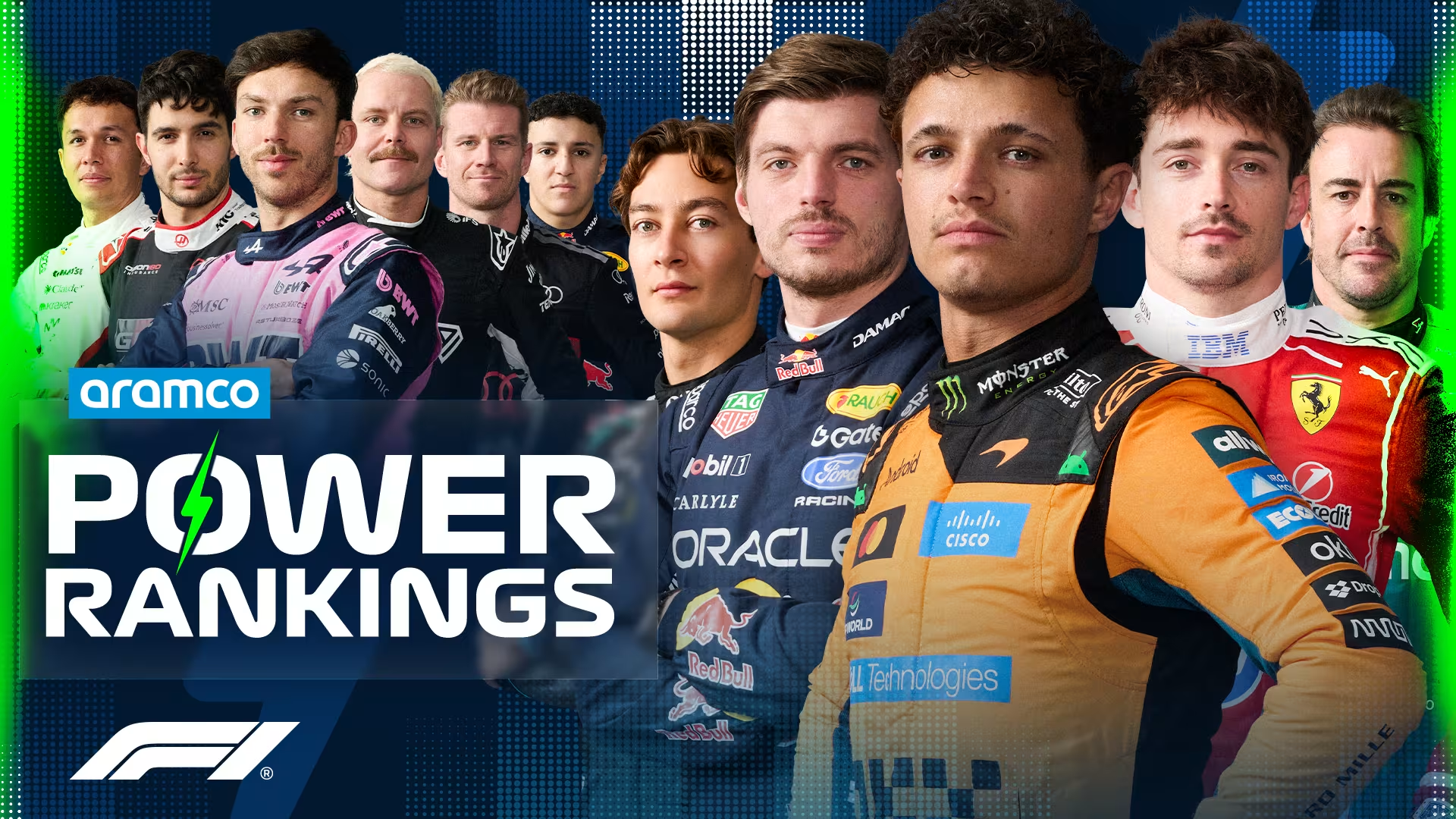
  • Power Rankings: Who Impressed the Judges at the Azerbaijan Grand Prix?

    Power Rankings: Who Impressed the Judges at the Azerbaijan Grand Prix?

    Key Highlights

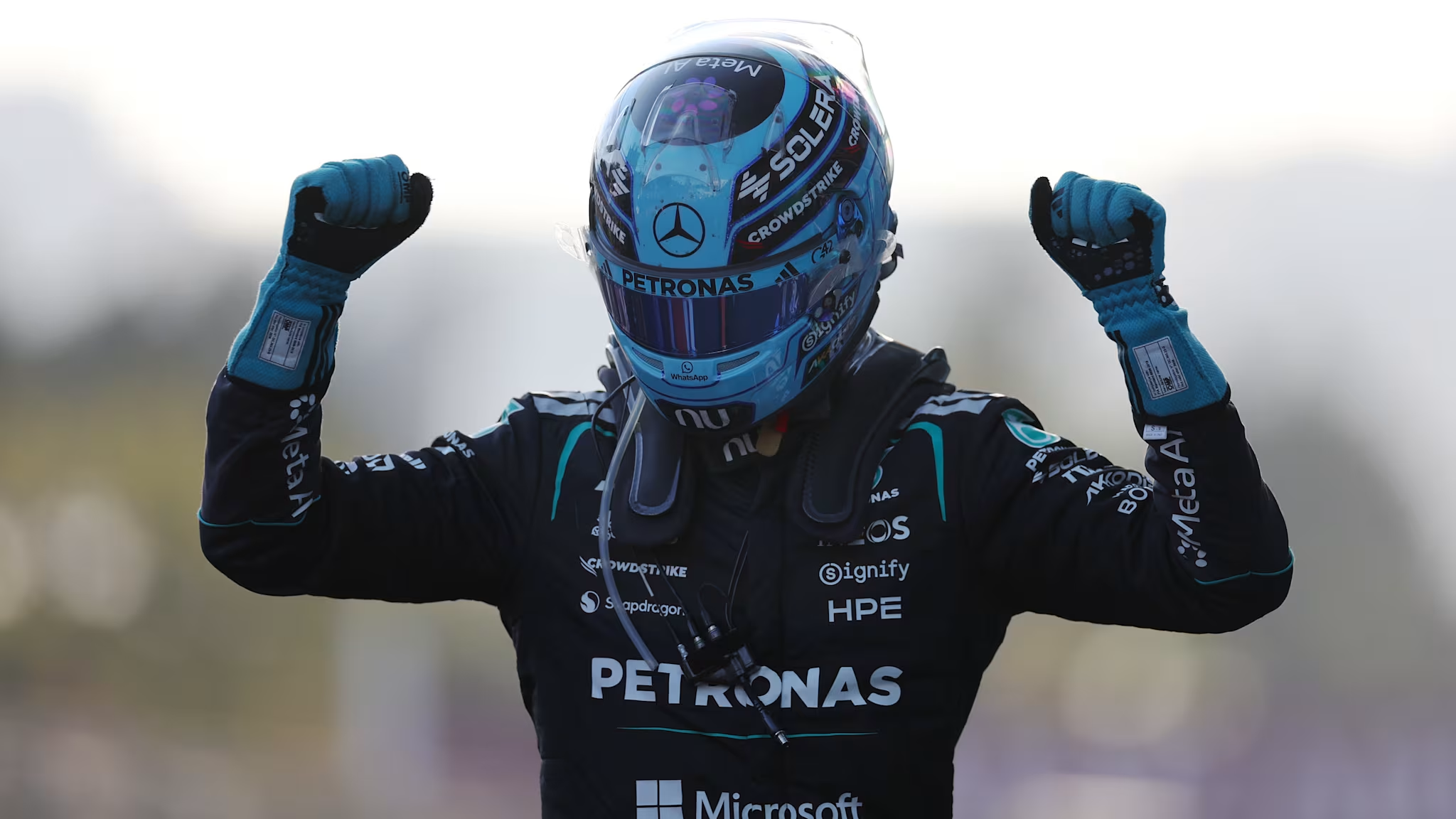
    • George Russell dominated the Azerbaijan Grand Prix weekend, taking pole position and converting it into victory.
    • Max Verstappen recovered from eighth on the grid to finish second, while Isack Hadjar secured his first proper podium on pure pace in Formula 1.
    • Esteban Ocon, Ollie Bearman, Arvid Lindblad and Carlos Sainz also impressed in the Baku Power Rankings contenders.

    George Russell Leads the Azerbaijan Grand Prix Power Rankings

    George Russell was the standout performer at the Baku City Circuit, producing a dominant Azerbaijan Grand Prix weekend. The Mercedes driver led Thursday practice, took pole position by eight tenths of a second and converted his qualifying advantage into victory despite intense late pressure from Red Bull’s Max Verstappen.

    With Russell delivering across every major session, the Power Rankings judges found little to criticize in his performance. Verstappen, meanwhile, endured a difficult qualifying session after apparent power unit and battery issues left him eighth on the grid, despite having topped final practice earlier that day. The Dutchman responded strongly in the race, moving through the field to finish second and coming close to challenging Russell for victory.

    Hadjar Delivers a Breakthrough Performance

    Isack Hadjar made an immediate impression after spending six weeks away from racing because of a wrist injury sustained during summer-break training. The Formula 1 rookie steadily increased his pace through practice before qualifying fourth in Baku.

    Hadjar maintained that form in the race and converted his strong starting position into what was described as a “first proper podium on pure pace” in F1. His performance placed him among the leading names in the latest Azerbaijan Grand Prix Power Rankings.

    Pierre Gasly also showed strong potential during the weekend, qualifying seventh and aiming for another significant points haul. However, the Alpine driver’s race ended after contact with team mate Franco Colapinto. Gasly was visibly disappointed afterward, saying, “I don’t think I really have words, and I don’t need the words now,” as both Alpine cars finished without points.

    Ocon and Bearman Put Haas in the Points

    Esteban Ocon arrived in Azerbaijan describing himself as a “free agent” for 2027, with his time at Haas appearing likely to end. After starting 14th because yellow flags affected his qualifying lap, Ocon produced a strong recovery drive to finish eighth.

    Ocon finished ahead of Haas team mate Ollie Bearman and was narrowly beaten to the finish line by Racing Bulls driver Arvid Lindblad. Bearman had qualified 11th, just short of reaching Q3, and led the Haas challenge for much of the race. His prospects were affected when he made contact with Kimi Antonelli at a Safety Car restart, allowing Ocon to move ahead.

    Bearman nevertheless finished ninth, giving Haas both cars in the points. The result represented a solid overall recovery for the team and helped underline the strength of its race pace in Baku.

    Lindblad Impresses Despite a Difficult Baku Weekend

    Arvid Lindblad endured a turbulent weekend on the streets of the Azerbaijani capital. The Formula 1 rookie crashed in FP2 for the second consecutive event and then qualified 15th. Reflecting on his approach, Lindblad admitted to “trying to be too special”.

    His race was also complicated by contact with Racing Bulls team mate Liam Lawson at the first Safety Car restart. Lindblad recovered effectively, however, and crossed the line seventh to claim an impressive result despite the setbacks.

    Lawson had been the lead Racing Bulls driver in Azerbaijan after returning from Red Bull, but the collision with Lindblad sent him into a spin. He later remarked sarcastically over team radio, “I love getting taken out by my team mate. That’s pretty sick,”. Lawson recovered some of the lost ground but ultimately finished 12th.

    Leclerc and Sainz Salvage Strong Results

    Charles Leclerc had mixed feelings after qualifying second in Baku. The Ferrari driver was pleased with his grid position but acknowledged that Russell’s pole advantage was considerably larger than expected. In the race, Leclerc was unable to prevent Oscar Piastri and the Red Bull cars from moving ahead, although he regained fourth place when Piastri locked up into Turn 1 late in the race.

    Williams introduced a substantial package of updates at the Baku City Circuit in an effort to improve its difficult 2026 campaign. Both drivers progressed to Q2, while Carlos Sainz produced a powerful lap to reach Q3.

    Sainz was initially set to start ninth, but a post-qualifying penalty for failing to follow yellow-flag requirements dropped him to 14th on the grid. He still capitalized on the events of the race to secure a morale-boosting point for Williams.

    Perez Heads Cadillac’s Azerbaijan Effort

    Sergio Perez described the Azerbaijan Grand Prix as “one of my best weekends” in the sport after “driving at a high level” from FP1 through to the chequered flag. The Cadillac driver comfortably led the team’s performance with its latest Ferrari power unit.

    Perez mixed it with several midfield competitors and finished 14th. Several retirements contributed to his final position, but his performance still represented a respectable showing for Cadillac in Baku.

    Why This Matters

    The Azerbaijan Grand Prix highlighted the importance of qualifying performance, race recovery and execution around the demanding Baku City Circuit. Russell converted a commanding pole position into victory, while Verstappen demonstrated how strongly a driver can recover from a difficult qualifying result.

    The weekend also provided encouraging signs for several teams and drivers. Hadjar’s podium-level performance, Haas’s double points finish, Lindblad’s recovery to seventh and Sainz’s point after a grid penalty all carried significance in the Power Rankings assessment. Williams’s upgrades also appeared to improve its competitiveness, with both cars reaching Q2 and Sainz making Q3.

    Frequently Asked Questions

    Who led the Azerbaijan Grand Prix Power Rankings?

    George Russell led the Power Rankings after taking pole position and winning the Azerbaijan Grand Prix at the Baku City Circuit.

    How did Max Verstappen perform in Azerbaijan?

    Max Verstappen started eighth after qualifying issues but recovered to finish second, putting pressure on Russell during the closing stages.

    Which drivers narrowly missed the Power Rankings list?

    Audi’s Nico Hulkenberg, Oscar Piastri and Kimi Antonelli narrowly missed inclusion. Hulkenberg finished within one second of a point, while Piastri’s score was affected by a late lock-up and Antonelli’s by his Q1 accident.
  • Russell Narrowly Holds Off Verstappen to Win Chaotic Azerbaijan GP

    Russell Narrowly Holds Off Verstappen to Win Chaotic Azerbaijan GP

    Key Highlights

    • George Russell secured his third victory of the 2025 season and eighth career win at the Azerbaijan Grand Prix, holding off Max Verstappen by a mere 0.1 seconds in a dramatic finish.
    • The race featured seven retirements—including Lando Norris, Alex Albon, and both Aston Martin drivers—and three Safety Car periods that reshuffled the order and created a chaotic finale.
    • Red Bull achieved a double podium with Isack Hadjar claiming third, while Kimi Antonelli recovered from a qualifying crash to finish fifth from 16th on the grid.

    Russell Survives Verstappen Assault to Win in Baku

    George Russell converted a dominant pole position into a hard-fought victory at the Azerbaijan Grand Prix, crossing the line just one-tenth of a second ahead of a charging Max Verstappen. The Mercedes driver controlled the opening stint after a superb launch, building a lead that peaked near ten seconds before a series of Safety Car interventions erased his advantage and set up a thrilling final-lap duel. The win marks Russell’s third of the season and his first since the Austrian Grand Prix in Round 8.

    Qualifying Masterclass Sets the Stage

    The foundation for victory was laid on Saturday when Russell delivered what the team described as a “superlative lap” in Q3, securing pole position by a massive 0.837-second margin over Charles Leclerc’s Ferrari—the largest gap of the year. The front row was completed by Oscar Piastri and Isack Hadjar on the second row, with Lando Norris and Lewis Hamilton lining up behind. The session was not without drama: championship leader Kimi Antonelli crashed heavily at Turn 1 in Q1, damaging his car and consigning him to a P16 start, significantly adrift of his dominant teammate. Pre-race penalties further shuffled the grid, with Carlos Sainz demoted five places for a yellow flag infringement and both Aston Martin drivers relegated to the back row for power unit element changes.

    Safety Cars and Chaos Rewrite the Race

    The Grand Prix was defined by attrition and intervention. An early stoppage for Lance Stroll’s water pressure issue was a mere prelude. On Lap 9, Alex Albon locked up and hit the barriers at Turn 6, bringing out the first full Safety Car and prompting a round of pit stops. Red Bull executed a flawless double stack to maintain Hadjar ahead of Verstappen. The restart saw Verstappen finally pass Piastri for second, but chaos erupted immediately behind: Franco Colapinto locked up at Turn 1, colliding with Alpine teammate Pierre Gasly and collecting Norris in a three-car pileout that neutralized the race again.

    A second restart handed Russell a cleaner getaway, but disaster struck Piastri when he, too, locked up at Turn 1 while running third, spinning to the rear of the field. Amid the turmoil, Antonelli methodically carved through the order, passing Hamilton for fifth with eight laps remaining. At the front, Verstappen hounded Russell relentlessly, the pair separated by mere tenths. A late yellow flag for Valtteri Bottas’s crash threatened to freeze the order, but the race stayed green for a final-lap shootout. Verstappen pulled alongside down the main straight but could not complete the pass.

    Red Bull Podium and Antonelli’s Damage Limitation

    Behind the leading duo, Hadjar held on for a career-best third place, delivering Red Bull a double podium. Leclerc finished a lonely fourth for Ferrari, while Antonelli’s recovery drive from P16 to P5 stood as one of the drives of the day, limiting the championship damage from his qualifying error. Hamilton crossed the line sixth for Ferrari, ahead of a fierce battle for seventh where Arvid Lindblad edged Esteban Ocon at the line. Haas celebrated a double points finish for the first time since Monaco, with Ollie Bearman ninth and Carlos Sainz tenth. Nico Hulkenberg and Liam Lawson missed out in eleventh and twelfth, the latter left frustrated after contact with Racing Bulls teammate Hadjar, who sarcastically remarked, I love getting taken out by my team mate. That’s pretty sick.

    Why This Matters

    The Azerbaijan Grand Prix underscored the extreme competitiveness of the 2025 field, where track position and tyre management are amplified by the Baku City Circuit’s unforgiving walls. Russell’s ability to manage a failing turbo issue on the final laps—revealing post-race that when the yellow flag came out, I lifted off the power, and when I went back, I had no turbo, so then I had no power—highlights the mechanical fragility underpinning the sporting spectacle. For Red Bull, the double podium signals strong race pace despite Verstappen’s early tyre struggles, while Mercedes will take confidence from Russell’s control and Antonelli’s resilience. The high attrition rate—seven non-finishers including both Aston Martins and both Alpines—emphasizes the premium on reliability as the championship heads into a critical triple-header sequence.

    Frequently Asked Questions

    Who won the 2025 Azerbaijan Grand Prix?
    George Russell won the race for Mercedes, securing his third victory of the season and eighth career win, finishing 0.1 seconds ahead of Max Verstappen.
    How many drivers retired from the Azerbaijan Grand Prix?
    Seven drivers failed to finish: Alex Albon, Franco Colapinto, Pierre Gasly, Lando Norris, Fernando Alonso, Lance Stroll, and Valtteri Bottas.
    What is the next race on the 2025 Formula 1 calendar?
    The next stop is the Bahrain Grand Prix at the Sepang International Circuit in Malaysia, scheduled for October 2–4, as part of a triple-header sequence.
  • Five Quick Takeaways from the Azerbaijan Grand Prix

    Five Quick Takeaways from the Azerbaijan Grand Prix

    Key Highlights

    • George Russell converted pole position into victory in Baku, modestly improving his Formula 1 championship prospects.
    • Isack Hadjar delivered a strong Red Bull comeback, qualifying fourth and supporting Max Verstappen on the way to the podium.
    • Franco Colapinto’s restart mistake damaged Alpine’s points chances, while Sergio Perez impressed on the Baku street circuit.

    George Russell makes the most of Mercedes’ Baku advantage

    George Russell produced one of his most convincing weekends of the year at the Azerbaijan Grand Prix, converting a dominant pole position into victory and taking full advantage of a rare difficult weekend for Mercedes team-mate Kimi Antonelli.

    The result does not transform Russell’s Formula 1 championship prospects. His chances may have increased from roughly one percent to about two percent, but there is still no clear championship battle. Given Mercedes’ advantage over its rivals in Baku, expectations of a major title resurgence would be excessive.

    Even so, Russell did everything required of him. He secured pole by a substantial margin, controlled the race and capitalised on Antonelli’s early Q1 mistake, which prevented the Italian from showing his full potential. The weekend was arguably Russell’s strongest of the season apart from Australia.

    Russell’s victory does not prove that he can still win the championship this year. It does, however, serve as an important reminder that the Mercedes driver remains quick and should not be dismissed completely.

    Isack Hadjar validates Red Bull’s long-term confidence

    Isack Hadjar’s position at Red Bull was not considered under serious threat during his recovery from a wrist injury. However, the contract extension handed to the French driver before his Formula 1 return prompted questions about the source of the team’s confidence.

    His performance in Baku provided a strong answer. Hadjar qualified fourth and stayed close to the action after Max Verstappen encountered mechanical problems. He then followed Red Bull’s strategic expectations in the race, giving up a promising position early on to support his team-mate.

    Hadjar acted as Verstappen’s wingman and even urged the reigning Red Bull driver to increase his pace, a dynamic not seen since Sergio Perez’s early years with the team. He handled two Safety Car restarts and pressured Oscar Piastri into a mistake before following Verstappen onto the podium.

    The result marked an impressive comeback for Hadjar and demonstrated why Red Bull has selected him as a long-term team-mate for Verstappen.

    Williams’ FW48 B-spec shows promise but falls short

    Williams arrived in Baku with significant expectations surrounding its long-awaited FW48 B-specification car. The package included an all-new, lighter chassis and a redesigned floor, although the team had described the update as a step toward stronger performance in 2027 rather than a revolutionary transformation.

    The Azerbaijan weekend broadly confirmed that assessment. Williams returned to the midfield fight, and Carlos Sainz progressed to Q3, providing encouragement after a period away from the competitive centre of the field.

    However, the high-speed Baku street circuit appeared well suited to the Mercedes-powered team’s natural strengths. With that advantage, remaining well outside the points picture on Saturday felt like a missed opportunity. The FW48’s performance at the higher-downforce circuits in Malaysia and Singapore will offer a clearer indication of whether the B-spec package can deliver consistent progress.

    Alpine loses points after Franco Colapinto’s costly error

    Alpine appeared set to secure another strong result as the leading team behind the frontrunners for a third consecutive race weekend. Both Franco Colapinto and Pierre Gasly were on course to score points, but the Baku race demonstrated how quickly Formula 1 fortunes can change.

    Following the Safety Car period caused by Alex Albon’s crash, Colapinto arrived too quickly at Turn 1 during the restart. He hit Gasly, who then made contact with Lando Norris’s McLaren, turning a promising Alpine result into a costly setback.

    Colapinto quickly apologised to Gasly and the entire Alpine team. The incident came while Alpine is engaged in a close battle with Racing Bulls for fifth place in the constructors’ championship, increasing the significance of the lost opportunity.

    The team’s response will attract attention after the tension between Gasly and Colapinto at the end of the previous race in Madrid, followed by online abuse aimed at Gasly. Alpine’s handling of the latest incident, both internally and publicly, will be closely watched.

    Sergio Perez underlines his strength on street circuits

    Sergio Perez showed his street-racing expertise in Baku, finishing 13th in Thursday’s second practice session and running one second per lap faster than Cadillac team-mate Valtteri Bottas. Bottas had a new floor and dampers for qualifying, which he described as transformative, but Perez was significantly stronger in the race, pulling away from him by between one and two seconds per lap.

    Perez’s precise driving style is particularly effective on street circuits. He can manipulate the rear axle into a controlled slide without putting the car into the barriers, and he has moved beyond the unruly approach that characterised the early part of his Formula 1 career. His ability to manage his tyres has made him an archetypal ‘tyre whisperer’.

    While watching FP2 from the Cadillac garage, the team observed Perez’s technique closely. At one stage, race engineer Carlo Pasetti asked Perez about what appeared to be an unusual braking approach into Turn 1.

    “Baku style,” replied Perez, keeping a few secrets in his box.

    In the race, Perez initially shadowed the Audi cars and opened a gap of more than 20 seconds to Bottas. The Safety Car disruption briefly gave him an opportunity to take 13th place from faster cars, but Gabriel Bortoleto and Oscar Piastri eventually passed him.

    Perez finished 15th, a modest result that did not reflect the quality of his drive. His performance received less attention because the focus was on the leading battle between George Russell and Max Verstappen, but the large gap to Bottas before the Finn’s final-lap crash was notable for the Cadillac pit wall.

    Why This Matters

    The Baku weekend highlighted several important trends across the Formula 1 field. Russell’s win keeps a small possibility of a championship recovery alive while confirming that Mercedes can exploit its performance advantage when its lead driver executes cleanly. Red Bull’s confidence in Hadjar was also reinforced by a podium-supporting performance under pressure.

    Further down the field, Williams still needs to establish whether its FW48 B-spec can provide reliable gains beyond circuits naturally suited to its package. Alpine’s clash showed how quickly points can disappear in a constructors’ battle, while Perez’s pace underlined the value of street-circuit expertise even when the final result does not reflect the quality of the performance.

    Frequently Asked Questions

    Did George Russell become a serious championship contender after winning in Baku?

    No. Russell’s victory modestly improved his already small title prospects, but it did not create a clear championship battle.

    Why was Isack Hadjar’s Red Bull performance significant?

    Hadjar qualified fourth, supported Max Verstappen during the race, handled two Safety Car restarts and finished on the podium. The result supported Red Bull’s decision to extend his contract and plan for him as Verstappen’s long-term team-mate.

    What happened between Alpine’s Franco Colapinto and Pierre Gasly?

    Colapinto arrived too quickly at Turn 1 during a Safety Car restart and hit Gasly. Gasly then made contact with Lando Norris, costing Alpine a strong chance of scoring points.

  • Max Verstappen Slams Red Bull as ‘Not Good Enough’ After ‘So Much Trouble’ in 2026 Azerbaijan GP Qualifying

    Max Verstappen Slams Red Bull as ‘Not Good Enough’ After ‘So Much Trouble’ in 2026 Azerbaijan GP Qualifying

    Key Highlights

    • Max Verstappen qualified eighth for the Azerbaijan Grand Prix after engine and battery issues cost him over 1.5 seconds to pole position.
    • Verstappen revealed his power unit was down half a second on straights compared to teammate Isack Hadjar from Q1, with an additional battery deployment failure in Q3.
    • Hadjar delivered a career-best qualifying result with fourth place on his return from a three-race absence due to a wrist injury.

    Verstappen’s Championship Challenge Hit by Power Unit Gremlins in Baku

    Max Verstappen’s bid for a fifth consecutive Formula 1 world championship suffered a significant setback on the streets of Baku as a cascade of power unit failures relegated the four-time title holder to eighth on the grid for the Azerbaijan Grand Prix. After dominating Friday’s final practice session — topping the timesheets ahead of the Mercedes duo of George Russell and Kimi Antonelli — Verstappen entered qualifying as the clear favorite for pole position. Instead, he found himself 1.5 seconds adrift of the front row, watching his championship lead come under renewed pressure.

    Engine Deficit and Battery Failure Derail Q3 Campaign

    The problems began immediately. From the opening segment of qualifying, Verstappen’s Honda power unit was delivering significantly less straight-line speed than the identical unit in his teammate’s car. The deficit — approximately half a second per lap on the long Baku straights — left Red Bull engineers baffled and the Dutch driver permanently on the back foot.

    Any hope of recovery evaporated in Q3. On what Verstappen described as his “middle lap, which is normally a good lap,” the energy recovery system failed to deploy fully exiting Turn 16, the final corner before the start-finish straight. “My battery just didn’t charge to 100%, so I had to abort the lap, which means you lose tyre temperature and around here that’s killing,” Verstappen explained. The aborted lap cost precious tyre temperature on a circuit where heat retention is critical. A subsequent yellow flag triggered by Lando Norris running off track further compromised his final attempt.

    “The whole Qualifying was not how it should be,” Verstappen said. “Already from Q1, my engine is already half a second down on the straight compared to my team mate and they can’t understand why, so you’re just on the back foot. Then in Q3, on my middle lap, which is normally a good lap, exiting the final corner Turn 16, my battery just didn’t charge to 100%, so I had to abort the lap, which means you lose tyre temperature and around here that’s killing. [I] tried to put as much temperature in it, tried to push on the final lap but of course being down on top speed and I had a yellow flag from Lando [Norris off] in front of me meant that’s where we are. It’s not good enough. The whole weekend we are running really well, the car was feeling well and then we run into so much trouble in Qualifying. It’s not good enough.”

    Verstappen acknowledged that matching Russell’s benchmark — eight tenths clear of the field — was likely unrealistic, but insisted second place was achievable. “When you have that many issues, you also don’t deserve to be there,” he added. “We need to be more robust and we need to be on top of these things.”

    Hadjar Shines on Injury Return as Red Bull’s Bright Spot

    While Verstappen struggled, the second Red Bull garage delivered a remarkable performance. Isack Hadjar, returning to Formula 1 after a three-round absence caused by a wrist injury sustained in a practice shunt at Zandvoort, qualified fourth — his best grid position of the season and only the fourth occasion in 2024 he has outqualified his world champion teammate.

    Hadjar’s measured approach paid dividends on a circuit notorious for punishing mistakes. “I’m actually even surprised to be that close from second,” Hadjar said. “It’s good. Even though I feel like there’s still more to come. I feel like I was building up the whole weekend, I didn’t take many risks [in practice], it’s a risky track, I don’t want to hit the wall with my conditions right now. Honestly, I took it quite easy but I felt like there was still more to unlock, even in Q3 I wish we had more laps. All in all, it’s still good.”

    Why This Matters

    Verstappen’s qualifying disaster arrives at a pivotal moment in the championship. With McLaren’s Lando Norris and Oscar Piastri consistently challenging at the front, and Mercedes showing resurgent form through Russell and Antonelli, Red Bull’s constructor lead has evaporated. The Baku street circuit offers limited overtaking opportunities, meaning Verstappen’s eighth-place start severely compromises his race-day points haul. More concerning for Red Bull is the unexplained power unit discrepancy between the two cars — a reliability concern that could resurface across the remaining flyaway races. Meanwhile, Hadjar’s strong showing validates Red Bull’s decision to retain him despite his rookie errors earlier in the season, providing a data baseline for 2025 driver lineup discussions.

    Frequently Asked Questions

    What caused Verstappen’s poor qualifying performance in Baku?

    A combination of an unexplained engine power deficit — approximately half a second per lap on straights compared to his teammate — and a battery deployment failure in Q3 that forced him to abort a flying lap, followed by a yellow flag on his final attempt.

    How did Isack Hadjar perform on his return from injury?

    Hadjar qualified fourth, his best grid position of the 2024 season, and outqualified Verstappen for only the fourth time this year. He adopted a conservative practice program to manage his recovering wrist before delivering a strong qualifying performance.

    What are the championship implications of Verstappen starting eighth?

    Starting eighth at Baku — a circuit with limited overtaking — significantly reduces Verstappen’s chance of a high points finish, allowing title rivals Lando Norris, Oscar Piastri, and George Russell to potentially close the gap in the drivers’ standings.

  • Isack Hadjar to make racing return with Red Bull at Azerbaijan Grand Prix

    Isack Hadjar to make racing return with Red Bull at Azerbaijan Grand Prix

    Key Highlights

    • Isack Hadjar returns to Red Bull Racing for the Azerbaijan Grand Prix after recovering from a wrist injury sustained during summer training.
    • Liam Lawson completes his three-race substitute stint and returns to Visa Cash App Racing Bulls, while Yuki Tsunoda resumes reserve driver duties.
    • The Baku weekend schedule is condensed: Free Practice on Thursday, Qualifying on Friday, and the Grand Prix on Saturday to avoid a clash with Azerbaijan’s Remembrance Day on September 27.

    Hadjar Cleared for Baku Return After Summer Injury Layoff

    Isack Hadjar is set to reclaim his seat at Oracle Red Bull Racing for the Azerbaijan Grand Prix, marking the end of a nearly two-month absence forced by a wrist injury sustained during off-track training over the summer break. The French-Algerian rookie missed three consecutive rounds — Zandvoort, Monza, and the inaugural Madring event — while undergoing rehabilitation. Red Bull confirmed on Tuesday that Hadjar has been declared fully fit and will participate in Thursday’s opening free practice session at the Baku City Circuit.

    Lawson’s Interim Stint Concludes with Praise from Red Bull Leadership

    Liam Lawson, who stepped into the second Red Bull seat alongside Max Verstappen for the three missed races, will now return to Visa Cash App Racing Bulls. The New Zealander’s performances drew explicit commendation from the team’s hierarchy. In a statement issued Tuesday, Red Bull emphasized Lawson’s professionalism under difficult circumstances:

    “Oracle Red Bull Racing is delighted to welcome Isack back this weekend,” read a statement issued by Red Bull on Tuesday.

    “Having made a successful recovery from his wrist injury, Isack will return to action at the Baku City Circuit on Thursday.”

    “The team would like to sincerely thank Liam for his professionalism, dedication and hard work over the past three races.”

    “Stepping in under challenging circumstances, he delivered some impressive performances and made a valuable contribution to the team.”

    “We wish him all the best as he returns to Visa Cash App Racing Bulls.”

    Lawson’s temporary promotion came at a critical juncture in the Constructors’ Championship battle, and his ability to extract competitive results from the RB20 on short notice strengthened Red Bull’s depth chart heading into the season’s final stretch.

    Tsunoda Resumes Reserve Role as Driver Rotation Resets

    The driver shuffle also sees Yuki Tsunoda revert to reserve driver duties for Red Bull Racing. The Japanese driver had been elevated to a more visible support role during Lawson’s stint but now returns to his standard simulator and development program. The rotation underscores Red Bull’s fluid driver pool strategy across its two Formula 1 entries, with Racing Bulls serving as both a development platform and a tactical reserve for the senior team.

    Compressed Baku Schedule Adds Tactical Complexity

    The Azerbaijan Grand Prix weekend operates on an altered timetable to accommodate Azerbaijan’s Remembrance Day on September 27. Rather than the traditional Friday-to-Sunday format, track action begins Thursday with Free Practice, followed by Qualifying on Friday and the Grand Prix itself on Saturday. This compression reduces preparation time for Hadjar’s reintegration and places a premium on immediate pace during the sole practice session. Engineers must finalize setup directions with minimal running, while Hadjar reacclimates to the RB20’s handling characteristics on a street circuit notorious for punishing errors.

    Why This Matters

    Hadjar’s return signals Red Bull’s confidence in their 2024 rookie investment amid a tightly contested Constructors’ fight. The team’s willingness to rotate Lawson back to Racing Bulls — rather than extend his audition — suggests satisfaction with Hadjar’s pre-injury trajectory and a desire to maintain continuity in their long-term driver development pipeline. For Lawson, the three-race audition provided valuable exposure to championship-pressure weekends, likely strengthening his case for a 2025 seat. The condensed Baku schedule, meanwhile, tests every team’s operational agility, with single-practice formats historically producing unpredictable grids and strategic variance.

    Frequently Asked Questions

    Why did Isack Hadjar miss the last three races?

    Hadjar sustained a wrist injury while training during the summer break, forcing him to sit out the Dutch Grand Prix at Zandvoort, the Italian Grand Prix at Monza, and the inaugural Madring event while he underwent rehabilitation.

    What happens to Liam Lawson now?

    Lawson returns to Visa Cash App Racing Bulls after completing his three-race substitute stint with the senior Red Bull team. Red Bull publicly thanked him for his “professionalism, dedication and hard work” and noted he “delivered some impressive performances.”

    Why is the Azerbaijan Grand Prix schedule different this year?

    The weekend has been moved forward by one day — Free Practice on Thursday, Qualifying on Friday, and the race on Saturday — to avoid a clash with Azerbaijan’s Remembrance Day on September 27.

  • Race Week: 5 Storylines to Watch Ahead of the 2026 Azerbaijan Grand Prix

    Race Week: 5 Storylines to Watch Ahead of the 2026 Azerbaijan Grand Prix

    Key Highlights

    • The 2026 Formula 1 season enters a decisive phase with the first of three consecutive triple-headers beginning at the Azerbaijan Grand Prix in Baku, where Kimi Antonelli leads the Drivers’ Championship for Mercedes.
    • Isack Hadjar may return to the Red Bull seat after missing three rounds with a wrist injury, though the team insists they will not rush his recovery ahead of a grueling three-race stretch.
    • Williams debut a long-planned upgrade package in Baku aiming to climb from ninth in the Constructors’ standings, while Formula 2 hosts a pivotal double-header with the title fight finely balanced among four drivers.

    Triple-Header Gauntlet Begins in Baku as Championship Momentum Builds

    The 2026 Formula 1 season shifts into its most demanding phase this weekend as the Azerbaijan Grand Prix launches the first of three consecutive triple-headers. With nine races compressed into eleven weeks, the schedule offers little margin for error and amplifies the significance of every development — on track and off. Kimi Antonelli arrives at the Baku City Circuit leading the Drivers’ Championship after winning the previous two rounds, giving Mercedes a psychological edge even as the team acknowledges its early-season performance advantage has eroded. The Italian rookie’s consistency has made him the benchmark, but the unique demands of Baku’s street layout — where barrier-kissing precision meets a 2.2-kilometre straight that invites late-braking overtakes — could reshuffle the competitive order.

    Hadjar Recovery Monitored Closely as Red Bull Prioritize Long-Term Health

    Isack Hadjar has not raced for Red Bull since sustaining a wrist injury during the summer shutdown, forcing him to miss the Zandvoort, Monza, and Madrid rounds. Liam Lawson has deputised at the senior team, with Yuki Tsunoda moving up to VCARB in a chain reaction that has reshaped Red Bull’s driver deployments. A two-week gap since Madrid has increased optimism regarding Hadjar’s potential return in Azerbaijan, but the team has been unequivocal: he will only resume driving once medical clearance confirms full recovery. Given that Baku begins a triple-header — followed by races in Singapore and Austin — any premature return risks aggravating the injury during a stretch with minimal recovery windows. Team officials have indicated an update is expected in the coming days, making Hadjar’s status one of the most closely watched storylines heading into the weekend.

    Williams Unveil Critical Upgrade Package Amid Constructors’ Battle

    Williams arrive in Baku with a substantial upgrade package telegraphed months in advance, a rare instance of a team publicly committing to a development timeline. The Grove-based squad sits ninth in the Constructors’ Championship, six points behind Audi and ten adrift of seventh-placed Haas. The 2026 season was internally targeted as a return to midfield competitiveness, but results have fallen short of expectations. Technical Director Pat Fry’s development group has focused the Baku package on aerodynamic efficiency and mechanical grip — areas where the FW48 has struggled relative to rivals. Beyond immediate points gains, the upgrade serves as a validation of Williams’ development trajectory; a clear step forward would confirm the team’s engineering direction is sound ahead of the 2027 regulation cycle.

    Mercedes Manage Upgrade Cadence While Defending Championship Lead

    Mercedes have been transparent about their constrained upgrade cadence this season, a consequence of prioritising the launch specification that dominated the opening rounds. While that early advantage has diminished, the team remains firmly in the championship hunt — Antonelli’s back-to-back victories underscore the W15’s underlying potential. Mercedes confirmed last week that new components will debut at the following round in Malaysia, meaning Baku represents another weekend where the Silver Arrows must extract maximum performance from their current package. McLaren, Ferrari, and Red Bull have all introduced updates more frequently, applying relentless development pressure. How Mercedes manage this defensive phase — balancing resource allocation between current and future cars — will be a defining strategic narrative of the triple-header period.

    Driver Market Stagnates Despite Impending Contract Deadlines

    While the on-track calendar accelerates, the 2027 driver market has scarcely moved since the Zandvoort announcements, which included Max Verstappen’s contract extension and the retention of both Williams drivers. Haas remain the most conspicuous open seat, having evaluated Ryo Hirakawa, Rafael Camara, Leonardo Fornaroli, and Jack Doohan across a month of testing. No decision is imminent. Fernando Alonso’s future continues to dominate paddock speculation; the double World Champion is widely expected to remain with Aston Martin, yet his home race in Madrid passed without an announcement. Racing Bulls also represent a potential flashpoint, though their current line-up appears stable. The lack of movement is unusual for this stage of the season and suggests teams are awaiting clarity on 2027 power unit regulations or key driver decisions before committing.

    Saturday Race and Revised Schedule Mark Baku’s Tenth Anniversary

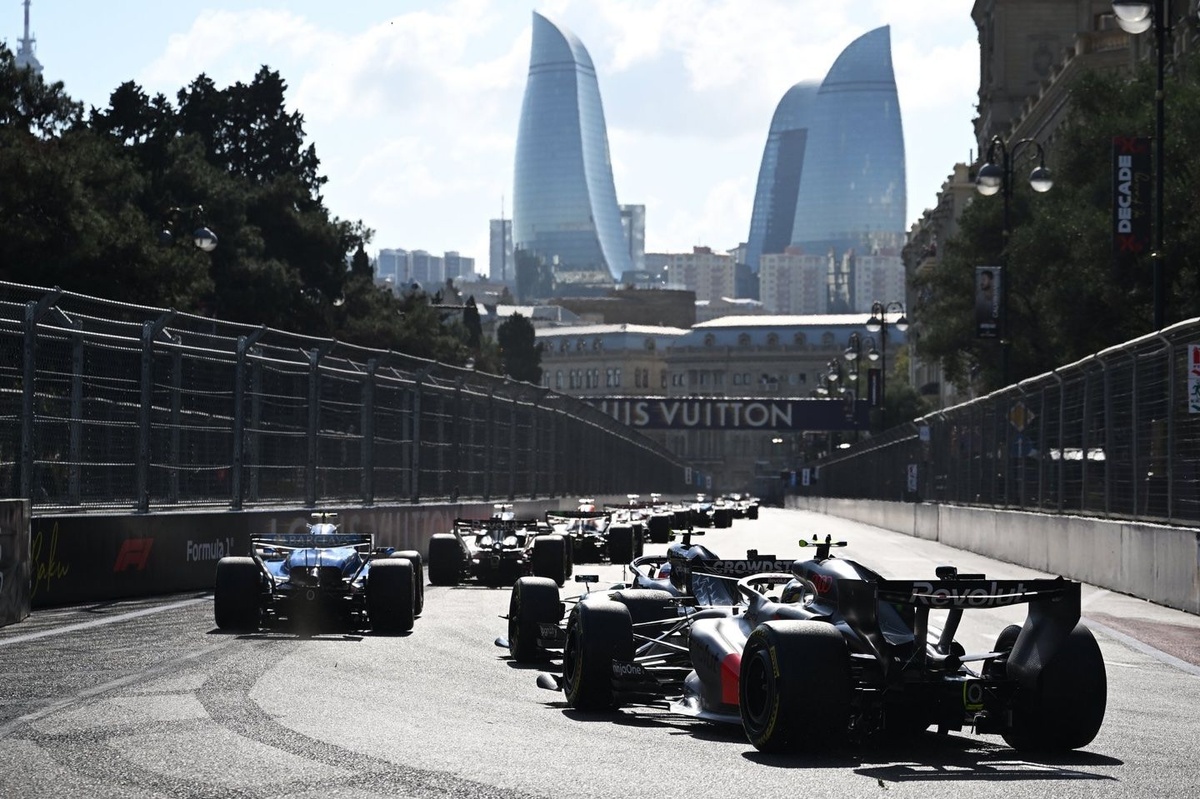
    This year marks a decade since Formula 1’s first visit to Azerbaijan in 2016, and the milestone edition arrives with a scheduling anomaly: the Grand Prix will be contested on Saturday, 26 September, rather than the traditional Sunday. The shift avoids a clash with Azerbaijan’s Remembrance Day on 27 September, compressing the entire weekend by 24 hours. Media obligations move to Wednesday, practice to Thursday, qualifying to Friday, and the race to Saturday. The format change compresses preparation time for teams and broadcasters alike, while the circuit itself remains unchanged — a 6.003-kilometre street layout that combines a hyper-technical castle section with the longest flat-out section on the calendar. Overtaking into Turn 1 is frequent, and races have historically been decided in the final metres of the final lap. The Saturday slot adds novelty to an already unpredictable venue.

    Formula 2 Title Fight Reaches Crescendo with Double-Header Format

    Support category action amplifies the weekend’s stakes as Formula 2 adopts a double-header format mirroring Formula 3’s season finale at the Madring. Two qualifying sessions on Thursday set the grids for a Friday morning Sprint Race and a Friday afternoon Feature Race preceding Formula 1 qualifying. A second Feature Race on Saturday leads into the Grand Prix. The championship battle is exceptionally tight: Red Bull junior Nikola Tsolov leads Ferrari academy driver Rafael Camara by just seven points. Alpine-backed Gabriele Mini sits 24 points behind Tsolov — within a single race victory — while team-mate Alex Dunne remains a mathematical contender at 38 points adrift. Baku’s history of chaotic, safety-car-influenced races makes it a potential title decider; the double-header format doubles the scoring opportunities and the risk.

    Why This Matters

    The Azerbaijan Grand Prix sits at a rare convergence of sporting, technical, and commercial inflection points. For the Drivers’ Championship, the triple-header sequence will test consistency and resilience over a compressed timeframe where a single mechanical failure or driving error carries disproportionate weight. Antonelli’s lead is slender in real terms; the circuits to come — Baku, Singapore, Austin — demand vastly different car characteristics, favouring no single team philosophy. For constructors, Williams’ upgrade represents a litmus test for midfield ambition: success could trigger a development arms race among Audi, Haas, and Alpine, while failure may force a strategic pivot toward 2027. The driver market’s inertia is equally significant; with fewer than ten races remaining, teams without confirmed 2027 line-ups risk losing preferred candidates to rival series or academy promotions. Finally, the Saturday race format — while a one-off — offers Formula 1 data on condensed weekend structures, a concept under study for future calendar compression. Baku, then, is not merely the next race; it is a stress test for the sport’s competitive, technical, and operational frameworks.

    Frequently Asked Questions

    Why is the Azerbaijan Grand Prix taking place on a Saturday?
    The race has been moved forward by 24 hours to avoid a clash with Azerbaijan’s Remembrance Day on 27 September. The entire weekend schedule shifts accordingly: media day on Wednesday, practice Thursday, qualifying Friday, and the Grand Prix on Saturday.
    Will Isack Hadjar race for Red Bull in Baku?
    Hadjar has missed the last three rounds with a wrist injury. A two-week break since Madrid increases the likelihood of his return, but Red Bull have stated he will only drive once fully cleared medically. An update is expected before the weekend.
    How close is the Formula 2 championship battle heading into Baku?
    Nikola Tsolov leads Rafael Camara by seven points. Gabriele Mini is 24 points behind the leader, and Alex Dunne trails by 38 points. With a double-header format offering two Feature Races, the title fight could swing dramatically this weekend.
  • ‘Nothing wrong with Isack’s recovery’

    ‘Nothing wrong with Isack’s recovery’

    Key Highlights

    • Isack Hadjar has missed three consecutive Formula 1 races — Zandvoort, Monza, and Madrid — due to a wrist injury sustained during the summer break training period.
    • Red Bull Racing team principal Laurent Mekies confirms Hadjar’s recovery is proceeding normally with no setbacks; a return decision will follow a simulator evaluation in approximately one week.
    • Liam Lawson has substituted for Hadjar at Red Bull Racing, scoring points in two of three starts, while Yuki Tsunoda has filled Lawson’s vacancy at Racing Bulls.

    Hadjar’s Injury and Absence

    French rookie Isack Hadjar has been sidelined since the summer break concluded, missing the Dutch Grand Prix at Zandvoort, the Italian Grand Prix at Monza, and the Madrid round while recovering from a wrist injury sustained during training in the three-week hiatus. The 20-year-old had made an impressive start to his Red Bull Racing tenure, registering eight top-10 finishes — including a podium in Monaco — and out-qualifying four-time world champion Max Verstappen on three occasions. His absence has cost him not only championship points but also crucial mileage in the RB22 as the team continues to understand the new generation of machinery. Although Hadjar has attended races to analyze data, Red Bull acknowledges that track time remains irreplaceable for correlating upgrades with on-track feel.

    Mekies Provides Recovery Update

    Speaking after the Spanish Grand Prix, Red Bull team principal Laurent Mekies offered a measured assessment of Hadjar’s condition, emphasizing that the recovery timeline aligns with medical expectations for the injury type.

    “Isack is good… There is nothing wrong with Isack’s recovery. I think we have learned that it’s fundamentally normal time for the sort of injuries he has,”

    Mekies stated. He outlined the process for the coming days:

    “So, we will continue with the same approach than what we had, we will evaluate the situations in a weeks’ time, we have a full week, with more than a full week to evaluate the situation to see how he feels.”

    The next step involves a simulator session to test Hadjar under realistic loads:

    “And then to put him on the simulator, to expose him to real-life constraints… If he feels close to 100%, we go for it. If he feels the recovery is not completed, we will stick [with] our approach to put his recovery first.”

    Mekies underscored the long-term perspective:

    “What we don’t want to do is by having an early return, compromise his long-term capacity to come back to 100%.”

    Impact on Championship and Team Dynamics

    In Hadjar’s absence, the driver lineup has shifted significantly. Liam Lawson has stepped up to the senior Red Bull Racing seat, delivering points finishes in two of his three outings, while Yuki Tsunoda has moved from Racing Bulls to replace Lawson. Verstappen, meanwhile, has secured two podiums during this stretch, demonstrating the RB22’s underlying potential. The situation creates a complex decision matrix for Red Bull ahead of the upcoming triple-header: whether to reinstate Hadjar if he clears the simulator test, or to retain Lawson for continuity. The team has indicated it is comfortable delaying the final call until the last possible moment.

    Historical Context: Wrist Injuries in Formula 1

    Recent precedents offer varied recovery timelines. Lance Stroll suffered a bicycle accident before the 2023 season, fracturing his wrist and toe; he missed pre-season testing but competed in the opening round in Bahrain, scoring points despite the injuries. Daniel Ricciardo’s 2023 hand fracture — sustained in a practice crash at Zandvoort — required a longer absence of five Grands Prix, with Lawson serving as his replacement at that time. Hadjar’s current three-race absence falls between these two benchmarks, and Red Bull’s cautious stance reflects lessons learned from both cases.

    Why This Matters

    Hadjar’s injury interrupts a breakthrough rookie campaign that positioned him as a credible long-term asset for Red Bull’s driver pipeline. His ability to challenge Verstappen in qualifying signaled rare adaptability to the RB22’s characteristics. The team’s willingness to prioritize his full recovery over short-term results reflects a strategic investment in his development trajectory. Simultaneously, Lawson’s competent deputizing strengthens his own case for a 2025 seat, either at Red Bull Racing or Racing Bulls. The upcoming triple-header — Azerbaijan, Singapore, and Austin — represents a critical window for car development; the driver in the second Red Bull cockpit will directly influence upgrade correlation and constructors’ championship positioning.

    Frequently Asked Questions

    When will Red Bull decide on Isack Hadjar’s return?

    Laurent Mekies indicated the team will evaluate Hadjar’s condition in approximately one week, including a simulator session to assess his readiness under race-like loads. A final decision is expected before the next Grand Prix in Azerbaijan.

    How has Liam Lawson performed in Hadjar’s absence?

    Lawson has scored points in two of his three starts for Red Bull Racing at Zandvoort, Monza, and Madrid, demonstrating his capability in the senior team environment.

    What is the nature of Hadjar’s wrist injury?

    The source specifies that Hadjar hurt his wrist during training in the summer break. Mekies described the recovery timeline as “fundamentally normal time for the sort of injuries he has,” without detailing the specific diagnosis.

  • Red Bull Insists “there is nothing wrong” With Isack Hadjar’s Recovery

    Red Bull Insists “there is nothing wrong” With Isack Hadjar’s Recovery

    Key Highlights

    • Red Bull team principal Laurent Mekies confirms Isack Hadjar’s wrist injury recovery is progressing normally, with a decision on his Baku return expected by Wednesday or Thursday.
    • Liam Lawson will continue preparing for both Red Bull Racing and Racing Bulls roles until Hadjar’s fitness is confirmed, having scored 14 points in three grands prix.
    • Hadjar consulted seven-time MotoGP champion Marc Marquez, whose own rushed return from a broken humerus in 2020 cost him an entire season, reinforcing the team’s cautious approach.

    Red Bull Prioritizes Long-Term Health Over Quick Return for Hadjar

    Red Bull Racing team principal Laurent Mekies delivered a measured update on Isack Hadjar’s injury situation following the Spanish Grand Prix, confirming the French rookie’s recovery from a wrist injury sustained during the summer break is proceeding according to plan. Hadjar has missed the last three Formula 1 rounds, with Liam Lawson stepping into the Red Bull Racing seat while Yuki Tsunoda covered reserve duties at Racing Bulls. Speaking after Sunday’s race in Madrid, Mekies emphasized that the team has no intention of rushing the sophomore driver back before he reaches full fitness.

    Marquez Consultation Reinforces Cautious Strategy

    A pivotal factor in shaping Red Bull’s conservative timeline was Hadjar’s interaction with seven-time MotoGP world champion Marc Marquez. The Spanish motorcycle racing icon famously fractured his humerus in the 2020 Jerez season opener, attempted to compete in the following race, and subsequently missed the remainder of the campaign due to complications. That cautionary tale resonated with the 20-year-old Frenchman, convincing him that patience serves his long-term interests better than an accelerated return. Mekies confirmed the team has “learned that it’s fundamentally a normal time for the sort of injuries he has,” validating their existing medical approach.

    Simulator Test Will Determine Baku Availability

    Mekies outlined a clear decision-making framework for the upcoming Azerbaijan Grand Prix. With “a bit more than a full week” before the Baku weekend, Hadjar will undergo evaluation before being placed on the simulator to experience “real-life constraints.” The team principal established a binary threshold: “If he feels close to 100%, we go for it; if he feels the recovery is not completed, we will stick on our approach to put his recovery first.” Mekies explicitly ruled out compromising Hadjar’s “long-term capacity to come back to 100%” for a premature race appearance, underscoring the organization’s investment in the driver’s development trajectory.

    Lawson Navigates Dual Preparation Challenge

    New Zealander Balances Two Team Workloads

    While Hadjar focuses on rehabilitation, Liam Lawson faces a demanding logistical challenge. The New Zealander must maintain race readiness for both Red Bull Racing and Racing Bulls until a final decision on Hadjar’s status emerges. “It’s a lot of time at the factory and doing a lot of extra preparations,” Lawson admitted, adding that “this week off won’t be much of a week off.” The 22-year-old has impressed in his three substitute appearances, accumulating 14 championship points and climbing to ninth in the drivers’ standings—just 12 points adrift of Hadjar despite the Frenchman’s five-race head start.

    Mental Preparation Complicated by Uncertainty

    Lawson candidly described the psychological toll of preparing for two fundamentally different cars with no guarantee of which he will drive in Baku. “Coming to the end of the [Madrid] weekend now, I feel quite comfortable in this car. But just going forward, it’s the unknown all the way up to the race weekends,” he explained. The Red Bull driver estimated clarity might not arrive until “Wednesday or Thursday for Baku,” making it “quite tricky to mentally prepare for what car I’m going to drive.” Lawson noted the machinery differences are substantial: “Going back now will be quite tough. It’s completely different to drive.”

    Why This Matters

    The Hadjar-Lawson situation highlights Red Bull’s evolving driver management philosophy under new leadership. With Mekies and sporting director Jonathan Wheatley steering the program following Christian Horner’s reduced operational role, the team is demonstrating a willingness to protect young assets rather than exploit short-term performance gaps. Hadjar’s consultation with Marquez—facilitated by Red Bull’s cross-discipline motorsport network—shows an innovative approach to athlete welfare that transcends series boundaries. For Lawson, the extended audition strengthens his case for a full-time 2026 seat, whether at Red Bull Racing, Racing Bulls, or elsewhere. The Baku decision will also test Red Bull’s simulator correlation capabilities, as Hadjar’s virtual running will serve as the primary fitness benchmark in the absence of on-track running. Championship-wise, Lawson’s 14-point haul has injected unexpected competitiveness into the midfield battle, with the New Zealander now within striking distance of established runners including Nico Hulkenberg and Fernando Alonso.

    Frequently Asked Questions

    When will Red Bull decide if Isack Hadjar races in Baku?

    According to team principal Laurent Mekies, the decision will likely come “probably all the way up to Wednesday or Thursday for Baku,” following a simulator evaluation after more than a week of recovery assessment.

    How has Liam Lawson performed in his three races replacing Hadjar?

    Lawson has scored 14 points across the three grands prix, placing him ninth in the drivers’ championship standings—just 12 points behind Hadjar despite missing the season’s first five rounds.

    Why did Isack Hadjar consult Marc Marquez about his injury?

    Hadjar sought advice from the seven-time MotoGP champion because Marquez famously rushed back from a broken humerus in 2020, aggravated the injury, and missed the rest of that season—a cautionary example that reinforced Red Bull’s patient approach to the Frenchman’s wrist recovery.

  • Liam Lawson to Remain at Red Bull for Third Race Weekend in Madrid as Isack Hadjar’s Recovery Continues

    Liam Lawson to Remain at Red Bull for Third Race Weekend in Madrid as Isack Hadjar’s Recovery Continues

    Red Bull Racing has confirmed Liam Lawson will retain his seat alongside Max Verstappen for the Spanish Grand Prix at the new Madring circuit in Madrid this weekend. The decision comes as Isack Hadjar continues his recovery from a wrist injury sustained during training over the summer break.

    Lawson Extends Stint with Senior Team

    Lawson initially replaced Hadjar at the Dutch Grand Prix in Zandvoort and kept the drive for the Italian Grand Prix at Monza. During this period, Yuki Tsunoda moved back to Racing Bulls to fill Lawson’s former seat alongside Arvid Lindblad.

    In a statement released Monday, Red Bull outlined the reasoning behind the extended arrangement:

    “After racing for the team in Zandvoort and Monza, Liam will continue to drive alongside Max at this week’s Spanish Grand Prix in Madrid,”

    read a statement from Red Bull.

    “The decision has been taken as Isack’s recovery continues to progress positively. While he is not yet ready to return to the cockpit, he will be in Madrid supporting the team.

    Everyone at Oracle Red Bull Racing looks forward to welcoming Isack back behind the wheel very soon.”

    Recent Form and Team Dynamics

    Lawson has delivered mixed results in his two starts for the senior squad, finishing seventh at Zandvoort and 14th at Monza. Meanwhile, Tsunoda has shown consistent pace since returning to Racing Bulls, scoring 11th and 10th-place finishes respectively.

    Hadjar will travel to Madrid to support the team trackside despite remaining sidelined. No definitive timeline has been provided for his return, though the team’s statement suggests his comeback is approaching.

    The Spanish Grand Prix marks Formula 1’s inaugural visit to the Madring layout, adding an extra layer of complexity for Lawson as he navigates an unfamiliar circuit in the Red Bull RB21.

  • Isack Hadjar Shares Injury Update as He Targets Red Bull Return at Italian GP

    Isack Hadjar Shares Injury Update as He Targets Red Bull Return at Italian GP

    Red Bull driver Isack Hadjar is “hopeful” of returning to the Formula 1 grid for the Italian Grand Prix after a wrist injury ruled him out of the Dutch Grand Prix.

    Hadjar suffered the injury during Formula 1’s summer shutdown. Although he missed the final F1 race at Zandvoort, the driver said he was “healing fast” while filming with the Milton Keynes-based team last weekend.

    Racing Bulls driver Liam Lawson replaced Hadjar alongside four-time world champion Max Verstappen, but Hadjar remained at Zandvoort to support the team.

    “Actually, it’s my first injury ever in my whole existence, career, whatever,” he told Red Bull in a behind-the-scenes video from the Dutch Grand Prix.

    “It’s weird to be on the bench and I’m not happy about it, for me and for the team. Obviously, I want to be there every lap.”

    Hadjar targets Monza return

    Pointing to his braced wrist, Hadjar added: “It’s not swollen, which is very good. It’s a good sign. So, actually, it’s healing fast. Every day I have a bit more mobility and I’m hopeful for Monza.”

    Lawson scored six points for Red Bull while standing in for Hadjar, finishing seventh at Zandvoort.

    “As for Liam, it’s never easy to jump from one team to another,” team principal Laurent Mekies said. “Today he took the points that we were able to take. Yesterday, he did a very good job in qualifying, being very close to Max and we thank him for having been able to adapt so quickly to the team.”

    The Italian Grand Prix at Monza is scheduled to take place from 4-6 September. Neither Red Bull nor Hadjar has officially confirmed whether he will return to the cockpit in Italy.

    Hadjar currently sits eighth in the drivers’ standings with 68 points, while his team-mate Verstappen is sixth with 112 points.