Tag: Interest rates

  • Data Proves Bitcoin Unfazed by Rising Bond Yields Long-Term

    Data Proves Bitcoin Unfazed by Rising Bond Yields Long-Term

    Key Highlights

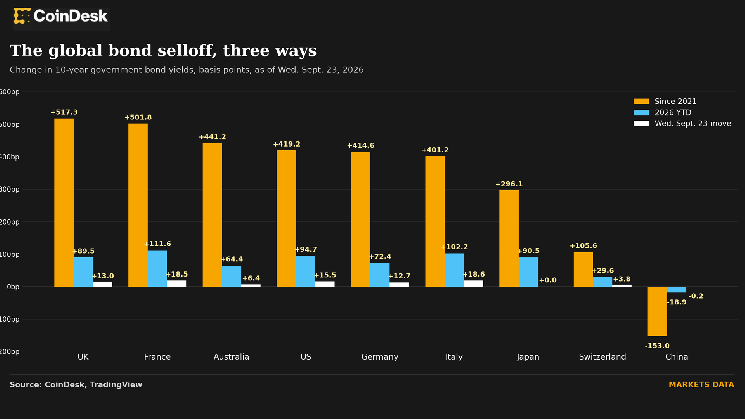
    • U.S. 10-year Treasury yield surged 15 basis points to 5.13%, the highest level since 2007, triggering global yield increases.
    • Bitcoin’s 90-day correlation with U.S. 10-year yield daily moves stands at just −0.18, with 180-day and 1-year correlations even closer to zero at −0.06 and −0.03 respectively.
    • Historical data analyzed by CoinDesk shows Bitcoin has demonstrated little to no consistent correlation with bond yields across multiple timeframes and international markets.

    Rising Yields Reignite Debate Over Bitcoin’s Macro Sensitivity

    The U.S. 10-year Treasury yield jumped 15 basis points on Wednesday to breach 5.13%, marking its highest level since the pre-financial crisis era of 2007. The move rippled across global fixed-income markets, pulling sovereign yields higher worldwide and reviving a familiar market narrative: that rising bond yields create a structural headwind for non-yielding assets like Bitcoin (BTC) and gold. The conventional logic posits that as risk-free returns become more attractive, the opportunity cost of holding zero-coupon assets increases, theoretically drawing capital away from crypto and toward government debt.

    Correlation Data Contradicts Conventional Wisdom

    While the theoretical framework appears sound on paper, empirical evidence fails to support a consistent inverse relationship. According to data analyzed by CoinDesk, the 90-day rolling correlation between Bitcoin’s daily returns and daily moves in the U.S. 10-year yield sits at just −0.18—a figure statistically indistinguishable from zero correlation. Extending the observation window does not strengthen the link; the 180-day correlation narrows further to −0.06, while the one-year correlation stands at a negligible −0.03. Across every measured timeframe, Bitcoin’s price action has exhibited virtually no linear dependence on the trajectory of U.S. benchmark yields.

    Global Yield Regimes Show Similar Disconnect

    The absence of correlation is not confined to the United States. Bitcoin has demonstrated an equally weak statistical relationship with the sovereign yields of other major economies. This global pattern suggests that Bitcoin’s valuation drivers operate independently of the interest rate channels that dominate traditional asset pricing models. Rather than functioning as a simple “risk-off” or “risk-on” proxy sensitive to the cost of capital, the asset’s historical behavior aligns more closely with a distinct, idiosyncratic return stream shaped by network adoption cycles, liquidity conditions specific to crypto markets, and evolving regulatory narratives.

    Why This Matters

    The persistent disconnect between Bitcoin and bond yields carries significant implications for portfolio construction and macro strategy. Investors and analysts who position Bitcoin strictly as a rate-sensitive speculative asset may be relying on a flawed mental model that has not held up over the asset’s history. As central banks navigate a potential “higher for longer” rate environment, understanding Bitcoin’s true correlation profile—effectively zero with respect to sovereign yields—becomes critical for accurate risk budgeting. The data suggests Bitcoin should be evaluated on its own fundamental merits and crypto-specific catalysts rather than through the lens of traditional duration risk.

    Frequently Asked Questions

    What is the current correlation between Bitcoin and the U.S. 10-year Treasury yield?

    As of the latest analysis by CoinDesk, the 90-day correlation is −0.18, the 180-day correlation is −0.06, and the one-year correlation is −0.03—all statistically near zero.

    Does Bitcoin correlate with bond yields in other countries?

    No. The data shows Bitcoin is equally uncorrelated with the sovereign yields of other nations, indicating this is a global phenomenon rather than a U.S.-specific anomaly.

    Why does the market still believe rising yields hurt Bitcoin?

    The narrative relies on theoretical opportunity cost logic: higher risk-free rates should make non-yielding assets less attractive. However, historical price data does not bear out this relationship, suggesting other factors dominate Bitcoin’s valuation.


  • Bitcoin Faces Eight-Year Rate Test as BOE Unwinds £368 Billion

    Bitcoin Faces Eight-Year Rate Test as BOE Unwinds £368 Billion

    Key Highlights

    • The Bank of England will reduce its monetary-policy gilt portfolio by £368 billion by September 2034, combining £46 billion annually from maturities and £20 billion from active sales.
    • The Monetary Policy Committee voted unanimously for the unwind but split 6–3 on Bank Rate, with Megan Greene, Catherine Mann, and Huw Pill favoring a hike to 4% while six members held at 3.75%.
    • Initial market reaction was muted: 10-year and 30-year gilt yields fell 7–10 basis points, and Bitcoin hovered near $78,000 with no isolated reaction to the announcement.

    Bank of England Sets Nine-Year Gilt Unwind Path

    The Bank of England has formalized a multi-year quantitative tightening (QT) program that will remove £368 billion of gilts held for monetary-policy purposes by September 2034. The figure represents the portfolio remaining after the Bank separated £120 billion of longer-dated gilts to back banknote issuance. Under the plan approved by the Monetary Policy Committee (MPC), the residual stock will contract by an average of £46 billion per year through a combination of bond maturities and £20 billion of annual active sales.

    Split Vote on Rates, Unanimous Backing for Balance-Sheet Reduction

    The rate decision and the balance-sheet decision were taken as separate votes. Six MPC members voted to maintain Bank Rate at 3.75%, while three members—Megan Greene, Catherine Mann, and Huw Pill—preferred an increase to 4%. Despite the divergence on the policy rate, all nine members backed the multi-year gilt unwind, signaling broad consensus on the need to normalize the central bank’s balance sheet even as opinions differ on the appropriate level of short-term interest rates.

    Implementation Details and Market Mechanics

    Auction Pause and Treasury Coordination

    Implementation will begin with a temporary reduction in active market sales. The Bank’s market notice confirmed that Asset Purchase Facility (APF) auctions will pause while officials review a possible arrangement involving HM Treasury and the Debt Management Office (DMO). Operational details for any sales-to-government model are due by April 2027, and the framework remains subject to a final decision. In the interim, gilts will continue to run off through maturities.

    Runoff Pace Comparable to Recent Practice

    The planned annual active sales pace of £20 billion aligns closely with recent experience. Over the preceding 12 months, the Bank sold £21 billion of gilts. However, average total runoff—including maturities—will slow to £46 billion per year from the previous year’s £70 billion reduction, reflecting the changing maturity profile of the portfolio.

    Market Reaction: Yields Ease, Bitcoin Steady

    Early market response pointed toward easier conditions in long-dated UK debt. Reuters reported that the 10-year gilt yield fell more than 7 basis points and the 30-year yield declined nearly 10 basis points by early Thursday afternoon. The Bank’s own yield-curve data provide the broader rates backdrop, though a single trading session cannot isolate how much each policy detail contributed to the move.

    BoE Sees Modest Cumulative QT Impact

    The Bank’s July assessment estimated that quantitative tightening accounted for only 20 to 30 basis points of an approximately 200-basis-point rise in long-term gilt term premia since 2022. The majority of the increase was attributed to global uncertainty, heavy sovereign issuance, and structural changes in UK demand. This suggests the incremental effect of the newly announced pace may be limited relative to the broader forces shaping long-term yields.

    Why This Matters

    The Bank of England’s QT framework represents a significant commitment to balance-sheet normalization that will test the capacity of private investors to absorb steady gilt supply over the next decade. By separating the rate decision from the unwind plan—and securing unanimous support for the latter—the MPC has signaled that balance-sheet policy will proceed on a predetermined schedule regardless of short-term rate moves. The auction pause and Treasury coordination review introduce an operational nuance that could reshape how central bank gilt sales interact with government debt management. For risk assets, the episode underscores the indirect transmission channel: predictable central-bank withdrawal may gradually tighten global financial conditions and dampen risk appetite, but the immediate market reaction was comparatively mild, with long-dated yields falling and Bitcoin showing no discernible isolated response. The coming years will reveal whether the cumulative pressure from steady QT, combined with heavy sovereign issuance globally, exerts a more pronounced influence on term premia and cross-asset correlations.

    Frequently Asked Questions

    What is the total amount of gilts the Bank of England plans to remove by 2034?
    £368 billion, covering the monetary-policy portfolio after £120 billion of longer-dated gilts were separated to back banknotes.
    How did the MPC vote on Bank Rate versus the QT plan?
    The MPC split 6–3 on Bank Rate, with six members holding at 3.75% and three (Megan Greene, Catherine Mann, Huw Pill) favoring a hike to 4%. All nine members voted unanimously for the multi-year gilt unwind.
    Did Bitcoin react to the Bank of England’s announcement?
    Bitcoin traded near $78,000 on Friday per CryptoSlate and Coinbase snapshots, but both were rolling levels that cannot isolate a reaction to Thursday’s announcement. No discernible isolated move was identified.
  • Kaiko Data Reveals Bitcoin Volatility

    Kaiko Data Reveals Bitcoin Volatility

    Bitcoin Volatility Surges Amid Federal Reserve Policy Uncertainty

    Bitcoin’s recent volatility has surged, reflecting renewed uncertainty surrounding Federal Reserve policy decisions. According to data from KaikoData, the 30-day rolling volatility for Bitcoin spiked following the August Jackson Hole speech, eased temporarily, and then climbed again into September. This pattern suggests traders should closely monitor future Fed communications for clearer guidance on interest rates, which directly impacts market sentiment across digital asset markets.

    Mixed Signals Across Crypto Markets

    The broader cryptocurrency market indicates mixed signals, with various assets experiencing different momentum shifts. As Bitcoin grapples with climbing volatility, reduced forward guidance from the Federal Reserve adds an element of unpredictability. This uncertainty is particularly relevant for traders engaged in the derivatives market, where open interest and funding rates serve as crucial indicators of market sentiment. The potential for liquidation cascades also rises as traders navigate this volatile landscape.

    Key Data Points

    • Bitcoin’s 30-day rolling volatility spiked after the August Jackson Hole speech
    • Volatility eased before climbing again into September
    • Reduced Fed forward guidance leaves markets uncertain about interest rate trajectory
    • Traders are advised to watch for clearer Fed signals moving forward

    Market Conditions and Trading Activity

    Bitcoin’s price remains relatively unchanged as volatility increases, with no significant trading volume reported in the past 24 hours. The current market environment showcases hesitancy among traders as they respond to the Federal Reserve’s policy indications. This volatility trend may lead to increased caution in the market as traders reassess their positions amid the shifting landscape.

    As the leading cryptocurrency, Bitcoin’s price volatility and market influence make it particularly sensitive to macroeconomic policy shifts. The Federal Reserve’s policy decisions significantly affect financial markets, including cryptocurrencies, given their impact on interest rates and overall economic conditions.

    Levels to Watch

    Traders are monitoring potential shifts in Bitcoin’s volatility based on upcoming Fed announcements. Key levels to watch will be the reactions to new guidance, which could either stabilize or exacerbate current volatility trends. Risks remain high, especially if traders encounter sudden market movements that could lead to significant liquidations.

    This article is for informational purposes only and does not constitute financial advice.

  • Clarity Law Fails, Bitcoin and Altcoins Drop; Analysts Say “Don’t Worry About It,” Outline Recovery Needs

    Clarity Law Fails, Bitcoin and Altcoins Drop; Analysts Say “Don’t Worry About It,” Outline Recovery Needs

    The Digital Asset Market Clarity Act failed to advance in the U.S. Senate on Tuesday, falling short of the 60-vote threshold required to proceed. The procedural vote tally stood at 49 in favor and 50 against, effectively stalling the comprehensive regulatory framework for digital assets.

    The outcome triggered immediate sell-offs across Bitcoin and altcoin markets. However, analysts speaking to The Block characterized the legislative setback as a delay rather than a structural shift for the crypto sector, emphasizing that macroeconomic forces—particularly Federal Reserve monetary policy—remain the primary driver of medium-to-long-term market direction.

    “The Failure of the Law to Pass is Not a Structural Problem”

    Arctic Digital Research President Justin d’Anethan told The Block that while the CLARITY Act’s failure was disappointing, it does not signal a fundamental market problem.

    d’Anethan pointed out that current Bitcoin price levels and previous all-time highs were achieved before the Clarity Act was in effect. He noted that institutional investors view the development not as a complete failure of the regulatory framework, but rather as a delay in the regulatory timeline. According to the analyst, interest rates and the overall monetary policy environment may be more decisive than regulatory clarity in determining the direction of the crypto market.

    Regulation Not a Key Determinant in Current Cycle

    BTC Markets crypto analyst Rachael Lucas offered a parallel assessment, stating that regulatory efforts are not a key determinant in the current crypto market cycle and that the market is more sensitive to interest rates.

    Lucas identified three critical areas for investors to monitor in the coming period:

    “1) Whether the Fed’s expected interest rate hikes will mark the beginning of a longer period of tightening, 2) Whether capital inflows into spot Bitcoin ETFs will accelerate again, 3) Whether an alternative regulatory path will emerge that can proceed without requiring 60 Senate votes.”

    Lucas added that capital is not exiting the market but concentrating in specific assets. While Congress is not strictly necessary for a fourth-quarter recovery, the analyst stressed that a prerequisite for such a rebound is for interest rates not to worsen further.

    “All Eyes Are on the FED Today!”

    Market attention has now pivoted squarely to the Federal Reserve. The U.S. central bank is expected to raise its benchmark interest rate for the first time since 2023 at today’s FOMC meeting, with a 25-basis-point increase widely anticipated. Futures markets are pricing in a higher than 90% probability of a hike at this session, with an additional increase projected before year-end.

    This is not investment advice.

  • Bitcoin’s Oil Risk Extends to 2027 as IEA Cuts Supply Outlook Again

    Bitcoin’s Oil Risk Extends to 2027 as IEA Cuts Supply Outlook Again

    IEA Cuts 2026 Oil Supply Forecast, Pushes Full Gulf Recovery to 2027

    The International Energy Agency (IEA) has lowered its 2026 global oil supply projection and now expects a full recovery of Gulf exports only in 2027, a timeline that could delay energy-driven relief in borrowing costs for leveraged Bitcoin investors.

    Supply and Demand Both Revised Lower

    In its September 11 report, the IEA projects average global supply of 100.7 million barrels per day (bpd) for 2025, down from 102 million bpd in the August 12 outlook—a downward revision of 1.3 million bpd. On the demand side, the agency forecasts global oil consumption will contract by 2.5 million bpd in 2026 versus 2025, a decline roughly 940,000 bpd deeper than previously expected.

    Weaker consumption would normally ease pressure on tight supplies. However, the IEA estimates global observed inventories fell by 95 million barrels in August, signaling that reduced usage has not yet translated into physical loosening.

    Gulf Export Recovery Remains Uneven

    There are signs of improvement in trade flows. The IEA notes that increased volumes bypassing the Strait of Hormuz and military-escorted shipments through the strait have helped narrow crude export losses. Yet Gulf refined-product and liquefied petroleum gas exports in August remained nearly 60% below February levels. The agency characterizes the recovery as uneven and emphasizes that the 2027 timetable remains a forecast.

    Inflation Expectations Complicate the Path to Cheaper Credit

    For investors borrowing dollars to hold Bitcoin, the connection runs through inflation and interest-rate expectations. Persistent energy-price pressure that keeps rate expectations elevated could postpone financing relief. This risk affects borrowers exposed to broader credit conditions; the IEA reports do not measure changes in Bitcoin-specific borrowing costs.

    The Federal Reserve’s monetary policy framework explains how short-term rates influence lending costs and how expectations of future policy affect longer-term rates and credit terms.

    University of Michigan Survey Shows Rising Inflation Expectations

    A preliminary September survey from the University of Michigan adds a cautionary signal: year-ahead inflation expectations jumped to 4.6% from 4.0% in August, while long-run expectations edged up to 3.4% from 3.3%. The modest move in long-run expectations warrants attention, though a single preliminary reading does not confirm a lasting shift.

    Fed Governor Waller’s Pre-IEA Assessment

    An earlier counterweight came from Fed Governor Christopher Waller. In a September 3 speech, Waller said his concern about energy costs spreading broadly into goods and services prices had not materialized so far. He identified renewed energy pressure and rising longer-term inflation expectations as risks. Waller indicated he could support holding rates steady if disinflation continued, but would consider a hike if August inflation data reversed that progress. Those conditional views preceded the IEA’s latest supply revision.

    Key Test Ahead of September Fed Meeting

    Ahead of the September 15–16 Federal Reserve meeting, the critical test for cheaper credit is whether weaker consumption and recovering flows translate into reduced inflation pressure. Sustained supply recovery and limited spillovers would strengthen the case for easing; persistent price pressure would weaken it. Falling oil demand alone offers Bitcoin borrowers no assurance of financing relief.

  • Bitcoin Recovers From CPI Dip as US Inflation Holds at 3.4%

    Bitcoin Recovers From CPI Dip as US Inflation Holds at 3.4%

    US Inflation Data Triggers Brief Bitcoin Dip Before Recovery Above $77,000

    Bitcoin experienced a sharp but short-lived decline toward $76,000 following the release of the latest US Consumer Price Index (CPI) report, which showed underlying price pressures running slightly hotter than economists anticipated. The cryptocurrency quickly reversed course, reclaiming the $77,000 level, while Ethereum and several major altcoins maintained gains throughout the trading session.

    Core CPI Exceeds Forecasts, Keeping Federal Reserve Policy in Focus

    The US Bureau of Labor Statistics reported that the Consumer Price Index rose 0.4% in August, accelerating from July’s 0.1% increase and matching consensus estimates. On a year-over-year basis, headline inflation held steady at 3.4%, remaining well above the Federal Reserve’s 2% target.

    The core inflation measure, which strips out volatile food and energy components, increased 0.3% month-over-month — above the 0.2% increase most economists had projected. However, the annual core inflation rate edged down from 2.5% to 2.4%.

    Gasoline prices accounted for over one-third of the monthly headline increase, surging 3.9% and lifting the broader energy index 2.1%. Shelter costs rose 0.3%, while food prices edged up 0.1%.

    Bitcoin Volatility Reflects Trader Uncertainty on Rate Outlook

    Bitcoin initially slid to approximately $76,050 immediately after the data release before recovering to trade above $77,100. The token’s intraday range spanned $76,400 to $79,550, highlighting the divided sentiment among market participants interpreting the inflation implications for US interest rates.

    The stronger-than-expected core reading could reinforce a more hawkish stance from the Federal Reserve at its September 15-16 policy meeting. Elevated interest rates typically reduce the appeal of riskier assets as investors find alternative yield opportunities in safer instruments.

    Ethereum Outperforms as Broader Crypto Market Shows Resilience

    Ethereum led the major cryptocurrencies during the session, trading near $2,543 — a gain of nearly 3.2% after reaching intraday highs of $2,648. Solana advanced approximately 1.5% to around $101, while BNB climbed 1.4% to roughly $723. Dogecoin added a modest 0.5%, and XRP was little changed near $1.35.

    Notably, gains across the altcoin complex began before the CPI release, meaning they cannot be attributed to the inflation data. However, the market’s refusal to follow Bitcoin’s initial slide lower suggests the sell pressure was isolated rather than systemic.

    Key Takeaways

    • US headline inflation held at 3.4% year-over-year; monthly core CPI (0.3%) exceeded the 0.2% forecast.
    • Bitcoin briefly dipped toward $76,000 before recovering above $77,000, with an unusually wide $3,000+ intraday range.
    • Ethereum and major altcoins held gains, indicating the initial Bitcoin weakness did not trigger a broader market sell-off.
  • Bitcoin Price Surges Despite Hot US Inflation Data

    Bitcoin Price Surges Despite Hot US Inflation Data

    Bitcoin Price Spikes, Shrugs Off Hot US Inflation Data

    Bitcoin’s price rose on Friday despite data revealing that U.S. inflation had accelerated, defying typical market expectations that higher inflation would pressure risk assets.

    Bitcoin Trades Near $79,000 Amid Inflation Surprise

    The largest cryptocurrency by market capitalization was recently trading close to $78,749 after jumping 2% over a 24-hour period. At one point on Friday morning in New York, bitcoin rose as high as $79,607.

    The price spike came after the release of August consumer price index data showing U.S. consumer prices accelerated, reinforcing expectations that the Federal Reserve will raise interest rates at its meeting next week.

    Core Inflation Exceeds Forecasts

    The consumer price index, excluding food and energy, climbed 0.3% in August from a month earlier, which was higher than expected. Inflation in the U.S. has been difficult to tame due to the war with Iran, which has lifted oil prices, in turn raising the costs of food, gasoline, and other goods.

    Higher inflation typically means the Federal Reserve will raise interest rates, which in turn could stop bitcoin’s price climbing higher. According to CME’s FedWatch tool, traders think there is an 85% chance interest rates will be higher by next week.

    Fed Policy Outlook and Bitcoin’s Rate Sensitivity

    Bitcoin has typically performed well in a low interest rate environment because it means people can buy more of the cryptocurrency with increased liquidity. The Federal Reserve will meet next week and reveal what it will do with borrowing costs.

    Federal Reserve Chairman Kevin Warsh, who took the helm in January, last month gave his first speech as head of the U.S. central bank and said he had more work to do to fight inflation.

    Political Context: Affordability Crisis and Midterm Elections

    The U.S. is currently in the grips of an affordability crisis and rising oil prices are a hot topic ahead of the midterm elections. U.S. President Donald Trump has reassured voters that prices will get under control and repeatedly put pressure on the central bank to lower interest rates.

    Recent Catalysts: Regulatory Clarity and Treasury Policy

    Bitcoin in August had its biggest run in years following positive regulatory news and an announcement from the U.S. Treasury. Treasury Secretary Scott Bessent announced the department would double the size of its long-dated bond buybacks, helping non-yielding assets like bitcoin and gold. The cryptocurrency then benefited from President Trump urging lawmakers to get key crypto legislation, the Clarity Act, over the line.

    This post first appeared on Bitcoin Magazine and is written by Mathew Di Salvo.

  • $100 Oil Could Be Bitcoin’s Next Problem

    $100 Oil Could Be Bitcoin’s Next Problem

    Oil Surges Toward $100 as Iran Tensions Escalate

    Brent crude reached a seven-week high near $99 a barrel this week, while West Texas Intermediate climbed above $92. The rally follows Iran’s announcement that it plans to declare a maritime “exclusion zone” around the Strait of Hormuz, warning it will stop ships attempting to pass without permission. This escalation comes after U.S. strikes targeted three Iranian oil tankers over the weekend. Iran has promised a “more intense” response, and Brent prices have surged close to 20% over the past month.

    Why Rising Crude Creates an Inflation Problem

    Oil functions as more than transportation fuel. It feeds directly into shipping costs, plastics manufacturing, fertilizer production, and food supply chains. When crude prices spike this rapidly, the increases appear at gas pumps within days and in grocery bills within weeks. U.S. inflation was already running above the Federal Reserve’s 2% target before this latest geopolitical flare-up. Fed Chair Kevin Warsh has maintained a hawkish stance through the summer, and traders are now pricing in genuine odds of a rate hike rather than a cut, a scenario that appeared unthinkable a year ago.

    The Federal Reserve Faces a Policy Trap

    The Fed balances two sometimes conflicting mandates: controlling inflation and maintaining a healthy labor market. A cooling jobs picture typically argues for lower rates. However, if oil-driven inflation continues climbing, cutting rates risks exacerbating price pressures. Should oil remain near $100, the Fed may delay cuts it would otherwise implement, or hold rates higher for longer than markets currently anticipate. Some forecasters now place the probability of a September rate hike above 50%.

    How Higher Rates Pressure Bitcoin

    Bitcoin offers no yield comparable to bonds or savings accounts. When interest rates and Treasury yields rise, investors gain a superior risk-free alternative, prompting capital to flow out of assets like Bitcoin and into fixed income or cash. Higher rates also tighten overall financial system liquidity, the total pool of money available to chase risk assets. Reduced liquidity generally translates to weaker demand for Bitcoin. When U.S. strikes on Iranian tankers pushed oil higher this week, Bitcoin slipped toward $79,700. A similar pattern emerged on September 2, when renewed conflict drove Brent higher and Bitcoin fell roughly 1.5%.

    Bitcoin’s Safe-Haven Narrative Faces Reality Check

    A Middle East war might appear to be the type of event that drives investors toward Bitcoin as a hedge. In practice, that correlation has not materialized. Bitcoin has largely moved in tandem with equities during this conflict, declining when tensions escalate and stabilizing when they ease. Geopolitical fear alone does not drive capital into Bitcoin. Instead, Bitcoin responds to the direction of interest rates, yields, and overall market liquidity. Geopolitical events matter to Bitcoin only to the extent they alter those financial conditions.

    Potential Bullish Reversal Scenario

    One scenario could eventually benefit Bitcoin. If sustained $100+ oil chokes consumer spending and slows the economy severely enough, the Fed may ultimately be forced to cut rates aggressively to support growth, even with inflation remaining elevated. Should expensive energy damage growth sufficiently to compel aggressive monetary easing, the resulting easier financial conditions could become supportive for Bitcoin. However, a sharp economic slowdown could still pressure risk assets before that liquidity benefit emerges.

    The Critical $100 Oil Threshold

    The $100 per barrel mark represents a psychological and policy inflection point. Below that level, this episode likely remains a volatility event: Bitcoin dips on headlines and recovers as tensions ease. Above it, and sustained, the situation becomes a macroeconomic problem that reshapes Fed policy for months. In that environment, Bitcoin’s trajectory depends less on Iran and more on what Jerome Powell’s successor decides to do next.

  • Fed Chair Kevin Warsh Speaks at Jackson Hole: Highlights and Bitcoin’s Initial Reaction

    Fed Chair Kevin Warsh Speaks at Jackson Hole: Highlights and Bitcoin’s Initial Reaction

    Federal Reserve Chairman Kevin Warsh has begun his highly anticipated address at the Jackson Hole symposium in Jackson Hole, Wyoming.

    In his first speech as Fed chairman, Warsh highlighted inflation as a key concern and adopted a hawkish tone, saying price stability should remain the Federal Reserve’s priority. He noted that although summer inflation data had improved, underlying trends had not changed significantly.

    Key points from Warsh’s Jackson Hole speech

    “I’m struggling to define the financial conditions as restrictive.”

    We need to make sure that the downward trend in inflation is moving towards the target, otherwise we’ll have work to do.

    This summer’s inflation figures are better than expected, but don’t tell me that the underlying trends have changed significantly.

    Consumer spending is healthy, and labor markets are stable.

    The Fed needs to ensure that inflation remains stable.

    The economy remains resilient: consumer spending is healthy, labor markets are stable, and business investment is growing rapidly.

    Warsh also said that at the July meeting, there was a good majority that advocated waiting before changing interest rates.

    Bitcoin falls during Warsh’s speech

    Before Warsh’s address, Bitcoin was trading at around $79,000. After the speech began, its price fell to the $78,000 level. The price movement of Bitcoin during Warsh’s speech was as follows:

    This is not investment advice.

  • 10-Year Treasury Yield Reaches 5%, Critical Threshold for US Economy and Markets

    10-Year Treasury Yield Reaches 5%, Critical Threshold for US Economy and Markets

    10-Year Treasury Yield Hits 5%: Borrowing Costs Surge to Highest Level Since 2007

    The 10-year U.S. Treasury yield climbed to 5% on Monday, reaching a critical threshold briefly touched in 2023 and otherwise unseen since 2007. This move in the key benchmark signals higher borrowing costs for Americans seeking mortgages, auto loans, and other credit.

    Bond Market Sell-Off Extends Globally

    The 10-year yield has extended a recent surge that has lifted borrowing costs for consumers, businesses, and the U.S. government alike. Yields have risen despite efforts by Treasury Secretary Scott Bessent to calm bond-market concerns. The global bond market, anchored by the nearly $32 trillion U.S. Treasury market, has sold off as investors weigh a mosaic of risks: soaring energy prices, expectations for further central-bank rate hikes, uncertainty surrounding the war with Iran, and unchecked government spending amid mounting debt.

    Government bond yields worldwide have touched multi-year and multi-decade highs this year, compounding affordability concerns, adding to unease about sovereign debt burdens, and threatening to weigh on equity markets. Yields rise when bond prices fall; the sell-off this year has pushed prices lower and sent the 10-year yield toward levels not seen in nearly two decades. The benchmark now sits at its highest since October 2023, just a whisker below its firmest level above 5% since 2007.

    Sharp Reversal Since Start of Year

    The 10-year yield began the year at 4.15% and dipped below 4% in February. After the outbreak of war with Iran, yields sharply reversed course and have climbed steadily since. The benchmark hit 4.5% in May before breaching 5% on Monday.

    Direct Impact on Mortgage Rates and Housing

    Higher bond yields translate directly into higher interest rates, making borrowing more expensive across the economy. The 10-year Treasury serves as the benchmark for borrowing costs economy-wide. Rising yields push up the rates consumers pay on mortgages and other loans.

    The housing market feels the sting most acutely. Mortgage rates track the 10-year yield closely. As the benchmark has surged this year, the average 30-year fixed mortgage rate has climbed to its highest level in more than a year. Last week, the average 30-year fixed rate reached 6.76%, up from 6.15% at the start of the year.

    Equity Market Implications: Context Matters

    Rising yields affect analysts’ earnings-discount models and can draw investors from riskier equities into safer government bonds. However, the impact on stocks depends on the context and volatility of the yield move.

    When yields spike dramatically, shocks can ripple through equities. In April 2025, President Donald Trump’s tariffs roiled financial markets: the 10-year yield spiked, the dollar fell, and stocks tumbled. Yet this year yields have risen steadily while the S&P 500 remains up more than 10%. Strong corporate earnings can outweigh nerves about higher yields.

    Markets may absorb steadily climbing yields if economic growth stays robust. But higher borrowing costs increase risks for equities; if earnings falter, elevated yields could become a larger headwind.

    Analyst Perspectives on the 5% Threshold

    The 10-year yield at 5% is seen by some as a threshold above which financial markets might go into meltdown, John Higgins, chief economic adviser for financial markets at Capital Economics, said in a note.

    While we aren’t convinced that 5% is that ‘magic’ number, higher Treasury yields would certainly pose a risk to the sustainability of the US’ public finances as well as threaten equities, Higgins said.

    End of the Ultra-Low-Rate Era

    Analysts say the rise in global yields isn’t entirely surprising and may signal that the era of ultra-low interest rates is over, with rates returning to levels more typical of past decades. After the 2008 financial crisis, central banks worldwide cut rates to historic lows. That shift began reversing in 2022, when central banks hiked rates to combat inflation sparked by the pandemic and Russia’s invasion of Ukraine.

    The 10-year yield traded at 1.3% five years ago; today it stands at 5%.

    What we’ve been communicating to our clients is ‘normal for longer,’ meaning these factors are here to stay, Luis Alvarado, co-head of global fixed income strategy at Wells Fargo Investment Institute, told CNN.

    A sustained push higher in yields across the globe has accelerated since the start of the war with Iran. Ten-year yields in Germany, France, and the United Kingdom are all at levels not seen in more than a decade. Rising energy prices are prompting central banks to raise rates to tamp down inflation; the European Central Bank hiked rates last week for the second time this year. Meanwhile, investors grow increasingly skeptical of governments’ bloated budgets and mounting deficits.