Tag: Institutional investment

  • Spot Bitcoin ETFs Attract Nearly $1 Billion Monday, Marking 9th Largest Inflow Ever

    Spot Bitcoin ETFs Attract Nearly $1 Billion Monday, Marking 9th Largest Inflow Ever

    Key Highlights

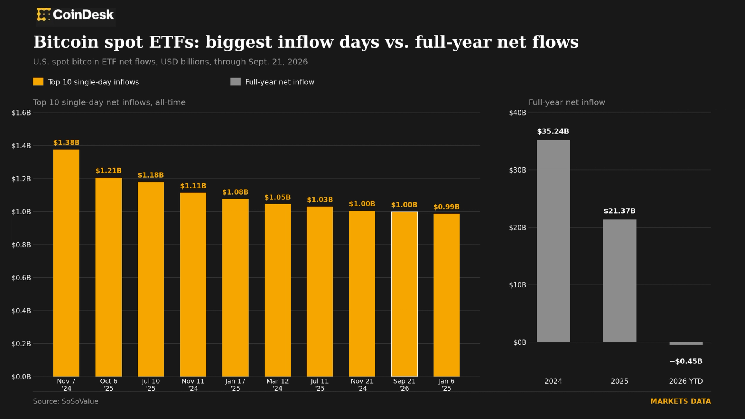
    • U.S. spot Bitcoin ETFs recorded a $998.95 million net inflow on Monday, the largest single-day haul since October 6, 2025, when Bitcoin traded near its all-time high of $126,200.
    • BlackRock’s IBIT led the surge with $381.37 million, followed by Ark’s ARKB ($289.12 million) and Fidelity’s FBTC ($238.84 million), marking the ninth-largest inflow day since the funds launched in January 2024.
    • The three-day winning streak lifts month-to-date inflows to $1.31 billion, extending August’s $3.52 billion pace and signaling sustained institutional conviction despite macroeconomic headwinds.

    Record-Breaking Inflow Signals Institutional Conviction

    U.S.-listed spot Bitcoin exchange-traded funds posted a staggering $998.95 million in net inflows on Monday, according to data from SoSoValue, marking the most significant single-day capital allocation since October 6, 2025. That date coincides with Bitcoin’s previous all-time high of approximately $126,200, a level the asset has yet to reclaim. Monday’s haul also ranks as the ninth-largest daily inflow since the ETF suite debuted on January 11, 2024, underscoring the magnitude of institutional appetite returning to the digital asset space.

    BlackRock, Ark, and Fidelity Lead the Charge

    The inflow was broad-based but heavily concentrated among the market’s dominant issuers. BlackRock’s iShares Bitcoin Trust (IBIT) captured $381.37 million, maintaining its position as the primary vehicle for institutional exposure. Ark Invest’s ARKB attracted $289.12 million, while Fidelity’s Wise Origin Bitcoin Fund (FBTC) drew $238.84 million. The combined strength across these three funds alone accounted for more than $900 million of the day’s total, reflecting a flight to liquidity and brand recognition among large allocators.

    Three-Day Streak Defies Legislative and Monetary Headwinds

    Monday’s print extends a three-day streak of positive flows—the first such run in two weeks—and arrives at a pivotal juncture. The cryptocurrency market recently absorbed a dual shock: a failed Senate cloture vote on the Clarity Act, which would have established a regulatory framework for digital assets, and a Federal Reserve interest-rate increase that typically pressures risk assets. Despite these headwinds, the persistent buying pressure suggests institutions are looking past near-term policy uncertainty and focusing on Bitcoin’s long-term portfolio role as a non-sovereign store of value.

    Monthly Momentum Builds on August’s Historic Pace

    The latest surge pushes month-to-date net inflows to $1.31 billion, building directly on August’s record-setting $3.52 billion tally. That two-month cumulative figure exceeds $4.8 billion, a pace that rivals the initial launch frenzy earlier this year. Analysts interpret the sustained flow data as evidence that allocators—ranging from registered investment advisors to hedge funds and corporate treasuries—are treating Bitcoin exposure as a strategic allocation rather than a tactical trade, even as fiscal debt concerns mount across advanced economies.

    Why This Matters

    The resilience of ETF flows amid legislative gridlock and restrictive monetary policy marks a maturation of the Bitcoin investment thesis. With the Clarity Act stalled, regulatory clarity remains elusive, yet capital continues to flow into the regulated ETF wrapper—a sign that institutions are comfortable navigating the current framework. The Fed’s rate hike cycle, while a traditional negative for non-yielding assets, has not deterred buyers, suggesting Bitcoin’s narrative as an inflation hedge and diversification tool is gaining traction in portfolio construction models. Upcoming catalysts include the next Federal Open Market Committee meeting, potential lame-duck session movement on crypto legislation, and the fourth-quarter rebalancing window that could amplify institutional positioning.

    Frequently Asked Questions

    Which Bitcoin ETFs saw the largest inflows on Monday?

    BlackRock’s IBIT led with $381.37 million, followed by Ark’s ARKB at $289.12 million and Fidelity’s FBTC at $238.84 million. These three funds accounted for the vast majority of the $998.95 million total net inflow.

    How does Monday’s inflow compare to historical levels?

    It was the largest single-day net inflow since October 6, 2025—the day Bitcoin hit its all-time high near $126,200—and ranks as the ninth-largest inflow day since the ETFs launched on January 11, 2024.

    What does the current flow trend suggest about institutional sentiment?

    The three-day winning streak and month-to-date total of $1.31 billion—following August’s $3.52 billion—indicate that institutions are maintaining conviction in Bitcoin despite the failed Clarity Act vote, a Fed rate hike, and broader fiscal debt concerns.


  • Bitcoin Miner MARA Holdings Makes Millions in Bitcoin Purchases: Details Revealed

    Bitcoin Miner MARA Holdings Makes Millions in Bitcoin Purchases: Details Revealed

    MARA Holdings Adds 1,292 Bitcoin to Treasury in $98.6 Million FalconX Transaction

    Bitcoin mining firm MARA Holdings (NASDAQ: MARA) has expanded its corporate treasury with a significant Bitcoin acquisition, according to on-chain data tracked by analytics platform Lookonchain. The company purchased 1,292 BTC through institutional trading platform FalconX approximately nine hours before the data was published.

    Transaction Details and Market Context

    The acquisition carries an estimated value of $98.64 million, marking another substantial single institutional Bitcoin purchase by the publicly traded miner. MARA Holdings operates with a dual strategy: mining Bitcoin through its operations while simultaneously accumulating the asset on its balance sheet.

    Large-scale Bitcoin purchases by public companies are widely viewed as a key indicator of institutional investor confidence in the cryptocurrency market. The use of FalconX—a prime brokerage catering to institutional clients—underscores the professional execution behind the transaction.

    Strategic Implications for Miner Treasuries

    Rather than immediately selling mined Bitcoin to cover operational costs, MARA and peers have increasingly adopted a long-term asset accumulation strategy. This approach treats Bitcoin as a treasury reserve asset, aligning corporate holdings with the very commodity the business produces.

    Market observers are monitoring the transaction not only for its potential price impact but also for signals regarding MARA’s total digital asset position. The company’s continued buying reinforces a broader trend of publicly traded firms deepening their institutional presence in the crypto ecosystem.

    Data Gaps Remain

    While Lookonchain’s on-chain analysis confirms the transaction size and counterparty, the data does not disclose:

    • The average purchase price per Bitcoin
    • MARA’s total Bitcoin holdings following this acquisition

    These details would provide further clarity on the company’s dollar-cost averaging approach and overall treasury exposure.

    This article is for informational purposes only and does not constitute investment advice.

  • Coinbase CEO: “$400,000 Is a Reasonable Target for Bitcoin”

    Coinbase CEO: “$400,000 Is a Reasonable Target for Bitcoin”

    Coinbase CEO Brian Armstrong Projects $400,000 Bitcoin by 2030

    Coinbase CEO Brian Armstrong has reiterated his long‑term bullish outlook for Bitcoin, stating that a price of $400,000 by 2030 is a “reasonable target.” In a recent interview, Armstrong outlined the key drivers behind his prediction, citing market cycles, evolving U.S. regulation, and growing institutional capital inflows.

    Bitcoin’s Four‑Year Market Cycle Nearing a Turning Point

    Armstrong emphasized that Bitcoin continues to follow an approximate four‑year cycle characterized by a strong rally, a period of euphoria, and a subsequent correction. He noted that the current downturn may be approaching its end.

    “Typically, there’s a rise, then a period of euphoria, and then a decline. Most declines last about a year, and we’ve already passed the one‑year threshold in the current decline.”

    Pointing to Bitcoin’s rebound from support around $60,000, Armstrong expressed confidence that the cycle bottom is behind us.

    “Personally, I believe that the bottom of this latest cycle in Bitcoin is behind us. We’ve already seen it start rising from around $60,000.”

    Regulatory Clarity and the CLARITY Act

    Regulatory developments in the United States play a significant role in Armstrong’s $400,000 forecast. He highlighted the CLARITY Act, a bill designed to establish a clearer legal framework for cryptocurrencies. While passage of the act would be a major milestone, Armstrong argued that Bitcoin’s upward trajectory does not depend solely on its success; subsequent regulatory rules could also shape the market’s direction.

    Armstrong described the legislation as a “regulatory checkbox” that would remove substantial uncertainty for banks and asset managers, potentially unlocking a wave of institutional investment.

    “This would be a huge milestone. It could pave the way for institutional capital and bring products like tokenized shares to the US. That would be very positive for the industry.”

    Macro Tailwinds: Bond Market Pressure and Alternative Assets

    Beyond crypto‑specific factors, Armstrong pointed to stress in global bond markets as a catalyst for demand for alternative stores of value such as Bitcoin. If these macroeconomic pressures combine with regulatory progress and the natural market cycle, he believes Bitcoin could enter another strong bull phase in the coming years, ultimately reaching the $400,000 level by 2030.

    *This is not investment advice.

  • Missed Bitcoin Rally? Wintermute Outlines Scenarios to Catch Next Move

    Missed Bitcoin Rally? Wintermute Outlines Scenarios to Catch Next Move

    While most investors remain fixated on the U.S. Federal Reserve’s hawkish stance and count equity-market losses, institutional capital is quietly rotating into cryptocurrency. A new report from market maker Wintermute warns that traders waiting for a deeper pullback after Bitcoin’s recent breakout may miss the start of a fresh bull cycle entirely. The firm’s analysts characterize the current consolidation not as a terminus but as preparation for the next leg higher.

    Crypto Defies Macro Headwinds

    The past week delivered a stress test for risk assets. Unexpectedly strong U.S. labor data pushed the probability of another Federal Reserve rate hike to 60%, sending gold, government bonds, and technology stocks lower. Bitcoin initially followed suit, plunging from $82,400 to below $80,000, yet recovered all losses within minutes and closed the week up 3.45%. A weekly cross-asset performance ranking from Wintermute shows crypto outperforming both equities and gold during Week 36.

    Divergence From Equities Drives Resilience

    Wintermute attributes this decoupling to exhaustion in the stock market after the prolonged AI-driven rally. Investors are taking profits in equities and redeploying capital into Bitcoin and Ethereum. According to the market maker, crypto is rising for the first time in a long while not alongside stocks, but because of their decline.

    Why a 75% Crash Looks Unlikely This Cycle

    The primary bearish argument remains: We are too high. Let’s wait for a crash. Wintermute’s data, however, suggests this cycle is fundamentally different. Nearly 340 days have passed since the all-time high. In the 2018 and 2022 bear markets, Bitcoin had already shed more than 75% of its value by this stage and languished near the bottom for years. This time, the maximum drawdown has been only around 50%, and the floor of each new cycle is becoming progressively shallower.

    The catalyst is institutional participation. Major funds no longer wait for arbitrary price levels such as $20,000; they buy aggressively through spot ETFs much earlier. Nearly $1 billion has flowed into these vehicles over the past three weeks, with last Thursday recording the largest single-day inflows since January.

    Rotation Into Altcoins and AI Tokens

    The report indicates the market has entered a young cycle phase, where capital gradually migrates from the largest cryptocurrencies into riskier assets. Bitcoin and Ether provided the initial momentum, and attention is now shifting to altcoins. UNI and ARB surged nearly 40% over the week, while activity is picking up in the artificial intelligence sector—including TAO and RENDER—ahead of key December events.

    Two Critical Price Levels to Watch

    Wintermute distills the near-term outlook into two decisive zones:

    • $82,000 — A confident break above this level could trigger FOMO among cash-heavy funds, forcing them to chase the rally and propel prices higher.
    • $72,000 — This is the scenario-invalidation zone. A sustained move below it, accompanied by heavy spot ETF outflows, would put the bullish trend on hold, analysts warn.

    September CPI: The Month’s Main Test

    The next pivotal macro event arrives on September 11 with the release of the U.S. Consumer Price Index. Wintermute notes this inflation report will determine whether smart money continues rotating from equities into crypto or whether a broad-based sell-off takes hold.