Tag: Institutional crypto adoption

  • US Banks Shift From Bitcoin to Altcoins as Three Tokens Gain Attention

    US Banks Shift From Bitcoin to Altcoins as Three Tokens Gain Attention

    Key Highlights

    • Bitcoin’s share of US banks’ cryptocurrency exposure dropped sharply from 75.8% to 44.2%, according to new Basel Committee on Banking Supervision data cited by Ledger Insights.
    • Ethereum’s allocation surged to 38.5%, while Solana (7.8%) and XRP (5.6%) entered bank portfolios as notable holdings.
    • Client-driven crypto transaction volumes at American banks jumped 93% to €6.4 billion, contrasting with a 25% decline in Europe to €1.9 billion.

    US Banks Drastically Reduce Bitcoin Exposure in Favor of Ethereum, Solana, and XRP

    New regulatory data published by the Basel Committee on Banking Supervision (BCBS) reveals a profound rotation in how financial institutions across the Americas are allocating capital across digital assets. According to analysis by Ledger Insights, Bitcoin’s ($BTC) dominance within bank cryptocurrency risk portfolios has nearly halved, falling from 75.8% to 44.2% — a shift that signals growing institutional comfort with alternative Layer 1 networks and a diversification away from the original cryptocurrency as a sole reserve asset.

    Ethereum Emerges as Primary Beneficiary of Portfolio Rebalancing

    The decline in Bitcoin’s weighting has coincided with a substantial rise in Ethereum ($ETH) exposure, which now accounts for 38.5% of banks’ crypto risk portfolios in the Americas. This near-parity with Bitcoin marks a watershed moment for institutional adoption of the second-largest blockchain by market capitalization. Additionally, Solana ($SOL) and XRP have established measurable footholds, registering 7.8% and 5.6% allocations respectively. The presence of these assets in regulated bank portfolios suggests evolving risk frameworks that now accommodate a broader spectrum of crypto assets beyond Bitcoin.

    Total Crypto Risk Exposure Remains Stable Amid Allocation Shift

    Notably, the BCBS data indicates no material change in the aggregate cryptocurrency risk held by banks during the reporting period. This stability implies that the observed rebalancing reflects strategic asset rotation rather than a net reduction in digital asset engagement. Banks appear to be actively managing concentration risk by redistributing exposure across multiple protocols, a development consistent with maturing institutional custody and risk management practices.

    Client-Driven Trading Activity Surges in Americas, Contracts in Europe

    Beyond proprietary holdings, the data captures a sharp divergence in client-facing crypto activity. Transaction volumes executed by banks on behalf of customers in the Americas surged 93% period-over-period, reaching €6.4 billion. In contrast, European banks saw a 25% decline in similar client flows, falling to €1.9 billion. The asymmetry underscores differing regulatory climates and market appetites across jurisdictions, with U.S. institutions capturing a growing share of institutional and high-net-worth crypto order flow.

    Why This Matters

    The BCBS portfolio data offers the most transparent window yet into how globally systemically important banks are treating digital assets under the evolving Basel III prudential framework. The rotation from Bitcoin toward Ethereum, Solana, and XRP suggests that regulatory capital rules — which assign higher risk weights to less liquid or more volatile assets — may be influencing allocation decisions as much as market conviction. Meanwhile, the explosion in Americas-based client volumes signals that U.S. banks are increasingly acting as on-ramps for institutional capital, even as Europe’s Markets in Crypto-Assets (MiCA) regime continues to take shape. Future BCBS disclosures will be critical for tracking whether this diversification trend accelerates or stabilizes.

    Frequently Asked Questions

    What does the BCBS data measure exactly?
    The data tracks the composition of cryptocurrency risk exposures held by banks in the Americas, expressed as percentage allocations across specific assets, as reported under Basel Committee supervisory standards.
    Did banks sell Bitcoin to buy Ethereum, Solana, and XRP?
    The data shows a shift in portfolio weightings but does not confirm net buying or selling of any specific asset, as total crypto risk exposure remained stable. The rebalancing could reflect valuation changes, new allocations, or a combination of both.
    Why did client transaction volumes rise in the Americas but fall in Europe?
    The divergence likely reflects differences in regulatory clarity, institutional adoption curves, and market structure. The U.S. has seen growing custodial and prime brokerage services for crypto, while Europe’s MiCA framework is still being implemented.
  • CME Group to Launch Bitcoin Cash, Uniswap Futures Next Month

    CME Group to Launch Bitcoin Cash, Uniswap Futures Next Month

    Key Highlights

    • CME Group will launch Bitcoin Cash and Uniswap futures contracts on Oct. 19, pending regulatory approval.
    • Both products will be offered in standard and Micro contract sizes, covering 250 BCH and 25 BCH for Bitcoin Cash, and 10,000 UNI and 1,000 UNI for Uniswap.
    • The expansion follows CME’s earlier 2026 rollout of futures for Cardano, Chainlink, Stellar, Avalanche, and Sui, reflecting growing institutional demand for crypto risk-management tools.

    CME Group Expands Crypto Derivatives Lineup with Bitcoin Cash and Uniswap Futures

    CME Group announced Tuesday that it plans to add Bitcoin Cash (BCH) and Uniswap (UNI) futures contracts to its cryptocurrency derivatives suite, with a targeted launch date of Oct. 19, subject to regulatory approval. The move marks a continued deepening of the exchange’s commitment to providing institutional-grade access to a broader spectrum of digital assets.

    Contract Specifications and Micro Options

    The new futures will be available in both standard and Micro contract sizes, catering to a range of market participants from large institutions to smaller traders. Standard Bitcoin Cash futures will represent 250 BCH, while Micro Bitcoin Cash futures will represent 25 BCH. For Uniswap, standard futures will cover 10,000 UNI and Micro futures will cover 1,000 UNI. This tiered structure mirrors the approach CME has taken with its existing Bitcoin and Ether futures and options, allowing for more precise position sizing and capital efficiency.

    Responding to Institutional Demand Amid Market Maturation

    The company said the new contracts respond to client demand for institutional-grade risk-management tools as crypto markets develop. CME’s crypto futures and options recorded average daily volume of 279,800 contracts in the first half of 2026, with average open interest of 264,600 contracts. These figures underscore the sustained engagement of professional market participants in regulated crypto derivatives, even amid broader market volatility.

    Building on a Year of Altcoin Futures Expansion

    The launch comes after CME rolled out futures tied to Cardano, Chainlink, Stellar, Avalanche, and Sui this year. That series of listings signaled a strategic pivot beyond the dominant Bitcoin and Ether complex, acknowledging the growing relevance of layer-one platforms and decentralized finance protocols in institutional portfolios. By adding Bitcoin Cash—a payments-focused fork of Bitcoin—and Uniswap—the leading decentralized exchange protocol—CME is further diversifying its crypto index to capture distinct use-case narratives.

    Why This Matters

    The introduction of Bitcoin Cash and Uniswap futures on a regulated exchange like CME Group represents a significant milestone for the institutional adoption of alternative crypto assets. It provides traditional financial institutions, hedge funds, and asset managers with a familiar, centrally cleared venue to hedge exposure or express directional views on these specific tokens without needing to hold the underlying assets directly. This development also reflects the evolving regulatory comfort with a wider array of digital assets, as evidenced by the pending approval process. For the broader market, the availability of Micro contracts lowers the barrier to entry, potentially increasing liquidity and price discovery for BCH and UNI. As CME continues to expand its crypto derivatives catalog, it reinforces the trend of traditional financial infrastructure integrating digital assets, which could accelerate capital inflows and further legitimize the asset class.

    Frequently Asked Questions

    When will the Bitcoin Cash and Uniswap futures launch?

    The targeted launch date is Oct. 19, pending regulatory approval.

    What contract sizes will be available?

    Both standard and Micro contract sizes will be offered. Standard Bitcoin Cash futures represent 250 BCH; Micro Bitcoin Cash futures represent 25 BCH. Standard Uniswap futures cover 10,000 UNI; Micro Uniswap futures cover 1,000 UNI.

    How does this fit into CME’s existing crypto derivatives lineup?

    CME already offers futures and options on Bitcoin and Ether, and earlier in 2026 launched futures for Cardano, Chainlink, Stellar, Avalanche, and Sui. The addition of Bitcoin Cash and Uniswap continues the expansion into a diversified set of crypto assets driven by institutional client demand.

  • CME Group Announces Futures Trading for Two New Altcoins, Prices Surge

    CME Group Announces Futures Trading for Two New Altcoins, Prices Surge

    Key Highlights

    • CME Group will launch Bitcoin Cash (BCH) and Uniswap (UNI) futures on October 19, 2025, following regulatory review.
    • Both standard and micro contract sizes will be available, offering institutional-grade risk management tools for highly liquid altcoin markets.
    • The addition expands CME Group’s single-asset cryptocurrency futures portfolio to include Bitcoin, Ethereum, XRP, Solana, Cardano, Chainlink, Stellar, Avalanche, Sui, and now BCH and UNI.

    CME Group Announces New Altcoin Futures Launch

    Chicago Mercantile Exchange Group (CME Group), the world’s largest derivatives exchange, announced today that it will launch Bitcoin Cash and Uniswap futures on October 19, 2025, following regulatory review. This latest expansion of CME Group’s cryptocurrency product portfolio comes in direct response to strong customer demand for institutional-level risk management tools in highly liquid altcoin markets. According to the official announcement, market participants will have the option to trade both large-scale and micro-scale contracts, providing flexibility for a wide range of trading strategies and capital requirements.

    Contract Specifications and Trading Details

    The new product suite comprises four distinct contracts designed for greater versatility and capital efficiency. Bitcoin Cash futures will be offered at a standard contract size of 250 BCH, alongside Micro Bitcoin Cash futures at 25 BCH. For Uniswap, standard contracts will represent 10,000 UNI, with Micro Uniswap futures sized at 1,000 UNI. All contracts will trade on CME Globex, the exchange’s 24/7 electronic trading platform, within a regulated marketplace framework that provides central counterparty clearing and risk mitigation.

    Institutional Demand Drives Product Expansion

    Giovanni Vicioso, Global Head of Cryptocurrency Products at CME Group, stated: “As cryptocurrency markets continue to mature, participants need broader, regulated tools to manage evolving digital asset price risk. Designed for greater versatility and capital efficiency, these new $BCH and $UNI contracts enable clients to manage price risk and gain access to key crypto networks in our 24/7 open, regulated marketplace.” The launch reflects CME Group’s strategy to deepen its cryptocurrency derivatives lineup as institutional adoption accelerates. At this point, CME is further expanding its comprehensive portfolio of single-asset cryptocurrency products, which includes Bitcoin, Ethereum, XRP, Solana, Cardano, Chainlink, Stellar, Avalanche, and Sui futures, along with the newly added BCH and UNI contracts.

    Market Reaction and Price Impact

    Following the news, both BCH and UNI prices increased, signaling positive market reception to the expanded availability of regulated derivatives. The introduction of futures contracts on a major regulated exchange like CME Group typically enhances price discovery, improves liquidity, and provides hedging mechanisms that can reduce volatility for underlying spot markets. Analysts note that the availability of micro contracts lowers the barrier to entry for smaller institutional participants and sophisticated retail traders, potentially broadening the investor base for these assets.

    Why This Matters

    The launch of Bitcoin Cash and Uniswap futures on CME Group represents a significant milestone in the mainstreaming of cryptocurrency derivatives. As the world’s largest derivatives marketplace, CME Group’s product decisions often serve as a bellwether for institutional acceptance of digital assets. The inclusion of BCH and UNI—both representing distinct blockchain ecosystems (a Bitcoin fork focused on payments and a leading decentralized exchange protocol, respectively)—signals growing institutional interest beyond the largest two cryptocurrencies by market capitalization. This expansion also occurs amid evolving regulatory clarity in major jurisdictions, which has encouraged traditional financial infrastructure providers to deepen their crypto offerings. The availability of regulated, centrally cleared futures contracts addresses a critical infrastructure gap for asset managers, hedge funds, and corporate treasuries seeking exposure to or hedges against altcoin price movements without direct custody of the underlying tokens.

    Frequently Asked Questions

    When do the new Bitcoin Cash and Uniswap futures begin trading?
    The contracts launch on October 19, 2025, following regulatory review.
    What contract sizes are available for BCH and UNI futures?
    Standard Bitcoin Cash futures are 250 BCH per contract; Micro Bitcoin Cash futures are 25 BCH. Standard Uniswap futures are 10,000 UNI; Micro Uniswap futures are 1,000 UNI.
    Where will these futures trade?
    All contracts will trade on CME Globex, CME Group’s 24/7 electronic trading platform, with central counterparty clearing.
  • Bitmine Buys $75 Million in Ether as Tom Lee Says Institutions Remain Underweight Crypto

    Bitmine Buys $75 Million in Ether as Tom Lee Says Institutions Remain Underweight Crypto

    Key Highlights

    • Bitmine Immersion Technologies (BMNR) acquired 27,562 ETH worth approximately $75.2 million last week, raising its total holdings to 5,983,940 ETH — roughly 4.9% of the total 122.1 million ETH supply.
    • The firm has purchased ether weekly since its June 2025 pivot to a crypto treasury strategy and has staked about 5 million ETH (85% of holdings), projecting roughly $357 million in annual staking revenue at current yields.
    • BMNR shares rose 5.8% in pre-market trading, extending Friday’s 8% rally, as ETH surged to a fresh high since late January; Chairman Tom Lee says institutional investors remain underexposed to crypto and may be playing catch-up after favoring AI-linked stocks earlier this year.

    Bitmine Immersion Technologies Accelerates Ethereum Accumulation Toward 5% Supply Target

    Bitmine Immersion Technologies, the largest corporate holder of Ethereum by treasury allocation, continued its methodical accumulation strategy last week with the purchase of 27,562 ETH at an average price of $2,727 per token. The transaction, valued at approximately $75.2 million, brings the company’s total holdings to 5,983,940 ETH — representing roughly 4.9% of the cryptocurrency’s 122.1 million circulating supply. At its current weekly acquisition pace, the firm is on track to reach its stated goal of controlling 5% of the total ETH supply within the next couple of months.

    Consistent Weekly Buying Since Strategic Pivot in June 2025

    The latest purchase extends a buying streak that began in June 2025, when Bitmine formally pivoted to a crypto treasury strategy. Since that inflection point, the company has executed weekly ether acquisitions without interruption, demonstrating a disciplined dollar-cost averaging approach regardless of short-term price volatility. This consistency has allowed Bitmine to build a dominant position while avoiding the market impact of larger, sporadic purchases. The firm’s treasury now holds nearly 6 million ETH, a scale that exceeds the reserves of most known institutional holders and positions Bitmine as a de facto whale in the Ethereum ecosystem.

    Staking Infrastructure Generates Significant Yield

    Beyond accumulation, Bitmine has deployed approximately 5 million ETH — roughly 85% of its total holdings — into staking infrastructure. At current network yields, this staked position is projected to generate approximately $357 million in annual revenue, creating a substantial income stream that supplements the company’s core operations. The staking strategy also reinforces Ethereum’s proof-of-stake security while providing Bitmine with a productive use of capital that aligns with its long-term conviction in the asset. The dual benefit of price appreciation potential and yield generation distinguishes Bitmine’s approach from pure speculative holding.

    Market Reaction and Institutional Sentiment

    Financial markets responded positively to the accumulation news. BMNR shares climbed 5.8% in pre-market trading on Monday, extending Friday’s 8% rally that coincided with ether’s surge to its highest level since late January. The share price action suggests equity investors are repricing Bitmine not merely as a technology company but as a leveraged proxy for Ethereum exposure. Chairman Tom Lee, a prominent voice in digital asset strategy, framed the buying within a broader institutional narrative: institutional investors remain underexposed to crypto and may be playing catch-up after favoring artificial intelligence-linked stocks earlier in the year. His assessment implies that Bitmine’s aggressive accumulation could be an early signal of a broader rotation into digital assets by traditional capital allocators.

    Why This Matters

    Bitmine’s pursuit of a 5% supply target represents one of the most aggressive corporate treasury strategies in the digital asset space, rivaling even MicroStrategy’s bitcoin accumulation in terms of supply percentage ownership. At nearly 6 million ETH, Bitmine’s holdings exceed the staked balances of many major validators and approach the scale of the Ethereum Foundation’s own reserves. This concentration raises structural questions about governance influence, liquidity availability, and the degree to which a single entity’s actions can move the market. For institutional observers, Bitmine’s weekly buying cadence provides a real-time case study in how traditional corporations can operationalize crypto treasury management at scale. The projected $357 million in staking revenue also introduces a new paradigm: crypto-native yield as a material line item on a public company’s income statement. As ETH approaches multi-month highs and institutional sentiment shifts, Bitmine’s next quarterly disclosures will be closely watched for signs of whether the 5% threshold is reached — and what the firm signals as its next strategic milestone.

    Frequently Asked Questions

    How much ETH does Bitmine Immersion Technologies currently hold?
    As of the latest purchase, Bitmine holds 5,983,940 ETH, representing approximately 4.9% of the total 122.1 million ETH circulating supply.
    What is the projected annual revenue from Bitmine’s staked ETH?
    With roughly 5 million ETH staked (85% of holdings), Bitmine projects approximately $357 million in annual staking revenue at current network yields.
    When did Bitmine begin its weekly ETH accumulation strategy?
    The company started buying ether every week in June 2025, when it formally pivoted to a crypto treasury strategy.
  • Legendary Analyst Tom Lee Reveals New Cryptocurrency Future Prediction

    Legendary Analyst Tom Lee Reveals New Cryptocurrency Future Prediction

    Key Highlights

    • BitMine Chairman Tom Lee asserts cryptocurrency market rally can continue despite CLARITY Act failing to advance in U.S. Senate
    • Lee emphasizes real user and investor demand outweighs single regulatory outcomes for crypto market trajectory
    • Ethereum remains preferred institutional blockchain platform; switching to alternatives creates unnecessary technical and operational risks

    CLARITY Act Stalls But Market Momentum Persists, Says BitMine Chairman

    BitMine Chairman Tom Lee maintains that the cryptocurrency market’s upward trajectory remains intact despite the CLARITY Act failing to secure the 60 votes needed to advance in a Senate procedural vote. The legislation, designed to establish a comprehensive regulatory framework for digital assets in the United States, would have explicitly defined the Commodity Futures Trading Commission’s (CFTC) oversight role. However, Lee argues that fundamental market forces—not any single piece of legislation—will ultimately determine the sector’s direction.

    User Demand Trumps Regulatory Milestones

    In an interview, Lee argued that real user and investor demand is more important than any single regulation for the future of the cryptocurrency market. He stated that the passage of the CLARITY Act would create a clearer regulatory framework for the industry and make the role of the US Commodity Futures Trading Commission (CFTC) more explicit, adding that the failure of the bill would not completely halt the regulation of the sector. Following the bill’s failure, the U.S. Securities and Exchange Commission (SEC) and the CFTC will continue to work on regulations for the cryptocurrency sector within their existing legal powers.

    Prediction Markets Demonstrate Resilience Amid Uncertainty

    Lee pointed out that sectors like prediction markets have shown that growth can continue in areas with strong demand despite regulatory uncertainty. Therefore, he argued that the failure of the CLARITY Act alone would not be a development that would end the bullish trend in the cryptocurrency market. This perspective suggests market participants are pricing in regulatory evolution as an ongoing process rather than a binary legislative event.

    Ethereum’s Institutional Dominance Remains Unchallenged

    Network Effects Outweigh Theoretical Alternatives

    The BitMine chairman also reiterated his strong views, particularly regarding Ethereum’s institutional use. He stated that it would not make sense for financial institutions to gravitate towards new networks with low liquidity and uncertainties surrounding code security, adoption, market makers, or node operators once they decide to use a public blockchain. Lee stated that Ethereum is currently the preferred platform for financial institutions, and that switching to alternative networks could create unnecessary technical and operational problems.

    Why This Matters

    The CLARITY Act’s stall reflects ongoing legislative gridlock around digital asset regulation in Washington, yet market structure continues evolving through agency rulemaking and institutional adoption. Lee’s analysis highlights a critical divergence: while policy makers debate comprehensive frameworks, market infrastructure—particularly Ethereum’s institutional entrenchment—is hardening around practical utility and network effects. The SEC and CFTC’s parallel regulatory tracks under existing authority suggest a fragmented but functional oversight regime may emerge absent congressional action. For investors and builders, this underscores that product-market fit and liquidity moats currently matter more than regulatory clarity timelines.

    Frequently Asked Questions

    Did the CLARITY Act fail completely?

    The CLARITY Act failed to reach the 60-vote threshold needed to advance in a Senate procedural vote, but this does not permanently kill the legislation—it could be reintroduced or its provisions incorporated into other bills.

    What happens to crypto regulation now that the CLARITY Act stalled?

    The SEC and CFTC will continue developing regulations within their existing statutory authorities, maintaining a dual-agency oversight approach rather than the unified framework the CLARITY Act proposed.

    Why does Tom Lee believe Ethereum will remain the primary institutional blockchain?

    Lee cites Ethereum’s established liquidity, proven code security, broad adoption, mature market maker ecosystem, and decentralized node operator network as factors that make switching to newer, less proven alternatives operationally and technically irrational for financial institutions.

    This is not investment advice.

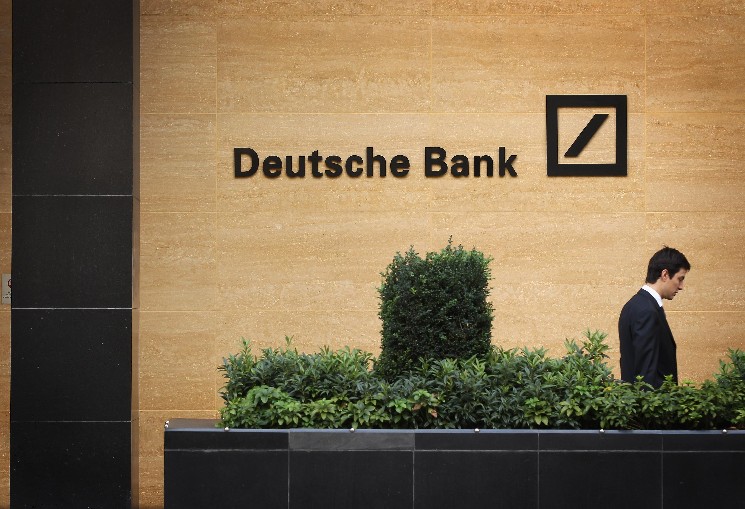
  • Deutsche Bank Launches Bitcoin Custody Service as BTC Trades at $75,500

    Deutsche Bank Launches Bitcoin Custody Service as BTC Trades at $75,500

    Key Highlights

    • Deutsche Bank will launch institutional crypto custody for Bitcoin, Ether, and select stablecoins in Europe before year-end under the EU’s MiCA regime, pending a BaFin licence expected in October.
    • The bank will manage private keys in-house using hardware-based protection, multi-person approvals, and segregated warm and cold storage, targeting corporates, asset managers, hedge funds, and sovereign institutions.
    • Germany’s largest lender enters a competitive European custody landscape already served by Standard Chartered, BBVA, DZ Bank, and Landesbank Baden-Württemberg, but brings globally systemically important bank (G-SIB) scale and existing client relationships.

    Deutsche Bank Commits to Regulated Crypto Custody Under MiCA

    Germany’s largest bank confirmed Wednesday it will begin safeguarding bitcoin and ether for institutional clients in Europe before the end of 2025, marking the most significant entry yet by a globally systemically important bank into regulated digital-asset custody. The announcement, made a day after the U.S. Senate failed to advance the Clarity Act, underscores a divergent regulatory path: while U.S. market-structure legislation stalls, Deutsche Bank is moving forward under the European Union’s Markets in Crypto-Assets (MiCA) framework.

    Gerald Podobnik, co-head of Deutsche Bank’s corporate bank, framed the move as complementary rather than disruptive. “digital assets are not a replacement for the traditional financial system but an important complement to it,” Podobnik said in a statement. “We see them as new rails that can coexist with existing market infrastructures while benefiting from the trust, security and safeguards that regulated financial institutions provide.” He added, “Our aim is to offer clients a secure and regulated gateway to this evolving market.” A bank spokesperson told Cointelegraph the firm expects to receive its MiCA custody licence from Germany’s BaFin in October. Bitcoin traded at $75,547 Wednesday afternoon, little changed over 24 hours, according to CoinGecko.

    Asset Scope and Technical Architecture

    At launch, the service will cover “a selected range of digital assets, including Bitcoin and Ether, as well as selected stable coins or e-money tokens, including USDC and EURC, EURAU,” the bank said. Circle issues USDC and EURC. EURAU is the euro-denominated stablecoin of AllUnity, a joint venture between Galaxy, Flow Traders, and DWS—the asset manager majority-owned by Deutsche Bank—which received a BaFin e-money licence in July 2025. “Tokenized financial instruments are also included in the roadmap,” the release added.

    The first clients will be corporates, asset managers, hedge funds, custodians, brokers, and sovereign institutions served by the corporate and investment banks. Critically, Deutsche Bank will manage the wallets and private keys itself, with keys secured behind hardware-based protection, multi-person approvals, and separate warm and cold storage. For Ido Sofer, founder and chief executive of key-management firm Sodot, that in-house approach signals strategic intent. “When you hear a bank is launching their own custody solution and they’re hiring blockchain engineers and so on, that means that they’re saying, okay, I want to go all in. I want to have those in-house capabilities and I want this as a business line,” Sofer said on the On The Margin podcast in April. “It really shifted from this is an experiment to this is a growth vector in the business line.”

    Three-Year Build and Competitive Landscape

    Deutsche Bank applied to BaFin for a digital-asset custody licence in June 2023 and named Swiss technology provider Taurus as its partner that September. In July 2025, Bloomberg reported the bank was targeting a 2026 launch and had engaged Bitpanda’s technology unit alongside Taurus. Wednesday’s release names neither firm, stating only that the service “will use selected external technology and infrastructure providers for defined technical components.”

    The bank arrives late to its immediate neighbourhood. Landesbank Baden-Württemberg announced institutional custody with Bitpanda in 2024; DZ Bank’s meinKrypto platform received MiCA authorisation in December 2025; and Standard Chartered and BBVA already operate regulated custody in Europe, as CoinDesk noted. What Deutsche Bank brings is scale: it is one of the banks the Financial Stability Board classifies as globally systemically important, and its clients have been asking who should hold the keys since a wave of exchange hacks last summer.

    Why This Matters

    Deutsche Bank’s entry signals a maturation of institutional crypto infrastructure in Europe. By operating under MiCA—the world’s first comprehensive crypto-asset regulatory regime—the bank offers a regulated alternative to offshore or unlicensed custodians, addressing a primary barrier for pension funds, insurers, and sovereign wealth funds. The decision to retain private keys in-house, rather than outsourcing to a specialist like Fireblocks or Copper, reflects a business logic older than blockchain: a custodian that controls the keys controls the client relationship and the cross-sell opportunities that follow. As Sofer noted, “It’s gonna be hard for you to leave.”

    However, the release carries a blunt risk disclosure: “Digital assets involve material risks, including price volatility, fraud, cyber incidents and failures of market participants,” it says. “Crypto-assets are not covered by a deposit-guarantee scheme comparable to the protection applicable to eligible bank deposits.” That trade-off—regulated custodial controls without deposit insurance—is the core proposition. Michael Tanguma, co-founder and chief executive of bitcoin custody firm Onramp, argues the market has already accepted it. “Nobody would tell an individual to take all their gold out of the bank and park it underneath their mattress,” Tanguma said in an August interview. “It’s a misnomer and fallacy to say that self custody is the only way.”

    Podobnik left the door open on scope: “The service will be further developed in line with client demand, regulatory requirements and the bank’s risk appetite,” he said. The release adds that timing, geography, and the asset list “may change as a result of regulatory requirements, internal approvals, market developments or client demand.” Sofer’s read is that such hedging is standard boilerplate once a G-SIB commits. “When a bank does something, this is for like five, 10 years, right?” he said. “They don’t say, well, let’s do this for a couple of quarters and re-evaluate.”

    Frequently Asked Questions

    Which digital assets will Deutsche Bank custody at launch?

    The bank will hold Bitcoin, Ether, and select stablecoins or e-money tokens including USDC, EURC, and EURAU. Tokenized financial instruments are on the roadmap for future inclusion.

    How does Deutsche Bank’s custody model differ from specialist crypto custodians?

    Deutsche Bank will manage wallets and private keys entirely in-house using hardware-based protection, multi-person approvals, and segregated warm and cold storage, rather than relying on third-party key-management providers. The bank argues this integrates the trust and safeguards of a regulated G-SIB with new digital-asset rails.

    Are crypto assets held by Deutsche Bank covered by deposit insurance?

    No. The bank explicitly warns that crypto-assets are not covered by any deposit-guarantee scheme comparable to the protection applicable to eligible bank deposits. Clients assume material risks including price volatility, fraud, cyber incidents, and counterparty failures.

  • The Next Trillion-Dollar Currency May Not Be a Stablecoin

    The Next Trillion-Dollar Currency May Not Be a Stablecoin

    A new CoinDesk analysis examines why the next trillion-dollar currency could emerge outside the stablecoin model used today—and why it may not have a name yet.

    What the CoinDesk Analysis Says

    The development is significant because it could alter the outlook for the next trillion-dollar currency. However, the available reporting identifies a specific development without establishing that it represents a completed, industry-wide shift.

    The figures and descriptions remain limited to the scope and claims presented in the source. Further evidence is needed before drawing broader conclusions about the digital-asset market.

    Why It Matters for Digital Assets

    Crypto infrastructure is increasingly linking payments, financial markets and software systems. These connections may create new opportunities for adoption, while also raising questions about security, regulation, liquidity and operational reliability.

    Those factors will help determine whether the reported development advances beyond an initial test, study or proposal. They will also indicate whether the system can support broader participation from users and institutions.

    What Comes Next

    The key milestones will be additional disclosures, implementation details and evidence of adoption by users or institutions. Until those details emerge, the development should be viewed as a dated event rather than a prediction about market prices or a guarantee of future adoption.

    BlockchainReporter has previously covered related digital-asset infrastructure in earlier reporting.

    Source: cryptonews.net