Tag: Inflation

  • Bitcoin Faces New Inflation Test as Diesel Hits Nominal $6.53 Record

    Bitcoin Faces New Inflation Test as Diesel Hits Nominal $6.53 Record

    Key Highlights

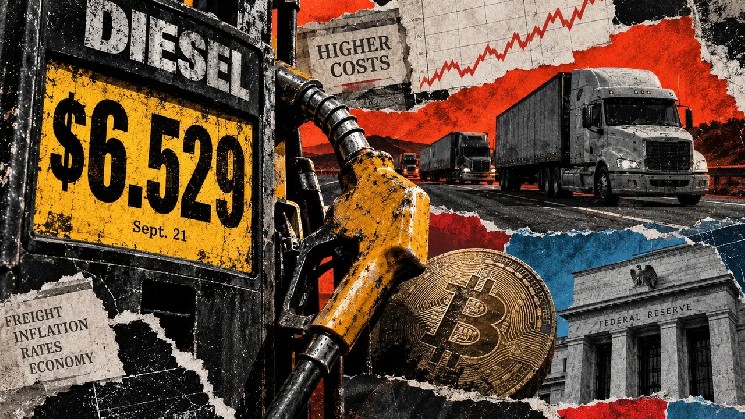
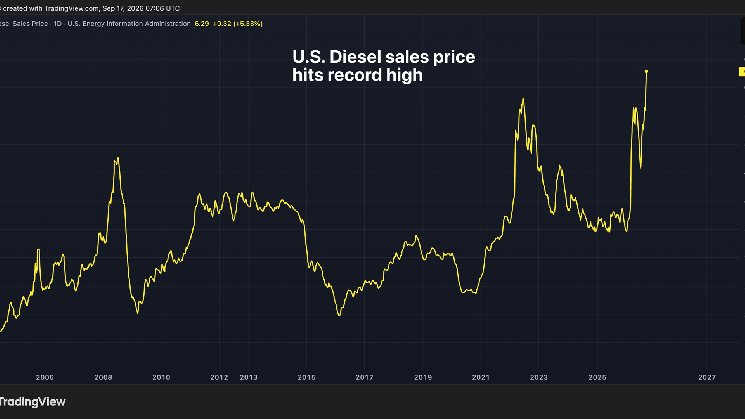
    • US on-highway diesel reached $6.529 per gallon on September 21, marking a new nominal record high and a 24.4-cent weekly increase, according to the Energy Information Administration.
    • Distillate fuel inventories fell to 107.431 million barrels in the week ended September 18, signaling constrained supply amid tight global distillate and crude markets.
    • The price surge raises freight-cost inflation risks that could influence Federal Reserve interest-rate policy, with upcoming CPI and PCE data releases in October serving as critical tests for Bitcoin and risk-asset investors.

    Diesel Hits Fresh Nominal Record as Inventories Tighten

    The Energy Information Administration reported Monday that the US average on-highway diesel price climbed to $6.529 per gallon on September 21, up 24.4 cents from the prior week. Because the EIA had already designated the September 14 reading as a nominal dollar record, the latest figure establishes another all-time high at the pump without inflation adjustment. The increase coincides with a drawdown in distillate fuel stocks, which fell to 107.431 million barrels in the week ended September 18 from 107.859 million barrels a week earlier, according to EIA data published September 23. The inventory decline reinforces evidence of constrained supply in the distillate complex.

    Global Supply Dynamics Drive Price Surge

    The EIA attributes the recent diesel surge to tight global distillate supply and elevated crude oil prices. Diesel fuels the majority of US freight movement by road and rail, and the agency notes that sustained high prices can translate into higher shipping costs across the logistics chain. Whether carriers pass those costs to shippers and ultimately to consumers depends on contract structures, competitive dynamics, and the duration of the fuel-price squeeze. A prolonged rise across multiple freight billing cycles would pose a more significant inflation risk than a single expensive week at the pump.

    Upstream Price Pressure Evident in Producer Data

    Earlier data from the Bureau of Labor Statistics illustrate why the diesel-to-freight channel warrants close monitoring. The producer price index for diesel fuel jumped 24.1% in August from July, while the truck freight transportation price index rose 2.0% over the same period. Both increases occurred before the latest retail diesel record, signaling upstream price pressure building in August. The data leave the precise cause of the freight index increase and any downstream consumer-price effect unsettled, but the sequence suggests a transmission mechanism from fuel costs to transportation services is active.

    Inflation and Rate Expectations Link Diesel to Bitcoin

    The potential Bitcoin effect operates through inflation and interest-rate expectations. If sustained fuel and freight costs keep broader inflation firm, investors may anticipate the Federal Reserve holding rates higher for longer, weighing on assets sensitive to financing conditions. The Federal Open Market Committee raised its target federal funds range to 3.75%–4% on September 16, citing elevated inflation broadly. That decision preceded the September 21 diesel reading. Bitcoin’s specific response to this diesel move remains to be seen, but the macroeconomic pathway is clear: diesel → freight costs → services inflation → Fed policy expectations → risk-asset valuation.

    Why This Matters

    The diesel price spike sits at the intersection of physical commodity markets and monetary policy. Distillate inventories remain near seasonal lows, and global refining constraints—particularly in Europe and Asia—limit quick supply responses. The Federal Reserve’s next policy meetings will incorporate the September CPI release scheduled for October 14, the September producer price index on October 15, and the September Personal Consumption Expenditures price index on October 29. If diesel prices moderate or freight and consumer prices show limited pass-through, the case for a lasting inflation impulse from this episode weakens. For Bitcoin investors, the sequence of data releases over the next month will clarify whether the latest diesel record represents a transient supply shock or a durable cost-push factor that could keep interest rates elevated deeper into 2025.

    Frequently Asked Questions

    What is the current US on-highway diesel price and how does it compare to recent history?

    The national average on-highway diesel price reached $6.529 per gallon on September 21, 2024, up 24.4 cents from the prior week. The EIA had already labeled the September 14 price a nominal record, making this the second consecutive weekly record high in nominal dollar terms.

    How could higher diesel prices affect Federal Reserve interest-rate decisions?

    Diesel powers most US freight transport. Sustained increases can raise shipping costs, which may feed into broader services inflation. If upcoming CPI and PCE data show persistent inflation partly driven by freight costs, the Fed may maintain its current 3.75%–4% target range longer than markets currently expect, creating headwinds for rate-sensitive assets like Bitcoin.

    What upcoming economic releases will clarify the inflation impact?

    Key releases include the September Consumer Price Index on October 14, the September Producer Price Index on October 15, and the September Personal Income and Outlays report (including PCE price data) on October 29. These will reveal whether August’s upstream diesel and freight price pressures have passed through to consumer-level inflation.
  • U.S. Diesel Prices Hit Record High as Bitcoin, Gold Struggle

    U.S. Diesel Prices Hit Record High as Bitcoin, Gold Struggle

    Diesel Prices Surge Amid Middle East Tensions and Tight Refining Capacity

    Diesel prices are climbing sharply, driven primarily by escalating geopolitical tensions in the Middle East. The ongoing conflict involving the U.S., Israel, and Iran has disrupted crude oil flows and inflated risk premiums on refined products. Constrained refinery capacity worldwide, combined with robust demand from freight and industrial sectors, has amplified the price move, transforming a regional supply shock into a global price spike.

    Federal Reserve Policy Adds Pressure

    The Federal Reserve’s Wednesday rate hike underscores how policymakers remain biased toward using interest rate increases to combat inflation stemming from oil-supply shocks—a strategy some observers characterize as a mistake. Record diesel prices now present a significant headwind for gold, bitcoin, and technology stocks.

    Like gold, bitcoin is widely viewed as a store of value and a sovereign hedge. However, historically, higher borrowing costs have weighed on the cryptocurrency’s market value, as evidenced during the 2022 Fed tightening cycle.

    Rate Hike Details and Forward Guidance

    On Thursday, the Fed raised rates by 25 basis points, lifting the benchmark borrowing cost to the 3.75%-4% range. Goldman Sachs and Morgan Stanley both anticipate an additional 25 basis point hike in October.

    Global Central Banks Follow Suit

    Other major central banks are also tightening monetary policy. The European Central Bank recently increased rates, and the Bank of Japan (BOJ) is expected to do the same on Friday.

  • Goldman Pivots, Now Forecasts Fed Rate Hike in October

    Goldman Pivots, Now Forecasts Fed Rate Hike in October

    Goldman Sachs Revises Fed Rate Forecast, Now Expects October Hike

    Goldman Sachs has executed a significant reversal in its Federal Reserve policy outlook, now projecting that the central bank will raise its benchmark interest rate once more in October. This new forecast marks a 180-degree pivot from the firm’s previous expectation of a September hike followed by an extended pause.

    Fed Signals Further Tightening After September Increase

    The shift follows the Federal Reserve’s Wednesday decision to lift rates by 25 basis points, bringing the target federal funds rate to a range of 3.75%–4.00%. Perhaps more critically, the central bank’s updated Summary of Economic Projections revealed that a strong majority of policymakers anticipate at least one additional rate increase before the end of the year.

    Warsh Strikes Hawkish Tone at Press Conference

    At the post-meeting press conference, Fed Chair Kevin Warsh adopted a notably hawkish stance. He stated that inflation remains “too high” and characterized the latest hike as having merely removed a “dose of accommodation”. The implication is clear: the current policy stance is still not restrictive enough, and further rate hikes remain in the pipeline.

    Markets Price In Elevated Probability of October Move

    Financial markets have quickly adjusted to the revised guidance. As of this writing, traders are pricing in just over a 50% probability of another 25 basis point hike at the Fed’s October meeting, according to data from the CME Group’s FedWatch tool.

    Bitcoin Holds Steady Amid Macro Uncertainty

    Despite the shifting rate outlook, Bitcoin has shown resilience, continuing to trade near the $76,260 level. The cryptocurrency is up a marginal 0.5% over the past 24 hours, suggesting digital asset markets are currently digesting the hawkish pivot without significant volatility.

  • Wall Street Bets on Fed Rate Hike: What It Means for Bitcoin, Bonds, and Trump

    Wall Street Bets on Fed Rate Hike: What It Means for Bitcoin, Bonds, and Trump

    Federal Reserve Poised for First Rate Hike Since 2023 Amid Inflation Pressure

    Wall Street is bracing for the Federal Reserve to raise interest rates on Wednesday, a move that would mark the first increase since 2023. The Federal Open Market Committee concludes its two-day meeting this week, and CME’s FedWatch tool places the probability of a 25-basis-point hike at 94.5%, up from under 50% just a month ago. Such a move would lift the federal funds rate to a range of 3.75%–4% from the current 3.50%–3.75%.

    Wall Street Consensus Shifts Rapidly Toward Tightening

    The shift from unlikely to near-universal expectation happened quickly. A Wall Street Journal survey published this week found nearly every major bank now anticipates a hike on Wednesday. Most institutions—including Barclays, Citigroup, JPMorgan, Morgan Stanley, and UBS—forecast 50 basis points of total tightening by year-end. Bank of America, Deutsche Bank, and RBC are more hawkish, calling for 75 basis points of tightening in 2026. Goldman Sachs sits at the dovish end of the hiking camp, penciling in only this week’s quarter-point increase. Jefferies and Oxford Economics remain outliers, forecasting a rate cut in December and in 2027, respectively.

    Higher rates increase borrowing costs, dampen spending, and pressure assets that thrive on cheap capital, such as equities and Bitcoin. They also boost yields on safe government bonds, drawing capital away from riskier investments. However, market anxiety stems less from the hike itself than from uncertainty about the trajectory of future moves. Markets are repricing now, ahead of the Fed’s communication, to account for that ambiguity.

    Inflation and Labor Data Drive the Decision

    The case for tightening rests on persistent inflation. Headline CPI ran at 3.4% annually in August, with core inflation at 2.5%—both comfortably above the Fed’s 2% target. Oil prices, elevated by the ongoing conflict with Iran, have added a layer of price pressure that neither tariffs nor rate cuts can easily offset.

    The Fed held rates steady at 3.50%–3.75% in July, but that decision passed by a narrow 9–3 vote, with three policymakers already advocating for a hike at the time. That internal split, combined with a stronger-than-expected August jobs report, tilted the committee toward tightening heading into this week’s meeting.

    Political Tension Mounts as Trump Pressures Fed Chair

    The impending hike places Fed Chair Kevin Warsh in a difficult position. President Donald Trump handpicked Warsh for the role in January and, at his swearing-in ceremony in May, urged him to be “totally independent” while making clear he expected lower rates. That expectation has not materialized—at least not in the way Trump likely meant by “totally independent.”

    In the past two weeks, Trump, Vice President JD Vance, and Treasury Secretary Scott Bessent have all publicly pushed for rate cuts. Trump went as far as threatening to halt trade with countries running surpluses with the U.S. if rates do not come down. Warsh has stated the president has had no influence on Fed decisions.

    The rate decision lands two months before the November midterms, where polls already show voters frustrated with high prices and borrowing costs. The tightening cycle arrives in part because of the tariff and Iran-conflict policies Trump himself has championed.

    Bond Markets Price In Higher-for-Longer Rates

    Bond markets have not waited for Wednesday’s announcement. The 10-year Treasury yield touched 5.04% this week, its highest level since July 2007, as traders priced in both the hike and a prolonged period of elevated rates. The two-year yield, more sensitive to Fed policy, hit its highest level since July 2024. Higher yields make Treasurys more attractive relative to risk assets and tend to strengthen the dollar—a headwind for assets like cryptocurrency that benefit from abundant liquidity.

    Bitcoin and Altcoins Enter Decision Week Under Pressure

    Crypto markets approach the Fed decision already weakened. On Tuesday, Bitcoin traded around $75,700, down roughly 3.2% on the day after the Clarity Act—crypto’s long-awaited market structure legislation—failed a Senate cloture vote. Bitcoin remains well below its September peak near $82,000.

    Technical analysts highlight $73,200 as a critical level: a daily close below it could open the door to $71,000 and even $66,900, negating the bullish structure that recently triggered a golden cross pattern.

    Bitcoin price data. Image: TradingView

    Not all analysts view a hike as purely bearish. Some argue a quarter-point move aimed primarily at anchoring long-term Treasury yields—rather than genuinely tightening financial conditions—could leave crypto’s medium-term outlook largely intact. In this view, the market’s reaction hinges on whether the decision and Warsh’s tone during the press conference surprise relative to what is already priced in.

    Higher-beta altcoins are expected to experience sharper percentage swings than Bitcoin in either direction, given thinner liquidity and heavier leverage.

    Key Events to Watch Wednesday

    The Fed’s policy statement and updated dot plot are due at 2:00 p.m. ET Wednesday, followed by Warsh’s press conference at 2:30 p.m. ET. Traders will scrutinize whether officials still pencil in just one more hike this year or something closer to the two additional moves Bank of America, Deutsche Bank, and RBC now project.

  • Dogecoin Co-Founder Proposes $1.2 Trillion Giveaway in Bold Move

    Dogecoin Co-Founder Proposes $1.2 Trillion Giveaway in Bold Move

    Dogecoin cofounder Billy Markus, known as Shibetoshi Nakamoto on X, responded to a proposal for a $5,000 stimulus check for every U.S. adult by suggesting the government purchase $1.2 trillion worth of Dogecoin instead. Economists warn that a one-time direct payment of that size would do little to ease affordability pressures and could push consumer prices higher in the coming months.

    instead the government should buy 1.2 trillion dollars of dogecoin and give some to every american 🤣 https://t.co/JkcrCMsQbI

    — Shibetoshi Nakamoto (@BillyM2k)

    Consumer Sentiment Weakens Amid Inflation Concerns

    In August, consumers’ short-term outlook slipped further into negative territory, according to a Conference Board report. The University of Michigan’s latest consumer survey also showed sentiment worsening due to concerns that inflation would remain elevated.

    $1.2 Trillion Dogecoin Giveaway: Feasibility Check

    Markus is known for his characteristic humor, and his recent comment about a $1.2 trillion Dogecoin giveaway may be taken lightly. Ranking as the 11th largest cryptocurrency by market cap, Dogecoin is currently worth $13.24 billion. The coin has a total supply of 155.88 billion DOGE (valued at over $13.09 billion), with all coins in circulation. A $1.2 trillion purchase would far exceed the asset’s total market value.

    Although Dogecoin has an infinite maximum supply, a fixed yearly issuance of 5 billion coins prevents excessive supply from flooding the market. This mechanism supports the narrative of a diminishing inflation rate for Dogecoin, meaning the rate of inflation decreases relative to the total supply each year. Markus’ comment may not directly imply a literal $1.2 trillion buy but rather highlight Dogecoin’s diminishing inflation property.

    Stimulus Checks Viewed as Inflationary

    Direct payments to consumers are often considered inflationary by economists and may cause prices to rise further, reducing the intended impact of a stimulus check. The Dogecoin cofounder supports this viewpoint, stating that the $5,000 stimulus payment may be inflationary when we don’t need more inflation.

    At the time of writing, Dogecoin was trading at $0.0849, up 1.75% in the last 24 hours, according to CoinMarketCap.

  • Fed Rate Hike Odds Surge to 87% Ahead of FOMC Meeting

    Fed Rate Hike Odds Surge to 87% Ahead of FOMC Meeting

    Federal Reserve officials face a critical policy test next week as financial markets now assign an 87% probability to a 25-basis-point rate increase at the September 15–16 meeting. The sharp repricing follows August consumer price index data that showed inflation remaining stubbornly above the central bank’s 2% target. With Bitcoin trading near $77,256, cryptocurrency traders are assessing how tighter monetary policy could influence digital asset flows.

    Markets Sharply Reprice September Hike Odds

    Rate futures indicate an 87% chance of a hike, up from 72% just a day earlier. Nearly all economists surveyed now expect a quarter-point move, a dramatic reversal from earlier consensus. The Federal Reserve’s benchmark rate currently sits at 3.50%–3.75%.

    Before the latest inflation report, most economists anticipated a pause, citing easing price pressures and the approaching U.S. midterm elections. Only 13 of 48 economists had penciled in a September increase. Hotter-than-expected core inflation upended that view. On a year-over-year basis, headline CPI rose 3.4%, matching forecasts, while core CPI held at 2.4%, also in line with estimates.

    Heather Long: September Hike “Almost Locked In”

    Chief economist Heather Long described a September increase as “almost locked in,” warning that the risk of entrenched inflation continues to grow. Long reinforced the call on social media:

    A September Fed rate hike is almost locked in now
    85% chance the Fed hikes next week.
    It’s the right call. The risks are growing that inflation remains entrenched (or keeps broadening). Fed Chair Warsh doesn’t want to make the same mistake Powell did of waiting too long to… pic.twitter.com/RdGcjhTP4G

    — Heather Long (@byHeatherLong) September 11, 2026

    If enacted, the move would mark the first Federal Reserve rate increase in three years.

    Traders Now See Multiple Hikes Through 2027

    The repricing extends well beyond September. Futures markets now imply at least three rate hikes through June 2027, up from two previously, with a base case of four increases by July 2027. That trajectory represents a stark turnaround from the start of 2026, when investors were pricing in four rate cuts over the same horizon.

    Former Fed Vice Chair Richard Clarida emphasized the likelihood of a sustained tightening cycle:

    “If we get a hike next week, certainly we’ll get additional ones.”

    “It would not be a ‘one and done’ move.”

    The shift signals a higher-for-longer interest-rate outlook as investors brace for prolonged inflation-fighting efforts.

    Implications for Bitcoin and Crypto Markets

    Higher interest rates typically reduce the appeal of riskier assets, as investors can earn competitive yields from safer instruments such as government bonds. That dynamic can drain capital from Bitcoin, Ethereum, and the broader cryptocurrency complex.

    Despite the hawkish repricing, digital assets rallied on the inflation data. Bitcoin briefly approached $77,500, while Ether climbed above $2,511, suggesting near-term momentum may be decoupling from rate expectations.

  • Bitcoin’s ‘Unusual Mix’: Bearish Inflation Print, Bullish Buyback Failure

    Bitcoin’s ‘Unusual Mix’: Bearish Inflation Print, Bullish Buyback Failure

    Bitcoin’s near-term upside faces fresh headwinds after hotter-than-expected core inflation data, but a potential failure of the U.S. Treasury’s bond buyback program could strengthen the longer-term bullish case, according to a new report from European asset manager CoinShares.

    Sticky Inflation Raises Odds of Tighter Fed Policy

    In a Friday note, CoinShares Head of Research James Butterfill said firmer-than-expected core inflation raises the probability of tighter Federal Reserve policy and could cap Bitcoin below $80,000 in the short term. Data released Friday showed the consumer price index, excluding food and energy, climbed 0.3% in August from the previous month — above consensus estimates.

    According to CME’s FedWatch tool, traders see an 85% chance interest rates will be higher after the Federal Reserve meets next week. Bitcoin has historically performed better in low interest rate environments.

    Treasury Buyback Failure Could Fuel Debasement Narrative

    Butterfill argued the longer-term case for Bitcoin rests on the U.S. Treasury’s bond buyback program failing to bring down long-end yields — a development that could ultimately feed the currency debasement narrative that has supported both Bitcoin and gold.

    “The result is therefore a somewhat unusual policy mix for Bitcoin,” the report read. “Today’s CPI data is negative at the margin, increasing the probability of tighter monetary policy and potentially limiting the immediate upside.

    “But the apparent failure of the Treasury’s current buying programme increases the likelihood of much more substantial intervention further ahead.”

    It continued: “If that happens, it could become one of the more powerful medium-term catalysts for Bitcoin.”

    Pressure Building for ‘Bazooka-Style’ Intervention

    The U.S. Treasury’s expanded bond buyback program has so far failed to materially suppress long-term yields. If yields remain stubbornly high, Butterfill said pressure will build on Treasury Secretary Scott Bessent to escalate to a much larger, “bazooka-style” buying program aimed at forcing borrowing costs down.

    Bitcoin recorded one of its best monthly runs in years this past August after Bessent announced the department would double the size of its long-dated bond buybacks. That announcement and subsequent price surge led some market observers to declare the so-called debasement trade had returned — a strategy where investors buy assets like Bitcoin and gold to hedge against currency devaluation as the dollar weakens.

  • $100 Oil Could Be Bitcoin’s Next Problem

    $100 Oil Could Be Bitcoin’s Next Problem

    Oil Surges Toward $100 as Iran Tensions Escalate

    Brent crude reached a seven-week high near $99 a barrel this week, while West Texas Intermediate climbed above $92. The rally follows Iran’s announcement that it plans to declare a maritime “exclusion zone” around the Strait of Hormuz, warning it will stop ships attempting to pass without permission. This escalation comes after U.S. strikes targeted three Iranian oil tankers over the weekend. Iran has promised a “more intense” response, and Brent prices have surged close to 20% over the past month.

    Why Rising Crude Creates an Inflation Problem

    Oil functions as more than transportation fuel. It feeds directly into shipping costs, plastics manufacturing, fertilizer production, and food supply chains. When crude prices spike this rapidly, the increases appear at gas pumps within days and in grocery bills within weeks. U.S. inflation was already running above the Federal Reserve’s 2% target before this latest geopolitical flare-up. Fed Chair Kevin Warsh has maintained a hawkish stance through the summer, and traders are now pricing in genuine odds of a rate hike rather than a cut, a scenario that appeared unthinkable a year ago.

    The Federal Reserve Faces a Policy Trap

    The Fed balances two sometimes conflicting mandates: controlling inflation and maintaining a healthy labor market. A cooling jobs picture typically argues for lower rates. However, if oil-driven inflation continues climbing, cutting rates risks exacerbating price pressures. Should oil remain near $100, the Fed may delay cuts it would otherwise implement, or hold rates higher for longer than markets currently anticipate. Some forecasters now place the probability of a September rate hike above 50%.

    How Higher Rates Pressure Bitcoin

    Bitcoin offers no yield comparable to bonds or savings accounts. When interest rates and Treasury yields rise, investors gain a superior risk-free alternative, prompting capital to flow out of assets like Bitcoin and into fixed income or cash. Higher rates also tighten overall financial system liquidity, the total pool of money available to chase risk assets. Reduced liquidity generally translates to weaker demand for Bitcoin. When U.S. strikes on Iranian tankers pushed oil higher this week, Bitcoin slipped toward $79,700. A similar pattern emerged on September 2, when renewed conflict drove Brent higher and Bitcoin fell roughly 1.5%.

    Bitcoin’s Safe-Haven Narrative Faces Reality Check

    A Middle East war might appear to be the type of event that drives investors toward Bitcoin as a hedge. In practice, that correlation has not materialized. Bitcoin has largely moved in tandem with equities during this conflict, declining when tensions escalate and stabilizing when they ease. Geopolitical fear alone does not drive capital into Bitcoin. Instead, Bitcoin responds to the direction of interest rates, yields, and overall market liquidity. Geopolitical events matter to Bitcoin only to the extent they alter those financial conditions.

    Potential Bullish Reversal Scenario

    One scenario could eventually benefit Bitcoin. If sustained $100+ oil chokes consumer spending and slows the economy severely enough, the Fed may ultimately be forced to cut rates aggressively to support growth, even with inflation remaining elevated. Should expensive energy damage growth sufficiently to compel aggressive monetary easing, the resulting easier financial conditions could become supportive for Bitcoin. However, a sharp economic slowdown could still pressure risk assets before that liquidity benefit emerges.

    The Critical $100 Oil Threshold

    The $100 per barrel mark represents a psychological and policy inflection point. Below that level, this episode likely remains a volatility event: Bitcoin dips on headlines and recovers as tensions ease. Above it, and sustained, the situation becomes a macroeconomic problem that reshapes Fed policy for months. In that environment, Bitcoin’s trajectory depends less on Iran and more on what Jerome Powell’s successor decides to do next.

  • Warsh at Jackson Hole: ‘We have work to do’ on inflation

    Warsh at Jackson Hole: ‘We have work to do’ on inflation

    Federal Reserve Chairman Kevin Warsh said the central bank’s “predominant focus” should remain on inflation, striking a hawkish tone in closely watched remarks at the Kansas City Fed’s annual Jackson Hole symposium.

    “The responsibility for 65 months of sustained, elevated inflation sits squarely with the central bank,” said Warsh, delivering his keynote address at the Kansas City’s Fed Jackson Hole symposium.

    “We must be confident that underlying inflation is moving to our objective, clearly and at sufficient speed. Otherwise, we have work to do. That’s our job . . . our mandate . . . and our charge to keep.”

    Markets react to Warsh’s hawkish remarks

    Bitcoin fell to $78,700 following the comments. U.S. stocks were modestly lower, while bond yields moved slightly higher as investors assessed the Federal Reserve chairman’s inflation-focused message.

    Warsh’s speech had been highly anticipated because the Kansas City Fed’s annual Jackson Hole symposium has often served as a venue for U.S. central bank chiefs to prepare markets for major policy changes.