Tag: Hurricane Lowell

  • Officials urge visitors to avoid Kauai during Hurricane Lowell recovery

    Officials urge visitors to avoid Kauai during Hurricane Lowell recovery

    Kauaʻi Officials and Residents Urge Tourists to Stay Away Following Hurricane Lowell

    LĪHUʻE, Kauaʻi — While the Hawaiian Islands typically welcome visitors with open arms, the message from Kauaʻi officials and residents is unambiguous in the wake of Hurricane Lowell: now is not the time for tourism.

    Recovery Takes Precedence Over Tourism

    Retired tourism executive Mufi Hannemann emphasized that the island’s immediate focus must remain on resident recovery.

    “If you’re very insistent on visiting Kauai, just be clear that you’re not going to see the Kauai that you imagined or you thought you would see because of what happened with Hurricane Lowell,” said retired tourism executive Mufi Hannemann.

    Hannemann outlined the critical resource shortages facing the community.

    “The greatest needs on Kauaʻi are food, electricity and gas,” he said. “And unless you are going there to provide that kind of relief or assistance, or you’re visiting family, this is not the time to visit.”

    Visitors Describe Harrowing Experience

    Hundreds of travelers crowded Līhuʻe Airport Sunday night in lengthy queues attempting to depart before the hurricane made its approach. Some were unable to secure flights, while others chose to shelter in place.

    Dave Reid, who was on the Garden Isle for a wedding with family and friends, decided to ride out the storm — a decision he quickly regretted.

    “It was actually pretty scary,” he told CBS News. “I always said I want to ride out a hurricane. I don’t want to ever do it again.”

    “I wish we would have left,” he added. “We had an opportunity to leave, and we didn’t.”

    Residents Report Widespread Stress and Resource Scarcity

    The early recovery phase has proven exceptionally difficult for the local population. Jeff Tucker, a longtime Kauaʻi resident and travel writer, described a palpable sense of alarm.

    “I’d say there’s some degree of panic right now,” said Jeff Tucker. “We saw that today in lines for the gas station. We’ve never seen lines that long, miles long.”

    Tucker and Rob Kvidt, co-founders of the travel publication “Beat of Hawaiʻi,” are both longtime residents advising potential visitors to postpone their trips.

    “We want it to be a good experience for everyone, and right now, all of us are fatigued and tired and stressed,” said Kvidt. “We’re just trying to get through all of this.”

    Accommodations Prioritizing Displaced Residents

    Hannemann confirmed that the hospitality sector has shifted its focus entirely to housing those who have lost their homes.

    “Even at the hotels and rentals, the priority is displaced residents that have lost their home and those that don’t have a place to stay anymore,” said Hannemann. “That’s the priority right now.”

    Alternative Hawaiian Islands Recommended

    Local experts suggest that travelers considering a Hawaiian vacation in the near term should redirect their plans to other islands in the chain while Kauaʻi navigates its recovery from Hurricane Lowell’s damaging winds and storm surge.
  • Pacific Hurricanes Active, Atlantic Season Still Without Storms This Year

    Pacific Hurricanes Active, Atlantic Season Still Without Storms This Year

    Three Simultaneous Pacific Hurricanes Contrast with Quiet Atlantic Season

    An unusual meteorological pattern has emerged across the Pacific and Atlantic basins. Three hurricanes are currently active in the Pacific Ocean, while the Atlantic remains hurricane-free well into September—a rare occurrence in the satellite era.

    Pacific Basin Sees Three Active Hurricanes

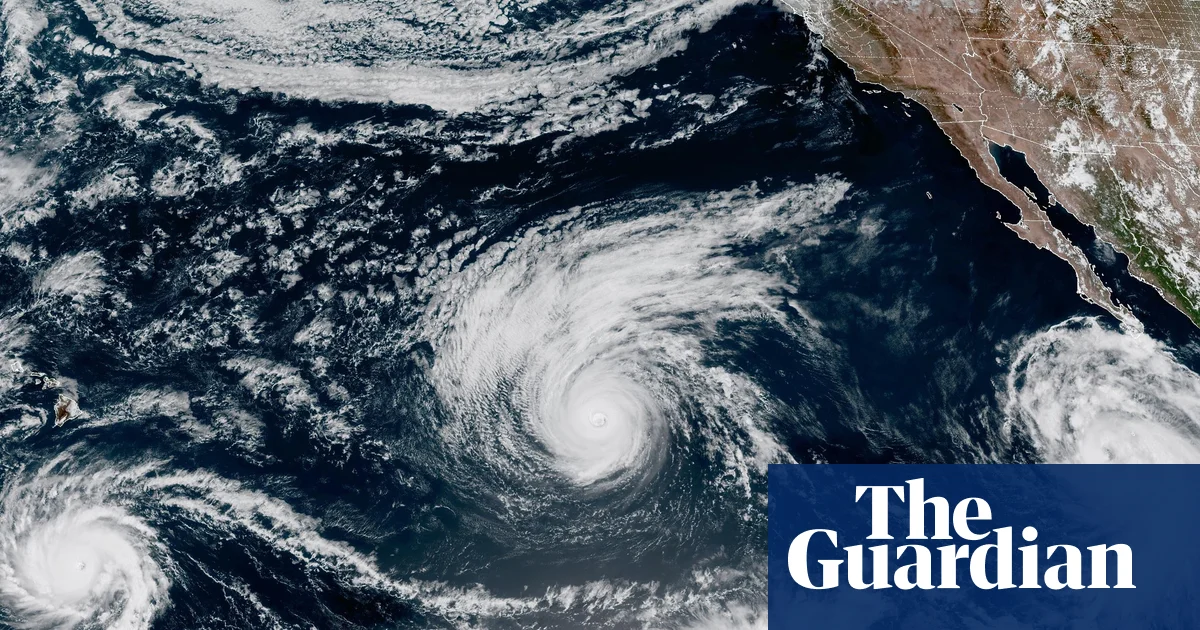
    Category 1 Hurricane Marie, Category 3 Hurricane Karina, and Category 4 Hurricane Lowell are all spinning in the Pacific simultaneously. According to the National Hurricane Center (NHC), having three hurricanes at once is highly unusual; the annual average is only eight Pacific hurricanes total. This phenomenon last occurred in 2015, when three Category 4 hurricanes existed concurrently.

    The NHC notes significant uncertainty regarding Hurricane Lowell’s potential track, making it too early to determine any impacts on Hawaii. Meanwhile, Hurricanes Marie and Karina are expected to remain over open waters with no current threat to land.

    Atlantic Hurricane Season Remains Historically Quiet

    In stark contrast, the Atlantic basin has not produced a single hurricane so far this season. This marks only the eighth year since satellite monitoring began around 1960 that the Atlantic has entered September without a hurricane formation. Forecast models indicate continued quiet conditions for at least the next seven days.

    This lull creates a possibility of breaking the record for the latest first Atlantic hurricane formation, currently held by September 11 in both 2002 and 2013.

    Tropical Storm Edouard Impacts Gulf Coast

    While the Atlantic lacks hurricanes, Tropical Storm Edouard made landfall in Louisiana at 11:25 UTC (12:25 BST) on September 1. The storm brought strong wind gusts, heavy rainfall, and flooding primarily to southwestern Louisiana and southeastern Texas. The highest recorded wind gust reached 69 mph at the Beaumont/Port Arthur airport.

    Impacts included widespread power outages and school closures. Flash flooding remains a continuing risk across east-central Texas throughout the week.

    Extreme Heat Grips Southern Texas

    Separate from tropical weather, parts of Texas are under an extreme heat warning. Heat index values—which measure how hot conditions feel when humidity combines with air temperature—have reached 46°C (114.8°F) at the state’s southern tip. The National Weather Service has identified heat-related illnesses as the primary health concern.

    Europe Records Warmest Summer on Record

    Across the Atlantic, Europe has just concluded its warmest summer since records began. The United Kingdom, France, and Belgium have all shattered mean temperature records by significant margins. France exceeded its previous 2003 record by 0.8°C, while the UK surpassed its 2025 record by 0.4°C. Additional national records are expected as more data becomes available.

  • Hawaii Hurricane Lowell: At least one dead as storm devastates parts of state, governor says

    Hawaii Hurricane Lowell: At least one dead as storm devastates parts of state, governor says

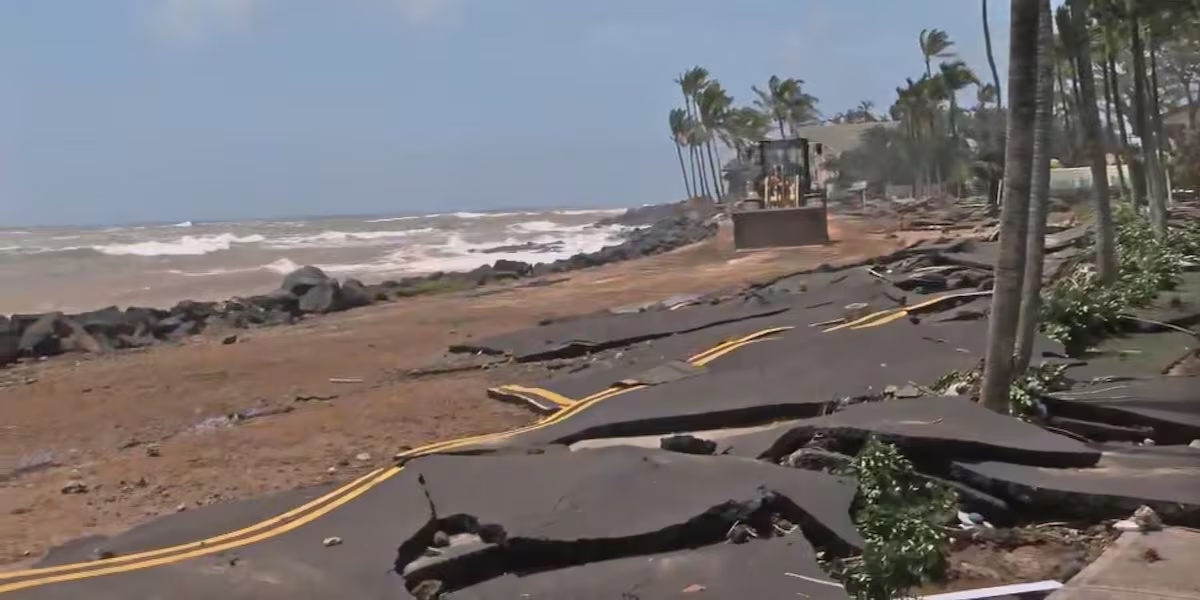
    Hurricane Lowell delivered a devastating blow to Hawaii as it swept past the state’s islands, leaving at least one person dead, damaging homes, and cutting power to tens of thousands, according to Gov. Josh Green.

    Governor Assesses Damage and Recovery Efforts

    We’ve seen an incredible amount of damage near the shore, Green told CNN’s Jake Tapper, adding the storm has likely caused hundreds of millions of dollars in damage. We’re doing what we can to recover, but this was a very serious storm, the governor told CNN.

    More than 300 National Guard members have been deployed across the islands, and the Department of Transportation is assisting with mudslides and washed-out or damaged roads. Crews are prioritizing power restoration to hospitals.

    Fatalities and Injuries Reported

    A homeless man on Oahu died after a tree fell on the tent he was living in, the governor confirmed. Kauai County spokesperson Ryan Wilson told CNN there have also been storm-related injuries, though details on severity and the extent of structural damage were not immediately available.

    Widespread Power Outages and Infrastructure Damage

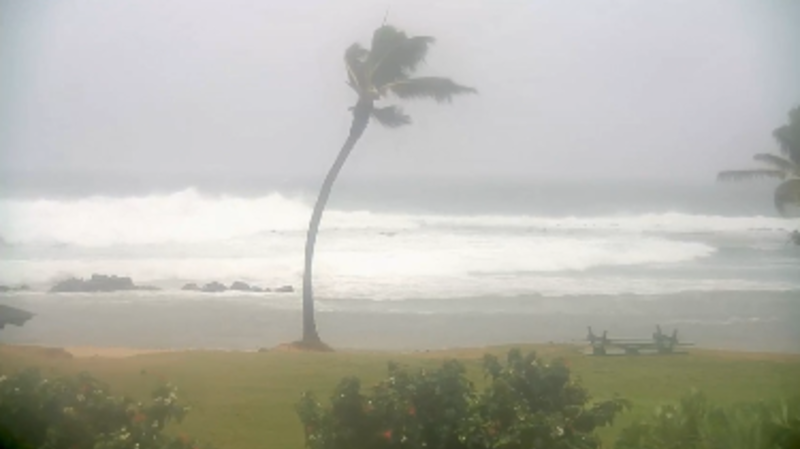
    Wind gusts exceeding 80 mph knocked out power for roughly 90% of homes and businesses in Kauai County, which includes the islands of Kauai and Niihau, according to PowerOutage.com. The county’s utility provider stated Tuesday morning there is no estimated time of restoration and warned outages could be long-lasting.

    There are currently downed power lines, downed trees, debris all over Kauai, so we are really urging folks to stay in place, said Alan Clinton, situation unit leader with Kauai County. More than 30,000 customers also lost power on Oahu due to tropical-storm-force wind gusts.

    Evacuations and Emergency Shelters

    Voluntary evacuation advisories are in place for 650 residences on the south and west shores of Kauai due to storm surge, Wilson and county emergency management spokesperson Molly Pierce told CNN. In Kapa’a, dozens of guests at the ISO Hotel were evacuated to shelters Monday, according to CNN affiliate KITV. As of Tuesday morning, more than 300 people and dozens of pets were housed in Kauai County emergency shelters.

    Coastal Flooding and Transportation Disruptions

    Coastal flooding closed roadways in South Maui and areas of Maui Nui Monday morning, the County of Maui reported on Facebook. The flooding left debris clogging roads, damaged transportation infrastructure, and forced park and service closures. On Oahu, high surf inundated several ground-floor units in a western condominium, CNN affiliate Hawaii News Now reported.

    All flights at Lihue Airport, Kauai’s primary airport, were canceled Monday afternoon. The airport will reopen when conditions allow, according to Hawaii’s Department of Transportation. All state and county offices, Kauai Community College, and public schools are closed in Kauai County and on Oahu Tuesday as cleanup and damage assessments continue.

    Rainfall Totals and Lingering Threats

    Lowell has weakened to a tropical storm as it moves north away from Hawaii, but trailing rainbands continue to drop rain on already saturated areas. More than a foot of rain has fallen in higher elevations on Kauai, while Oahu’s Koolau mountains recorded 5 to 9 inches. Most other areas received 1 to 3 inches.

    El Niño Fuels Active Pacific Season

    El Niño is amplifying storm potential in the central Pacific this year, warming ocean temperatures and weakening upper-level winds that typically suppress hurricane formation, on top of long-term ocean warming from climate change. Five named storms, including Lowell, have already formed or tracked into the Central Pacific. A typical season sees only five total, but NOAA’s forecast calls for as many as 13 by season’s end.